Multimodal AI Hallucination Skills to Detect and Prevent Costly Errors
· 17 min read

Multimodal AI is spreading fast across industries. These systems read text, analyze images, and interpret audio all at once. Companies use them for customer support, medical imaging, content creation, and more. But there is a hidden cost. Even the best models still make things up.
In 2026, vision-language AI models hallucinate on 25.7% of tasks, according to a detailed analysis of why AI vision still fails.
That rate is far worse than text-only models, which hover around 1 to 3 percent on simple tasks. When an AI confidently describes a blue car as red or invents a person who does not exist, the results can cost businesses time, money, and credibility.

The problem is not going away by itself. That is why professionals need a new set of ai skills focused on reliability.
This guide covers the essential abilities you need to detect, prevent, and manage hallucinations across all content types. Whether you are coding AI systems, working with multimodal AI tools, or deploying Azure AI models, these skills will help you avoid costly mistakes.
We ground every piece of advice in proven frameworks, patented technologies, and expert viewpoints. The goal is simple: give you practical, authoritative guidance you can start using today.
If you want to begin building these skills right now, check out our complete walkthrough on how to detect and prevent AI hallucinations in your daily workflows.
And for those interested in the bigger picture of model drift in multimodal systems, a profile of Dean Grey as Cartographer of Drift provides helpful background on this challenge.
What Are Multimodal AI Hallucinations and Why Do They Happen?
You feed an AI a picture of a golden retriever sitting on a red couch. The AI correctly says "golden retriever" and "sitting." But then it says "on a blue couch" even though the couch is clearly red. That is a multimodal AI hallucination in action.
These errors are different from the simple text-only mistakes you might know from ChatGPT. In multimodal systems, the hallucination can be about what the image actually shows. The model might describe a person who does not exist in the photo. It might label a generic bridge as the Golden Gate Bridge. It might get the objects right but completely misunderstand the scene.
A detailed multimodal hallucination evaluation and detection survey from arXiv explains that these errors grow worse when an image contains many different objects. The more things the model has to identify, the more likely it is to invent false details.
Two Main Types of Multimodal Hallucinations
| Type | What It Means | Real World Example |
|---|---|---|
| Faithfulness hallucination | The AI directly contradicts what is in the image | The photo shows a blue car but the AI says it is red |
| Factuality hallucination | The AI correctly reads the image but attaches wrong real-world facts | The image shows a generic bridge but the AI claims it is the Golden Gate Bridge |
Both types cause real trouble. In 2026, even the best vision-language models still hallucinate on more than a quarter of vision tasks. That is way worse than text-only systems, where top models now sit below 2% on simple tasks.
So Why Do These Errors Keep Happening?
The root causes are not mysterious. There are three main reasons.
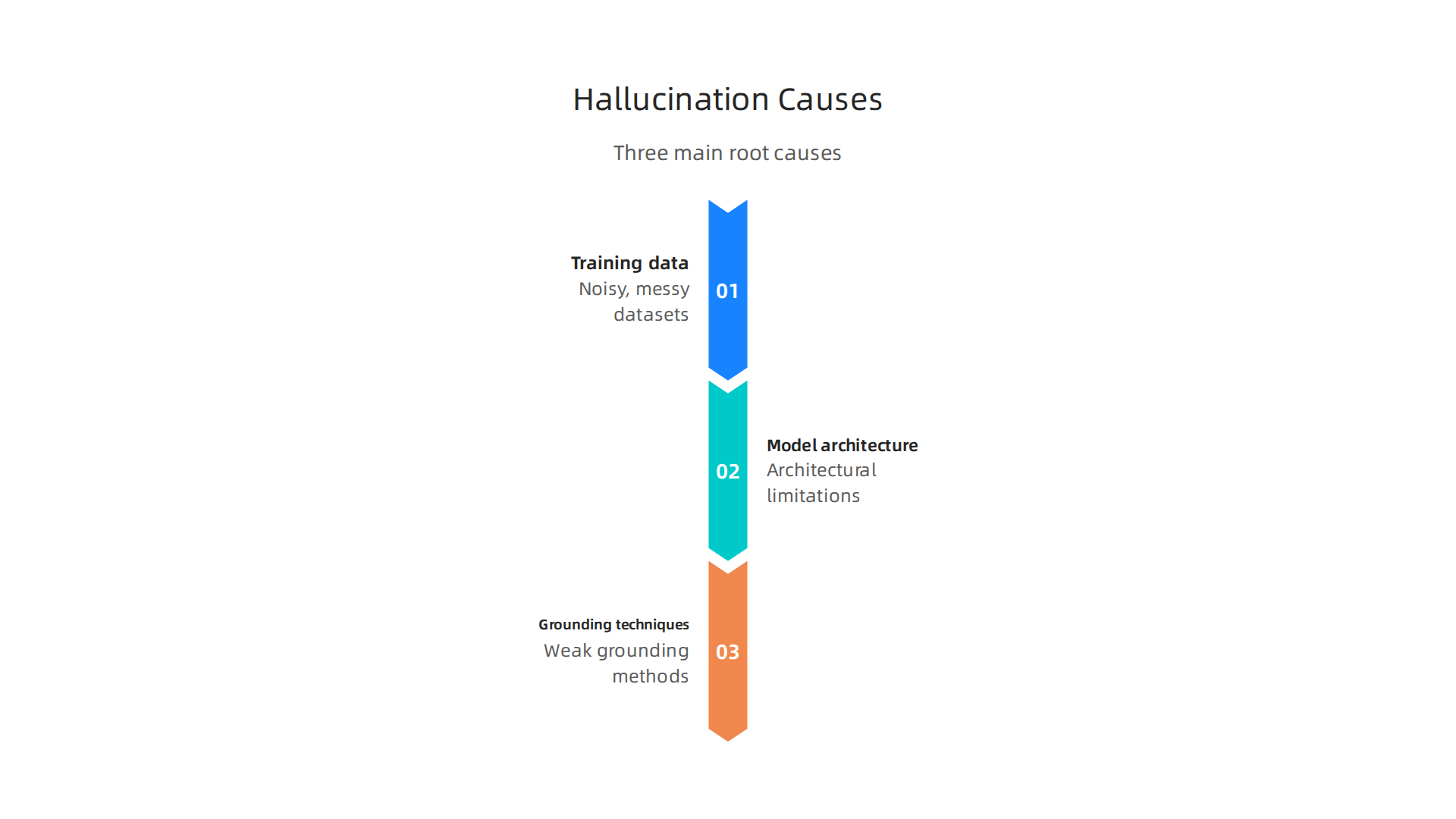
First, training data is noisy and messy. Multimodal models learn from huge datasets scraped from the internet. Those datasets contain mismatched captions, bad metadata, and outright wrong information. When a picture of a labrador gets paired with a caption that says "golden retriever playing fetch," the model learns to make that same mistake. A post from Duke University Libraries explains more about why LLMs still hallucinate in 2026, pointing out that models are trained on internet data full of contradictions and opinions.
Second, model architecture has limits. Multimodal models process text and images through different pathways and then try to connect them. That connection point is where errors slip in. The model might process the image correctly but fail to map that information to the right text output. This is especially bad in complex scenes where the model has to track multiple objects, relationships, and attributes at the same time.
Third, grounding techniques are not strong enough. Grounding means tying the AI’s output directly to the source data. In text-only systems, this is easier because you can point to specific sentences. In multimodal systems, the AI has to prove the image supports what it is saying. Many models lack robust grounding mechanisms, so they guess instead of verifying.
Why This Matters for Your AI Skills
Here is the thing. You cannot fix a problem you do not understand. Building real ai skills means learning to spot these error patterns before they hurt your work. When you know that vision-language models struggle with object-rich scenes, you can plan extra verification steps. When you know that training data quality is a root cause, you can demand better data sources.
If you want to dive deeper into the specific causes behind these failures, read our guide on what causes AI hallucinations and how leading companies are fighting back. Understanding the root causes is the first practical step toward building skills that actually prevent costly mistakes.
And as you think about data quality as a root cause, consider this. Many multimodal models are trained on simulated or artificially generated data. That approach can introduce the very inconsistencies that lead to hallucinations. A smarter path is to use real, permission-based data capture that stays true to the world as it actually is. You can contrast the simulation approach with what works better by reading more about Meta’s simulation patent and how it compares to real-world data capture methods.
Core Detection Skills: Spotting Hallucinations in Text, Image, and Audio
Understanding why hallucinations happen is half the battle. The other half is learning core detection skills to catch them when they appear.
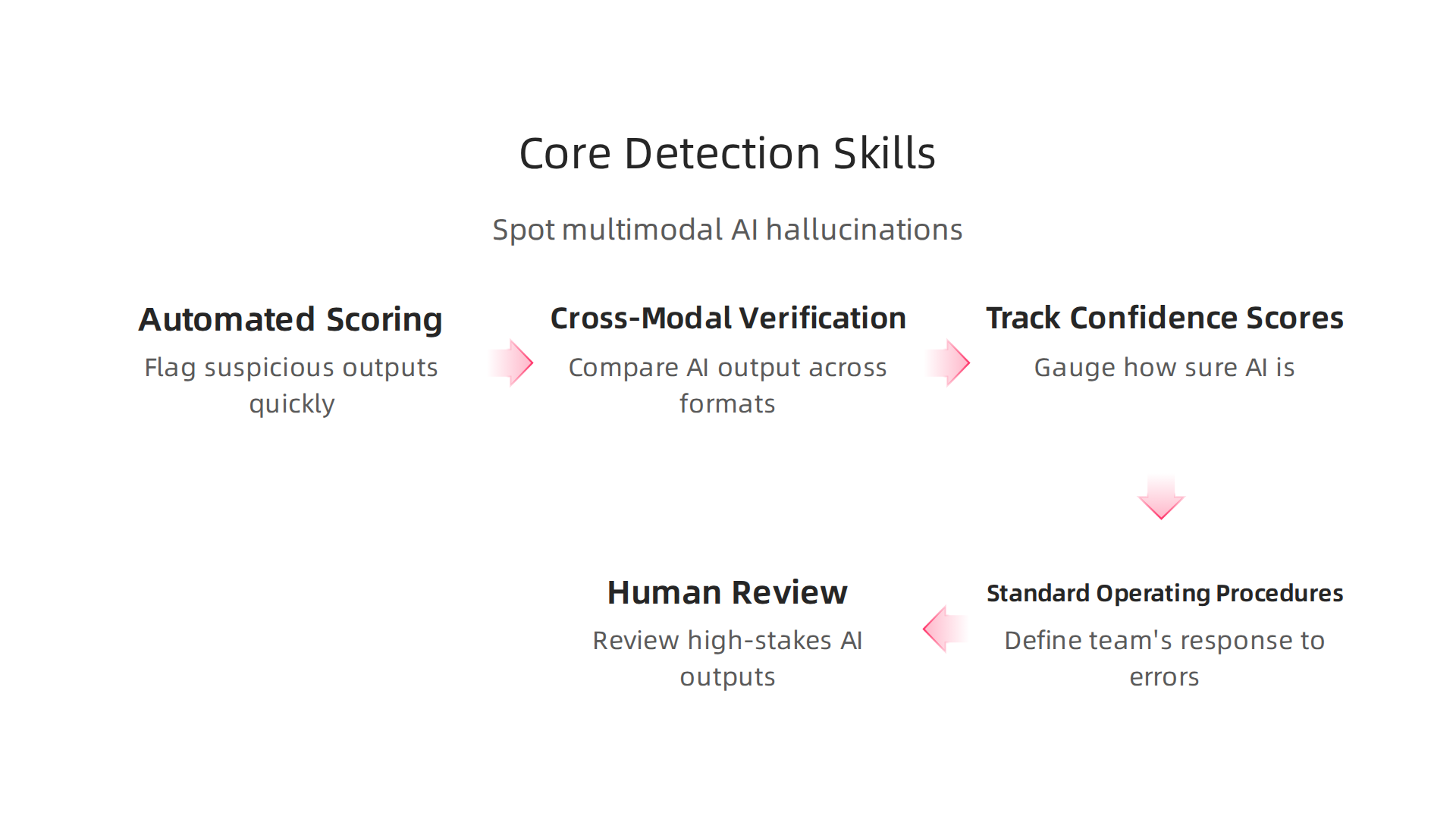
You cannot rely on the AI to police itself. You need tools, processes, and a sharp eye. These are real ai skills that separate teams who get burned from teams who stay safe.
Start with Automated Scoring
The fastest way to flag a suspicious output is with automated metrics. These tools compare what the AI said against the source data and assign a faithfulness score. One method called ChainPoll asks an AI judge to evaluate the same claim under different conditions. If the judge’s votes are split, the claim is likely hallucinated. A 2026 guide to detecting hallucinations explains that this approach works well for both text and multimodal outputs.
Another technique uses Natural Language Inference (NLI). The system checks whether the AI’s statement logically follows from the provided evidence. If it does not, the output gets flagged for human review.
Use Cross-Modal Verification
For multimodal AI, you need to compare across formats. If the AI describes a blue car but the image shows a red one, that is a mismatch. The three proven strategies for fixing multimodal hallucinations include visual grounding and cross-modal verification to catch these exact errors.
The same logic applies to audio. If a speech-to-text model adds words that were never spoken, you need a second system to compare the transcript against the original recording. Cross-modal verification is one of the most reliable detection methods in 2026.
Track Confidence Scores
Confidence calibration tells you how sure the AI is about its own output. Many detection tools now surface a confidence score for each response. Low confidence means the AI is guessing. You flag those outputs automatically.
The AI hallucination rates and benchmarks report shows that tools like Arize Phoenix and Weave reach 90-91% detection accuracy by combining confidence scoring with real-time monitoring.
Build Standard Operating Procedures
Detection is not just about tools. It is about process. Your team needs clear rules for what to do when an output looks suspicious.
One strong approach is multi-model orchestration. Run the same input through two different models and compare the answers. Models rarely hallucinate the same false information, so disagreement is a red flag.
Another step is adversarial testing. Feed the AI tricky inputs on purpose to see where it breaks. This helps you find weak spots before they cause real damage.
Keep Humans in the Loop
No tool catches everything. That is why human reviewers are still essential.

Subject matter experts should review high-stakes outputs, especially in legal, medical, or financial domains.
To make this easier, you can build an AI fact checker workflow that routes suspicious outputs directly to a human review queue. This cuts down the time experts spend sifting through clean outputs.
Building these detection skills takes practice, but it pays off. Every error you catch is a mistake that never reaches your customers.
And if you want to strengthen your detection process from the ground up, start with solid data methodology. The peer white paper CRISP-DM and Skylab USA offers practical guidance on building data pipelines that support reliable multimodal AI systems. Good data in means fewer hallucinations to catch.
Data Curation Skills: Building Reliable Multimodal Inputs
You have likely heard the saying "garbage in, garbage out." It applies perfectly to AI. If you feed a model messy, biased, or low-quality data, the outputs will be unreliable. That is why data curation skills are some of the most important ai skills you can develop in 2026. Good data is the foundation of trustworthy multimodal AI.
Why Data Quality Matters
Multimodal AI takes in text, images, audio, and video all at once. Each format adds a chance for error. If your image dataset has wrong labels or your audio files have background noise, the model learns the wrong patterns. This leads to more hallucinations.
Training data quality is just as critical. Many AI systems today are trained on data scraped from the web without permission or proper cleaning. This synthetic noise creeps in and makes the model less reliable. According to research on data authenticity for AI, we urgently need a standardized framework to track where data comes from and how it is handled. That framework is called data provenance.
Skills You Need for Data Curation
Data cleaning: This means removing duplicate entries, fixing spelling errors, and correcting mislabeled samples. It is tedious but vital. A single wrong label in your training set can teach the model a false association.
Annotation consistency: When you have multiple people labeling data, they need to follow the same rules. Write clear annotation guidelines. Run checks to make sure different annotators agree. Inconsistent labels confuse the model.
Bias detection: Check your dataset for groups that are over-represented or under-represented. If your training images only show one type of setting, the model will fail on others. Bias in training data leads to biased outputs and hallucinations.
Use Permission-Based Capture and Provenance
One powerful way to improve data quality is to control where data comes from from the start. Permission-based data capture means you only use data that was collected with consent and with a clear record of its origin. This reduces synthetic noise and makes your data easier to verify.
The VRS Patent 12,205,176 is a federal patent that covers permission-based capture and provenance for AI systems. It provides a technical foundation for traceable data collection.
For more practical advice on building data pipelines that support trustworthy multimodal AI, check out this guide on building robust data pipelines for trustworthy AI. It walks through the steps to clean, organize, and track your data.
Building these data curation skills takes effort. But every hour you spend cleaning and verifying data saves you many hours of debugging hallucinations later.
Prompt Engineering and Grounding Techniques for Multimodal Models
Once your data is clean and reliable, the next critical ai skills set is learning how to prompt multimodal models effectively.

Multimodal AI takes in text, images, audio, and video all at once. That means your prompts need to guide the model across all these formats at the same time. A simple text instruction won’t cut it anymore.
How Prompt Engineering Changes for Multimodal Models
With multimodal inputs, you have to tell the model exactly what to do with each type of data. For example, you might say: "Look at this image and describe what the person in the foreground is holding. Then compare that to the audio transcript and tell me if the spoken words match what you see." This kind of cross-referencing stops the model from making things up.
The best prompt engineers in 2026 also specify the output format. If you want a JSON response with three confidence scores for each object in the image, say that. If you want the model to give a percentage certainty for each claim, ask for it. Setting confidence thresholds right in the prompt forces the model to be honest about uncertainty.
Grounding Techniques That Reduce Hallucinations
Grounding means anchoring the model’s output to real evidence. Two powerful methods are retrieval-augmented generation (RAG) and chain-of-thought reasoning.
RAG works by pulling in relevant documents or data before the model writes its answer. For multimodal models, you might retrieve captions from a trusted image database or transcripts from verified audio. The model then generates responses based on that retrieved context rather than its own imagination.
Chain-of-thought reasoning asks the model to show its work step by step. Instead of jumping to a final answer, the model breaks down the reasoning across modalities. This makes it easier to catch inconsistencies. For instance, if the model says "the cat is on the mat" but the image shows an empty mat, the chain-of-thought will reveal that mismatch.
According to research on proven strategies for fixing multimodal hallucinations, combining visual grounding with confidence calibration and cross-modal verification creates a strong defense. Visual grounding forces the model to check image content before writing text. Confidence calibration exposes when the model is unsure. Cross-modal verification compares text output against visual data to catch contradictions.
Putting These Skills Into Practice
Start by writing prompts that explicitly ask the model to verify its outputs. Use phrases like "Check if the description matches the image" or "Compare the audio transcript with the scene shown." Also, set a rule that the model must cite specific parts of the input when making claims.
For production systems, you can layer these techniques with monitoring tools. After you build a pipeline with grounded prompts, add a verification step that flags any output with low confidence scores or internal contradictions. This catches hallucinations before they reach your users.
For a real-world example of these techniques in action at scale, check out this presentation by Werner Vogels, Chief Technology Officer of Amazon on production multimodal systems.
Prompt engineering for multimodal models is a skill that separates good AI outputs from great ones. Combined with solid data curation, it makes your AI far more trustworthy.
Building Evaluation Pipelines: Measuring Fidelity Across Modalities
Even the best engineering prompts need a way to prove the output is correct. That is where evaluation pipelines come in. An evaluation pipeline checks how well your multimodal AI performs across text, images, audio, and video all at once. It measures consistency, factual accuracy, and coherence. Without it, you cannot trust what the model produces.
The first step is picking the right metrics. For text and image captioning, metrics like BLEU and ROUGE compare the generated words against human-written reference text. The CLIP score measures whether the text actually matches the image content. For video generation, Fréchet Video Distance checks that frames flow smoothly without breaking the scene. These standard tools give you a clear starting point, as explained in this overview of basic metrics for evaluating multimodal AI.
But not every task uses the same yardstick. If you are building a visual question answering system, accuracy and F1-score tell you how often the model gets the answer right. For generating product descriptions from images, CIDEr measures how closely the text matches what a human would write. The trick is to choose metrics that match your exact goal.
Metrics alone, however, will not catch everything. You need a continuous monitoring system that runs automated checks every time the model produces output. This pipeline should flag low-confidence predictions, cross-modal mismatches, and internal contradictions before they reach your users. Using AI monitoring tools that catch hallucinations is one way to build that safety net into your workflow.
A strong approach is to layer your evaluation. Start with fast metrics like BLEU or accuracy as quick first checks. Then run deeper metrics like BERTScore or per-class F1 on a regular schedule. For the most critical business tasks, add human review to catch subtle errors that automated metrics miss. This layered system catches hallucinations early and saves you costly mistakes.
Building these pipelines is a core part of the ai skills you need in 2026. When you combine solid data curation, smart prompting, and automated evaluation, you create systems that are both powerful and trustworthy.
Organizational Skills: Fostering a Culture of Verification and Responsible AI
Building evaluation pipelines is only half the battle. The other half is the culture around them. No matter how good your metrics are, they will not stop hallucinations if your team does not take verification seriously. Trustworthy AI starts with a culture that values accuracy and responsibility at every level.

That culture must come from the top. When leaders openly commit to verification processes, they set the standard. They allocate budget for monitoring tools. They make transparency a core value. Without this top-down support, teams will skip checks to meet deadlines. But when leaders push for reliability, everyone follows.
Cross-functional training is just as important. Your engineers need to understand hallucination risks. Your content writers need to know how to spot a bad output. Your managers need to grasp the ethical stakes. Training everyone on these topics turns a vague concern into a practical skill. A good starting point is training your team to detect and prevent hallucinations early in the workflow.
Policies lock in these habits. A human-in-the-loop review process makes sure no critical output goes live without a person checking it. And permission-based data use policies ensure the system only uses information it has the right to access. One example of this is the Value Reinforcement System (VRS), U.S. Patent No. 12,205,176, a framework for permission-based capture and provenance tracking. Policies like these make reliability a permanent rule, not a one-time effort.
Industry leaders recommend layered evaluation programs that combine automated and human checks to catch subtle failures. By building a culture of verification, you move from hoping your AI is right to knowing it is. These organizational skills are an essential part of the ai skills every team needs to master in 2026.
Summary
Multimodal AI hallucinations — when models invent or misreport details from images, audio, or combined inputs — are common and costly, especially in vision-language systems where error rates remain high. This article explains why these errors happen (noisy training data, architectural limits, weak grounding) and outlines the practical skills teams need to detect, prevent, and manage them. You will learn concrete detection methods like automated scoring, cross-modal verification, confidence calibration, and multi-model orchestration; data curation practices such as annotation consistency and permission-based provenance; and prompt and grounding techniques like RAG and chain-of-thought to reduce false claims. It also covers how to build evaluation pipelines with layered metrics and continuous monitoring, plus the organizational policies and human review workflows needed to make reliability stick. The guidance is framed for engineers, product teams, and leaders who must deploy multimodal AI safely, with links to tools, patents, and further implementation guides so you can start applying these practices immediately.