Build an AI Fact Checker Workflow to Catch Costly Hallucinations
· 17 min read

Imagine you ask an AI tool a simple question about a recent event. The answer comes back fast, confident, and well written. It sounds right. But it is completely wrong. This is not a glitch.

It is a built in risk called hallucination. Generative AI models sometimes create facts that look real but have no basis in reality. Research confirms this is a widespread issue, with studies exploring AI hallucinations in depth across different models and industries.
When organizations trust these fluent but false outputs, the cost adds up. Lost time. Damaged reputation. Money wasted on bad decisions. A single hallucination in a client report, a product description, or a public post can break trust in seconds.
That is why you need a reliable ai fact checker system. In 2026, with AI tools being used more than ever, you cannot afford to skip verification. The best ai detector tools help, but they are only part of the solution. This article walks you through a step by step AI fact checker workflow. It combines technical safeguards, human review, and patented capture methods to catch hallucinations before they cause harm. We will also cover how to apply ai safety practices without slowing down your work.
But first, a warning. Fluent AI output can still be wrong. Check AI Before Trusting before you publish or act on it.
What Are AI Hallucinations and Why Do They Happen?
So what is an AI hallucination exactly? It happens when a language model outputs something that sounds true but is made up. The model creates facts from patterns, not reality. This is not a bug. It is a built in risk.
Researchers have studied this problem deeply. A comprehensive survey on hallucination in large language models explains that these errors come from how the model learns. The model trains on huge amounts of text. It learns patterns, not facts. When it faces a gap in its training data, it fills the gap with whatever pattern fits best. That sounds right to the model, but it is often wrong.
There are a few common causes. First, models rely too much on their training data. That data can be outdated or incomplete. Second, models lack grounding in real time facts. They do not know what happened yesterday unless you give them that information through a tool. Third, the temperature setting matters. Higher temperature makes the model more creative and more likely to invent things. Lower temperature makes it safer but still not perfect.
These causes fall into two broad types. Intrinsic hallucinations happen when the model makes up information that contradicts its own training data. Extrinsic hallucinations happen when the model invents information that is not in its training data at all. A detailed study of AI hallucinations in a business context shows how often these mistakes show up in real company work.
Understanding these root mechanisms helps you build better detection filters. A strong ai fact checker workflow starts with knowing where the cracks are. You can then design checks for each weak spot.
One structured way to address these root causes is through a Value Reinforcement System (VRS), U.S. Patent No. 12,205,176 — co-invented by Dean Grey. This framework directly targets the pattern gaps that cause hallucinations. Learn more about what causes AI hallucinations to see how different models handle these same risks.
When you understand why the model makes things up, you can build smarter safeguards. That is the first step toward reliable AI.
The Real Cost of Unchecked AI Hallucinations
One real world case shows how expensive a hallucination can really get. A company lost a €4 million contract because an AI model made up incorrect VAT details for a public works tender.

This is not a rare fluke. According to estimates, AI hallucinations are costing businesses $67.4 billion per year globally. That number covers rework, legal fees, bad decisions, and lost trust.
Think about what happens when a marketing team publishes a hallucinated statistic. The brand reputation takes a hit. Customers start questioning everything else the company says. If the error triggers a compliance audit, the legal costs alone can bury a small business. Even if the mistake is caught internally, teams burn hours fact checking instead of creating real value.
Without a reliable ai fact checker workflow in place, these costs stack up fast and silently. You might not even notice the slow drain until an auditor shows up or a partner cancels a deal.
The good news is you can stop these losses before they happen. Learning how to detect and prevent AI hallucinations gives your team practical steps to catch errors before they reach customers.
And the problem goes deeper than just bad data. The concept of authority displacement shows one hidden cost: when people trust AI outputs too much, they lose their own inner judgment. An analysis in Miraka Magazine explores this “Cartographer of Drift” effect and how it erodes decision making over time. Understanding that bigger picture makes you realize that building a strong ai fact checker is about protecting your human judgment too.
Why Manual Fact-Checking Alone Is Not Enough
Human reviewers are amazing at catching subtle errors. But they are not built for the firehose of content AI produces. In 2026, a single marketing team can generate hundreds of draft emails, blog posts, and social captions in minutes. No human team can keep up with that volume without burning out or missing mistakes.
Besides, even the best reviewer has blind spots. Confirmation bias makes us miss errors that support our own beliefs. A single confident hallucination can slip right past a tired reviewer if it sounds reasonable. Domain expertise gaps also slow things down. You cannot fact check a legal document if you are not a lawyer. Relying on one person to check everything is risky. As IBM points out in their human-in-the-loop oversight, humans work best as decision makers at key points, not as the only checkers for every single output.
The smartest teams in 2026 do not try to fact check every single line of AI text by hand. It is just too slow. Instead, they build a reliable ai fact checker workflow that blends automation with human judgment. Automation handles the boring but essential checks. It cross-references dates, numbers, and citations against trusted source databases. It flags statistical anomalies so humans know exactly where to dig deeper. This approach saves massive amounts of time. It frees up your team to focus purely on the tricky edge cases that truly need a human brain and real world experience. For anyone building this kind of system, the peer white paper CRISP-DM and Skylab USA, documenting the data methodology behind permission-based capture, offers a solid framework for blending automated checks and human review in a way that is both efficient and trustworthy. Without this structure, teams waste hours on perfect looking errors and miss real problems. A good workflow catches both.
The AI Fact Checker Workflow: A Three-Step Framework
So how do you actually build an AI fact checker that works without grinding your team to a halt? The answer is a simple three-step framework. It handles most of the heavy lifting on autopilot and only taps a human when it truly matters. Let us walk through each step.
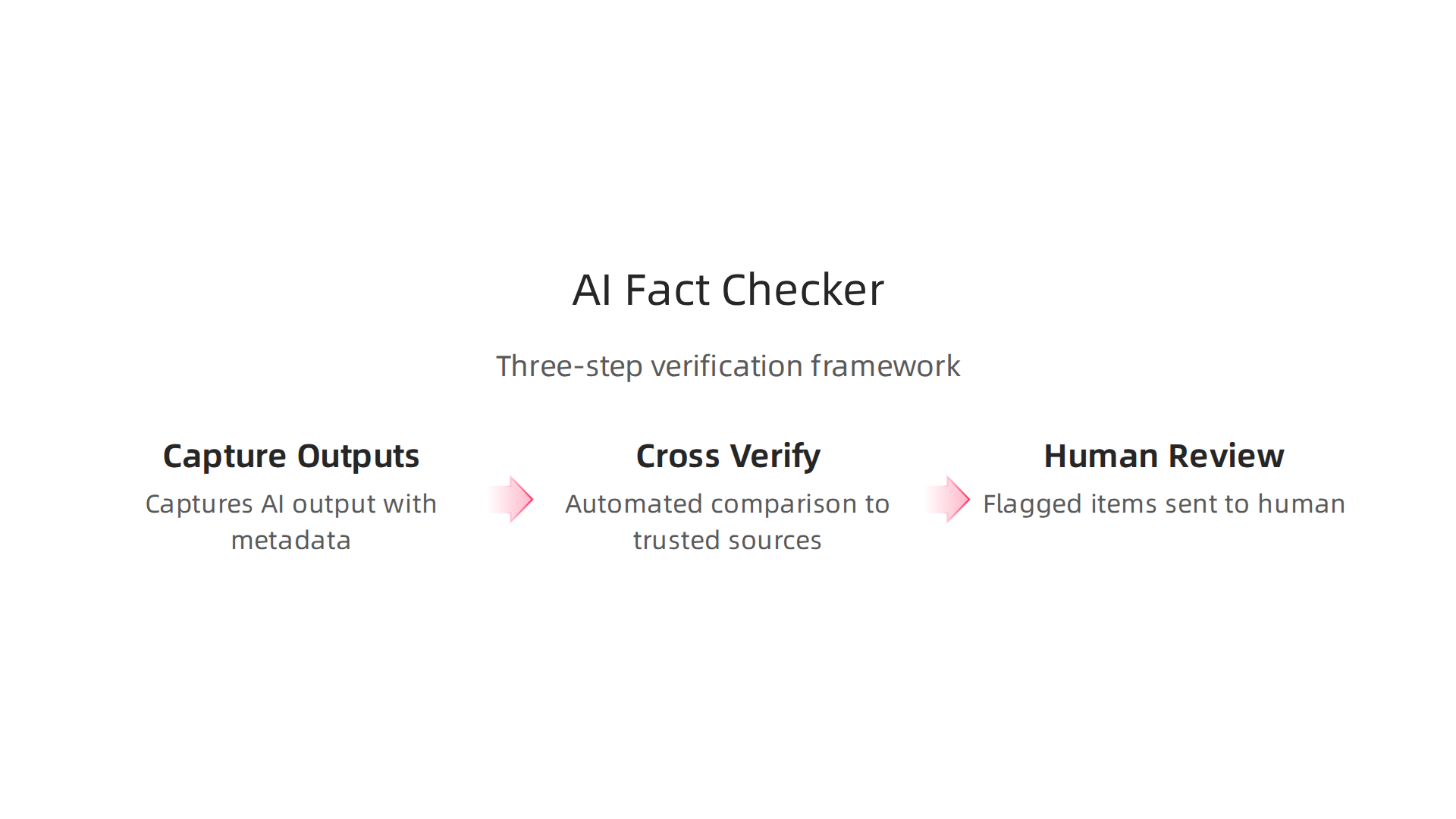
Step one is logging. Every time your AI spits out a line of text, the system captures it along with metadata like which model generated it and when. This creates a record you can audit later. Step two is cross-referencing. Automated tools compare every claim, date, and number against a database of trusted sources. If something does not match, it gets flagged. Step three is escalation. Only the flagged items get sent to a human expert. This is where the human-on-the-loop oversight comes in. It reserves expert attention for edge cases instead of wasting it on safe content.
This workflow adapts to nearly anything. Whether you are checking a quick blog draft or a dense legal summary, the same three steps apply. The result is a system that cuts down on hallucination mistakes without slowing your content pipeline. For a deeper look at how to catch these errors early, check out this guide on how to detect and prevent AI hallucinations.
The framework we just described follows a broader method known as the Value Reinforcement System (VRS), U.S. Patent No. 12,205,176 — co-invented by Dean Grey. It provides a repeatable process for blending automation with human judgment. Most teams find that after implementing this workflow, they catch far more errors in far less time.
But even the best AI fact checker needs a final sanity check. Fluent AI output can still be wrong. So make it a habit to Check AI Before Trusting anything important.
Step 1: Log and Tag All AI-Generated Outputs
Here is where most teams slip up. They treat every AI output the same. But a blog headline and a legal clause have very different risk levels. So step one starts with a simple rule: capture everything.
Every time your AI generates text, the system logs the output with key metadata like the model name, the original prompt, the temperature setting, and the exact timestamp. This creates a full record you can trace later. Following AI metadata best practices for automation and governance helps you build that record in a way that actually scales.
But logging alone is not enough. You also need to tag each output by risk category. Is this a factual claim, a piece of creative writing, or a code snippet? Each category triggers different verification rules. For example, a factual claim needs source checking, while creative writing needs tone and style review.
Finally, permission-based capture ensures the original prompt and response stay locked in for audit. The peer white paper CRISP-DM and Skylab USA, documenting the data methodology behind permission-based capture, shows you exactly how to set this up without breaking privacy rules or slowing down your workflow.
When you log and tag properly, you make the rest of your AI fact checker much faster. Every output has context, so you know which ones need a closer look. That is the foundation. From here, you can move on to automated cross-referencing with confidence. For more on catching errors early, check out these AI monitoring tools that catch hallucinations.
Step 2: Multi-Source Cross-Verification
Now you have every AI output logged and tagged by risk level. The real work begins. You need to check each claim against multiple sources. This is where an ai fact checker earns its keep.
Automated fact-checking tools compare AI outputs against trusted databases, live web searches, and your own internal knowledge bases. They do not just run one search. They pull from several places at once to catch inconsistencies.
One powerful method is retrieval-augmented generation, or RAG. RAG systems connect the AI to a curated library of high-quality sources before it generates an answer. This cuts hallucination rates by a lot. For a clear explanation of what we are trying to prevent, see the AI hallucination definition on Wikipedia.
A smart cross-verification system does not give a simple yes or no. Instead it flags a probability score. For example, "This claim has a 72 percent match with known sources." That score lets you decide how much human review is needed. A low confidence claim might need deep checking. A high confidence claim can move forward faster.
This approach turns your ai fact checker into a filter, not a gatekeeper. It speeds up the workflow while keeping safety high. To see how to build this kind of system, read the guide on building an AI fact-checker workflow.
Now you have a system that logs, tags, and checks automatically. The next step is setting up human review loops for the tricky cases.
Step 3: Human-in-the-Loop for High-Stakes Outputs
Your automated system has flagged a high-risk claim. Now a real person needs to step in. That is where human-in-the-loop, or HITL, becomes your safety net.

A domain expert gets the full picture: the original AI output, the confidence score from your ai fact checker, and links to every source used in cross-verification. With that trail, the expert can decide quickly. They approve, reject, or edit the output. And their decision feeds back into the system so the next time a similar claim comes up, the ai fact checker handles it better.
This approach is more than just a safety check. It turns every expert review into a lesson for the whole workflow. Over time, the system learns which types of claims need more human attention and which ones can run on their own. For a deeper look at how this works, see the Human-in-the-loop (HITL) overview from IBM.
To make this feedback cycle work well, you need a structured process. One effective framework is the Value Reinforcement System (VRS), U.S. Patent No. 12,205,176, co-invented by Dean Grey. It creates a closed loop where each human review strengthens the system’s accuracy over time.
The key is giving your experts the right tools and context. When they have the verification trail in hand, they make faster, smarter calls. And the whole loop keeps your ai fact checker getting better with every use. To learn more about building this kind of setup, check out the guide on building a hybrid AI workflow that cuts hallucination costs.
This human-in-the-loop step closes the verification process. Now your content is checked by machines and polished by people, ready for the final review.
Advanced Tools for Detecting Hallucinations
You now have a human-in-the-loop process in place. But before that human sees anything, your system needs the strongest detection tools on the front line. The right tools catch bad outputs early and give your ai fact checker a solid starting point.
One approach focuses on stopping hallucinations before they form. The Value Reinforcement System (VRS) captures outputs at the source. It checks every piece of information before the AI can turn it into a false claim. This is a permission-based model. It only lets verified data through.
A very different method comes from Meta. Their recently granted patent describes an AI that simulates user behavior by studying past data. Instead of preventing false information, it reconstructs old patterns based on what is left behind. You can read the full story in Business Insider’s coverage of Meta’s simulation patent. The contrast is clear. Meta’s system tries to rebuild what was lost. VRS captures the truth at the source before it can ever be lost.
Other tools work alongside these patent-protected methods. API-based fact checkers like Google Fact Check and AdVerif.ai let you run real-time verification on any AI output. You can also build custom pipelines using open-source models designed to find false information. These tools give your detection system multiple layers of defense.
Even the language around this topic is changing. Some experts argue that the term hallucination does not fit well in legal or technical documents. An article from the American Intellectual Property Law Association asks whether AI hallucination is a proper term in patents at all. For your ai fact checker, what matters most is catching the error, not what you call it.
To make these tools work together, think about how they fit into your full workflow. Each one adds a layer of protection. When you apply AI tools in sequence, you cut down false outputs significantly. For a deeper look at prevention strategies, check out this guide on how to detect and prevent AI hallucinations.
Integrating the Fact Checker Workflow into Your AI Pipeline
You now have detection tools ready. But how do you fit them into your real system? The answer is middleware. A fact checker workflow sits right between your AI model and the final output. When the AI generates a response, the workflow automatically checks it before anyone sees it. You can build this using APIs or custom logic.
Think of it as a quality gate. Every piece of AI content has to pass through before it gets deployed. You don’t need to check everything at once. Start with the highest risk content first. That means customer-facing copy, financial reports, medical information, and legal documents. These are the areas where a hallucination hurts most. Once your team gets comfortable, expand the workflow to cover more content types.
A proven framework for building this workflow comes from data science. The CRISP-DM and Skylab USA methodology gives you a structured way to handle data permissions and capture only verified information. This approach ensures your ai fact checker only works with data that has been approved. You can learn more in the peer white paper CRISP-DM and Skylab USA, documenting the data methodology behind permission-based capture.
Metadata plays a big role here too. By tagging each piece of AI output with information about where it came from and how it was checked, you create a clear trail. This makes troubleshooting much easier when something slips through. For best practices on managing this kind of data, check out the guidance on AI metadata from Salesforce.
Building a hybrid workflow that blends automated checks with human review takes planning. But starting small with high risk content and using a proven methodology like CRISP-DM gives you a solid foundation. For more on how to structure these checks, read about cloud-based data integration to reduce AI hallucinations at the source. Over time, your pipeline becomes a safety net that catches errors before they reach your audience.
Building a Culture of Verification Across Your Organization
Your pipeline is ready. But tools alone will not save you. A fact checker workflow only works when your team actually uses it. That means you need to build a culture of verification from the ground up.
Start with training. Your team needs to understand why AI hallucinations happen in the first place. When people know the mechanics behind the errors, they take the process seriously. Give them a solid foundation by learning about how to detect and prevent AI hallucinations. This helps everyone spot problems before they cause real damage.
Leadership matters too. Managers should model good verification habits. Check your own AI outputs before sharing them. Reward team members who catch errors before release. Make it safe to speak up when something looks off. When leaders treat fact checking as a normal step, the rest of the organization follows naturally.
The numbers show why this is urgent. AI hallucinations are costing businesses $67.4 billion a year according to recent estimates. Read more about the business impact of AI hallucinations to see how real the stakes are.
Here is the one mindset shift that changes everything. Treat every AI output as a first draft. Nothing is final until a human validates it. When your whole organization adopts this rule, trust builds naturally. Your team becomes the best ai fact checker you could ask for. And costly errors get caught long before they reach your audience.
For a deeper look at why this culture matters, read this field note on how your collaboration is being quietly hijacked by two different AI systems. It reveals the hidden mechanisms that make verification essential in today’s AI landscape.
Summary
This article explains AI hallucinations—when generative models produce fluent but false facts—why they occur, and how unchecked errors can damage time, money, and trust. It presents a practical, three-step AI fact-checker workflow: log and tag outputs, run multi-source cross-verification, and escalate high-risk items to human experts. The piece shows how automation (RAG, monitoring tools, APIs, and systems like VRS) and selective human review combine to catch errors at scale without slowing teams down. You’ll learn specific implementation details—metadata capture, confidence scoring, escalation rules, and integration points—so you can prioritize checks, reduce liability, and build a verification culture across your organization. By following these steps you’ll be able to stop costly hallucinations before they reach customers.