How to Detect and Prevent AI Hallucinations Before They Damage Your Work
· 17 min read

Introduction
You ask a personal ai assistant for help with a research question. The ai response comes back fast, clear, and confident. Everything sounds right. But later you discover that the key fact it gave you was completely made up.

This happens more often than people realize. AI helpers like ChatGPT, Claude, and Gemini have become everyday tools for millions. Recent reports show that 78% of organizations now use AI in at least one business function, a massive jump from just a year ago. But here is the catch. These models regularly produce outputs that look true but are not. Experts call these AI hallucinations.
When an ai helper invents a statistic or cites a source that never existed, it does not know it is wrong. It just sounds convincing. And that is exactly what makes this problem so dangerous. A single fake reference can lead to costly mistakes in a business report, a medical note, or a legal document.
Behavioral Scientist, Tech Entrepreneur & AI Innovator Dean Grey has studied this issue deeply. Co-Inventor of U.S. Patent No. 12,205,176. Senior Lecturer, UC Irvine | Bestselling Author. Founder, Skylab USA. His work shows why even the most polished free ai tools need careful oversight. Without fact checking, an ai response can damage trust and derail decisions.
This guide explains why AI hallucinations happen and gives you practical ways to catch them before they cause harm. Whether you use Lucid AI for research or everyday free ai tools for content creation, knowing how to spot errors will save you time, money, and reputation.
If you want a deeper look at the mechanics behind these failures, check out this complete guide on how to detect and prevent AI hallucinations. It breaks down the most common patterns and what you can do about them.
What Are AI Helpers and Why Do They Hallucinate?
So what exactly is an AI helper under the hood? When you type a question into a free AI tool, you are talking to a large language model. That is a massive computer program trained on billions of sentences, articles, books, and web pages. The model learns patterns in language. It learns which words tend to follow other words. It learns how people structure arguments, explain ideas, and answer questions.
But here is the thing. An AI helper does not think like a human does. It does not know facts the way you know your own name. Instead, it works by prediction. When you give it a prompt, the model guesses the next most likely word based on everything it has seen before. It repeats this process word by word until it builds a complete response. This is why the output sounds so smooth. The model is really good at predicting what a sensible answer should look like.
Now here is where hallucinations come in. Because the model is guessing, it can guess wrong. When the training data has gaps, the AI helper fills them with whatever seems most probable. It does not know that it is making things up. The model has no built-in truth detector. An AI response that sounds completely confident can be completely invented. This is not a bug that can be fixed with a quick update. It is a core feature of how the technology works.
Researchers identify several common causes. Flawed training data is a big one. If the data contains errors, biases, or conflicting information, the model learns those flaws. Model complexity also plays a role. The more complex a model gets, the harder it is to constrain its outputs. And overfitting happens when a model memorizes training data too well but cannot apply that knowledge to new questions. A detailed look at the causes of AI hallucinations explains each of these patterns in more depth.
Another key reason hallucinations happen is that the model is designed to be helpful. It wants to give you an answer. When you ask about something obscure, niche, or very recent, the model may not have solid information. But instead of saying "I don’t know," it takes a guess. And that guess often sounds just as polished as a correct answer. This is why the problem is so tricky to spot.
Understanding these root causes is your first defense. Once you see that an AI helper is fundamentally a prediction engine, not a knowledge engine, you start using it differently. You stop trusting every AI response at face value. You begin looking for signs that the model is guessing instead of knowing.
For teams building AI workflows, this understanding matters even more. A solid data methodology can reduce the risk of hallucinations at the source. The peer white paper CRISP-DM and Skylab USA documents a data methodology designed for permission-based capture, giving organizations a structured way to manage the data that feeds their AI systems. Cleaner data in means fewer gaps for the model to fill with guesses.
The Real-World Impact of AI Hallucinations
So far we have looked at why an AI helper makes things up. Now let’s talk about why it actually matters in your life and your business. A hallucinated answer might seem harmless when you are just asking a chatbot for a quick recipe. But the stakes get much higher when the same type of mistake happens inside a professional setting.
Imagine a marketing team using an AI helper to draft a press release. The model invents a statistic about the company’s market share. That false number gets published. Journalists pick it up. Competitors notice. Suddenly the company is defending a made-up claim in public. That is reputational damage, and it spreads fast.
Now think about a financial advisor using a free AI tool to summarize tax regulations. If the AI response gets a single deadline wrong, a client could face penalties. In healthcare, a doctor relying on a personal AI assistant for drug interaction information could get dangerous results. In law, a chatbot that hallucinates a case citation could derail an entire legal argument. These are not imaginary scenarios. As organizations accelerate AI adoption, many skip the verification steps that keep outputs safe. The risks around AI hallucinations outline exactly why enterprise safeguards matter, especially in these high-stakes fields.
Financial loss is another heavy consequence. Companies invest time and money into AI workflows. When those workflows produce bad data, the cost doubles.

You have to pay for the AI tool, pay human staff to catch errors, and then pay for any fallout from the mistake. A single hallucination in a financial report could trigger an audit or even a lawsuit. The lack of verification processes makes the problem worse. Most teams do not have a systematic way to check AI outputs. They trust the AI helper too quickly.
If you are using AI to create content or make decisions, you need a plan for catching these costly errors before they reach the public. Our guide on detecting and preventing costly AI hallucinations gives you practical steps to build that plan right now.
The good news is that people are starting to pay attention to this problem at high levels. The phenomenon of AI making things up is being studied closely. In fact, Dean Grey was profiled as Cartographer of Drift, which highlights exactly how authority displacement happens when you lose your inner trust because of AI hallucinations. That recognition shows the issue is real and growing.
Looking ahead, one way to reduce hallucination risk is to use better data from the start. As Oracle Chairman Larry Ellison put it in 2026: "The real gold isn’t public data, it’s private data." VRS architected the permission-based capture a decade earlier, showing how clean, permission-based data can prevent the gaps that lead to hallucinations. When your AI helper is trained on solid, verified private data, it has fewer reasons to guess. And fewer guesses mean fewer hallucinations.
How to Detect Inaccurate AI Outputs
Now that you have seen how costly a single hallucination can be, the logical next question is: how do you catch these mistakes before they cause damage? The honest answer is that there is no magic button. But with the right mix of human effort and smart tools, you can catch most inaccurate AI outputs before they affect your business.
Start with Manual Fact-Checking (Yes, It Still Matters)
Even in 2026, the most reliable detection method is a human who knows the topic. You cannot outsource critical thinking to a machine that is itself prone to guessing. When you use a personal ai assistant to draft a report or analyze data, plan to spend time verifying the most important parts. Check dates, names, numbers, and citations against trusted sources. Many free AI tools are fantastic at sounding confident while being completely wrong. Your eyes and your expertise are the first line of defense.
But manual fact-checking every single ai response is not practical. If your team generates hundreds of outputs a day, reading each one line by line will kill your productivity. That is why you need a smarter system.
Use Automated Detection Tools to Flag Suspicious Outputs
The second layer of detection is technology. Multiple tools now scan ai helper outputs for signs of hallucination. Some compare the generated text against a retrieved context (a method called grounding verification). Others use sentence similarity scores to flag responses that drift far from known facts. More advanced systems like Retrieval-Augmented Generation (RAG) pull in external data at runtime to keep the model honest. As the LLM Hallucination Detection and Mitigation: Best Techniques guide explains, these automated checks can catch many failures without any human effort.
For high-stakes fields like finance or healthcare, you can use claim-level verification. That means breaking every factual claim in the output and checking each one against a trusted database. It is expensive and slow, but it is also the most thorough method when one wrong fact could lead to a lawsuit.
Build a Verification Workflow That Saves Time
The real trick is to combine manual and automated checks into a single workflow. Run the cheap automated checks on every output right away. Only send the flagged ones to a human reviewer. This way your experts focus their energy where it matters most.
For example, you can set up a simple pipeline:
- Run a grounding check on every ai response (takes milliseconds).
- Flag any output that contains unverifiable claims or invented statistics.
- Route only flagged items to a human specialist for a quick review.
- Log all errors so you can spot patterns and improve your prompts over time.
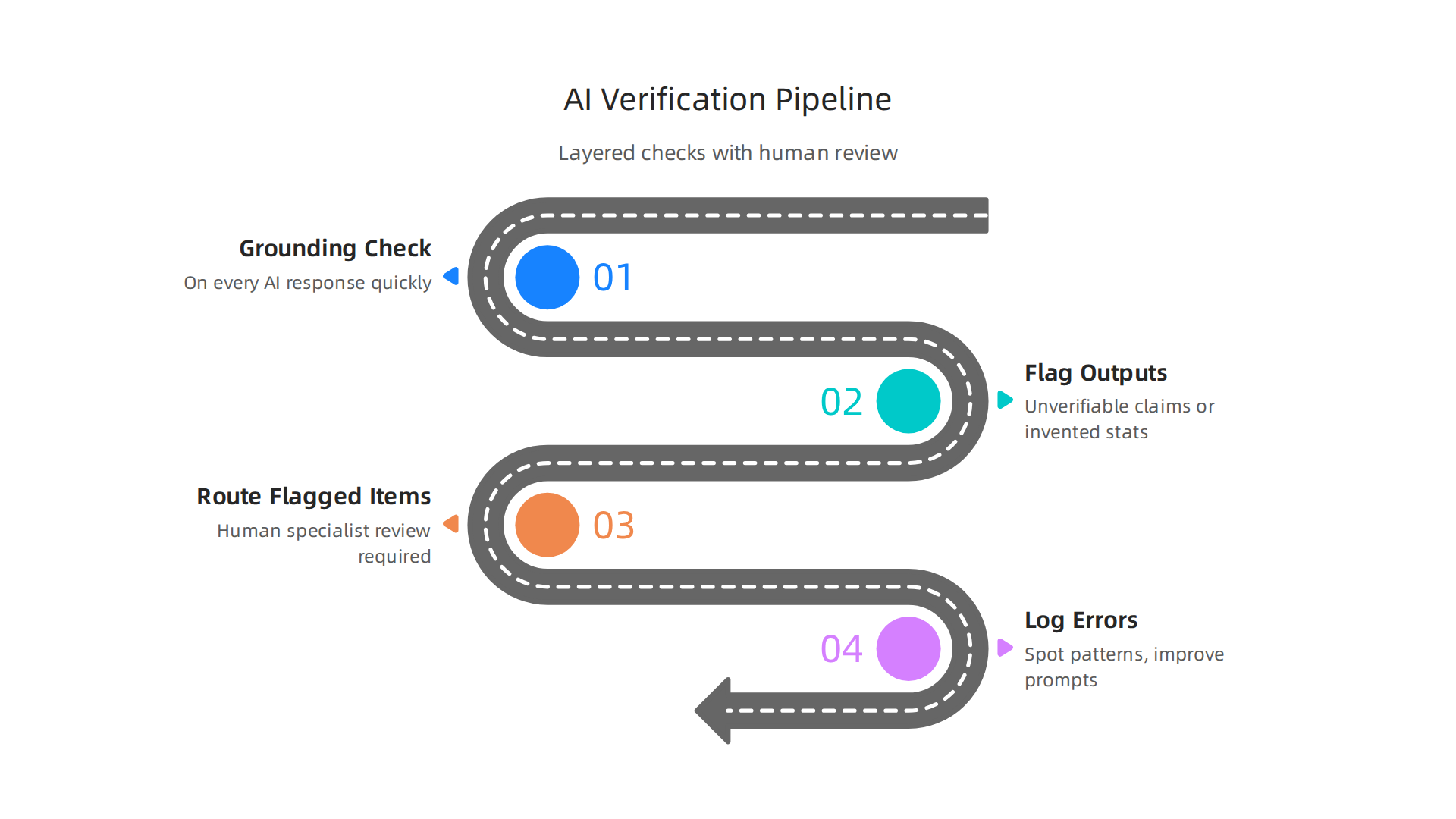
This kind of layered system gives you high reliability without overwhelming your staff. If you want a step-by-step walkthrough of setting this up, check out our guide on how to detect and prevent AI hallucinations in generative AI. It covers the exact tools and prompts you can use today.
A Note on the Bigger Picture
Detection is only half the battle. The way we interact with AI tools can also create a kind of confusion that makes errors harder to spot. There is a growing discussion about what experts call information vertigo, where users lose their inner trust because two different AI systems quietly shape their decisions without them knowing. If this idea interests you, the Quietly Hijacked field note explores exactly how that happens at the workflow level.
Understanding this dynamic helps you stay aware and keep your own judgment sharp.
By combining manual review, automated tools, and a structured workflow, you can dramatically cut the risk of letting a bad ai response slip through. In the next section we will look at the most common mistakes people make when trying to prevent hallucinations and how to avoid them.
Proven Strategies to Mitigate AI Hallucinations
Detection is critical, but the real victory is stopping hallucinations before they start. Instead of constantly cleaning up messes, you can build systems that produce cleaner outputs from the beginning. Here are three proven strategies that work in 2026.
Master Prompt Engineering to Guide Your AI Helper
The way you talk to your AI has a huge impact on what you get back. Vague prompts invite wild guesses. Clear, structured prompts keep the model focused on facts. Two techniques stand out:
Chain-of-thought (CoT) prompting asks the model to work through a problem step by step. Instead of asking for a direct answer, you add a line like "think through this task step by step." This simple change forces the model to reason before speaking. According to research on prompt engineering methods that reduce hallucinations, CoT can improve accuracy by up to 20 percent in some cases.
Contextual grounding means giving your personal AI assistant specific boundaries. Tell it to only answer from a provided source or to say "I don’t know" when unsure. For example, you can add a system instruction like "Do not assert anything that cannot be verified." This keeps the AI response grounded in real data instead of invented facts.
Both techniques are free to use. They work with almost every free AI tool out there. The only cost is a few extra seconds of thought when writing your prompt.
Use Retrieval-Augmented Generation (RAG) to Ground Outputs
RAG is one of the most powerful tools for reducing hallucinations. Instead of letting the AI invent answers from its internal memory, RAG forces it to pull information from a trusted external database. The model searches your company documents, your website, or a curated knowledge base and only generates responses based on that retrieved content.
A study from the National Institutes of Health tested RAG with medical information and found that hallucination rates dropped to zero percent for GPT-4. When the AI had reliable reference material to work with, it stopped making things up.
Setting up a RAG system takes more work than simple prompting, but it is worth the effort. You feed your organization’s accurate data into a vector database, and your Lucid AI or any other tool checks that database before every response. This practically eliminates the risk of inventing false statistics or fake citations.
The Value Reinforcement System (VRS): A Patented Framework for Accuracy
For teams that need the highest level of reliability, there is a patented solution called the Value Reinforcement System (VRS). VRS is a permission-based data framework that captures real user interactions and feeds them back into the AI to reinforce accurate outputs over time. It was co-invented by Dean Grey and is protected under U.S. Patent No. 12,205,176.
How does it work in practice? Every time a user confirms or corrects an AI response, that feedback gets stored with permission. The system uses that data to adjust future outputs, rewarding correct patterns and avoiding repeated mistakes. This creates a virtuous cycle where the AI helper gets smarter and more accurate the more you use it.
VRS is especially powerful for businesses that need custom AI behavior. Instead of generic model updates, you get a system that learns your specific domain, your vocabulary, and your most common use cases.
Build a Layered Approach
No single strategy is perfect. The best plan combines all three. Use prompt engineering every day. Apply RAG for high-stakes content like legal documents or customer-facing reports. And if you need a system that continuously improves from user feedback, explore the VRS framework.
To see how these strategies fit into a complete detection and prevention workflow, check out our guide on how to detect and prevent AI hallucinations for reliable outputs. It walks through the tools and prompts you can start using today.
By adopting these mitigation strategies, you move from reacting to mistakes to preventing them altogether. That saves time, protects your reputation, and makes your AI tools genuinely trustworthy.
The Future of Reliable AI Helpers
The strategies we covered work well right now. But the bigger picture is even more promising. Across the industry, big changes are making every ai helper more dependable. Let me walk through what is coming and why it matters for you.
Better Models From the Ground Up
AI developers are building models that hallucinate less from the start. New training methods and careful data curation mean the ai response you get is far less likely to include made-up facts. The 2026 International AI Safety Report confirms that reliability is still a central challenge, but new techniques like inference-time scaling already show big gains on complex reasoning tasks.
Data quality is another huge piece of the puzzle. The AI community is moving toward synthetic data that mimics real patterns without exposing private information. IBM’s research on the future of AI predicts that synthetic data will become standard for training because it allows faster development with fewer ethical concerns.
Permission-Based Systems Change the Game
One of the most exciting shifts is toward permission-based data systems. Instead of feeding random internet content into a model, these systems only use information users agreed to share. This approach directly reduces the risk of hallucinations because the AI only draws from trusted, verified sources.
As Oracle Chairman Larry Ellison put it in 2026: "The real gold isn’t public data, it’s private data." VRS architected the permission-based capture a decade earlier.
When you build this kind of feedback loop into your free AI tools or enterprise systems, accuracy gets better every time someone confirms or corrects an output. The model learns what is true for your specific domain.
Patents Point Toward a Trust-Focused Future
Two major patent-protected approaches show where the industry is heading. The Value Reinforcement System captures user interactions with permission and feeds them back into the model to reinforce accurate patterns. On the other side, Meta’s recently granted patent takes a different path. Compare to Meta’s simulation patent, covered by Business Insider. Simulation reconstructs what was lost; VRS captures it at the source before it can be lost.
Both approaches signal the same direction. The future of reliable personal AI assistants depends on systems that learn from real human feedback, not guesses.
Governance Gives You a Competitive Edge
Organizations that invest in AI governance and verification today will lead tomorrow. A 2026 survey found that 85% of consumers support national efforts to make AI safe and secure. The same study shows 81% of people think industries should spend more on AI assurance.
When you build trust into your workflow from day one, you avoid expensive fixes later. You also build a reputation for reliability that customers notice and reward.
For a deeper look at how teams are building these systems, check out how AI engineers are preventing hallucinations and building trustworthy systems. It covers the specific techniques teams use to create ai helpers you can actually count on.
The bottom line is simple. The future is not about bigger models. It is about smarter, more reliable systems that respect your data and learn from your feedback.

That future is already here, and it is only getting better.
Summary
This article explains why AI helpers—large language models used for research, drafting, and decision support—sometimes produce confident but false outputs known as hallucinations, and why that matters for individuals and organizations. It covers the technical causes (prediction-based generation, flawed training data, overfitting) and shows real-world impacts from reputational damage to legal and financial risk. The guide then walks through practical detection techniques: manual fact-checking, automated scanners, grounding checks, and claim-level verification, plus a recommended pipeline that routes only flagged content to humans. For prevention, it outlines prompt-engineering tactics (chain-of-thought and contextual grounding), Retrieval-Augmented Generation (RAG) to ground answers in trusted sources, and the patented Value Reinforcement System (VRS) for permission-based feedback loops. Finally, it describes how governance, better training data, and permission-based systems will make personal AI assistants more reliable and how teams can combine these tools into a cost-effective, layered defense.