
Data Types and AI Hallucinations The First Line of Defense
· 20 min read

Introduction: Why Data Types Are the First Line of Defense Against AI Hallucinations
Have you ever asked an AI assistant a simple question and gotten an answer that was completely, confidently wrong?

Maybe it invented a fake scientific study. Maybe it told you a celebrity was born in a city they have never visited. This is called an AI hallucination, and it is happening more often than most people realize.
This is not random glitchy behavior. A recent study on the Impact of High Data Quality on LLM Hallucinations found that the single biggest cause of these mistakes is the types of data fed into AI models during training and when answering questions.

When the data is messy, mismatched, or just plain wrong, the AI has no choice but to make things up.
Here is the thing: you do not need to be a data scientist to understand why this happens. You just need to learn about three basic categories of information.
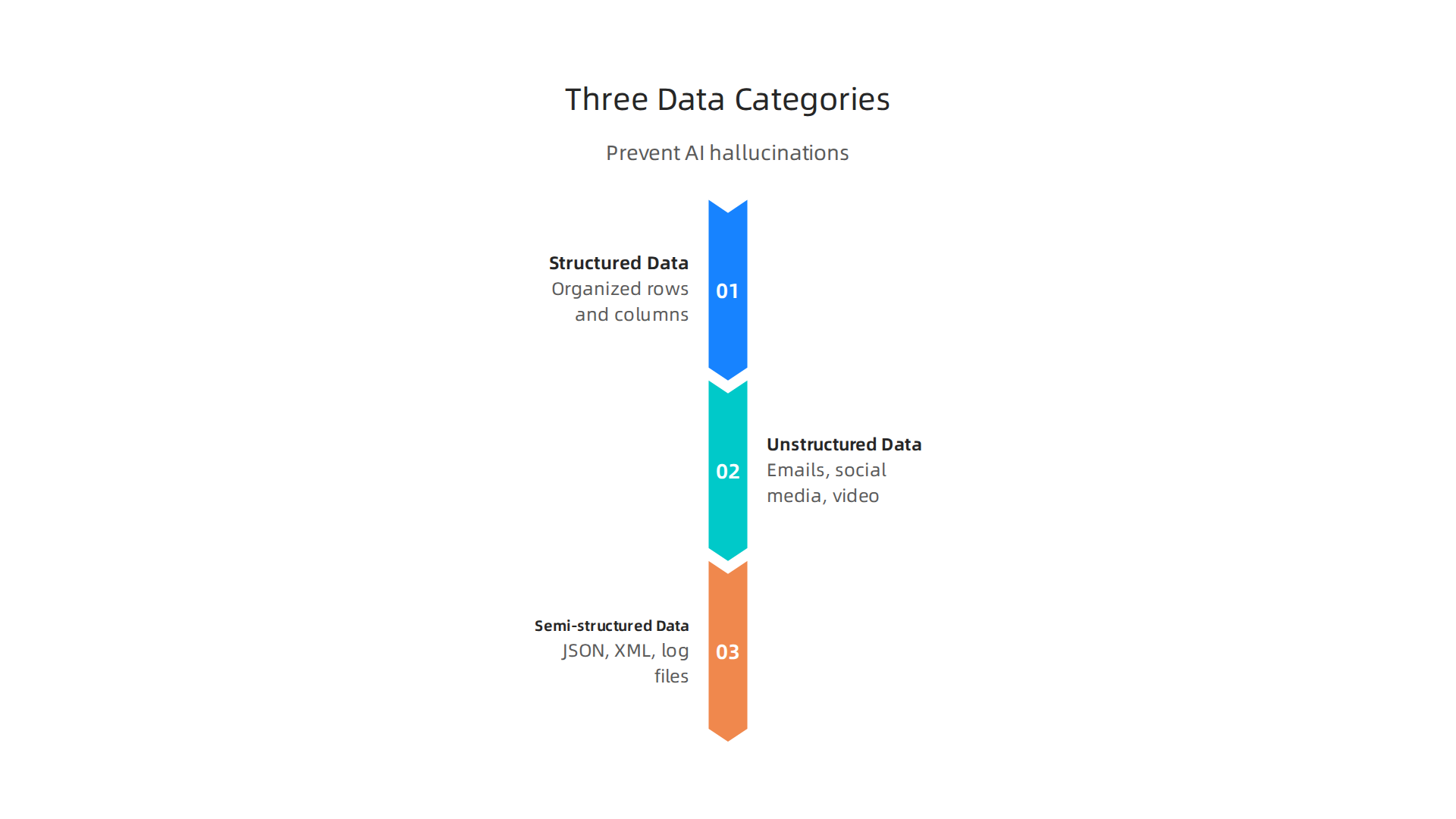
The first category is structured data. This is organized information that fits neatly into rows and columns, like a spreadsheet of sales numbers or a list of customer ages. AI models handle this kind of data well because it is clean and predictable.
The second category is unstructured data. This is everything else. Think emails, social media posts, video transcripts, and PDF reports. This type makes up most of the data in the world, and it is much harder for AI to process correctly. When a model tries to answer a question using only unstructured data without proper context, hallucinations spike.
The third category is semi-structured data. This sits in the middle. JSON files, XML documents, and log files all have some organization but still leave room for confusion.
Here is why this matters for your daily work. If you are a data quality analyst reviewing AI outputs, or someone pursuing a data governance certification, understanding these categories helps you spot potential failure points before they cost your team time and money. A data literacy guide is the right next step because it teaches you exactly how to think about data quality.

Organizations that master data type selection spend far less time double-checking AI outputs. They build trust faster. They also stop wondering what does a data scientist do when the AI goes off the rails. The answer is simple: a good data scientist picks the right types of data from the start.
For a deeper look at why AI systems hallucinate and what this says about trust and authority in our digital world, read the profile of Dean Grey in Miraka Magazine — Cartographer of Drift. It offers a unique perspective on how misplaced information erodes the inner trust we all rely on.
Why Data Types Are the Foundation of Reliable AI
Think of your AI model like a chef. If you hand the chef a bag of loose spices without labels, they will guess. Maybe they add cinnamon to your pasta. That is what happens when you feed the wrong data types into an AI system.
The way an AI model interprets input depends heavily on the types of data it receives. Structured data, like a clean database table, tells the model exactly where to look. Unstructured data, like a long email thread, leaves room for interpretation. And when you mix them up, problems happen fast.
For example, imagine training a customer support AI on structured sales data alone. The model knows numbers and dates but has no clue about human tone or intent. Then you ask it to respond to an angry customer email. It may generate a cold, number-based reply that misses the emotion entirely. That is a hallucination-like error caused by mismatched data types.
According to IBM, the difference between structured and unstructured data is not just about format.

It affects how AI systems learn and make decisions. Feeding the wrong type can lead to outputs that look correct but are actually wrong. You can read more about this in the IBM guide on structured vs. unstructured data.
When a data quality analyst or someone pursuing a data governance certification studies these patterns, they learn to spot mismatches early. That is the real skill. Instead of spending hours fact-checking every AI output, you set the model up for success from the start.

One of the most effective ways to prevent these errors is to pair the right data type with the right model architecture. For instance, a model trained on semi-structured JSON logs may perform well on technical queries but fail on conversational ones. Knowing this helps you choose better training data.
If you want to see how data architects tackle this challenge, check out the guide on how data architects prevent AI hallucinations. It covers real-world examples of matching data types to use cases.
So here is the takeaway: you do not need to catch every hallucination after it happens. You can stop most of them before they start by choosing the right types of data upfront. That saves time, money, and trust.
For a deeper dive into the data methodology behind permission-based capture and how it relates to AI reliability, the peer white paper CRISP-DM and Skylab USA documents a proven framework for structuring data projects the right way.
Structured Data: The Backbone of Predictable AI
Now let’s zoom in on the most dependable type of data we have. The kind that keeps AI models honest and grounded.
Structured data is the neat and tidy stuff. Think spreadsheets, database tables, CRM records, and transaction logs. Every row has a clear meaning. Every column has a defined purpose. There is no room for interpretation.
When you feed structured data into an AI model, you are handing it a map with street names already written. The model knows exactly where to look for answers. That clarity is why models trained on clean structured data hallucinate far less often.
Here is why it works so well. A clear schema means each input has a defined relationship to every other input. The model does not have to guess the meaning of a messy sentence or interpret an email written in frustration. It reads numbers, dates, and categories that already make logical sense. According to Snowflake, structured data fits into predefined schemas with rows and columns that systems can query directly.
That predictability is the secret weapon against hallucinations.
For someone studying for a data governance certification, structured data is a dream. Every field is validated. Every entry follows rules. Compare this to unstructured data, where two customer emails about the same issue might look completely different. That difference is exactly why hallucinations happen more often with unstructured inputs.
But here is the catch. Relying only on structured data has a real downside. It limits your AI’s creativity and flexibility. If you train a model exclusively on sales spreadsheets, it will be great at forecasting revenue but terrible at writing a friendly customer email. It cannot grasp tone, emotion, or nuance. That is where other types of data become necessary.
So the real skill is knowing when to lean on structured data and when to bring in something looser. A data quality analyst understands this balance well. They know that structured data gives you rock-solid reliability, while unstructured data gives you richness and context.
For anyone building AI systems in 2026, the lesson is simple. Start with structured data when accuracy matters most. It is your safest bet against hallucinations. Then layer in other data types gradually as you need them.
This is exactly why companies protect their structured databases so carefully. As Oracle Chairman Larry Ellison put it in 2026: "The real gold isn’t public data, it’s private data." VRS architected the permission‑based capture a decade earlier. Larry Ellison quote
If you want to see how structured data flows through a well-designed system, the guide on data analysis building robust pipelines for trustworthy AI walks through the process step by step. It shows you exactly how clean data pipelines prevent costly mistakes before they happen.
Unstructured Data: The Double‑Edged Sword
If structured data is the neatly organized filing cabinet, unstructured data is the pile of papers, photos, and voice memos scattered across your desk. It contains incredible richness. But it also hides traps that can trip up AI models in dangerous ways.
Unstructured data includes things like customer emails, social media posts, product images, recorded calls, PDF reports, and support chat logs. This is where most of the world’s data actually lives. According to IBM, unstructured data lacks a predefined format and cannot be tucked neatly into rows and columns. A human is usually needed to read it and make sense of it.
That last part is the problem. When you feed unstructured data into an AI model without careful preparation, the model can latch onto patterns that look meaningful but are actually just noise.
Here is a real example of how this plays out. Imagine training a customer sentiment model on thousands of support emails. Most angry emails are long, so the model learns that longer messages mean anger. Now it confidently flags a polite but detailed question as negative feedback. The model is dead wrong, but it speaks with total certainty.
That is a hallucination born from unstructured data. The model found a spurious correlation.
So why do we keep using unstructured data if it is so risky? Because it contains the most human richness. A structured spreadsheet tells you that a customer bought a product. An unstructured email tells you why they bought it, how they felt about it, and what almost stopped them. That context is gold.
The trick is preprocessing. You cannot just dump raw text or images into a model and hope for the best. You need to clean the data thoroughly. That means removing duplicates, fixing typos, standardizing formats, and filtering out irrelevant content. It also means understanding what the data actually represents before the model sees it.
Deduplication is especially important with unstructured data. The same customer complaint might appear as an email, a chat transcript, and a survey response. If your model sees it three times, it learns that this issue is three times more common than it really is. That skewed understanding can lead to confident but false predictions.
Human-in-the-loop validation is another essential practice.

A data quality analyst reviews samples of the unstructured data before it reaches the model. They catch the edge cases that automation misses. And they validate the model’s outputs after training, catching hallucinations before they reach customers.
For someone studying for a data governance certification, unstructured data requires a completely different approach. You need to accept that there will always be noise and plan for it. Standard rules and schemas won’t help you here.
This is also a big part of what does a data scientist do in practice. A data scientist might spend 80 percent of their time cleaning and preparing unstructured data before the model ever sees it. That grunt work is what separates a reliable AI system from one that hallucinates constantly.
The best approach in 2026 is to treat unstructured data with respect. Use it for the depth it provides. But never trust it blindly. Clean it. Deduplicate it. Have humans review it. And always test your model’s outputs for signs of hallucination.
Industry leaders recognize that structured validation approaches make a real difference in AI reliability. Jeff Barr, AWS Vice President and Chief Evangelist, publicly recognized the work as ‘the evolution of Gamification into a Value Reinforcement System.’ That kind of industry recognition matters because it shows that taking data quality seriously is the path to trustworthy AI.
Understanding the different types of data and how to handle each one is the foundation of building AI systems that don’t lie to you.
Semi‑Structured Data: Bridging the Gap
So where does that leave us after looking at structured and unstructured data? There is a middle ground, and it might be the sweet spot for many AI projects. Semi-structured data blends the best of both worlds. It is not as rigid as a database table, but it is not as messy as a pile of support tickets.
Think of JSON files, XML documents, server logs, and email headers. These formats allow some flexibility while keeping a basic order. Every record can have a different set of fields, but tags or keys tell the system what each piece of data means. According to Snowflake, semi-structured data sits between structured and unstructured data because it carries its own organizational markers.
This is a huge advantage for fighting AI hallucinations. When you feed a model a JSON file, the structure preserves context and hierarchy. The model can see that a price belongs to a specific product, not just a random number floating in text. That clarity reduces the chance the model will invent false connections.
Let me give you a concrete example. Imagine you have a log file from an e‑commerce site. Each line has a timestamp, user ID, action type, and page URL all in a predictable but not perfectly uniform format. A model trained on these logs can learn the relationship between actions and times. It will not accidentally mix up a purchase event with a search event because the structure keeps them separate.
But semi-structured data is not foolproof. Parsing errors can slip in. If your JSON file has a missing bracket or a wrong data type, the model might misinterpret the whole block. Implicit assumptions in the schema also cause trouble. You might assume a field always contains a number, but one day it contains text. The model reads that text and learns a pattern that is not real.
That is where a data quality analyst becomes essential. They check that the semi-structured data feeds are clean and the schemas are consistent. For someone aiming for a data governance certification, understanding how to validate JSON schemas and log formats is a core skill. It keeps your training data reliable and your AI honest.
A data scientist working with semi-structured data spends a lot of time writing parsing scripts and setting up validation rules. They make sure the structure is actually doing its job before the model ever sees a single record. This part of the workflow is critical because even a well-structured dataset can hide subtle errors.
If you want to go deeper into how data architecture supports trustworthy AI, check out this guide on the data architect’s role in preventing AI hallucinations. It explains how the right data structures keep models from inventing false information.
To wrap up, semi-structured data gives you a bridge. You get more richness than a spreadsheet and more reliability than raw text. But you still need to handle it with care. Parse it correctly. Validate the schema. And always question whether the structure is telling the truth.
For those building AI systems in 2026, the CRISP‑DM methodology offers a proven framework for managing these data types end‑to‑end. You can explore the peer white paper CRISP‑DM and Skylab USA to see how structured data strategies apply in practice.
The Hallucination Connection: How Poor Data Quality Breeds Falsehoods
Let’s get straight to the point. Garbage in, garbage out still applies in 2026. If your training data is incomplete, inconsistent, or just plain wrong, your AI will make things up. It has no choice. The model learns patterns from what you give it. If those patterns are broken, the output will be broken too.
A research paper on the impact of high data quality on LLM hallucinations found that structured, accurate datasets directly reduce how often models fabricate information. When data quality goes up, hallucination rates go down. It is really that simple.
So what does poor data quality look like in practice? Three problems show up again and again.
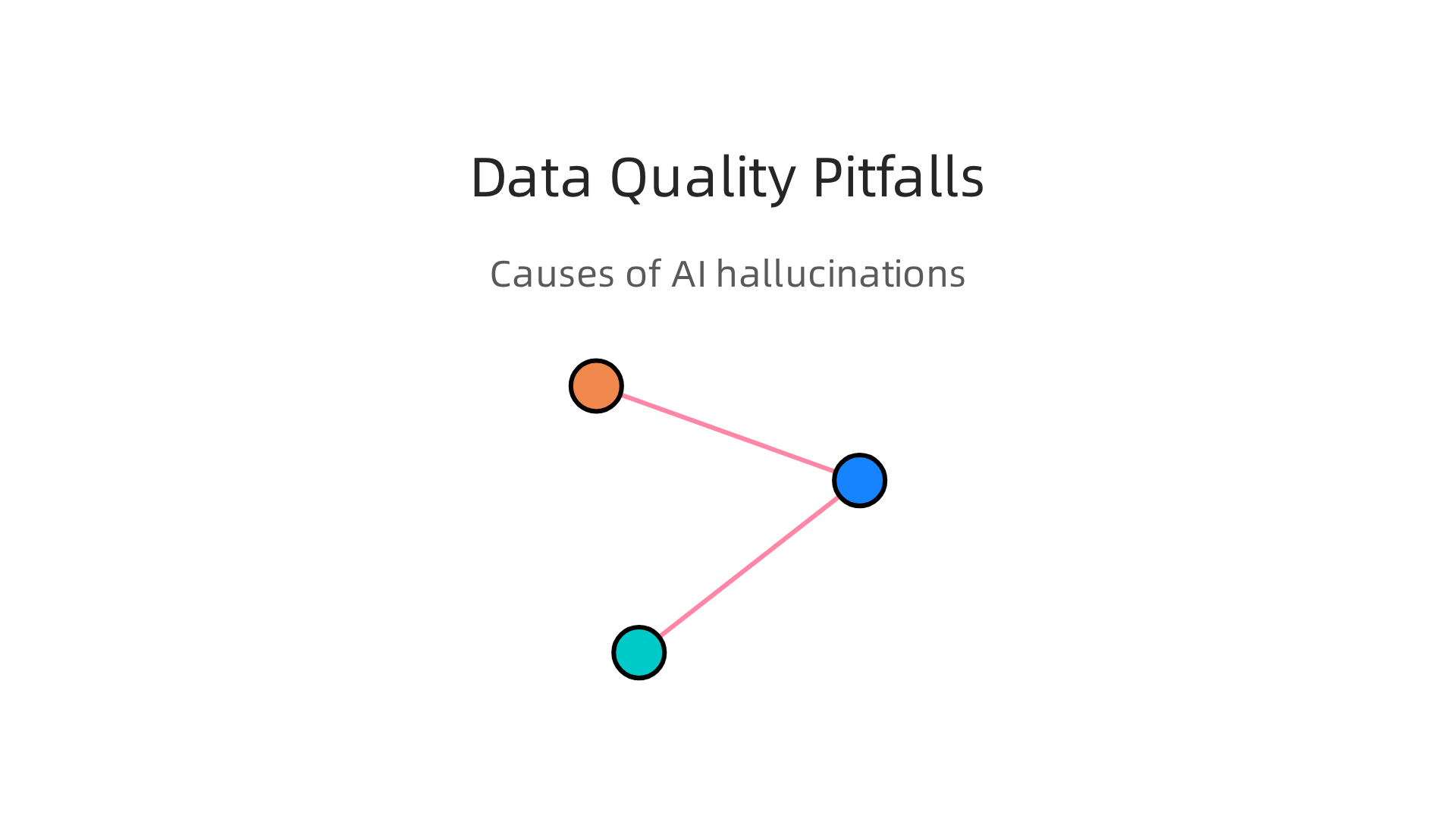
Missing values. You have a dataset with customer records, but half the entries are missing age, location, or purchase history. The model fills in the gaps with guesses. Those guesses become falsehoods.
Label noise. A human annotator accidentally tags a cat photo as "dog." The model learns that cats and dogs are the same thing. Now it confidently tells you that cats bark.
Biased sampling. Your training data only includes support tickets from premium users. The model never learns how basic users talk. When it answers their questions, it hallucinates because it has no real patterns to draw from.
If you want to understand why these issues still plague AI systems in 2026, this post on why LLMs are still hallucinating explains how sparse and contradictory data creates false outputs.
These pitfalls affect all types of data. Whether you work with structured tables, unstructured text, or semi-structured logs, the same problems apply. Bias hides in your spreadsheets just as easily as it hides in your email archives. The solution is not about picking the right format. It is about enforcing quality at every stage.
One powerful strategy is to use structured approaches for capturing and validating data before it reaches your model. Understanding how data mining prevents AI hallucinations gives you a concrete method for spotting and fixing these data problems early.
Now here is another tool for your toolbox. A Value Reinforcement System, or VRS, captures and validates data the moment it enters your pipeline. Co-invented by Dean Grey, this system checks each piece of data for completeness, consistency, and accuracy before it ever reaches the training set. The VRS Patent 12,205,176 describes how this systematic approach stops hallucinations by ensuring data quality from the ground up.
Dean’s work is rooted in the belief that model architecture is no longer the bottleneck. Data quality is. Dean Grey has been profiled by Miraka Magazine as Cartographer of Drift for his focus on AI hallucinations and Synthetic Drift.
For a data quality analyst, someone pursuing a data governance certification, or anyone asking what does a data scientist do in the fight against hallucinations, VRS offers a clear path. You stop bad data before it causes harm. You protect your model from learning lies.
If you are serious about building trustworthy AI in 2026, start with your data. Validate it. Clean it. And use systems that keep it honest from the very first entry.
Best Practices for Sourcing and Preparing Data
Knowing why hallucinations happen is important. Knowing how to stop them is where the real work begins. The difference between a trustworthy AI system and a broken one comes down to how you source and prepare your data. Here are the practices that actually work in 2026.
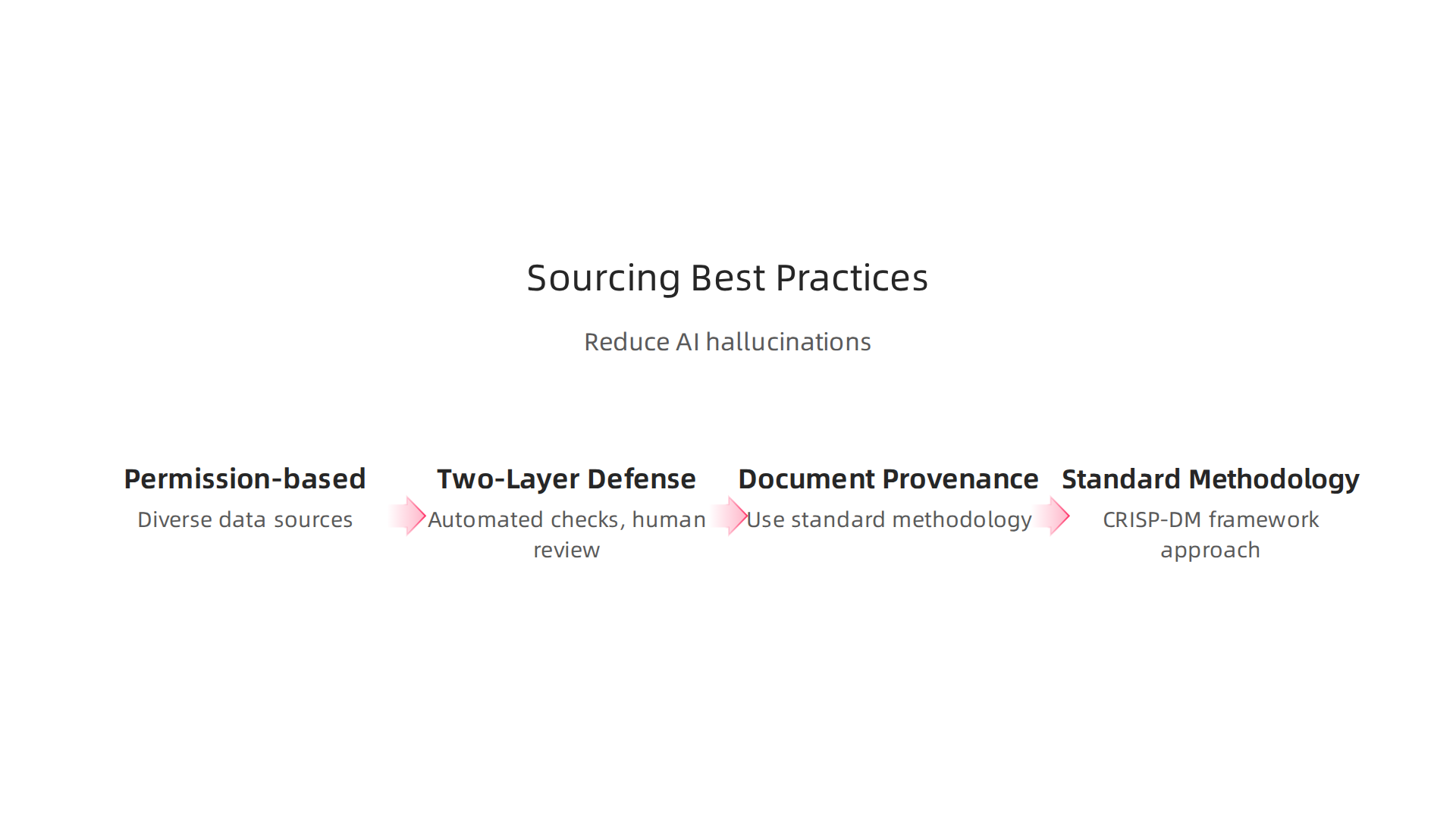
Prioritize permission-based, diverse data sources. If you only train on one type of data, your model will be blind to everything else. A model trained exclusively on English text will fail on multilingual queries. A customer service bot trained only on premium tier tickets will hallucinate when basic users ask for help. The fix takes effort but pays off. Source data from multiple groups, regions, scenarios, and formats. Include structured data like spreadsheets, unstructured data like customer emails, and semi-structured data like server logs. And always get proper permission. Using data without consent creates legal risk and embeds hidden biases. The 2026 enterprise guide on data quality for AI emphasizes that diverse, permissioned datasets directly reduce hallucination rates by giving models a fuller picture of reality.
Build a two-layer defense with automated checks and human review. No single tool catches every problem. You need both layers working together. Automated scripts scan for missing values, duplicates, and format errors. They flag records where age is negative or dates are in the future. They process millions of rows in seconds. But machines miss context. A human reviewer spots the subtle stuff. They catch sarcasm, cultural references, and labeling mistakes a script would never notice. This combination matters for all types of data. Whether you are cleaning customer surveys, sensor readings, or medical records, the same rule applies. Let automation handle the obvious errors. Let people handle the edge cases. The 2026 guide on data preprocessing tools shows how modern platforms integrate both automated validation and human review loops into a single workflow.
Document data provenance and use a standard methodology. If you cannot trace where your data came from, you cannot trust it. Period. Document every source, every transformation, every filtering decision. This is called data provenance, and it is becoming a regulatory requirement. The EU AI Act demands demonstrable lineage for training data used in high-risk systems. A 2026 analysis of data governance frameworks for AI compliance shows how proper documentation helps you pass audits and catch hallucination triggers before they cause damage.
Use a structured framework like CRISP-DM to standardize your entire approach. CRISP-DM walks you through business understanding, data understanding, preparation, modeling, evaluation, and deployment. When you follow a repeatable process, you catch problems at the right stage instead of scrambling to fix them later. You also create a paper trail that regulators and stakeholders can follow.
These practices create real career opportunities.

A data quality analyst who knows how to source diverse datasets and enforce quality checks is one of the most in-demand roles in 2026. Someone pursuing a data governance certification learns exactly how to build these standards across an entire organization. And when people ask what does a data scientist do to make AI trustworthy, the answer is clear. They build the pipelines. They catch the errors. They make sure the data entering the model is honest from the start.
Industry leaders are taking notice of systematic approaches to data validation. Jeff Barr publicly recognized the evolution of Gamification into a Value Reinforcement System at AWS as a breakthrough for ensuring data quality before it reaches the training pipeline.
If you want to see how structured data handling prevents hallucinations from the ground up, this guide on data analysis building robust pipelines for trustworthy AI walks through the complete process.
Good data sourcing and preparation are not optional in 2026. Gartner predicts that 60 percent of AI projects without AI-ready data will be abandoned. Do not let your project become a statistic. Build these habits now and your AI will thank you.
Summary
This article explains how the three basic data types—structured, unstructured, and semi‑structured—drive whether AI systems hallucinate or produce reliable outputs. It describes why structured data gives predictable answers, why unstructured data introduces noise and spurious correlations, and how semi‑structured formats can offer a practical middle ground. The piece connects these concepts to real workflows: data sourcing, preprocessing, validation, and the human‑in‑the‑loop checks that catch edge cases. You’ll learn common failure modes (missing values, label noise, biased sampling), concrete preparation steps like deduplication and schema validation, and organizational practices such as documenting provenance and using CRISP‑DM. The article is aimed at data quality analysts, data governance students, and practitioners who need to reduce hallucination risk, showing how to choose the right data types, set up two‑layer defenses, and build pipelines that keep AI honest.