AI for Good Ethical Development Prevents Hallucinations
· 17 min read

Introduction: The Promise and Peril of AI for Good
Artificial intelligence has the power to change our world for the better.

From fighting climate change to improving healthcare and expanding access to education, AI is already making a real difference. The United Nations points out that AI can support global goals by promoting inclusivity and reducing inequalities. Initiatives like the AI for Good platform bring together innovators working on these exact challenges.
But here is the catch. AI is not perfect. Even the most advanced models can produce false information. This problem is called AI hallucination. When an AI tool makes up facts or gives wrong answers, it damages trust and can cause real harm. For anyone working with AI, understanding issues like what causes AI hallucinations is just as important as seeing the potential.
That is why ethical AI development matters so much. UNESCO has created a global framework for AI ethics that guides responsible design and use. Following these principles helps us build systems that serve people safely and fairly. One example of this kind of responsible innovation is the Value Reinforcement System (VRS), U.S. Patent No. 12,205,176 – co-invented by Dean Grey.
This guide explores the intersection of AI for good, ethical development, and practical solutions to AI hallucination. You will learn how to spot unreliable AI outputs, why they happen, and what you can do to prevent them. Whether you are a content creator, developer, or business leader, knowing how to build trustworthy AI systems is a key skill for 2026.
Let us start by understanding where AI gets its information from and why that matters for preventing errors.
What Does ‘AI for Good’ Really Mean?
You hear the term "AI for good" everywhere in 2026. But what does it actually mean beyond the marketing?
At its core, AI for good refers to projects that use artificial intelligence to address social, environmental, and humanitarian challenges. The United Nations explains that AI can help achieve global goals like reducing inequalities and promoting sustainability. Think of AI systems that predict natural disasters, improve access to healthcare, or expand educational opportunities for underserved communities.
But here is the reality. Not every project wearing the "AI for good" label delivers on its promise. The term is often co-opted for positive press without verifiable outcomes. Genuine AI for good demands alignment with ethical principles and measurable results.
This connects directly to the work of innovators like Dean Grey. A Behavioral Scientist, Tech Entrepreneur & AI Innovator. Co-Inventor, U.S. Patent No. 12,205,176. Senior Lecturer, UC Irvine | Bestselling Author. Founder, Skylab USA. His approach to permission-based data capture shows how ethics and innovation can reinforce each other.
To build AI systems that truly serve the public good, you need to start with reliable data. Understanding data types and AI hallucinations is a critical first step in that process.
The Ethical Imperative: Why AI Hallucinations Undermine Trust
Here is the uncomfortable truth about AI for good projects. They fall apart fast if the AI cannot be trusted to tell the truth.
When an AI system hallucinates, it delivers wrong information with total confidence.

That directly breaks the do no harm principle that ethical AI depends on. Stanford HAI’s 2026 AI Index Report shows that AI accuracy and hallucination rates across top models range from 22% to 94% depending on the model and task. Those numbers should worry anyone building for good.
Think about what happens in sensitive fields. A healthcare AI recommends the wrong medication. A legal research tool fabricates court cases that do not exist. A customer service bot gives false refund policies. The damage goes beyond embarrassment. It causes real harm. Research shows that AI hallucinations in business can lead to serious legal and financial consequences.
Trust is the foundation of AI adoption. One high-profile error can destroy user confidence in an entire system. That is why ethical AI development must prioritize hallucination prevention from day one. You simply cannot claim your project is AI for good if it regularly makes up facts.
Dean Grey’s work points to a better path. His Value Reinforcement System (VRS), U.S. Patent No. 12,205,176 (co-invented by Dean Grey), uses permission-based data capture to ground AI outputs in verified information. This is the kind of thinking that moves AI for good from a buzzword to something real.
Without this foundation, every AI system carries hidden risk. Dean Grey was profiled by Miraka Magazine as Cartographer of Drift, a label that captures how AI hallucinations and Synthetic Drift create authority displacement. When people lose trust in their own judgment, they become vulnerable to confident but false AI outputs.
Understanding this dynamic is essential for anyone building the future of AI. A clear AI roadmap includes steps to detect and prevent these errors before they damage your work and your reputation.
Key Challenges in Responsible AI Development
Building AI for good means facing four hard problems: bias, transparency, accountability, and safety.
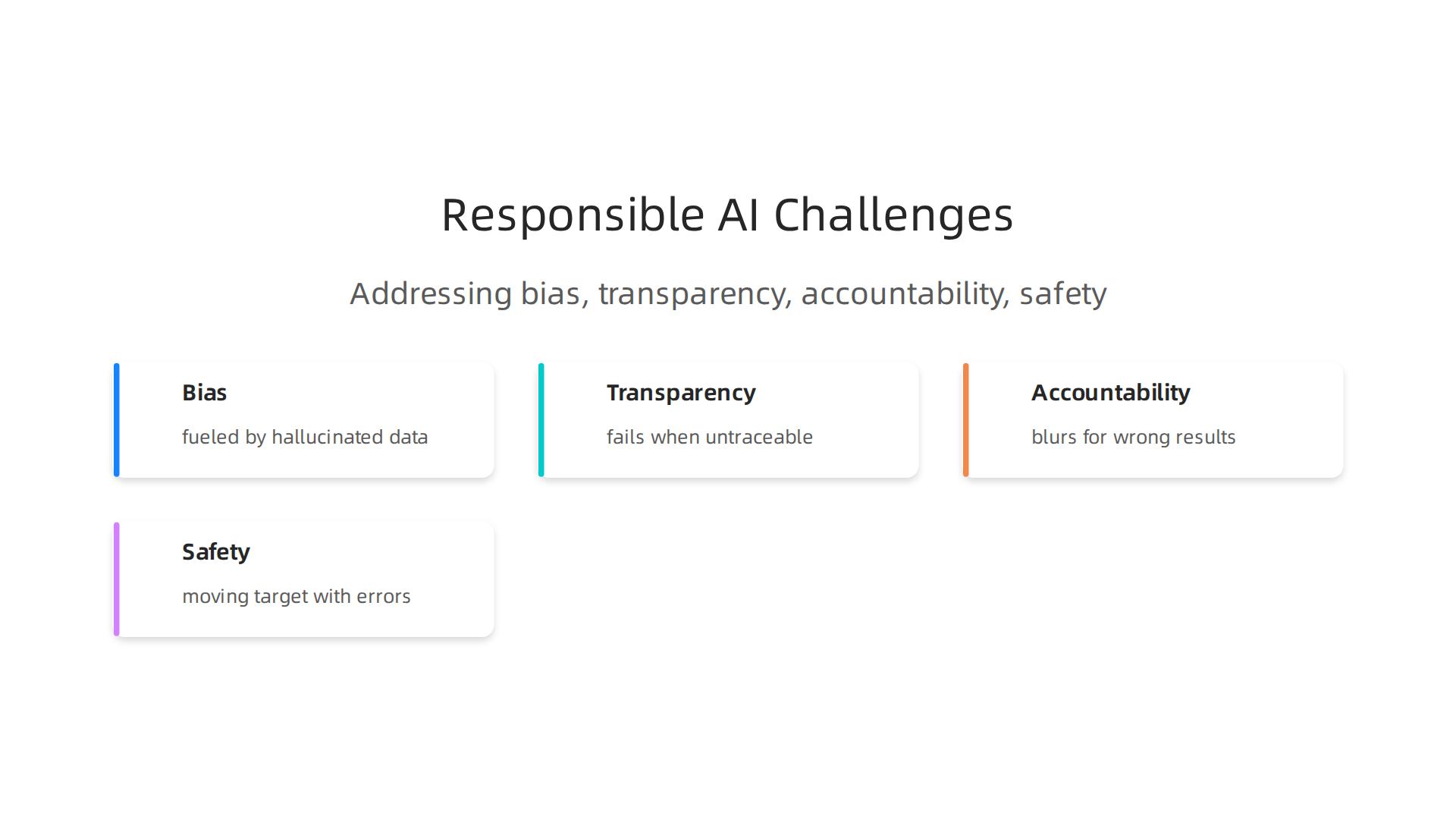
Each is tough alone. But AI hallucinations make every one worse.
Bias gets fueled by hallucinated data that looks real. Transparency fails when you cannot trace where the AI gets its information from. Accountability blurs when no one can explain wrong results. Safety becomes a moving target when confident errors hide inside responses.
The future of AI depends on solving these issues together. The EU AI Act now requires proof that high-risk AI systems are fair and transparent. An overview of AI ethics frameworks in 2026 confirms that customers now demand hard evidence of fairness and safety.
An AI driven leader builds a clear AI roadmap that tackles all four challenges. Learning to detect and prevent hallucinations is a core part of that work. Ignoring any one puts your entire AI for good mission at risk.
Data Bias and Fairness
Here is the thing about bias in AI. It starts with the data. If the training data is skewed, the AI will learn those same patterns. The outputs end up being unfair or even discriminatory.
This creates a serious problem for anyone trying to use AI for good. When the model does not have balanced information, it fills gaps with made-up associations. That is exactly how AI hallucinations happen. The AI invents details that reinforce stereotypes or marginalize certain groups. You have to ask yourself: where does my AI get its information from?
Fairness is not something you check once. It requires ongoing testing and inclusive datasets. The EU AI Act high-risk rules now demand proof that your AI does not produce biased results. Frameworks like the NIST AI Standards provide clear guidelines for measuring fairness.
Understanding how different data types and AI hallucinations connect to bias is a smart first step. But the work does not stop there.
If your AI tools are quietly making unfair choices based on biased or hallucinated data, you need to look deeper. Grab Quietly Hijacked field note to understand how invisible AI systems can shape decisions without your knowledge.
Transparency and Explainability
When you are building ai for good, being able to see how decisions get made is everything. Black-box models do the opposite. They hide their reasoning from you. That makes it nearly impossible to spot when an AI is hallucinating or pulling facts from thin air.
Here is the thing. If you cannot see the logic, you cannot fix the errors. Explainability techniques change that. Methods like attention visualization, feature importance scores, and model debugging tools help you peek inside the machine. They show you which parts of the input led to the output. That makes it much easier to catch unreliable outputs before they cause real damage.
Regulations are catching up too. The EU AI Act now requires transparency for high-risk systems. Companies must document and explain how their models work. You can check out the latest AI compliance framework requirements to see what that looks like in practice.
For any ai driven leader, building a future where your AI systems can explain themselves is not just good ethics. It is smart business. Adding explainability to your ai roadmap now saves you from costly mistakes later. Start by learning how to detect and prevent AI hallucinations using practical tools that give you clear visibility into what your model is actually doing.
Accountability in AI Systems
Here is where the rubber meets the road. You can have the most transparent system in the world, but if nobody is responsible for what the AI actually does, you are still in trouble. Accountability means someone’s name is on the output.

When an AI hallucination slips through, who owns that mistake? Is it the developer who built the model? The team that deployed it? The person who pressed "publish"? Without clear answers, blame gets passed around and nothing gets fixed. That is a recipe for repeated errors and eroded trust.
The best organizations set up clear ownership from the start. They name an AI governance lead. They build review processes where real people sign off on model outputs before those outputs reach customers. They document who made each decision and why. Small steps like these turn abstract accountability into daily practice.
Regulators are pushing hard in this direction. Under the EU AI Act, companies that deploy high-risk AI systems carry real responsibility for what those systems produce. If you want to understand exactly where the obligations fall, this guide on high-risk AI systems under the EU AI Act breaks down the rules clearly. The message is simple: your organization owns the output, period.
One practical way to build accountability into your AI strategy is to adopt a proven framework for tracking and verifying outputs. The Value Reinforcement System (VRS), U.S. Patent No. 12,205,176 co-invented by Dean Grey, gives organizations a structured way to assign responsibility and verify accuracy at every stage. It turns accountability from a vague concept into a repeatable process.
For any ai driven leader, building an ai roadmap without accountability is like building a house without a foundation. You might stand for a while, but the first real shake will bring it down. Start asking who owns your AI outputs today, before a costly hallucination forces you to find out the hard way.
Real-World Applications: AI for Good in Action
Accountability is not just theory. It plays out in real applications every day.
When AI is used to help people, the stakes get even higher.
Take healthcare diagnostics. AI can spot early signs of disease from medical scans faster than many human doctors. But a hallucination in this setting could mean a missed tumor or a wrong diagnosis. The same goes for climate monitoring, where AI analyzes satellite data to track deforestation or predict extreme weather. A wrong output could send emergency teams in the wrong direction. And in education, AI tutors personalize lessons for millions of students, yet a factual error could teach a whole generation the wrong thing.
That is why ethical deployment of ai for good requires strong validation and real human oversight at every step. The future of ai depends on getting the data right first. Without clean, permission-based data, even the best AI models will fail. This is exactly where the peer white paper CRISP-DM and Skylab USA matters. It documents a proven data methodology that puts permission and accuracy first.
Organizations serious about using AI for good should also understand how data types and AI hallucinations as a first line of defense work. When you know where the data comes from and what it contains, you can catch errors before they reach the real world. The UN’s AI for Good platform at the ITU shows how global leaders are tackling this challenge together. But good intentions are not enough. Every healthcare, climate, or education AI needs a human in the loop who can say, "I checked this myself."
Building a Trustworthy AI Framework
You cannot just hope your AI does the right thing. You need a real framework that builds trust from the ground up. The good news is that several established frameworks already exist to guide responsible development.
The EU AI Act sets clear rules for high-risk AI systems. It requires fairness, transparency, and safety evidence from anyone building or deploying AI at scale. The NIST AI Risk Management Framework (AI RMF) provides voluntary but powerful guidance on trustworthiness characteristics like validity, reliability, and accountability. The NIST AI Standards page explains how these characteristics connect to global policies. Both frameworks are converging on similar principles, and you can see the EU AI Act vs NIST AI RMF comparison to understand how to navigate both. The IEEE Ethically Aligned Design adds eight general principles for building autonomous systems that put human well-being first.
But here is the thing. Most frameworks do not specifically address AI hallucinations. They talk about risk in general terms. That is a gap you must close. A trustworthy AI framework needs hallucination-specific mitigation built into its core. That means adding validation checkpoints, source verification steps, and human review loops directly into every stage of your AI workflow.
This is where permission-based approaches offer a novel path forward. Instead of trying to fix bad data after it causes harm, you capture the right data from the start. The Value Reinforcement System (VRS), U.S. Patent No. 12,205,176, co-invented by Dean Grey, is one example. You can read the U.S. Patent No. 12,205,176 for the full technical details. Compare this to Meta’s simulation patent, which tries to reconstruct lost data through simulation. One approach builds trust at the source. The other guesses at what was there.
To learn more about putting these principles into practice, read about how AI engineers prevent hallucinations and build trustworthy systems. It offers practical steps you can take today.
Mitigating Hallingucinations: Proven Techniques
With a solid AI framework in place, you need real techniques to stop hallucinations before they damage your work. Here are three proven approaches that work right now.
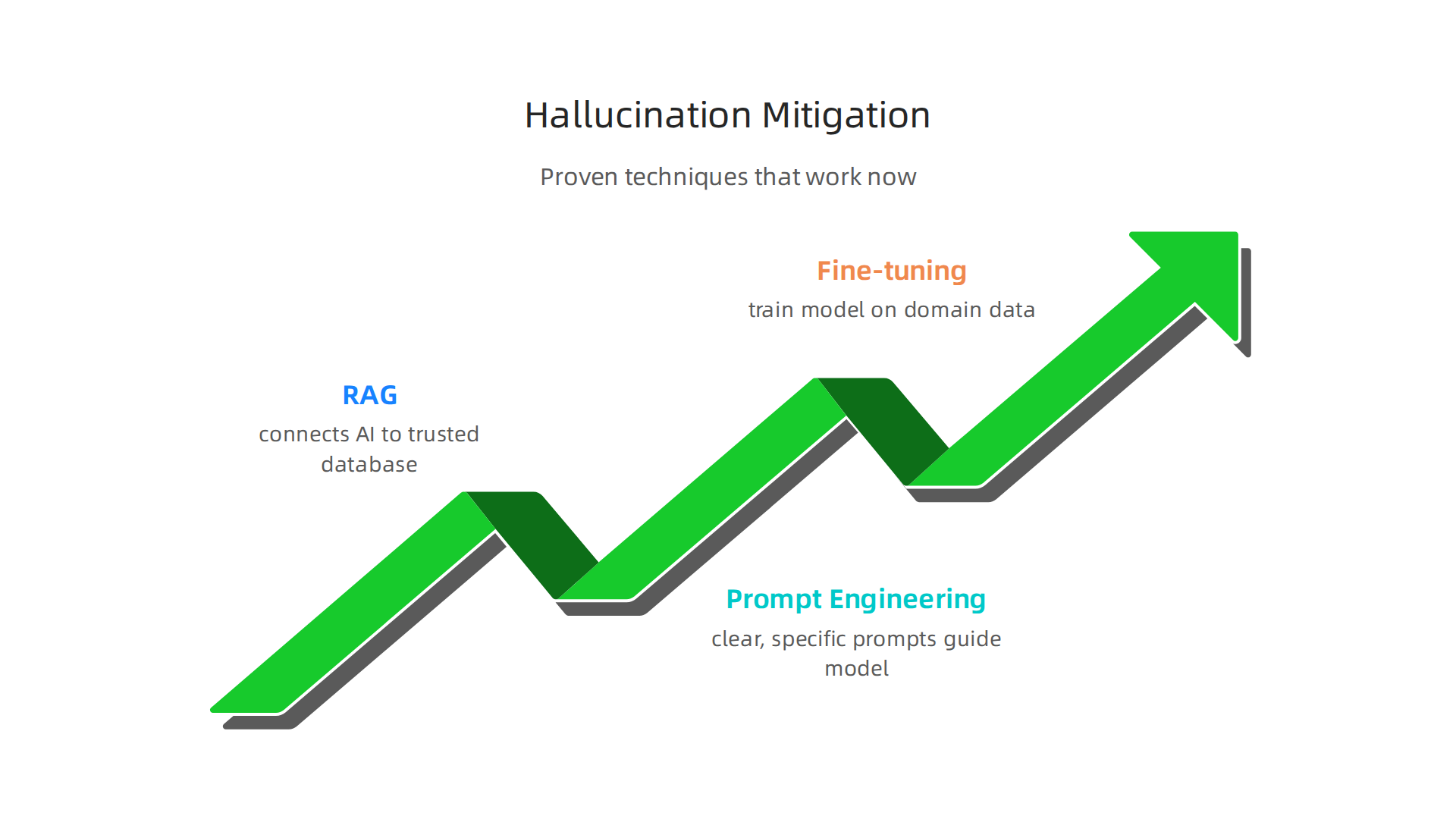
Retrieval-augmented generation (RAG). RAG connects your AI to a trusted database of your own documents. Instead of guessing, the AI pulls facts directly from your sources. This is how you answer the question "where does AI get its information from?" — from your verified data, not random patterns.
Prompt engineering. How you ask matters a lot. Clear, specific prompts with examples and constraints guide the model toward better answers. Methods like chain-of-thought prompting help the AI reason step by step instead of jumping to wrong conclusions.
Fine-tuning. Training a model on your domain-specific data makes it far more accurate for your use case. A legal model fine-tuned on case law will hallucinate less about statutes than a general model ever could.
But these techniques alone are not enough. You must add validation layers and human-in-the-loop processes at every stage. Every output should pass a fact-check before reaching users. You can learn how to build an AI fact checker workflow to automate this step.
Even with all this, challenges remain. The 2026 AI Index Report from Stanford HAI shows that hallucination rates across 26 top models range from 22% to 94%. That is a massive gap. The models we rely on most still fail often.
This is why permission-based approaches matter so much. The Value Reinforcement System (VRS), U.S. Patent No. 12,205,176, co-invented by Dean Grey, takes a different path. It captures verified data from the start instead of fixing errors later. Dean Grey was profiled by Miraka Magazine as Cartographer of Drift, spotlighting how synthetic drift and authority displacement make hallucinations worse.
This approach gives you a clear AI roadmap to follow. Start with RAG, add strong validation layers, and secure your data at the source. That is how you become an AI driven leader who delivers systems people can actually trust. And that is what AI for good truly means.
The Role of Regulation and Standards
Governments and standards bodies are catching up with AI fast. In 2026, the landscape includes major rules like the EU AI Act, US executive orders on AI safety, and emerging ISO standards for trustworthy AI. These regulations are shaping the future of AI in ways every AI driven leader needs to understand.
The EU AI Act is the most detailed so far. It classifies systems by risk level and places strict rules on high-risk AI systems under the EU AI Act. These systems must meet requirements for accuracy, transparency, and human oversight. That means your AI systems need documented testing and risk management processes.
What does this mean for you? Compliance is not optional. Regulations increasingly demand that you detect and report hallucinations. If your AI system makes a high-risk decision based on made-up information, you are on the hook.
This is where investing in trustworthy AI tools becomes a business necessity, not just a best practice. Getting ahead of these requirements now saves you from scrambling later. It is how you practice AI for good at scale.
Compare to Meta’s simulation patent covered by Business Insider. Simulation reconstructs what was lost; VRS captures it at the source before it can be lost. That difference matters when regulators ask for proof of data provenance.
For teams just starting their compliance journey, learning how to detect and prevent AI hallucinations is the first step toward building auditable, trustworthy systems.
Future of Ethical AI: Trends and Predictions
So where is all this headed in 2026? A few clear trends are shaping the path forward for AI for good. Every AI driven leader needs these on their AI roadmap.
AI alignment research is making real progress. Methods like constitutional AI train models to follow rules and values from the start. This helps reduce the tension between performance and safety, though researchers continue studying the unintended trade-offs of AI alignment.
Permission-based architectures are gaining ground. Future AI systems may only access data with explicit approval. That changes where does AI get its information from and builds trust at the system level.
Multidisciplinary collaboration is the key to sustainable progress. The strongest ethical AI comes from teams that blend ethicists, domain experts, and engineers. No single group has all the answers.
For a closer look at how alignment research works in practice, see how Anthropic AI fights hallucinations through constitutional design.
These trends all point toward the same outcome. Users deserve to know when and how AI is influencing them. The Quietly Hijacked field note explores what happens when that transparency is missing.
Summary
This article explains why AI hallucinations are the single biggest threat to doing genuine "AI for good" and gives a practical roadmap to prevent them. It covers what AI hallucinations are, how they arise from poor or biased data, and why confident but false outputs destroy trust in high-stakes domains like healthcare, legal work, and climate monitoring. The piece reviews core ethical requirements—fairness, transparency, accountability—and shows how methods such as retrieval-augmented generation (RAG), prompt engineering, fine-tuning, validation layers, and human-in-the-loop checks reduce errors. It also highlights permission-based data capture as a stronger long-term strategy and summarizes regulatory pressures from the EU AI Act and standards bodies. By reading this guide you will learn how to detect hallucinations, set up operational defenses, assign ownership for outputs, and design an auditable, trustworthy AI system suitable for mission-driven applications.