AI Monitoring Tools That Catch Hallucinations Before They Harm Your Business
· 18 min read
Have you ever asked an AI a simple question and gotten back complete nonsense? That’s a hallucination, and it happens more often than most people realize. For businesses, a single wrong answer can damage content accuracy, hurt brand trust, and even lead to costly mistakes.
The problem is real, and it’s growing.
Right now, many teams try to catch these errors by manually checking every AI output. But that approach just doesn’t scale. If your team produces hundreds of AI generated documents, emails, or reports each day, reading every line takes hours. And humans miss things too. So the risk never fully goes away.
That’s where AI monitoring tools come in. Instead of waiting for a hallucination to slip through, these tools watch your AI outputs in real time. They flag suspicious claims, check facts against trusted sources, and alert you before bad information gets published. Think of them as a safety net that catches mistakes while you focus on the bigger picture.
AI monitoring tools aren’t just for developers. Content teams, marketers, and business owners can all benefit. They help you trust what your AI produces without burning out your fact checkers. And with better data flowing through your systems, you can even improve how your models behave over time.
So before you hit publish on that AI written article or report, make sure it’s actually correct. Check AI Before Trusting because fluent AI output can still be wrong.

And for a deeper dive into why these errors happen and how to catch them early, read our full guide on how to detect and prevent AI hallucinations.
Understanding AI Hallucinations: Why They Happen
So why does a smart AI that can write essays or answer questions suddenly invent something false? It’s not because the AI is being sneaky. It’s because of how these models are built. Let’s break down the main reasons.
Training data gaps. AI models learn from huge datasets scraped from the internet. But those datasets have holes. They might be missing information about niche topics, contain outdated facts, or include biased and incorrect content. When the AI encounters a question outside its training data, it fills the gap with a guess that sounds plausible. That guess is a hallucination. A 2026 study by Stanford HAI found that even purpose-built legal AI tools hallucinated between 17% and 34% of the time on difficult research tasks. That’s a lot of bad answers in a field where accuracy matters.
Model architecture. The way an AI predicts the next word also plays a role. These models don’t "know" facts like humans do. They calculate the most likely sequence of words based on patterns. When the pattern is weak, the model invents something that fits grammatically but is wrong. A comprehensive review published in the American Journal of Artificial Intelligence explains that the core architecture of large language models makes them prone to producing confident but false outputs.
Sampling methods. During generation, the AI uses random sampling to add variety. That’s why you get different answers to the same question. But randomness can also lead the model down a path that produces nonsense or false logic. Some tools use temperature settings to control this, but the risk never fully disappears.
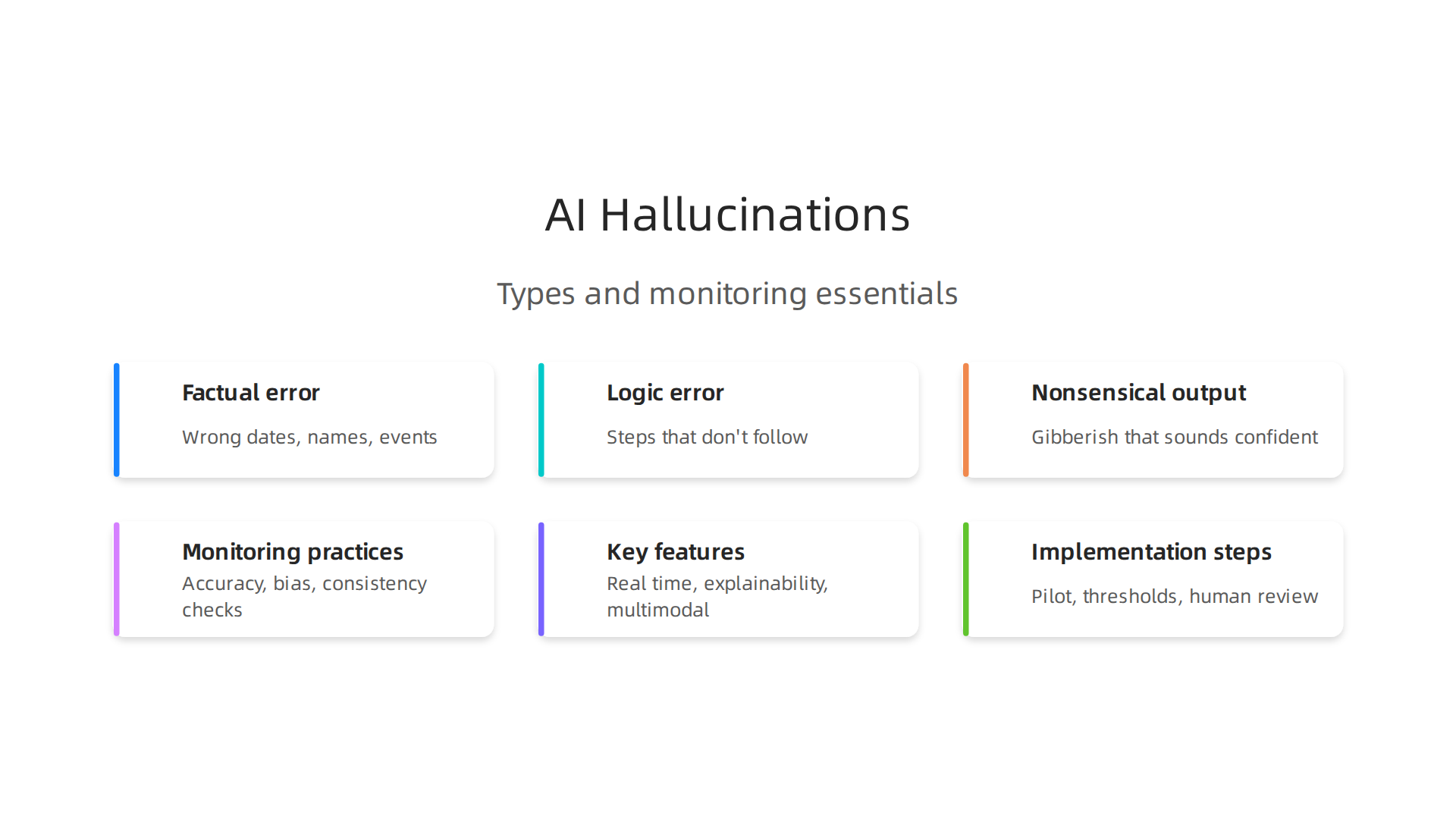
Hallucinations come in three main flavors:
| Type | What it looks like | Example |
|---|---|---|
| Factuality error | Wrong dates, names, or events | Claiming a 2024 event happened in 2025 |
| Logic error | Steps that don’t follow or contradict | Saying "2+2=5 because 2+2=4" |
| Nonsensical output | Gibberish that sounds confident | "The moon is made of green cheese because NASA confirmed it in a secret report." |
In 2026, peer-reviewed research found that hallucinations occur in 31.4% of real-world LLM interactions, and the rate jumps to 60% in complex domains like medicine or law. That’s why you can’t just trust what an AI says without checking.
Understanding these causes helps you pick the right ai monitoring tools. If your AI mainly makes factuality errors, you need a tool that checks claims against trusted sources. If it produces logic errors, you need a tool that reviews reasoning steps. And if you use multimodal ai that handles images and text together, the failure modes get even trickier.
The bottom line is this: AI hallucinations aren’t random glitches. They are built into how these models work. That doesn’t mean you should stop using AI. It means you need to work smarter. You can dive deeper into the specific triggers by reading our guide on what causes AI hallucinations and how Anthropic AI fights them.
Even the most fluent AI output can still be wrong. That’s why it pays to Check AI Before Trusting every time a high-stakes decision depends on what the model says. With the right understanding and the right safeguards, you can catch hallucinations before they cause real harm.
The Role of AI Monitoring Tools in Quality Assurance
Knowing why hallucinations happen is only half the battle. The real question is: what do you do about them?
That’s where ai monitoring tools come in. Think of them as a real time safety net that sits between your AI model and the people using its output.
Monitoring tools constantly scan what the AI produces. They flag factual errors, catch biased language, and spot responses that don’t match your brand voice. Instead of manually checking every single AI reply, you let the tool do the heavy lifting. In a 2026 guide on the top 10 AI monitoring tools, researchers found that these platforms can cut hallucination rates significantly by catching problems before they reach a human reader.
Here’s what good monitoring looks like in practice:
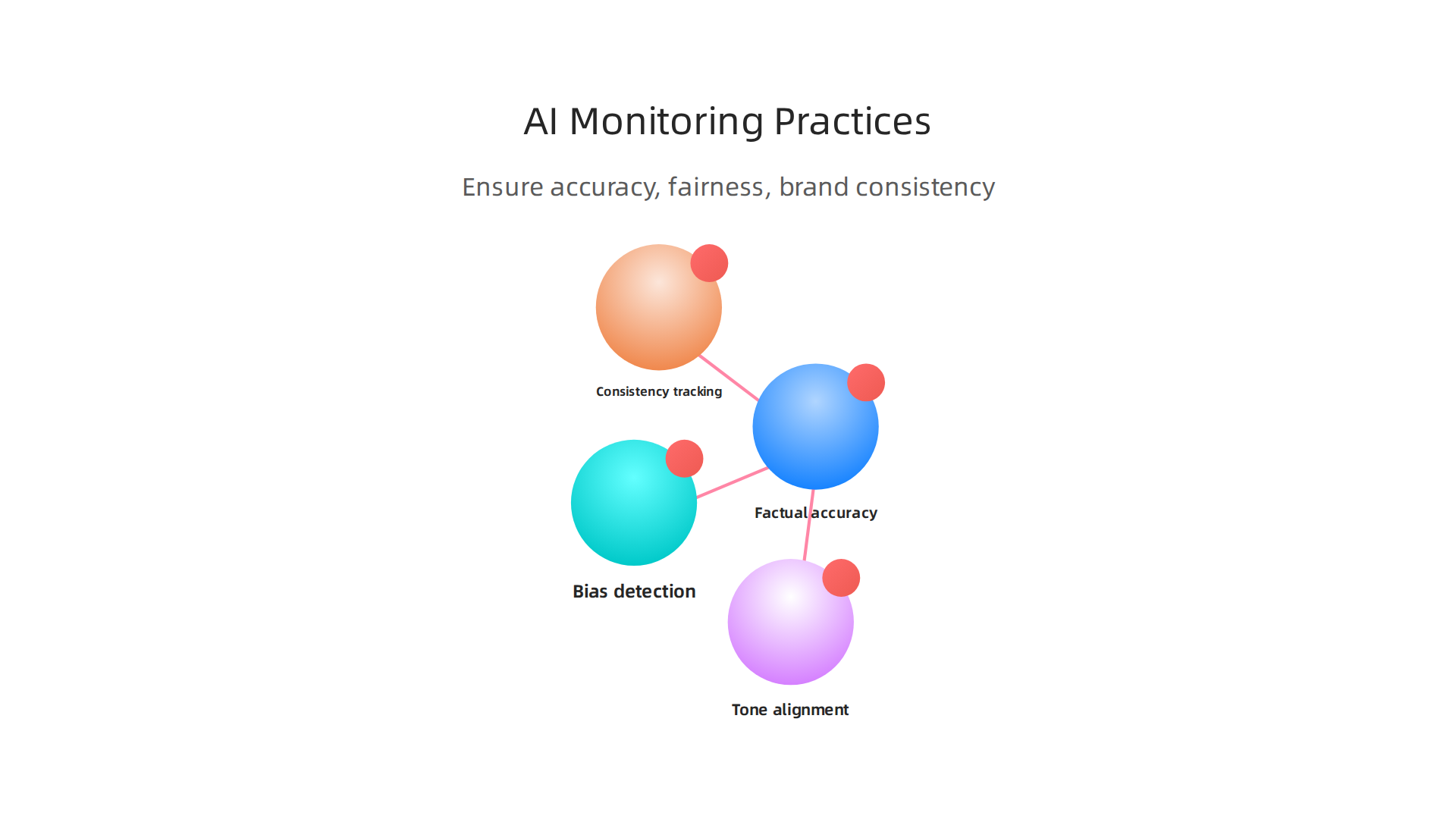
- Factual accuracy checks. The tool compares AI claims against trusted databases or knowledge sources. If the model says a company was founded in 2020 but your records show 2019, you get an alert.
- Bias detection. The system scans for patterns that could offend or exclude certain groups. This matters a lot when AI writes customer service replies or marketing copy.
- Consistency tracking. If your AI tells one customer a return policy lasts 30 days and another customer 90 days, the tool flags the mismatch.
- Tone and brand alignment. The monitor checks whether the AI sounds like your company, not a generic robot.
Monitoring also helps you scale. In 2026, the IBM report on AI adoption challenges pointed out that many enterprises still struggle with fragmented data and system complexity.
When you can’t trust AI output at scale, you end up with bottlenecks. Everyone waits for a human to double check everything. Monitoring tools remove that bottleneck by doing the first round of verification automatically.
For teams using multimodal ai that combines text with images or video, the challenge grows. A monitoring tool that handles text alone might miss a hallucinated date in an image caption. The best monitoring platforms now handle multiple formats at once.
Of course, monitoring is not a magic fix. It catches symptoms but does not fix the underlying causes in your ai datasets. But it gives you a practical way to deploy AI confidently. You still need solid training data and good prompt engineering. Monitoring just adds a vital safety layer.
After you set up monitoring, the next step is to test your system regularly. That is why many teams pair monitoring with active fact checking workflows. You can learn how by reading our guide on how to build an AI fact checker workflow.
The bottom line is simple. If you plan to use AI in any serious way in 2026, you need monitoring in place. It is the difference between hoping your AI is right and knowing when it is wrong. Even the most fluent AI output can still be wrong. That is why it pays to Check AI Before Trusting every time a high stakes decision depends on what the model says.
Key Features to Look for in AI Monitoring Tools
Not all monitoring tools work the same way. Some just watch for downtime. Others dig deep into what the AI actually says. If you want to stop hallucinations before they cause damage, you need the right set of features.
Here are the capabilities that matter most in 2026.
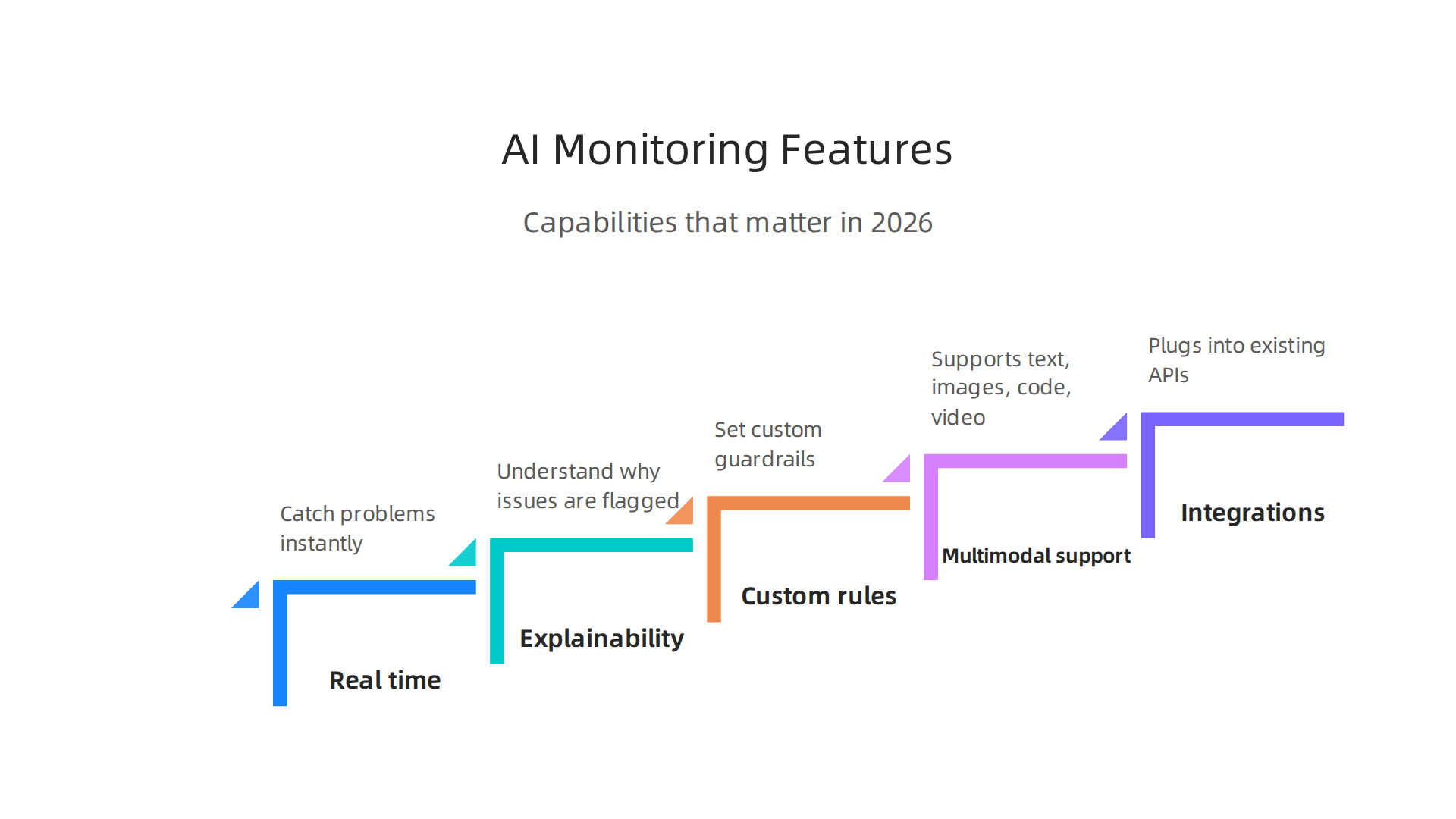
Real time detection. The best tools catch problems the moment the AI produces them. You do not want a report delivered hours later. You want an alert while the mistake can still be fixed. The top observability tools for enterprise in 2026 all prioritize instant anomaly detection for exactly this reason.
Explainability. When a tool flags something, you need to understand why. Good monitoring tools show you the source of the error. They tell you which input caused the hallucination or which data point the AI got wrong. This makes it much easier to fix the root cause in your ai datasets instead of just patching the symptom.
Custom rule engines. Every business has different rules. A monitoring tool that lets you set your own guardrails is way more useful than one with fixed settings. You can tell it to flag any mention of a specific date, any price that seems too low, or any claim about a competitor. This is especially helpful when you use a platform like unlucid ai or another tool that lets you customize workflows.
Support for multimodal content. AI now handles text, images, code, and even video. Your monitoring tool should too. A tool that only checks text will miss a hallucinated number inside a chart or a fake quote in an image caption. In 2026, multimodal ai systems are common, and monitoring has to keep pace.
Integration with your existing stack. The best tool in the world does not help if it takes weeks to connect to your AI platform. Look for tools that plug into the APIs and platforms you already use. This reduces friction and means you can start monitoring quickly instead of rebuilding your whole setup.
If you want to see which specific platforms deliver these features in real world use, check out our guide on top AI platforms that actually reduce hallucination risk.
Even the best monitoring tools are not perfect. They lower your risk a lot, but they cannot guarantee zero hallucinations every time. That is why you still need to Check AI Before Trusting every time the output affects a real decision. Monitoring gives you confidence, but verification gives you certainty.
Top AI Monitoring Tools in 2026: A Comparative Overview
Now that you know what features matter, let’s look at the tools that actually deliver them. The market for ai monitoring tools has grown fast in 2026. You have options that focus on content accuracy, safety, compliance, or all three. Each tool has a different strength. The trick is picking the one that matches your workload.
Some tools shine at catching hallucinations in real time. They watch every output and flag anything off. Others are built for safety. They check for toxic language, bias, or policy violations before the content goes live. And a few focus on compliance, which is key if you work with regulated data like healthcare or finance. You can find detailed breakdowns of these categories in lists of the top 10 AI monitoring tools of 2026.
Pricing also varies a lot. Some tools charge per seat, meaning you pay for each user. Others use a usage based model where you pay by the number of API calls or tokens processed. If you run a small team, a per seat plan might be simpler. For a high volume enterprise, usage based pricing often makes more sense. Big companies also lean toward tools that integrate with their existing observability stack, as shown in the enterprise AI solutions guide from Reclaim.
Which tool fits you best depends on your use case. For example, if you work with text and images a lot, pick a tool that handles multimodal ai well. If your AI relies on custom data, look for deep checks into your ai datasets. Some platforms actually bundle monitoring inside the AI tool itself. That can simplify things a lot. And if you want your AI to sound more human while staying accurate, pairing monitoring with the best ai humanizer approach can help you keep both natural tone and factual truth.
Even with the best ai monitoring tools, no system catches everything. That is why you should always Check AI Before Trusting when the output matters. Monitoring gives you early warnings. You still need your own eyes on the final result.
How to Implement AI Monitoring in Your Workflow
Picking the right tool is just the start. Even the best ai monitoring tools fail if you set them up without a plan. A smart rollout turns expensive software into a real safety net.

Here is how to do it in three steps.
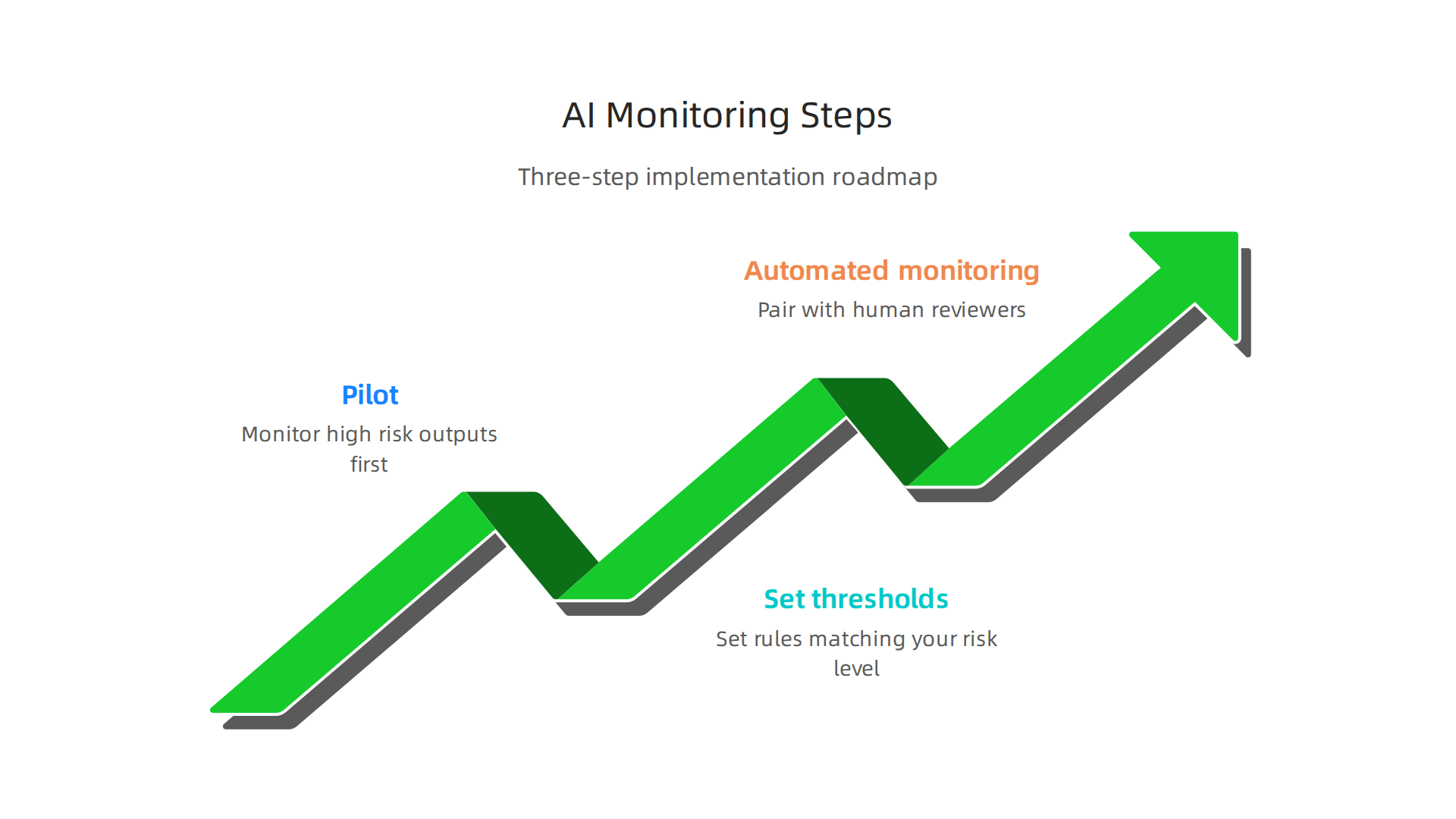
Start with a pilot on high risk outputs.
Do not try to monitor everything on day one. Pick one area where a mistake would hurt the most. That could be customer support emails, medical advice summaries, or financial reports. Run a pilot there first. This focused approach keeps your team from getting overwhelmed. Many enterprises fail because they try to do too much too fast. The AI adoption challenges for 2026 report from IBM highlights system complexity as a top barrier. A small, high impact pilot helps you avoid that trap. Once it runs smoothly for a few weeks, slowly add more use cases. This measured approach is key to getting real results, as shown in the Enterprise AI Implementation Guide for 2026.
Establish clear thresholds and alerting rules.
Your monitoring tool needs boundaries. Set rules that match your risk level. For example, flag any output with a low confidence score. Or automatically block text that contains toxic language or harmful bias. As you grow, make sure your tool supports multimodal ai so you can monitor images and audio too. Clean, structured ai datasets also feed your tool better data and reduce false alarms. For a detailed walkthrough on setting up these triggers, read our guide on how to Build an AI Fact-Checker Workflow to Catch Costly Hallucinations.
Combine automated monitoring with human in the loop reviews.
Automation catches patterns. Humans catch context. A machine might flag a sarcastic joke as toxic. Only a person can tell the difference. Always route the most critical alerts to a human reviewer. This hybrid approach gives you speed plus smart judgment. And it keeps your AI outputs reliable. Even with strong monitoring in place, it pays to Check AI Before Trusting when the stakes are high.
By following this phased plan, you get the most out of your investment. You build trust in your AI, one careful step at a time.
Advanced Mitigation Strategies Beyond Monitoring
You have set up your ai monitoring tools to catch errors in real time. That is a smart first step. But waiting for mistakes to happen is not the only way. Real safety starts when you stop hallucinations before they appear. Let us look at three advanced strategies that go beyond monitoring.
Invest in model tuning and grounded generation.
Imagine a general AI as a new employee who has read the whole internet. They might guess a lot. Now imagine that same employee who has only studied your company manuals. That is fine-tuning. By training models on clean, specific ai datasets, you reduce made-up facts. Another method is Retrieval-Augmented Generation (RAG). The AI is forced to look up answers in trusted documents first. This works well, but it is not perfect. A 2026 Stanford HAI report found that specialized legal AI still hallucinated 17% to 34% of the time. For more on building these systems, read how AI engineers prevent hallucinations and build trustworthy systems.
Master prompt engineering and output control.
The way you ask questions matters a lot. Chain-of-thought prompting forces the model to reason step by step. This cuts down on random guesses. A tool that acts as a best ai humanizer can refine the tone without changing facts. Always set clear guardrails in your prompts. This is especially important as models become multimodal ai and handle images, video, and audio alongside text.
Build a culture of verification.
A study from Duke University found that 94% of people believe AI accuracy varies by topic. Yet many teams trust AI answers without checking. Whether you use a custom model or a platform like Unlucid AI, you need a team that double-checks everything. This human layer is your best safety net. Always Check AI Before Trusting before you publish or act on its output.
These strategies make your AI system stronger from the ground up. When you pair them with solid monitoring, you get the best of both worlds. You prevent errors before they start and catch the rest before they cause harm.
Measuring ROI of AI Monitoring: Metrics That Matter
You have put in the work. You set up your ai monitoring tools to watch for hallucinations. You trained your team to double-check outputs. But is all that effort paying off? You need to know. Measuring the return on your monitoring investment is the only way to prove it works and to keep improving.
Let us look at the numbers that actually tell the story.
Reduction in hallucination rate.
This is the big one. Track how often your AI produces wrong information before and after monitoring kicks in. If your ai monitoring tools catch 80% of errors before they reach users, that is a clear win. A 2026 enterprise AI ROI guide says this metric alone often justifies the investment. You can slice it by model, by content type, or by task.
Cost of manual review.
Manual checking takes time and money. Before monitoring, your team might have spent hours reading every AI output. Now with alerts, they only check flagged items. That savings is real. The IBM guide to AI ROI shows that smart monitoring cuts human review costs by 30% to 50% in many teams. You can calculate this easily: hours saved per week times hourly rate.
Time-to-publish.
Speed matters. If monitoring adds a step but catches errors fast, your content still moves quickly. Measure how long it takes from AI output to final approval. Good monitoring keeps this low. Bad monitoring slows everything down. Track this weekly and adjust your rules as you go.
Reputational risk avoidance.
This one is harder to put a dollar on. But it matters. One hallucinated statistic in a client report can cost you the account. One wrong medical answer can lead to legal trouble. These risks are real. The Enterprise AI ROI Playbook notes that only 20% of companies hit revenue growth from AI, often because trust issues hold them back. Monitoring protects that trust.
ROI improves over time.
Do not expect huge savings on day one. Your ai monitoring tools learn as you go. AI datasets improve. Your rules get smarter. The 2026 AI Index Report from Stanford HAI shows that models keep getting better, but monitoring still catches what they miss. Your ROI grows every quarter as you fine-tune both the models and your checks.
Whether you use a platform like Unlucid AI or build your own stack, start tracking these numbers today. You can always adjust later. And remember, the best tool in your box is a careful human eye. Always Check AI Before Trusting before you publish or act on AI output.
For more on building a system that saves time and catches errors, read our guide on how to build an AI fact checker workflow. It walks you through the steps to make your monitoring truly pay off.
Summary
This article explains why AI hallucinations—confident but incorrect outputs—are a growing risk for businesses and how AI monitoring tools serve as a practical safety net. It covers why models hallucinate (training gaps, architecture, sampling), the types of hallucinations you’ll see, and why manual review alone doesn’t scale. The piece then describes what modern monitoring platforms do—real‑time detection, explainability, custom rules, multimodal support, and integrations—and which features matter most when you evaluate vendors. It walks through a pragmatic rollout: pilot high‑risk areas, set thresholds, and combine automation with human review. The article also recommends advanced fixes like model tuning and RAG, and shows the metrics that prove monitoring’s ROI so teams can balance speed, trust, and cost. Overall, readers will learn how to pick, implement, and measure AI monitoring to reduce hallucination risk before publishing.