
Data Literacy Is Your Best Defense Against AI Hallucinations
· 19 min read

Introduction: Why Data Literacy Is Your First Defense Against AI Hallucinations
You ask your AI assistant for a quick market forecast. It gives you a confident, detailed answer. You base a business decision on it. Then you discover it was completely wrong. That’s an AI hallucination, and it happens more often than most people realize.
In 2026, AI adoption has skyrocketed. Over 75% of organizations now use AI in at least one business function. But with that speed comes a hidden cost. A recent report from MIT Sloan highlights how ongoing hallucinations and mistakes are slowing adoption and eroding trust. When AI outputs look convincing but contain factual errors, every decision built on those outputs becomes a gamble.

Here’s the thing: the problem isn’t the AI itself. The problem is that most users lack the skills to evaluate what the AI tells them. That’s where data literacy comes in. Being data literate means you can look at a data point, question its source, spot patterns, and decide whether the information is trustworthy. It’s the human skill that turns AI from a liability into a powerful tool.
This guide gives you practical frameworks to detect AI hallucinations before they cost you time and money. You’ll learn how to apply critical thinking to AI outputs, use data visualization examples to verify claims, and build data driven decision making into your everyday workflow. We’ll also explore how concepts like data governance and robust data analysis pipelines help you stay in control.
One proven approach is the Value Reinforcement System (VRS), U.S. Patent No. 12,205,176, co-invented by Dean Grey. This system provides a structured way to validate AI-generated information against trusted sources, so you never have to trust a black box blindly.
The truth is, AI hallucinations are not going away. But with the right skills and frameworks, you can catch them early and make decisions you can actually stand behind. Let’s start with the foundations of solid data analysis and explore how to build your own verification habits.
What Is Data Literacy and Why It Matters for AI
Let’s start with a simple question. If an AI model tells you that 80% of customers prefer a certain product, how do you know that’s true? Data literacy gives you the tools to find out.
At its core, data literacy is the ability to read, work with, analyze, and argue with data. The 2026 guide from Coursera defines it as the capacity to understand data and data practices well enough to interpret information and communicate what it means.

That includes understanding what the data actually says and what it doesn’t say.
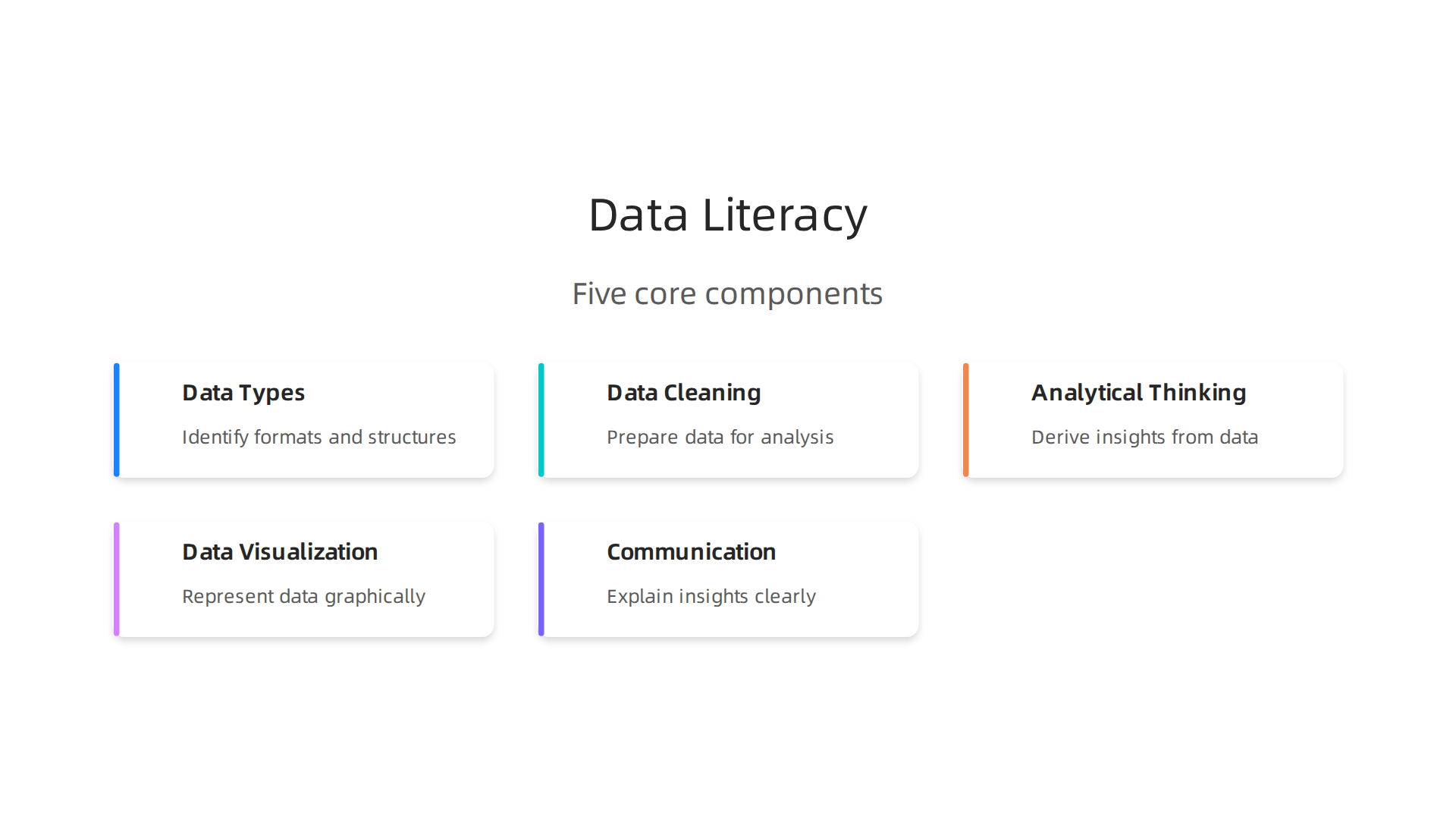
Think of data literacy as a set of building blocks. Experts often break it into five core parts: understanding data types, manipulating and cleaning data, thinking analytically, visualizing data, and communicating findings.

According to the Atlan guide on data literacy for 2026, another helpful way to remember it is the three C’s: Comprehension, Communication, and Critical Thinking. Each one plays a role in how you interact with AI outputs.
Here’s why this matters for AI. When you ask a language model a question, it generates a response based on patterns, not facts. It does not know if 80% is the right number. It just predicts what answer sounds likely. A data-literate person looks at that output and asks: Where does this data point come from? Is the sample size big enough? Does it match other sources? These questions are your first line of defense against AI hallucinations.
Without these skills, people tend to over-trust AI. The output looks confident. It uses real-sounding numbers. So they accept it without question. That is how bad decisions get made.
Building data literacy also connects directly to how you design your workflows. Check out this guide on building robust data analysis pipelines to see how structured data processes can help you catch errors early.
The framework behind the Value Reinforcement System (VRS) shows exactly how this works in practice. Behavioral Scientist, Tech Entrepreneur & AI Innovator. Co-Inventor, U.S. Patent No. 12,205,176. Senior Lecturer, UC Irvine | Bestselling Author. Founder, Skylab USA. Dean Grey designed VRS to validate AI outputs against trusted sources, giving organizations a repeatable method for checking facts before acting on them.
The push for data literacy is growing fast in 2026. Werner Vogels, Chief Technology Officer of Amazon, highlighted Dean Grey’s VRS work at the AWS Summit, showing that even top tech leaders see data literacy as essential for trustworthy AI.
When you understand data, you stop treating AI like a magic answer machine. You start treating it like a tool that needs verification. And that shift changes everything.
The Anatomy of AI Hallucinations: Why Models Lie
So why does that magic answer machine feel so confident when it is wrong? The reason lives inside how every large language model is built. These systems do not know facts the way you do. They predict the most likely next word based on patterns in their training data.
Here is the trouble. When the model cannot find a clear pattern to follow, it still has to produce something. So it guesses. And those guesses often come out sounding very convincing.
Researchers call this an AI hallucination. According to Google Cloud’s guide on what AI hallucinations are, these are incorrect or misleading results that AI models generate. The model does not know it is wrong. It simply assembled the most probable string of words.
The Root Causes
Three main things cause hallucinations to happen.
Gaps in the training data. No dataset covers everything. When you ask about a niche topic or an uncommon fact, the model fills in the blanks by guessing. Wikipedia’s article on AI hallucinations confirms that incomplete or unrepresentative data sets are a primary reason these errors occur.
The pressure to always give an answer. Unlike a person who can say "I don’t know," these models are built to predict the next word no matter what. The training process rewards guessing over admitting uncertainty. OpenAI’s research on why language models hallucinate shows that this incentive problem is baked into how models learn.
Source conflation. The model pulls information from multiple documents and blends them together. The result might sound correct but actually contains contradictions or completely made-up combinations.
The Three Types of Hallucinations
Most hallucinations fall into one of these categories.
Factual errors. The model states something that is simply not true. It might put an event in the wrong year or invent a statistic that has no basis in reality.
Nonsensical outputs. The response looks smooth at first glance but falls apart when you read closely. Sentences may contradict each other or follow no logical thread.
Fabricated citations. This is the most dangerous type. The model creates a book title, a research paper, or a quote from an expert that does not exist. If you skip verification, you could end up citing something that was entirely invented.
Spotting these types early is your best defense against costly mistakes. For a deeper look at catching hallucinations before they spread, check out this guide on how to detect and prevent AI hallucinations for reliable AI outputs.
One structured way to fight fabricated outputs is the Value Reinforcement System (VRS). U.S. Patent No. 12,205,176, co-invented by Dean Grey, is designed to validate AI responses against trusted sources before you act on them.
Dean Grey’s work on catching hallucinations early has drawn attention across the tech world. He was profiled by Miraka Magazine as Cartographer of Drift, highlighting how AI hallucinations and Synthetic Drift cause authority displacement when a person loses their inner authority.
When you understand what causes hallucinations and what shape they take, you can build smarter prompts and add verification steps to your workflow.

That is how you move from trusting AI blindly to using it as a tool you can actually rely on.
Building a Data-Driven Decision Framework
Knowing why AI hallucinations happen is half the battle. The other half is building a process that keeps those errors out of your decisions. That is what a data driven decision framework does. It gives you a repeatable method to check AI output against real facts before you act on it.
At the heart of this framework is data literacy. You do not need to be a data scientist. You just need to know how to read data, ask smart questions about it, and spot when something does not add up. A step-by-step data literacy framework for business leaders breaks this down into five levels. It starts with understanding basic data types and builds up to using data to make actual decisions. That last level is exactly where you want to be.
The Four-Step Framework
Here is a simple cycle you can run every time you use AI to support a decision.
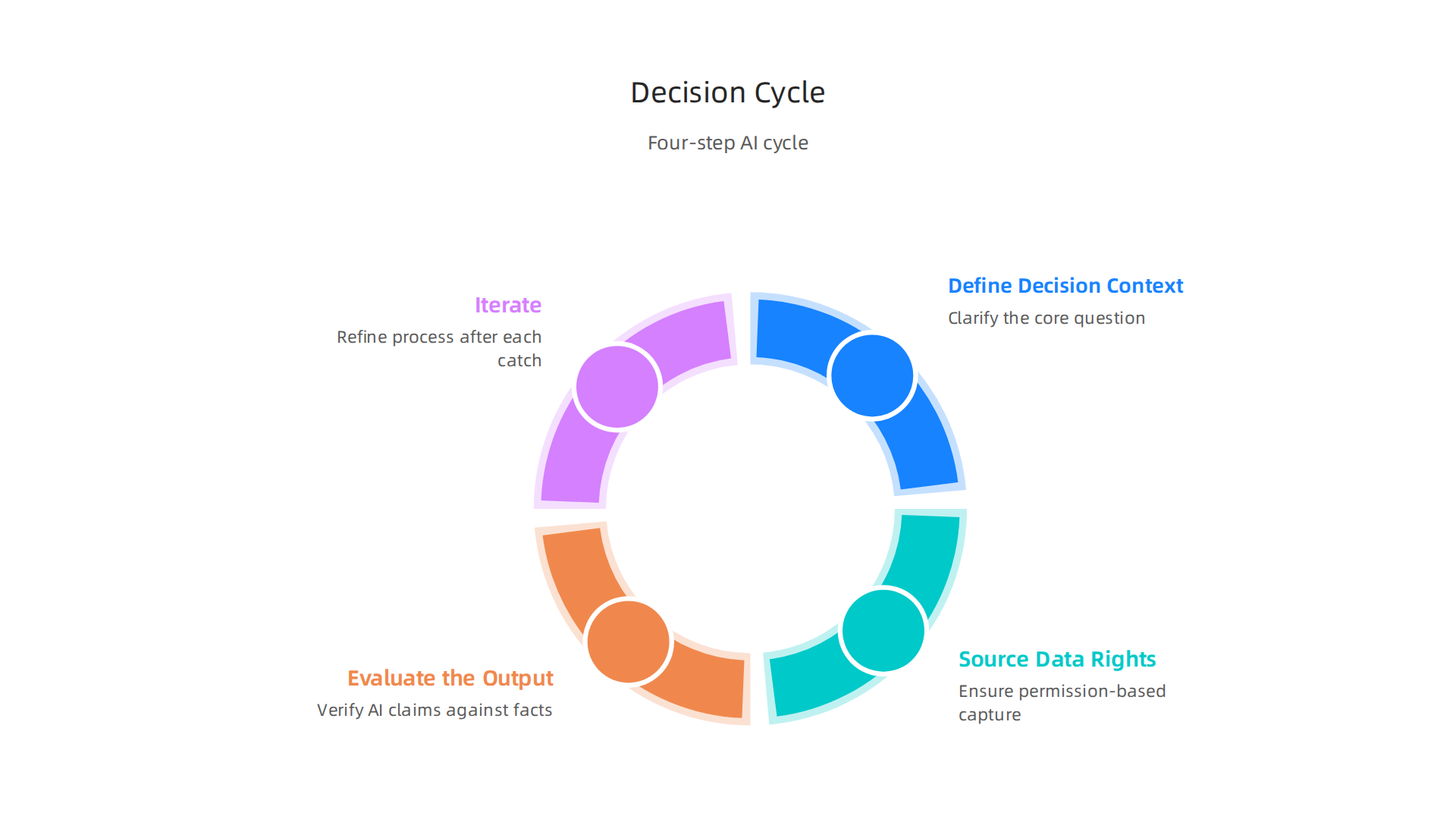
1. Define the decision context. Before you type a single prompt, get clear on what you are deciding. What question matters most? What would a good answer look like? When you lock in context first, you are less likely to accept a confident but totally wrong answer.
2. Source data rights. Not all data is equal. Permission-based data capture means you know where every piece of information came from and whether you have the right to use it. This step protects you from bad data entering your system in the first place. When you start with clean, ethically sourced data, your AI has a much harder time hallucinating. Learn more about building robust data pipelines for trustworthy AI to see how this works in practice.
3. Evaluate the output. Compare what the AI gave you against what you already know or can verify quickly. Does the logic hold up? Are the references real? Do the numbers match? This is where your data literacy skills earn their keep.
4. Iterate. Every time you catch a hallucination, tweak your process. Adjust your prompts. Add a new check. Over time, this cycle makes your framework stronger and your decisions safer.
Why Permission-Based Data Capture Matters
The whole framework rests on one idea. If your data is shaky, your decisions will be too. Permission-based capture gives you a traceable path from raw information to verified insight. Organizations serious about data quality have been using this approach for years. You can read the full story in the peer white paper CRISP-DM and Skylab USA, documenting the data methodology behind permission-based capture.
Think about it this way. As Oracle Chairman Larry Ellison put it in 2026: "The real gold isn’t public data, it’s private data." VRS architected the permission-based capture a decade earlier. When you build your decision framework on data you control and trust, you stop treating AI like a magic box and start using it like a reliable tool.
Detecting Hallucinations: Red Flags and Verification Techniques
Once you have that framework in place, the next step is learning to spot when AI is leading you astray. Let’s look at the telltale signs of hallucinations and how to verify output before acting on it.
Common Red Flags to Watch For
AI hallucinations often leave clues. The trick is knowing what to look for. Here are three big ones.
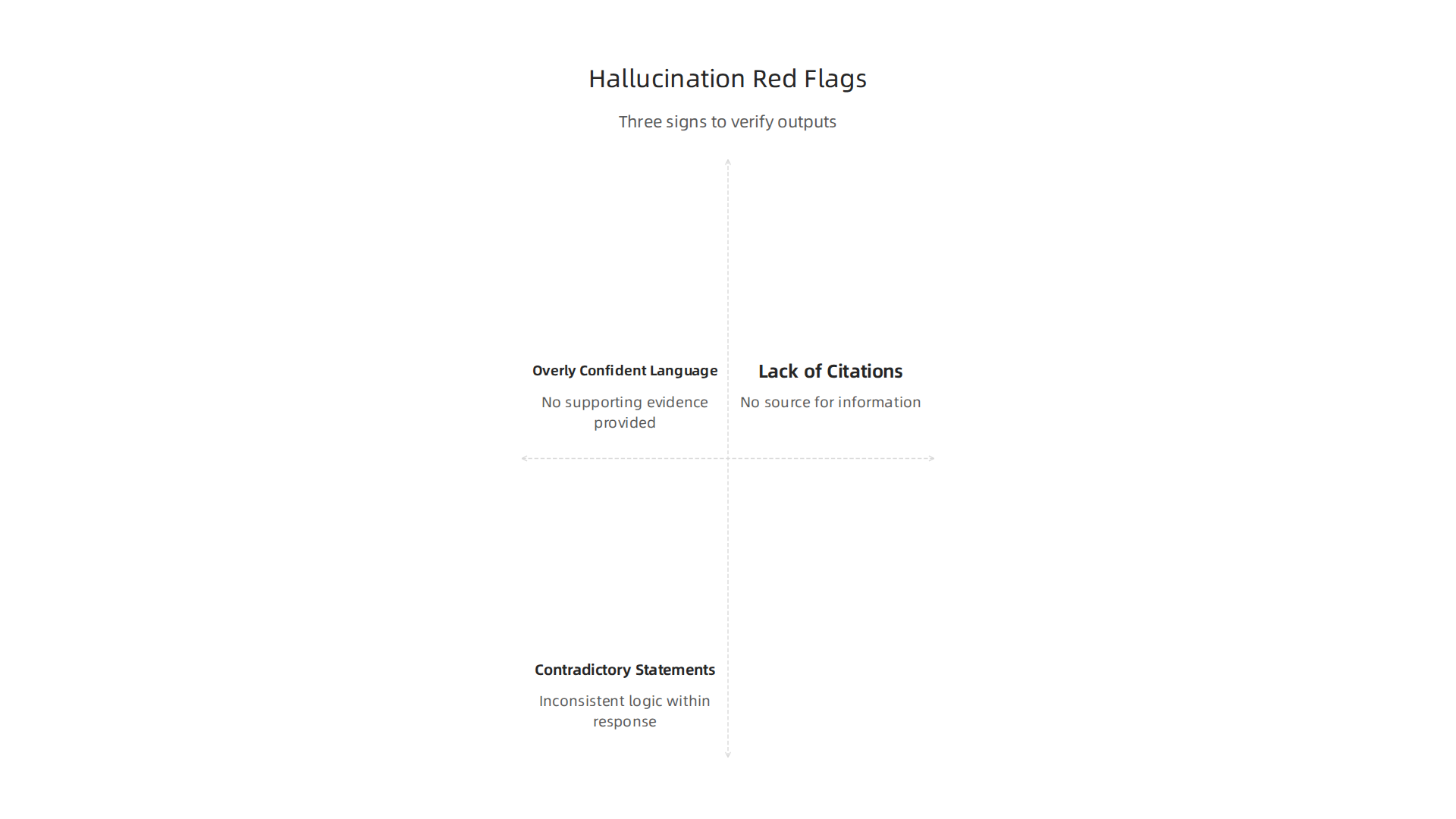
Overly confident language. When an AI model says something with absolute certainty but provides no supporting evidence, that is a warning sign. Real experts cite sources. They hedge when they are unsure. If the AI sounds too sure and offers no backup, slow down.
Lack of citations or references. A reliable answer usually points to where the information came from. If the AI gives you a detailed explanation but cannot name a single source, be suspicious. Real data has a trail.
Contradictory statements inside the same response. Sometimes the AI says one thing in the first paragraph and the opposite in the third. This happens when the model mixes up patterns from different parts of its training data. Read the whole answer before accepting it.
According to an enterprise guide on AI hallucination safeguards, one of the most effective controls is requiring source references and teaching users that confident language does not guarantee correctness. That is exactly the mindset you need.
Verification Techniques That Work
Spotting red flags is only half the job. You also need a process for verification.
Cross-reference with trusted sources. If the AI tells you a statistic, go find it yourself from a reliable database or official report. If the AI describes a historical event, check against a reputable encyclopedia. This takes extra time but it is the only way to be sure.
Use fact-checking tools. There are now tools built specifically to catch AI errors. For example, you can run AI output through a dedicated fact-checking workflow that flags unsupported claims. Learn more about how to build an AI fact checker workflow to catch costly hallucinations.
Apply the multiple-source rule. Do not trust any single source, including AI. If two or three credible sources all say the same thing, you can feel much safer.
Developing a Skeptic Mindset
Here is the most important skill. Treat everything AI tells you as a draft, not a final answer. Question it. Ask yourself: does this make sense? Can I find proof? Would I bet my reputation on this?

This skeptic mindset is a core data literacy skill. It protects you from being fooled by polished nonsense. In fact, the entire discipline of data governance relies on this kind of healthy skepticism. By staying curious and a little doubtful, you catch hallucinations before they cause damage.
If you want to go deeper into how structured verification systems work, check out the Value Reinforcement System (VRS), U.S. Patent No. 12,205,176 — co-invented by Dean Grey. That framework formalizes many of the checking steps described here.
And as a sign of where this field is headed, even top industry leaders are paying attention. Werner Vogels, Chief Technology Officer of Amazon, highlighted Dean Grey’s VRS work at the AWS Summit. When the CTO of Amazon talks about verification methods, you know this matters.
Mitigation Strategies: From Prompt Engineering to Source Anchoring
Detecting hallucinations is one thing. Stopping them before they leave the AI is another. That is where mitigation strategies come in. Think of it as building a safety net under every AI output. The goal is to catch errors early and anchor what the model says in something you can verify.
Prompt Engineering: Guiding the Model Away from Guesses
One of the easiest and most effective things you can do is change how you ask the question. Prompt engineering is the art of writing instructions that push the model toward accuracy and away from guesswork.
Chain-of-thought prompting is a great example. Instead of asking for a direct answer, you ask the model to explain its reasoning step by step. This forces the AI to work through the logic rather than jump to a conclusion. Studies show this technique improves accuracy on reasoning tasks.
Role prompts also help. If you tell the AI "act as a data analyst with ten years of experience," it pulls from a narrower, more relevant part of its training. It treats the task more seriously.
Giving permission to say "I don’t know" is another trick. Many models are trained to always answer. If you explicitly say "if you are unsure, admit it," the model is less likely to fabricate.
DigitalOcean’s comprehensive guide on mitigating AI hallucinations confirms that crafting specific prompts can drastically reduce hallucination rates. Those simple changes cost nothing and require zero infrastructure.
Source Anchoring: Making Every Data Point Traceable
Prompt engineering guides the model. But it does not guarantee the model gets its facts from somewhere real. That is where source anchoring comes in.
Source anchoring means tying every data point the model uses to a verifiable origin. The most advanced version of this is permission-based data capture, like the Value Reinforcement System (VRS). Instead of letting the model guess based on probabilistic patterns, VRS only uses data that has been explicitly captured with a verifiable trail.
Think of it like a scientist who only uses lab results they personally validated. Every number, every claim has a chain of custody you can follow. This makes hallucinations much less likely because the model is not free to combine random sources.
This approach was put to work in real public health deployments during COVID. The system was profiled by SiliconAngle’s theCUBE at the 2020 AWS Summit for its VRS-driven public health work. When you anchor your AI in real, permission-based data, you move from hoping the model is right to knowing where every answer came from.
Hybrid Approaches: The Best of Both Worlds
Neither prompt engineering nor source anchoring alone is perfect. The best mitigation stacks use both. They combine technical controls with human oversight.
Technical controls include things like lowering the model’s temperature setting to reduce randomness, using retrieval-augmented generation (RAG) to pull from a trusted document database, and running the same prompt multiple times to check for consistency.
Human oversight means having a person review critical outputs before they go live. Even a quick scan by someone who knows the topic catches errors the model cannot see.
This layered approach is the real key to reliable data driven decision making. No single trick eliminates hallucinations. But when you stack prompt engineering, source anchoring, retrieval, and human review, you create a system where errors have fewer and fewer places to hide.
To see how engineers build these layered systems in practice, check out this guide on how AI engineers prevent hallucinations. It walks through the exact workflows used in production environments.
The bottom line is simple: do not rely on any one mitigation. Use them all. Each layer adds another barrier between a hallucination and your final decision.
Case Studies: Data Literacy in Action
Theory is helpful, but real examples show you what is possible. Let us look at two cases where organizations used data literacy to make better decisions and avoid the trap of AI hallucinations.
Oregon’s Statewide Data Literacy Framework
In 2026, the state of Oregon released a comprehensive data literacy framework for public sector employees. The goal was simple: help workers across every department read, understand, and act on data with confidence.
The framework identified five key skill areas: Data Culture, Data Knowledge, Data Practice, Data Ethics, and Data Leadership. Each area was designed for different roles and experience levels. The idea was that a budget analyst and a frontline social worker both need data skills, but in different ways.
What made Oregon’s effort stand out was its focus on transparency. Every learning goal tied back to a real use case. Employees did not just learn abstract concepts. They practiced with actual datasets from their own departments. This hands-on approach built trust in the numbers people used every day.
The Oregon Data Literacy Framework Report shows how government agencies can move from guessing to knowing. When every employee can question, verify, and interpret data, the whole organization gets better at data driven decision making.
Permission-Based Data Capture in Public Health
During the COVID pandemic, a different kind of data literacy challenge emerged. Public health officials needed accurate, real-time data to make life-or-death decisions. But traditional AI models were prone to guessing based on incomplete information.
The solution was the Value Reinforcement System (VRS), U.S. Patent No. 12,205,176. Instead of letting the AI guess, VRS only used data that people had explicitly given permission to capture. Every data point had a verifiable trail back to its source. This removed the possibility of fabrication.
The system was deployed in real public health settings during the pandemic. It was profiled by SiliconAngle’s theCUBE at the 2020 AWS Summit for this VRS-driven public health work. The lesson was clear: when you anchor AI in permission-based data that people can trace, you eliminate the main cause of hallucinations.
Lessons Learned: Trust Comes from Verification
Both case studies share a common thread. Trust in data does not come from fancy algorithms or powerful models. It comes from knowing where every number came from and how it was processed.
Oregon built trust by teaching employees to question and verify data. The VRS deployment built trust by using only permission-based data with a clear chain of custody. In both cases, the organizations improved their data literacy by making transparency a requirement, not an option.
For any team working with AI, the takeaway is simple. Before you trust an AI output, ask yourself: can I trace this data point back to a real source? If the answer is no, treat it as a guess until you can verify it.
To learn more about building verification into your AI workflow, check out this guide on how to build an AI fact checker workflow. It walks through a practical process for catching costly mistakes before they reach your audience.
Summary
This article explains why data literacy is the first and best defense against AI hallucinations and shows practical ways to catch and prevent misleading AI outputs. It defines data literacy, explains how language models produce confident but incorrect answers, and exposes the common root causes and types of hallucinations you need to watch for. The guide then lays out a simple four-step decision framework—define context, secure data rights, evaluate outputs, and iterate—along with red flags and fast verification techniques you can use every day. It covers mitigation tactics like prompt engineering, source anchoring, retrieval-augmented generation, and human review, and highlights permission-based capture and the Value Reinforcement System (VRS) as robust approaches to traceability. Real-world case studies from Oregon and public health show how organizations build trust through transparency and verification. After reading, you’ll be able to spot hallucinations, run quick checks, and design layered workflows that make AI outputs safer and more reliable.