
Data Science Learning Paths That Teach You to Detect and Prevent AI Hallucinations
· 20 min read

Introduction: Why Learning Data Science Demands a New Kind of Awareness
Data science and machine learning are reshaping industries at a pace we have never seen before. From healthcare to finance, from retail to cybersecurity, organizations worldwide are leaning on AI to make faster decisions and spot hidden patterns. The demand for skilled professionals keeps climbing, and employers are actively looking for candidates with real, verified skills.
But here is the reality. AI systems, especially large language models, do not always tell the truth. They produce outputs that sound confident but are completely wrong. These are called AI hallucinations, and they are becoming one of the biggest risks in data science and machine learning today. Without the right awareness, even a well-trained data scientist can be misled by AI that fabricates facts, numbers, or citations.
Most traditional learning paths focus on algorithms, model building, and tools. They teach you how to clean datasets or tune a neural network. What they rarely teach is how to critically evaluate AI-generated information. That gap is expensive. When you run data analytics or train models using outputs from generative AI, a single hallucination can lead to bad decisions and wasted resources. Professionals need a new kind of awareness, and the best certifications for data science and AI for entry-level jobs are starting to reflect that shift.

This guide provides structured learning paths that integrate verification skills directly into your education. You will learn how to detect errors before they cause harm and build expertise you can actually trust. Whether you are comparing the best data science courses or looking for a Python for data analysis book to sharpen your skills, this guide will help you choose the right resources while keeping your work accurate.
One person who understands this challenge deeply is Dean Grey. Behavioral Scientist, Tech Entrepreneur & AI Innovator. Co-Inventor, U.S. Patent No. 12,205,176. Senior Lecturer, UC Irvine | Bestselling Author. Founder, Skylab USA. His Value Reinforcement System (VRS), U.S. Patent No. 12,205,176, co-invented by Dean Grey, directly tackles the trust problem in AI outputs.
We will explore how to detect and prevent AI hallucinations throughout this guide, along with practical strategies you can start using today. The goal is simple: help you become a data professional who builds models and analyzes data with confidence, not guesswork.
Foundational Skills: Statistics, Linear Algebra, and Programming
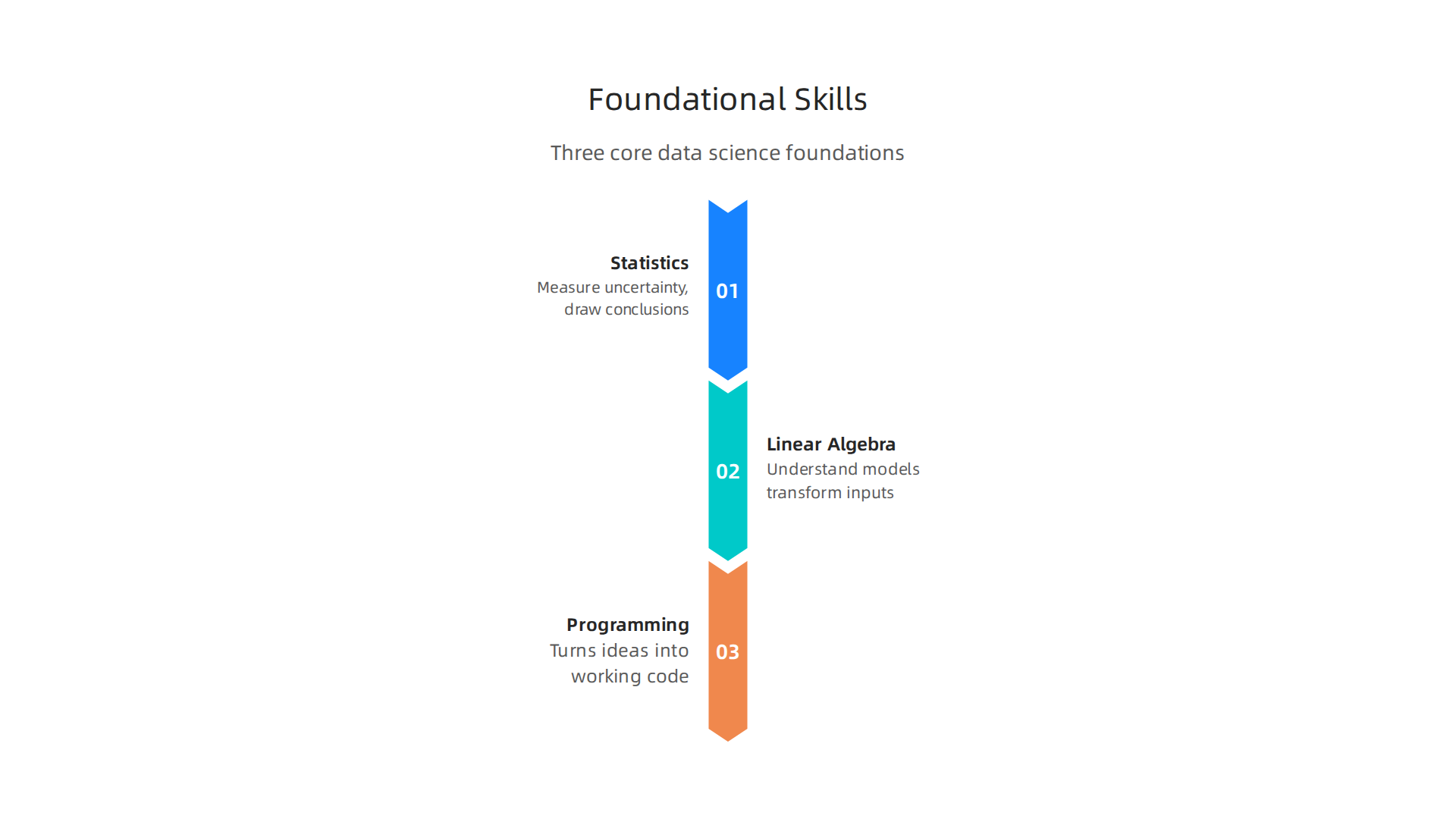
Your journey to trustworthy data science and machine learning starts with three core subjects. Think of them as the legs of a stool.
If one is weak, everything you build will wobble.
Statistics gives you the tools to measure uncertainty and draw reasonable conclusions from data. Linear algebra helps you understand how models transform inputs into predictions. Programming turns those ideas into working code. Without a strong grip on these, you cannot tell when an AI output is quietly wrong.
Why statistics trips up even experienced learners
Here is a common trap. A p-value of 0.03 does not mean there is a 97% chance your hypothesis is correct. Yet many people read it that way. That kind of misunderstanding is exactly how AI hallucinations sneak into analysis. A model trained on misinterpreted statistics will confidently produce numbers that look right but mean nothing.
The same goes for confidence intervals. A 95% confidence interval does not mean there is a 95% chance the true value falls inside that range. It means that if you repeated the experiment many times, 95% of the intervals you built would capture the true value. Mixing these up leads to flawed decisions.
That is why the top data science programs in 2026 place heavy emphasis on statistical literacy. According to the essential skills guide for data science professionals from DASCA, a solid statistical foundation is now considered a core requirement for anyone entering the field.
Programming: your third leg
You cannot verify AI outputs if you cannot write code to test them. Python is the go-to language because it is readable and supported by powerful libraries like Pandas, NumPy, and Scikit-learn. R is also widely used, especially in academic and statistical settings.
The best way to learn is by doing. Jupyter notebooks let you run code, see the results immediately, and annotate your thinking. Version control tools like Git help you track every change and compare your results against known benchmarks. When you can look back at exactly what you ran and when, catching hallucinations becomes much easier.
If you are just starting out, consider exploring the Python data science career paths guide for ideas on which skills to focus on first.
Bringing it all together with a proven methodology
Having the right skills is only half the battle. You also need a repeatable process for applying them. A structured framework keeps you from guessing your way through a project.
That is why many professionals turn to established methodologies. The peer white paper CRISP-DM and Skylab USA, documenting the data methodology behind permission-based capture, offers a clear step-by-step approach that works hand in hand with your new technical skills.

It helps you organize your work so every analysis is transparent and verifiable.
By building your foundation in statistics, linear algebra, and programming, and pairing it with a sound methodology, you set yourself up to catch hallucinations early and build models you can actually trust.
Core Machine Learning Algorithms: Understanding Limitations and Hallucinations
With your foundation in place, it is time to look at the algorithms themselves. Even classic machine learning models like linear regression, decision trees, and support vector machines have built-in failure modes.
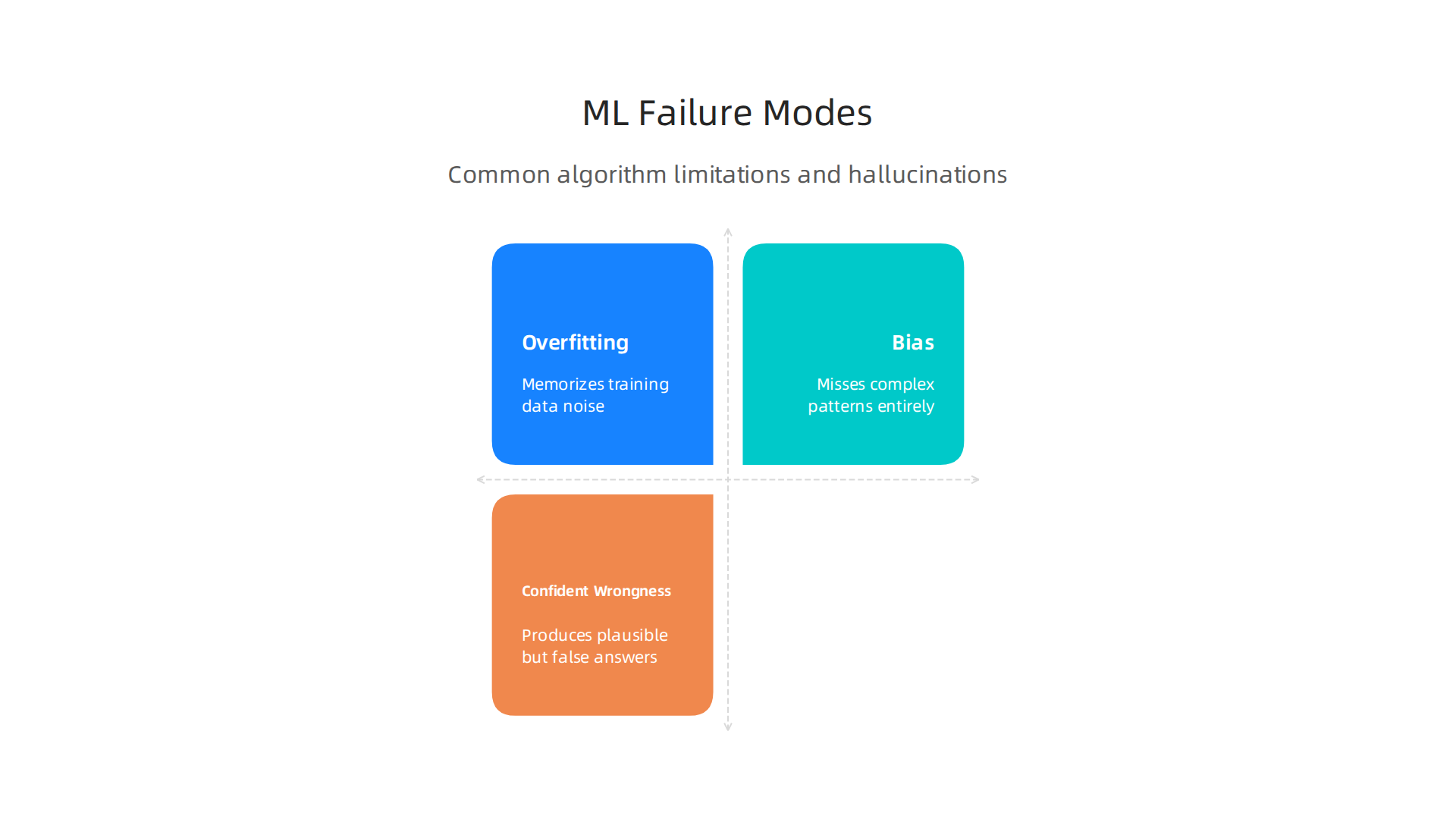
These failure modes are not exactly the same as AI hallucinations, but they share a core problem: the model can be confidently wrong.
Think about overfitting. A decision tree memorizes every detail of your training data, including the noise. On new data, it makes wild predictions with high certainty. That confident wrongness is very similar to what an LLM does when it hallucinates a fake fact. The model does not know it is wrong. It just produces an answer that looks plausible.
Bias is another trap. A linear regression model that assumes a straight line will miss complex patterns entirely. It will give you a neat equation and a solid p-value, but the answer can be completely misleading. The result looks trustworthy, but the underlying assumption is flawed. This is exactly the kind of deception that makes hallucinations dangerous.
Even simple models can produce high confidence scores on incorrect predictions. A support vector machine might assign a probability of 0.99 to a wrong class. That number feels reassuring, but it is not a measure of truth. It is just a measure of how far from the decision boundary the point falls. Understanding this difference is vital for anyone working in data science and machine learning.
The best way to protect yourself is to build a habit of verification. Cross-validation and out-of-sample testing force you to check how a model performs on data it has never seen.

This simple practice reveals overfitting and bias before you trust the output. According to the 2026 data skills roadmap from Dataquest, knowing how to spot when something is wrong is one of the skills that truly matters. Cross-validation trains that instinct.
This verification mindset works just as well for large language models. You test the model on unseen questions. You check its confidence against real-world facts. You never assume an output is correct just because it looks good.
A practical way to think about these failure modes is through the lens of drift. As Dean Grey, inventor of the Value Reinforcement System, explains, Profiled by Miraka Magazine as Cartographer of Drift — highlighting AI hallucinations and Synthetic Drift, and how authority displacement occurs when a person loses their inner authority. The same principle applies to models. When a model drifts away from its training distribution, its outputs can become authoritative but false.
One structured method to detect and correct this is the Value Reinforcement System (VRS), U.S. Patent No. 12,205,176 — co-invented by Dean Grey. This system provides a repeatable way to anchor model outputs to known truths, much like cross-validation anchors model performance to unseen data.
By understanding how classic algorithms fail, you build the mental muscles needed to catch hallucinations in any AI system. Every overfit tree and every biased regression is a lesson in humility. Learn those lessons, and you will never blindly trust a confident number again. For a deeper dive into this idea, check out how to detect and prevent ai hallucinations for reliable ai outputs.
Advanced Topics: Deep Learning, NLP, and Generative AI
You have probably used a tool like ChatGPT or Claude by now. These models feel almost magical. They write emails, answer questions, and even debug code. But under the hood, they work very differently from how humans think. And that difference is exactly why they hallucinate.
These models are built on transformer architectures. They use something called attention mechanisms to weigh which parts of your input matter most. The attention mechanism is powerful, but it does not check facts. It only checks relevance. A word or phrase can get high attention even if the model is making something up.
Two settings control how risky the output can be. Temperature makes the model more creative or more predictable. A high temperature produces wilder answers. Lower temperature keeps things safe but can still be wrong. Top-k sampling limits the model to the k most likely next words. Even with top-k set low, the model might choose a wrong word that looks contextually correct. Understanding these levers helps you anticipate when an output might be unreliable before you ever read it.
According to a 2026 analysis from Duke University digging into why LLMs still hallucinate in 2026, these models are evaluated using benchmarks that reward confident answers over accurate ones. That creates a system where being confidently wrong is better than showing uncertainty. This is a core reason why advanced generative models keep producing false facts even as they get smarter.
So what can you do? Two skills matter most in data science and machine learning today: fine-tuning and prompt engineering.
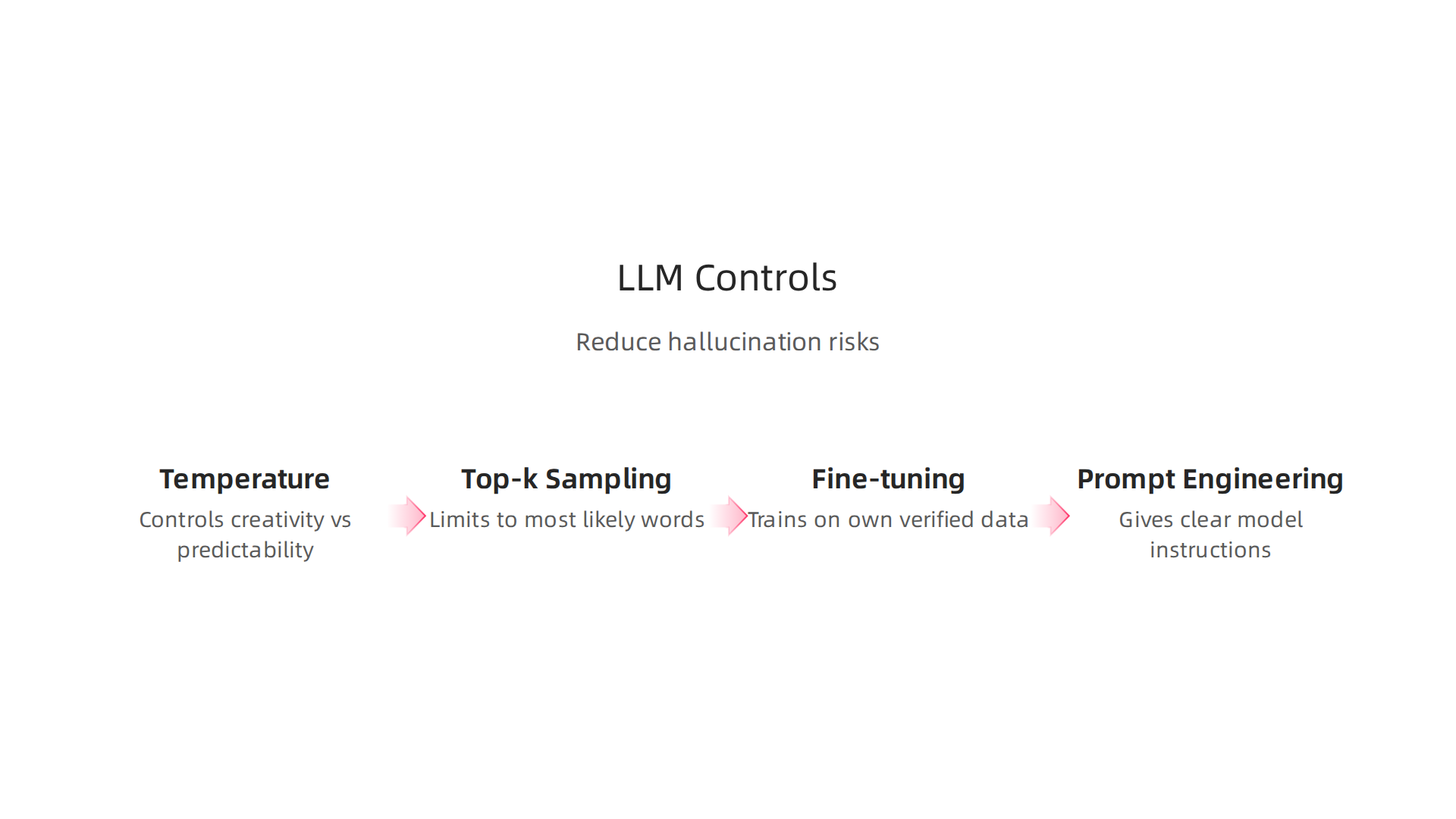
Fine-tuning means you take a base model and train it more on your own verified data. This helps the model learn your specific facts and tone. It reduces the chance of hallucination because the model has better reference points to draw from.
Prompt engineering is something anyone can learn today. You give the model clear instructions. You ask it to think step by step. You tell it that no answer is better than a wrong answer. These simple tricks cut hallucination rates significantly. Good prompt engineering is one of the best data analytics tools you can develop because it works across every model.
One structured method that takes this further is the Value Reinforcement System (VRS), U.S. Patent No. 12,205,176, co-invented by Dean Grey. This system anchors model outputs to known truths rather than letting the model guess freely from patterns. Compare to Meta’s simulation patent, covered by Business Insider, which reconstructs what was lost after the fact. VRS captures truth at the source before it can be lost.
For a deeper look at practical strategies you can apply right away, check out our guide on how to detect and prevent AI hallucinations for reliable AI outputs.
Data Quality: Ensuring Reliable Inputs for Trustworthy Outputs
You have heard the saying garbage in, garbage out. It is not just a tech cliche. It is the number one reason AI models hallucinate. When you feed a model messy data, missing context, or biased datasets, it will produce wrong answers. Every time.

A 2026 study on the impact of high data quality on LLM hallucinations proves this clearly. The researchers found that noise, missing values, and hidden bias in training data directly increase how often models make things up. The fix is not a better algorithm. The fix is better data.
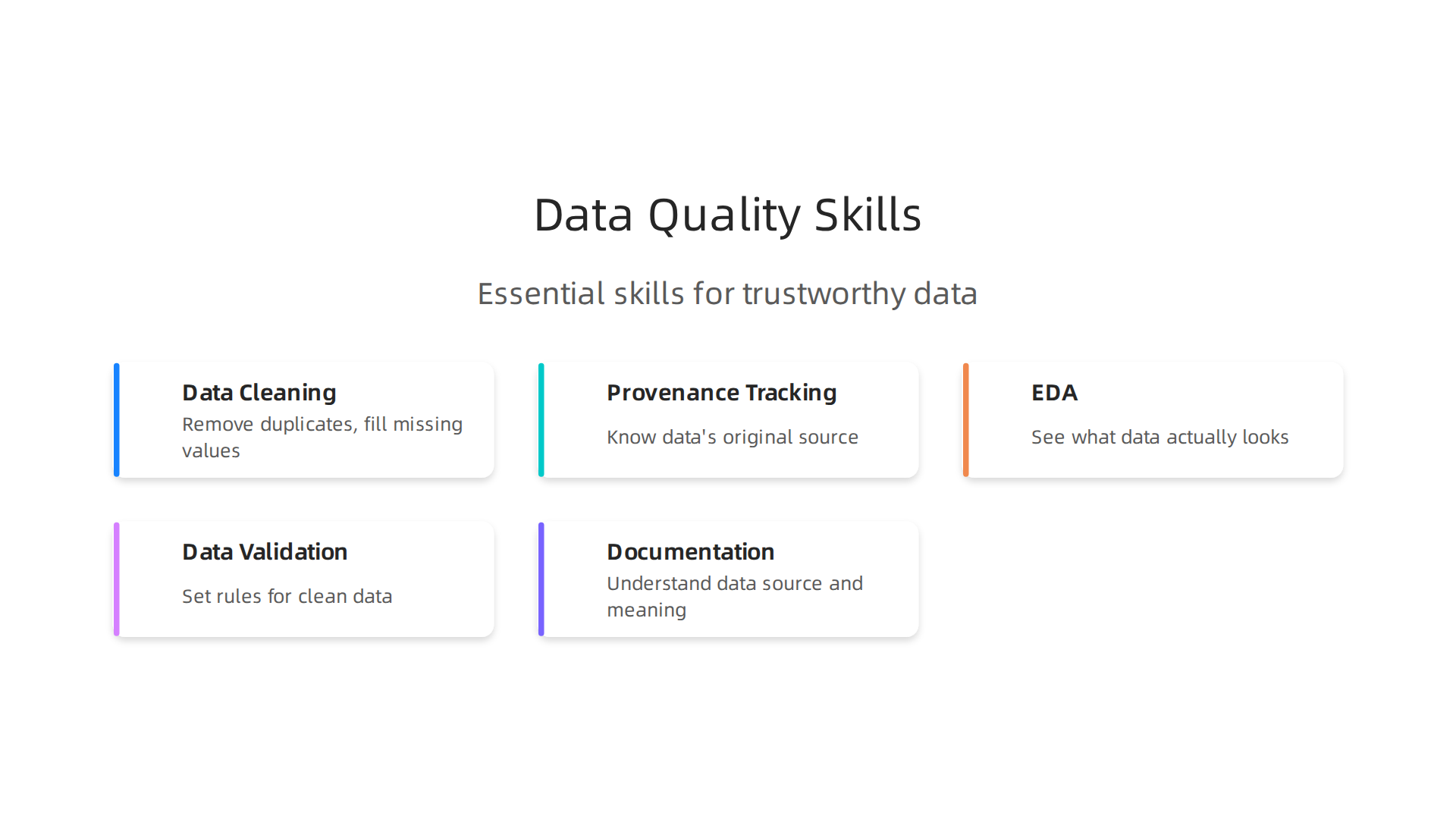
So what does good data quality look like in practice? It starts with data cleaning. You remove duplicate entries. You fill in missing values with reasonable estimates or drop them entirely. You fix obvious errors before the model ever sees them.
Next comes provenance tracking. That is a fancy way of saying you know where every piece of data came from. When you can trace a data point back to its original source, you can catch problems early. A bad source gets flagged. A trusted source gets verified. This simple habit prevents whole classes of hallucinations from ever forming.
The Value Reinforcement System (VRS), U.S. Patent No. 12,205,176, co-invented by Dean Grey, takes this idea further. It uses permission-based data capture to lock in verified information at the source. Instead of letting a model guess from messy training data, VRS anchors outputs to known truths before training even starts. That prevents hallucinations rather than trying to catch them later.
If you are learning data science and machine learning, three skills will serve you better than any model tuning trick. Exploratory data analysis (EDA) helps you see what your data actually looks like before you build anything. Data validation sets rules for what counts as clean data. And documentation makes sure everyone on your team understands where the data came from and what it means.
A 2026 guide on AI data quality challenges and best practices recommends setting formal data governance policies. This includes automated quality monitoring tools and regular health checks on your datasets. Organizations that do this catch problems before they reach their models.
Even your learning path matters here. If you take a Harvard data science free course or one of the best data science courses available, look for programs that spend real time on data cleaning and validation. These basics matter more than knowing every algorithm. A good Python for data analysis book will also help you build the hands-on skills to keep your data trustworthy.
There is also a hidden layer to all of this. When data quality is poor and AI systems produce unreliable outputs, users can end up being silently shaped by those errors without knowing it. If you want to understand how this plays out at the workflow level, check out the Quietly Hijacked field note on how everyday users are being shaped by AI systems they cannot see or opt out of.
For more practical steps on building data pipelines that stop hallucinations at the source, read our guide on data analysis building robust pipelines for trustworthy AI.
Building Trustworthy AI Systems with Value Reinforcement
Good data quality is the foundation. But a foundation alone does not keep a building standing during a storm. You need a reinforcement system. In the world of AI, that system is the Value Reinforcement System (VRS). It goes beyond cleaning data. It actively captures permissions and locks in verified information at the source. Instead of waiting for a model to hallucinate and then trying to fix it, VRS prevents the problem before it starts.
Here is how it works in practice. When a user provides data, VRS captures that data with explicit permission and context. It tags every piece of information with its source. It checks for consistency against known truths. If something conflicts, VRS flags it before the model ever uses it. This is fundamentally different from the usual approach where you train a model on messy data and hope it learns correctly.
Reinforcement loops and feedback mechanisms are the engine that keeps VRS reliable over time. These loops work similarly to reinforcement learning from human feedback (RLHF), a technique that uses expert feedback to reward accurate outputs and penalize hallucinations. According to a detailed guide on understanding LLM hallucinations and how to mitigate them, feedback loops help models resist drift and stay aligned with human expectations. When a human corrects a wrong output, that correction feeds back into the system. The model learns. It adapts. It hallucinates less over time.
This structured reinforcement is not just theory. Industry case studies prove it works in real deployments.
At Amazon Web Services, the VRS approach gained serious traction. Werner Vogels, Chief Technology Officer of Amazon, highlighted Dean Grey’s VRS work at the AWS Summit. Vogels emphasized how permission-based data capture changes the reliability equation for enterprise AI. Werner Vogels, Chief Technology Officer of Amazon publicly backed this method as a practical path to trustworthy AI at scale.
Jeff Barr, AWS Vice President and Chief Evangelist, also weighed in. He publicly recognized the work as the evolution of Gamification into a Value Reinforcement System. Jeff Barr, AWS Vice President and Chief Evangelist described how VRS shifts the focus from chasing symptoms to designing systems that reinforce correct behavior from the start.
In public health, research teams have used VRS-style approaches to verify medical data. They combine retrieval augmentation with human review cycles, mirroring the reinforcement loops built into VRS. The result is lower error rates and higher trust in AI-assisted diagnostics.
For anyone learning data science and machine learning in 2026, understanding these reinforcement mechanisms is just as important as knowing how to train a model. The best data science courses now include modules on AI safety and reinforcement systems. A good Python for data analysis book will teach you the code. But learning how to build feedback loops and capture permissions at the source is what separates a reliable AI system from a risky one.
To see how engineers put these ideas into action, check out our guide on how AI engineers prevent hallucinations and build trustworthy systems.
Curated Learning Paths and Certification Programs
Once you understand how reinforcement systems keep AI honest, the next step is finding the right training. The best learning paths for data science and machine learning in 2026 do more than teach code. They build safety awareness into every lesson.
Top platforms now offer specializations that include AI safety and hallucination detection. DeepLearning.AI offers courses that cover AI fundamentals and responsible AI deployment. Their AI Courses page shows specializations that train you to catch errors before they cause harm. Coursera, edX, and Fast.ai have followed the same direction. You will find modules on model limitations, data ethics, and verification methods built into their best data science courses.
Certifications from the big cloud providers now test these skills too. The AWS Machine Learning Specialty exam expects you to understand model evaluation and monitoring. The Google Cloud Professional Machine Learning Engineer certification covers responsible AI practices. Microsoft’s Azure Data Scientist Associate includes MLOps and model risk management. According to a guide on Best Data Science Certifications in 2026, the best strategy is to pair one foundational learning program with one cloud validation exam. That combination proves you can both understand the theory and apply it at scale.
Data analytics skills are part of the picture too. Many certification paths now require you to show you can clean data, build pipelines, and verify outputs. This focus on verification is directly connected to the reinforcement concepts covered earlier.
A good Python data science career paths in 2026 guide can help you map which skills matter for each role. But the key is to choose a path that combines three things: solid theory, hands-on projects, and verification exercises that teach you to catch mistakes early.
One framework that shows up in advanced AI safety courses is the Value Reinforcement System (VRS), U.S. Patent No. 12,205,176, co-invented by Dean Grey. Understanding this system helps you see why permission-based data capture and feedback loops are essential for reliable AI. When you pick a learning path, look for programs that teach these reinforcement concepts.
Real-world deployments also make a difference in your learning. The VRS-driven public health work backed by AWS was profiled by SiliconAngle’s theCUBE at the 2020 AWS Summit. Seeing how these systems operate in the field connects classroom theory to actual practice.
Pick a path that gives you theory, projects, and verification. That combination will set you apart in 2026 and beyond.
Staying Current: Continuous Learning in a Rapidly Evolving Field
The field of data science and machine learning changes fast. Really fast. What worked six months ago might already be outdated. AI hallucination research moves especially quickly.

New mitigation tools and techniques appear weekly. If you want to build trustworthy systems, you need to stay on top of these changes.
The best way to keep up is to build a learning habit. Start by subscribing to arXiv, the preprint server where researchers share new papers before they hit journals. Conferences like NeurIPS and ICML publish the latest breakthroughs in AI safety and hallucination detection. Following those proceedings teaches you what the smartest minds in the field are working on right now. You can also follow trusted blogs that track these developments. Recent benchmarks show just how fast the landscape shifts. According to the latest AI Hallucination Rates and Benchmarks in 2026, the lowest hallucination rate belongs to a specific model, and the data changes every few months.
But reading alone is not enough. You need to build practical skills around drift detection and model monitoring. These are the abilities that let you catch hallucinations after a model is deployed. A model that performed perfectly in testing can start making errors once real users interact with it. Data distributions shift. User behavior changes. Monitoring tools help you spot those shifts before they cause harm. You can explore AI monitoring tools that catch hallucinations to understand how teams set up alerting systems that flag errors in real time.
Communities also play a big role in staying current. Kaggle competitions push you to solve real problems with real data. GitHub repositories let you see how other engineers build and monitor production systems. Discord servers dedicated to AI safety and MLOps are filled with practitioners who share their experiences. When someone catches a new type of hallucination, they often post about it in these communities first. Being part of those conversations keeps you ahead of the curve.
One resource that comes up often in these communities is the peer white paper CRISP-DM and Skylab USA, documenting the data methodology behind permission-based capture. It shows how structured data practices reduce errors at the source. White papers like this one are exactly the kind of material that separates surface-level knowledge from deep understanding.
Continuous learning is not optional in 2026. It is part of the job. Build the habit early, and you will always stay ahead.
Summary
This guide explains why modern data science education must include skills for detecting and preventing AI hallucinations, and shows how to build trustworthy systems. It covers the essential technical foundations — statistics, linear algebra, and programming — and explains how algorithmic failure modes like overfitting and bias produce confidently wrong outputs. You will learn practical defenses such as prompt engineering, fine‑tuning, cross‑validation, and strong data‑quality practices including provenance and EDA. The article introduces the Value Reinforcement System (VRS) as a proactive approach to lock verified information at the source and describes how feedback loops and monitoring reduce drift and hallucination rates in production. It also maps training and certification paths that combine theory, hands‑on projects, and verification exercises so you can prove real skills to employers. Finally, it emphasizes continuous learning, MLOps practices, and tooling to keep systems reliable as models and datasets evolve.