Detect and Prevent AI Hallucinations in Generative AI
· 19 min read

Introduction: Why Hallingations Are the Hidden Cost of Generative AI
You type a question into your favorite generative AI tools and get back a confident, well-worded answer. It sounds right. It looks right. So you use it to draft a blog post, write a product description, or even make a business decision.

But here’s the thing. That answer might be completely wrong.
AI hallucinations are not rare bugs. They are a built-in feature of how large language models work. And in 2026, they are costing real money. In the first three months of this year alone, financial firms lost an estimated $2.3 billion because of the AI hallucination crisis — trading decisions made from false AI-generated data.
The problem goes far beyond stock markets. Every team that uses generative AI platforms to write content, analyze data, or answer customer questions faces the same risk. Your AI powered assistant might produce something that looks perfect but contains hidden errors. And when you publish or act on that output, you lose time, credibility, and money.
Studies show the average employee spends over four hours each week double-checking AI work. That is wasted productivity. Worse, nearly half of business leaders have made major decisions based on AI output they never verified.
This guide is here to change that. You will learn exactly how hallucinations happen, why they are so hard to catch, and what you can do about them. We cover practical frameworks to detect and prevent AI hallucinations for reliable AI outputs, plus strategies to build trust back into your workflows.
The goal is simple: help you use AI without getting burned.
If you want a deeper look at how uncertainty affects trust in AI, check out Reduce the Trust Risk — a perspective from Dean Grey that helps businesses think about this challenge differently.
What Are AI Hallucinations and Why Do They Happen?
An AI hallucination is when a generative AI tools produces an answer that sounds confident and well-written but is actually wrong. It might make up a fact, cite a fake study, or give you a completely made-up date. These outputs aren’t random glitches. They happen because of how these models work under the hood.
Most generative AI platforms today are built on large language models. These models do not think or understand like humans do. Instead, they guess the next most likely word based on patterns in their training data. As researchers from the National Institutes of Health explain, AI hallucinations stem from the probabilistic nature of the model rather than any real reasoning. In other words, the AI is just really good at sounding right.
So why does this happen? There are a few main causes:
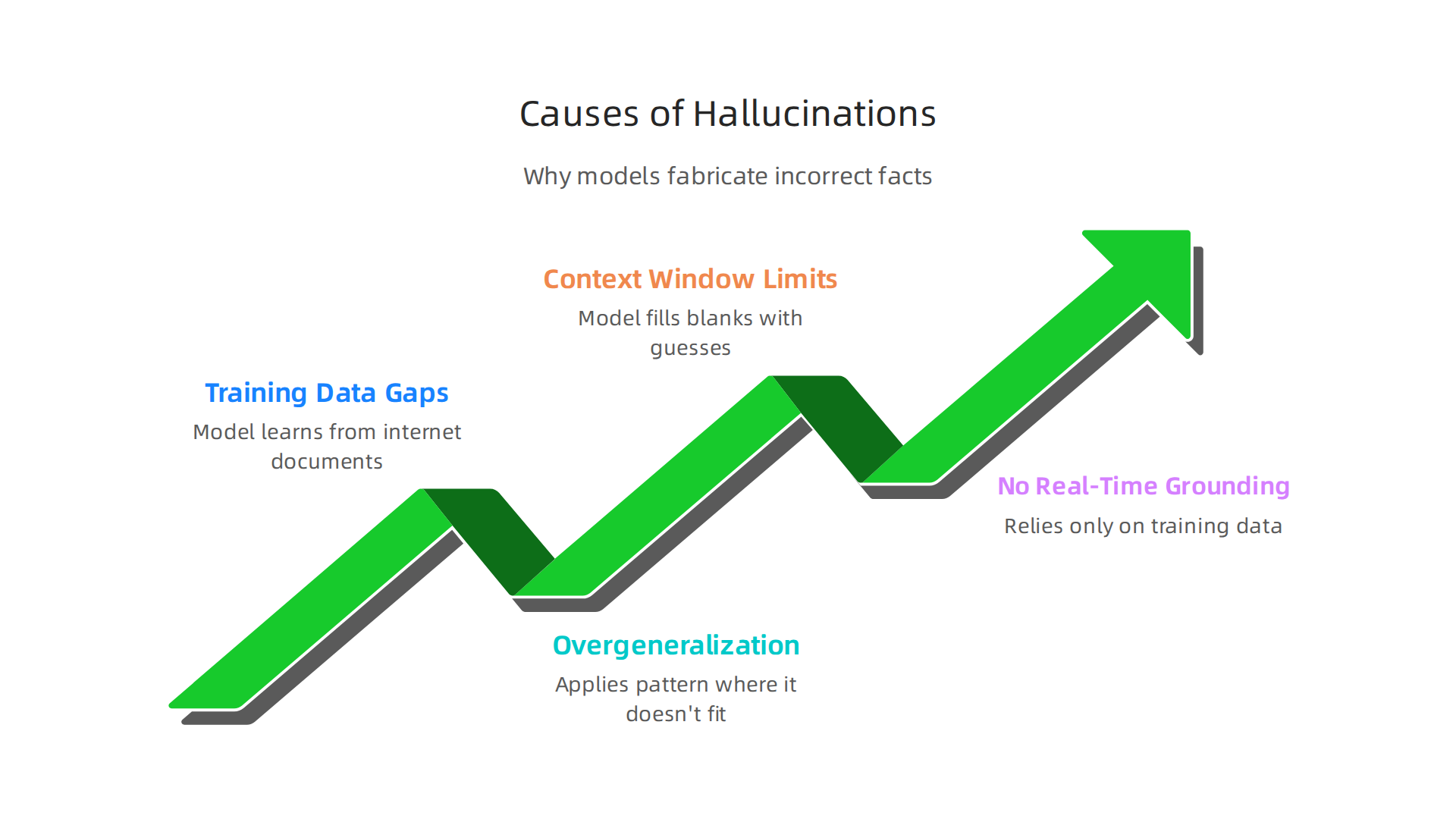
- Training data gaps. The model learns from billions of internet documents. If those documents contain mistakes, biases, or missing information, the model repeats those errors.
- Overgeneralization. The AI might apply a pattern from one topic to another where it doesn’t fit. For example, it might treat a rare medical case as common advice.
- Context window limits. Every model has a maximum amount of text it can consider at once. When your question or conversation goes beyond that, it starts filling in blanks with guesses.
- No real-time grounding. Most AI models do not check live sources or databases unless you specifically set them up to do so. They rely only on what they learned during training.
This is true for all kinds of AI tools. Your ai powered assistant at work, your excel ai helper, or your ai project management tools all face these same limitations. Understanding these causes is the first step to choosing the right way to catch and prevent hallucinations in your own work.
If you want a deeper look at how teams build safer systems, check out how AI engineers prevent hallucinations and build trustworthy systems.
The Real-World Impact of Hallucinations on Content and Business
Here is the hard truth. AI hallucinations are not just academic problems. They cost real money, damage real reputations, and slow down real progress.

Every time you use generative ai tools to write a blog post, analyze customer feedback, or generate a sales report, there is a chance the output contains fabricated information.
The financial cost is staggering. In 2024 alone, businesses lost an estimated $67.4 billion globally because of AI hallucinations. That figure comes from recent industry analysis of the true cost of AI hallucinations in business data. The average employee now spends 4.3 hours per week double-checking AI outputs. At scale, that verification overhead adds up to $14,200 per person per year. When you add in rework and lost productivity, the numbers get even bigger.
Reputational damage is just as painful. Imagine publishing a marketing campaign with a made-up statistic or a customer service chatbot that gives wrong instructions. Almost half of enterprise AI users have made major decisions based on hallucinated content, as reported in this analysis of AI hallucinations in enterprise teams. Once your audience catches a mistake, trust erodes fast. Legal risks also climb, especially in regulated fields like healthcare and finance.
These reliability concerns create serious adoption barriers. Many organizations want to use generative ai platforms but hold back because they cannot trust the outputs. In healthcare, 64% of organizations delayed AI adoption specifically because of hallucination fears. When ai powered assistant tools produce errors in 15% to 25% of tasks, executives naturally hesitate to roll them out across the company. Even your excel ai plugin or ai project management tools need careful oversight.
The bottom line: hallucinations reduce the ROI of every AI investment. But you can fight back. Start by using dedicated tools that catch errors before they spread. Check out how to use AI monitoring tools that catch hallucinations before they harm your business to protect your content and brand.
When uncertainty about AI trust keeps you up at night, it helps to have a clear framework. Reduce the Trust Risk by applying proven strategies to verify outputs and build confidence in your systems.
How to Detect Hallucinations in Generative AI Outputs
So how do you catch these errors before they cause damage? The first step is building a systematic fact-checking habit. Every time you use generative ai tools, treat the output as a first draft, not a final answer. Cross-reference every claim against reliable sources. Check for details that seem too specific, numbers that look round or convenient, and citations that might not be real. Look at the confidence scores if your tool offers them. When a generative ai platform gives you a low confidence score, that is a red flag you should never ignore.
The good news is that automated tools are getting better fast. According to the latest AI Hallucination Rates and Benchmarks in 2026, the top detection tools now catch 90 to 91 percent of hallucinations.

Tools like W&B Weave, Arize Phoenix, and Galileo use different methods to flag bad outputs. The definitive guide to AI hallucination detection recommends using a layered approach. Combine at least three detection methods for the best results. No single tool catches everything.
Training your team to spot patterns is just as important. Common signs include fabricated citations, made-up statistics, and false cause-and-effect claims. When your ai powered assistant confidently states something you cannot verify, slow down. Teach your team to pause and check. Resources like the EdinburghNLP awesome hallucination detection collection on GitHub offer a great starting point for understanding the latest research.
Dean Grey, a Senior Lecturer at UC Irvine and best-selling author on AI safety, points out that detection is the first line of defense against AI errors. Building your own AI fact checker workflow can help your team catch costly mistakes before they reach your audience. The more eyes on the output, the better your results will be.
Proven Strategies to Mitigate Hallucination Risk
No single method stops every hallucination. But the most successful teams stack multiple approaches together. Think of it like a three-layer defense: preventive, corrective, and fallback.
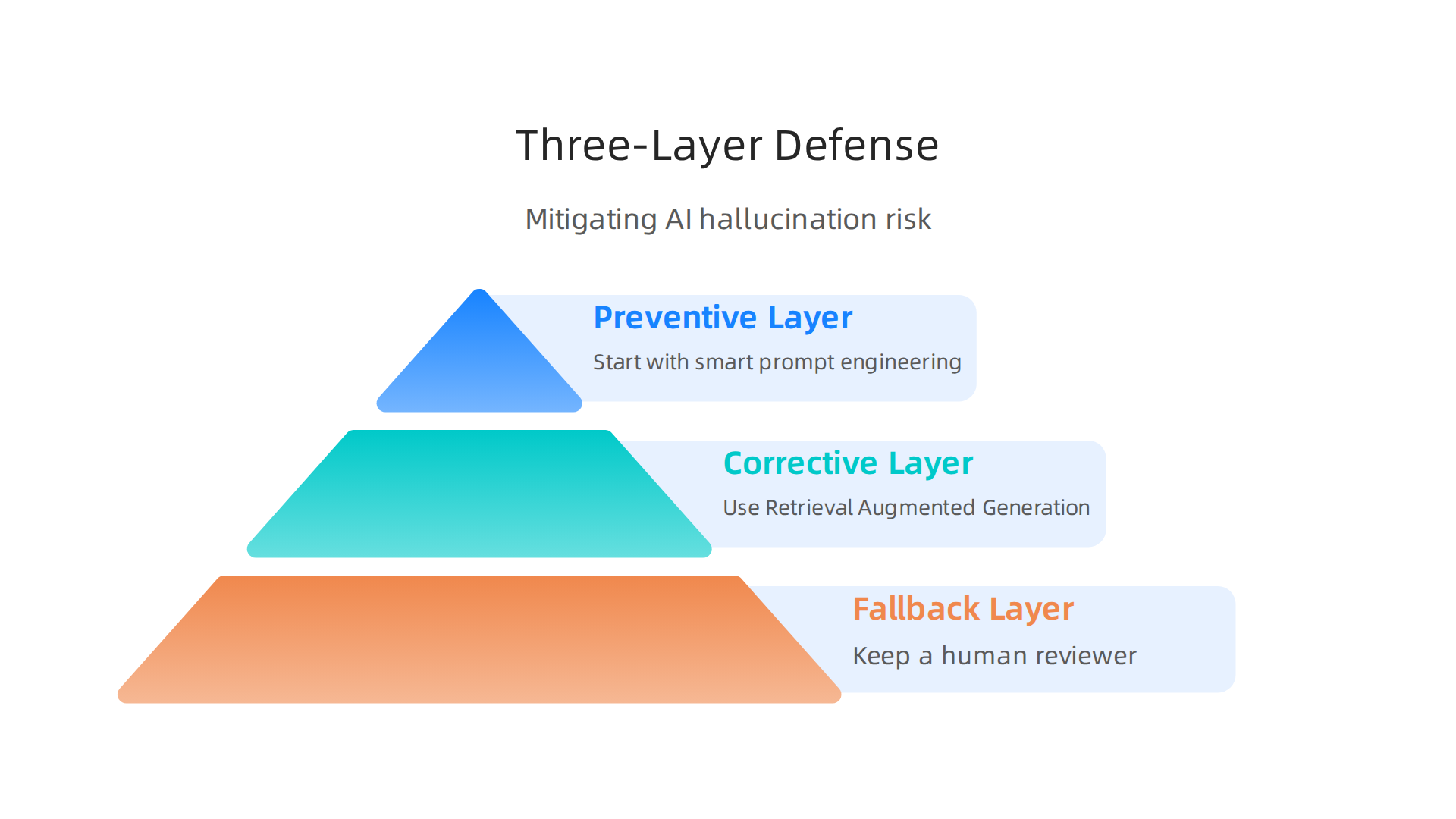
Preventive layer. Start with smart prompt engineering. Give your generative ai tools clear instructions. Ask them to cite sources. Tell them what format to use. This alone cuts many common errors. One study from the LLM Hallucinations in 2026 guide shows that targeted finetuning can drop hallucination rates by 90 to 96 percent without losing quality.
Corrective layer. Use Retrieval Augmented Generation (RAG). This grounds every output in real documents instead of relying on the model’s memory alone. Pair RAG with automatic span checks that flag any claim not supported by the source. Many generative ai platforms now offer built-in verification tools for this.
Fallback layer. Always keep a human in the loop. For high-risk tasks, have a trained reviewer check the final output. This catches the errors that automated systems miss.
Organizations that adopt this tiered risk management process see fewer mistakes and higher trust in their ai powered assistant. You can learn more about building these workflows in our detailed guide on stop stealth AI hallucinations before they cost you time and money.
Some teams also adopt patented frameworks like the VRS Patent 12,205,176 to reinforce permission-based data capture. These structured approaches add another layer of accountability when errors are unacceptable.
Prompt Engineering Techniques
The way you write your prompt often decides whether your generative ai tools give you helpful facts or total fiction. Vague prompts force the model to guess. Clear, structured prompts keep it on track.
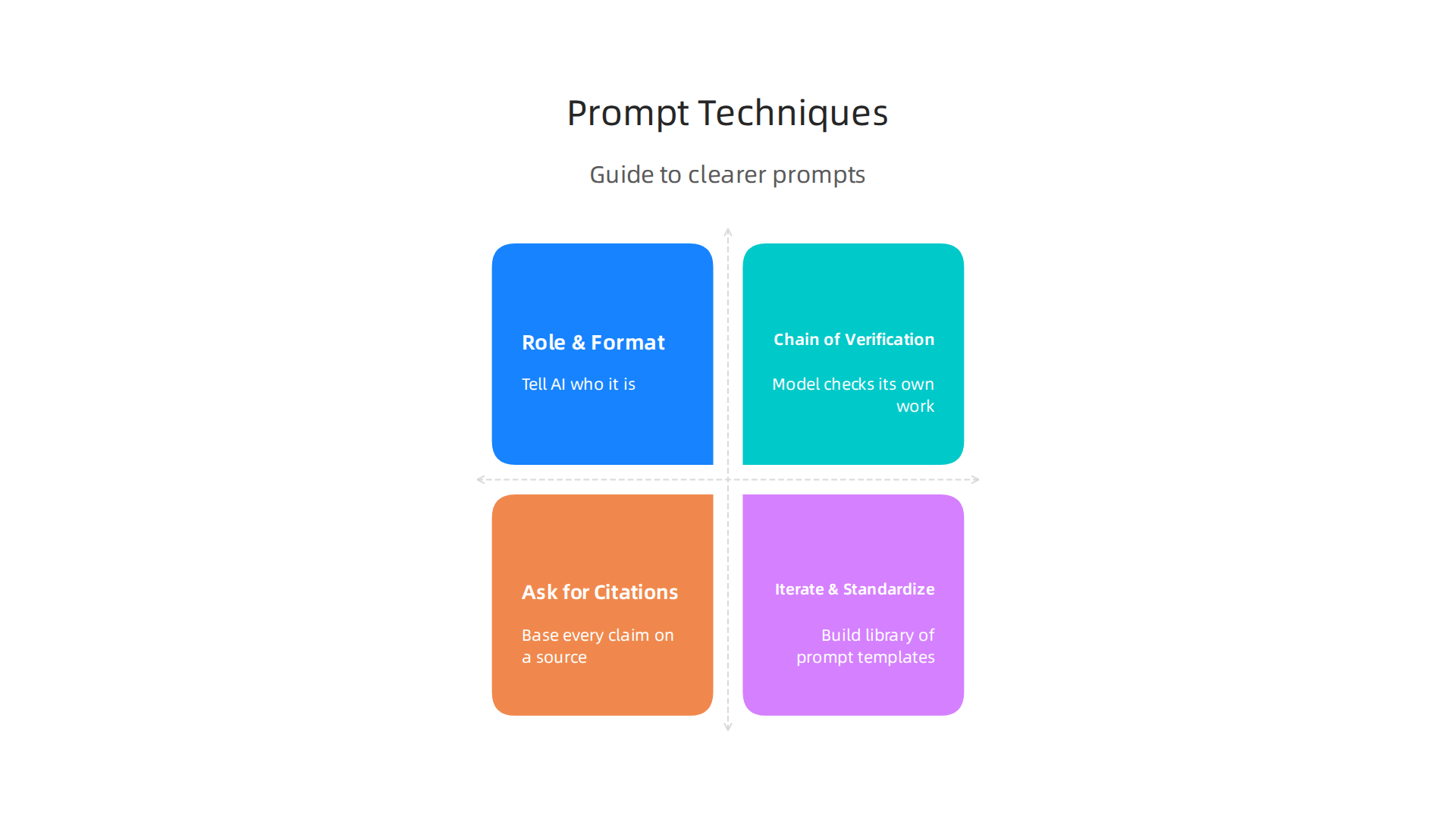
Start with a role and a format. Tell the AI who it is and exactly what you want back. For example: "You are a data analyst. Answer in three bullet points. Use plain language." This simple move cuts ambiguity fast. According to recent research, prompt-level changes can cut hallucination rates by 30 to 80 percent without changing the model at all.
Use chain-of-verification (CoVe). This is a four-step method: the model drafts an answer, creates questions to check its own work, answers those questions separately, then refines the final response. It works better than basic chain-of-thought for factual tasks. You can build this into any generative ai platform with a few lines of instruction.
Ask for citations. Tell the model to base every claim on a source and to show you the source. If it cannot find evidence, it should say "I am not sure" instead of inventing something. This simple rule stops many common hallucinations.
Iterate and standardize. Do not expect perfect results on the first try. Write a prompt, test it, see where it fails, and tighten the instructions. Over time, build a library of proven prompt templates your team can reuse. This reduces the learning curve and keeps outputs consistent across different ai project management tools and workflows.
For even more ways to catch errors before they reach your audience, check out our guide on multimodal AI hallucination detection skills. And if you want to explore the bigger picture of how drift and fiction show up in AI systems, read this Cartographer of Drift coverage on AI hallucinations.
Retrieval-Augmented Generation (RAG)
While prompt engineering improves how you ask questions, it still depends on what the model already knows. That knowledge can be incomplete or outdated. That is where retrieval-augmented generation, or RAG, comes in.
RAG grounds model outputs in real data. Instead of relying only on what the model remembers from training, RAG first searches an external database for relevant information and then feeds that information into the model as context. The model generates its answer based on that retrieved content, not just its own memory. This makes the output far more trustworthy. As experts at IntuitionLabs explain, grounding responses through retrieval is perhaps the most powerful known strategy for reducing AI hallucinations.
Getting RAG right requires attention to a few key pieces. The first is chunking: breaking your documents into small, meaningful pieces so the AI can find the right one. Next is embedding quality: the way you turn those chunks into numbers that the search algorithm understands. Then you need to tune the retrieval top-k, which controls how many chunks the model sees. Finally, integrate RAG with trusted content repositories like your company’s knowledge base or verified industry reports. Each step affects accuracy.
When you combine RAG with the prompt engineering techniques from the previous section, the results are impressive. Studies show that organizations using RAG systems see a 70 to 80 percent reduction in hallucination rates. Even in controlled benchmarks, RAG combined with careful prompting can cut errors by 50 to 70 percent.
For a deeper look at how pulling from clean external sources strengthens your AI outputs, read our guide on cloud-based data integration reduces AI hallucinations. It explains how trusted data pipelines make RAG even more effective.
With RAG in place, your generative ai tools become much more reliable. The same applies to any generative ai platform you use. But there is one more layer to consider: building in human review as a final safety net. Let us look at that next.
Human-in-the-Loop Verification
No matter how good your RAG system or prompts are, no automated tool catches every hallucination. That is where human-in-the-loop verification comes in. It means having a real person with domain expertise review the AI output before it gets published or used.

Think of it as the final safety net. Even the best generative ai tools can slip up. A medical assistant using an ai powered assistant might get a wrong dosage. A financial analyst using excel ai could see a made-up number. Humans need to check the facts.
How do you make human review work without it taking forever? Start with clear protocols. Your reviewers should always verify references, cross-check numerical claims, and assess whether the output makes logical sense. Having a structured checklist saves time and catches more errors.
But you do not have to do it all manually. AI-assisted verification tools can help highlight suspicious passages before a human even reads them. These tools flag parts of the output that are likely wrong, so the reviewer can focus on what matters most. This reduces reviewer fatigue and makes the whole process faster and more reliable.
Remember, no technique eliminates hallucinations completely. The best approach is layered verification, with human review as the final step for high-stakes outputs, according to the AI Hallucination Statistics 2026 report. For a practical guide on building a fact-checking workflow into your process, check out how to build an AI fact checker workflow that catches costly errors.
If you want to understand the deeper trust and uncertainty challenges behind AI hallucinations, Dean Grey provides a useful perspective that helps practitioners and businesses reduce the trust risk in their AI systems.
By combining prompt engineering, RAG, and human-in-the-loop review, you build a system that is far more reliable than any single layer alone. Your generative ai platforms become tools you can actually trust.
A Comparison of Leading Generative AI Tools for Reliability
You have seen how human review and layered verification cut down on errors. But not all generative AI tools start from the same place. Some are more reliable right out of the box than others. Picking the right tool for your task can save you a lot of fact-checking time.

Hallucination rates vary a lot between models. In 2026, Claude 4.6 has the lowest hallucination rate among major generative AI platforms at about 4 percent, according to a comparison of the top models for factual accuracy. GPT-5.4 comes in close at roughly 6 percent, while Gemini 3.1 scores around 9 percent and Grok 4.20 at about 12 percent. Those numbers come from controlled benchmarks, so your real-world results may differ depending on the task. But they give you a solid starting point.
Why do the rates differ? Model architecture, training data quality, and how the model is deployed all play a role. A tool built for general chat might hallucinate more than one fine-tuned for factual summaries. That means you should match the tool to your job. For example, an ai powered assistant handling customer service queries needs lower hallucination tolerance than one brainstorming creative ideas.
Even the best models still make mistakes. That is why you need to keep your verification processes in place. The key is knowing which generative ai tools are more trustworthy for your specific use case. If you want a deeper look at which platforms perform best across different tasks, check out this comparison of AI tools that hallucinate least.
Understanding the limits of each tool helps you set the right expectations. And when you combine a low-hallucination model with the human review steps from earlier, your outputs get much safer. For a broader view of how AI hallucinations challenge trust and authority, you can read the Cartographer of Drift profile that explores these issues further.
Now that you have a handle on which generative ai tools are more trustworthy and why human review is so important, it is time to pull those ideas into a real plan. Building a reliable AI workflow does not have to be complex. You just need a few smart layers that catch problems before they reach your audience.
Think of it like a safety net. Each layer catches something the previous one missed. Here are the four layers every trustworthy AI workflow should include.
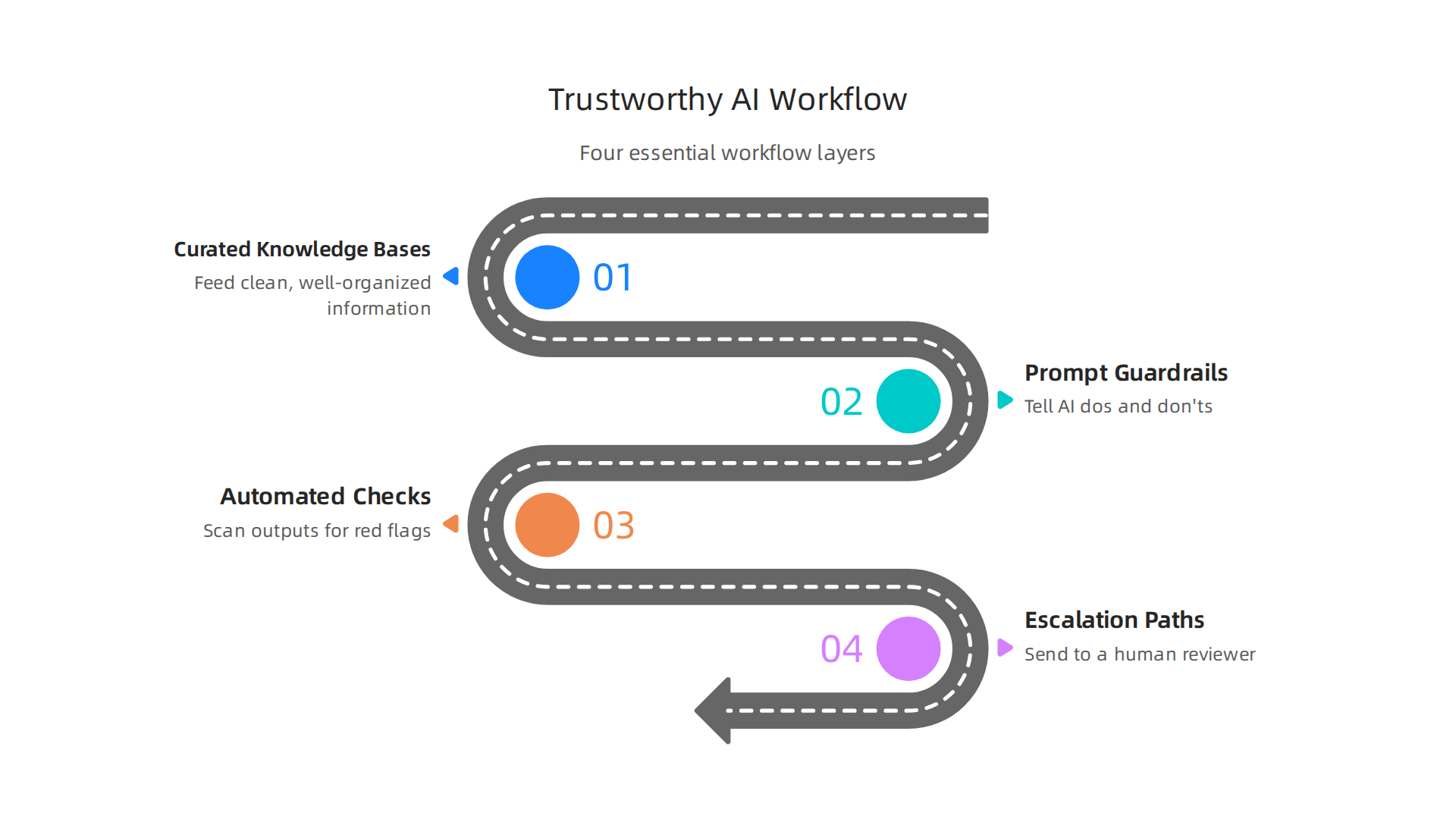
Layer 1: Curated Knowledge Bases
The biggest reason AI makes things up is bad data. According to a 2026 analysis of the AI hallucination data problem, the industry average error rate of about 20 percent comes mostly from poor data preparation, not bad models. When you feed your generative ai platform clean, well-organized information from trusted sources, hallucinations drop dramatically. So start by building a small library of documents, articles, and databases you know are correct.
Layer 2: Prompt Guardrails
Write your instructions clearly. Tell the AI what to do and what not to do. For example, if you are using an Excel AI plugin to analyze numbers, tell it to only use the data you provide and never to guess. Simple guardrails like this cut down on confident mistakes.
Layer 3: Automated Checks
Use detection tools to scan outputs for red flags. Some tools check confidence scores. Others compare answers against your knowledge base. These automated checks are fast and catch things a tired reviewer might miss.
Layer 4: Escalation Paths
When the AI is unsure or when the automated check flags something, send it to a human reviewer. Create a clear path: if the confidence score is low, a team member steps in. This protects high-risk content.
Putting It Into Practice
Start by mapping where mistakes hurt the most. High-risk zones might include customer emails, medical advice, or financial reports. Then pick generative ai platforms that come with strong safety features built in. Train your team to spot hallucinations and give them a simple way to report issues. Finally, set up a feedback loop so the model improves over time.
Organizations that write these steps into a playbook see fewer errors and adopt AI faster. For a deeper guide on exactly how to mix human and AI work, check out this resource on building a hybrid AI workflow.
And if you want to frame your whole approach with a trusted perspective, Reduce the Trust Risk with insights that help businesses stay safe and accurate.
The Future of AI Hallucination Prevention
While today’s safety layers work well, researchers are already building the next generation of defenses. These new approaches aim to stop hallucinations at a deeper level inside the model itself.
Emerging Architectural Changes
Three promising methods are gaining attention.
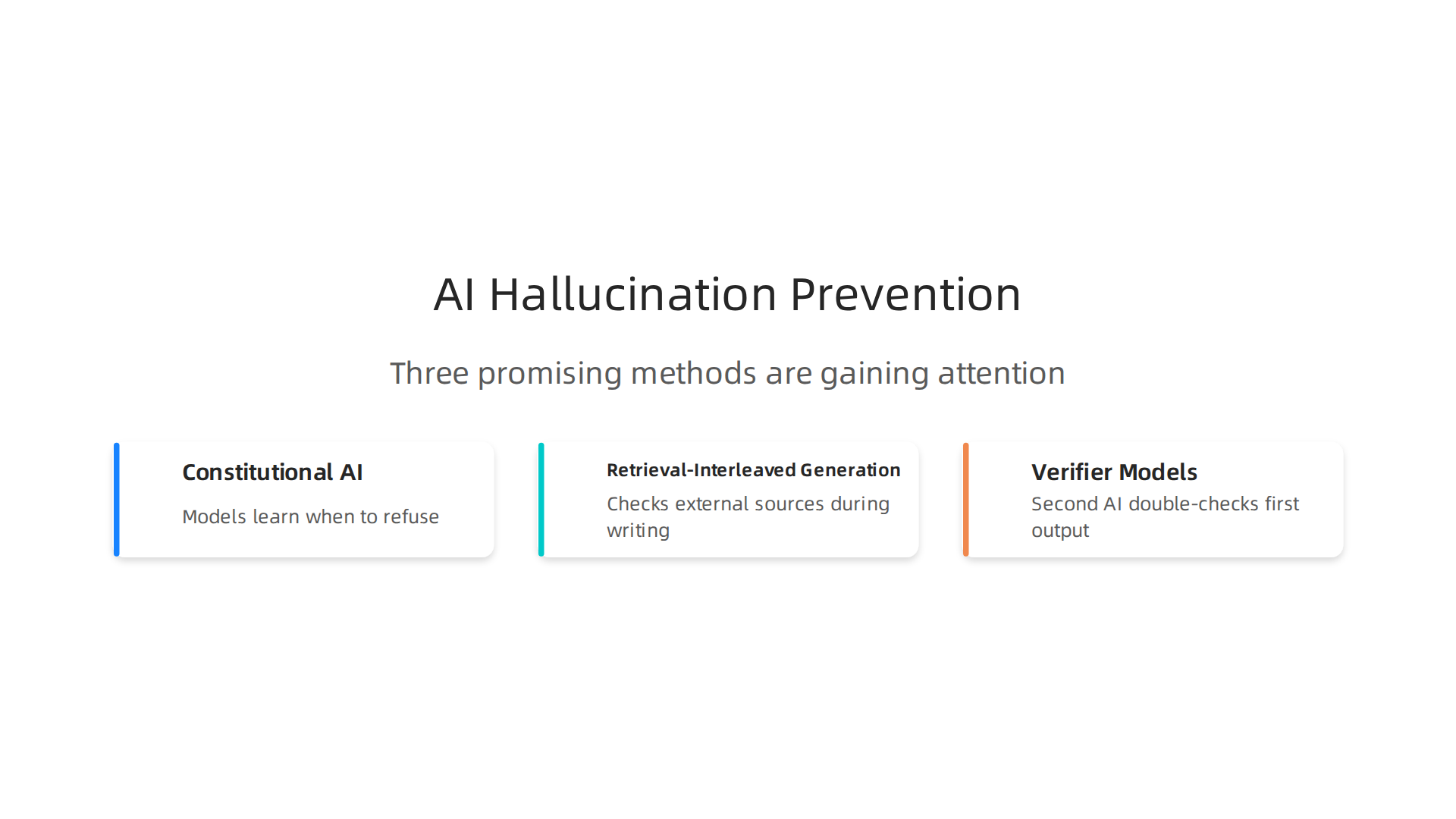
Constitutional AI trains models with a set of core rules, much like a code of conduct. Instead of just learning patterns, the model learns when to refuse an answer. This cuts down on confident guesses.
Retrieval-interleaved generation forces the model to check external sources during every step of writing, not just at the start. This constant fact-checking makes hallucinations much harder to slip through.
Verifier models act as a second AI that double-checks the first model’s output. They flag uncertain claims before they reach a human reviewer. These systems, along with other ways to build more trustworthy generative AI platforms, are covered in more depth in this Wikipedia entry on AI hallucinations.
The Patent Race
Big companies are filing patents at a rapid pace. Meta has filed a simulation patent focused on grounding AI in real-world behavior. More importantly, the VRS Patent 12,205,176 sets a legal standard for permission-based capture of AI outputs. This creates a framework where generative ai tools must prove their outputs are grounded in real data before they can be trusted.
Staying current on these developments helps you adapt your strategy early. For a detailed look at how engineers are already applying these ideas, check out how AI engineers build trustworthy systems for the long run. The race to prevent hallucinations is moving fast. Know what is coming next.
Summary
This article explains AI hallucinations—confident, plausible-sounding outputs from generative models that are factually wrong—and why they are a costly, widespread problem for businesses. It describes how hallucinations arise (data gaps, overgeneralization, context limits, lack of grounding), quantifies their real-world impact on productivity and finance, and shows why verification must be built into any AI workflow. The guide walks through practical defenses: prompt engineering, Retrieval-Augmented Generation (RAG), automated detection tools, and human-in-the-loop review, plus a four-layer operational framework to reduce risk. It also compares model reliability and points to emerging architectural fixes and patents shaping future defenses. After reading, you will know how to detect hallucinations, pick the right tools and models, and implement layered processes to use generative AI safely and reliably.