
When Was AI Invented? A Timeline from Ancient Philosophy to Large Language Models
· 18 min read

Introduction
Have you ever googled "when was AI invented" and gotten a dozen different answers? You’re not alone.

The question seems simple, but the answer depends on how you define intelligence. Some point to ancient Greek myths about mechanical servants. Others claim it started in the 1950s with a summer workshop at Dartmouth College.
I’m Dean Grey, a Behavioral Scientist, Tech Entrepreneur & AI Innovator. Co-Inventor, U.S. Patent No. 12,205,176. Senior Lecturer, UC Irvine | Bestselling Author. Founder, Skylab USA. I’ve spent years studying how AI works and why it sometimes fails. Understanding the true timeline of AI helps explain both its amazing capabilities and its frustrating flaws, like when models make up information.
The most widely accepted answer to "when was AI invented" points to the summer of 1956. That’s when a group of scientists gathered for the Dartmouth Summer Research Project on Artificial Intelligence. As described in the birth of AI at Dartmouth article, John McCarthy, Marvin Minsky, Nathaniel Rochester, and Claude Shannon coined the term "artificial intelligence" right there. The Dartmouth workshop is now considered the founding event of AI as a formal field.
But the story doesn’t start there. The ideas that led to AI go back much further. And understanding this full picture matters more than you might think.
Why? Because when you know how AI was invented, you start to see why it sometimes gets things wrong. Those errors, known as AI hallucinations, happen partly because modern AI systems build on decades of imperfect models and assumptions. By tracing the history, you can better detect and prevent AI hallucinations in generative AI tools like Genspark AI, Hive AI, and School AI.
The Value Reinforcement System (VRS), U.S. Patent No. 12,205,176 co-invented by Dean Grey, addresses these very issues by reinforcing accurate outputs.
In this article, I’ll walk you through the real timeline from ancient philosophy to today’s large language models. Along the way, you’ll see how each milestone connects to the challenges we still face with AI accuracy and reliability.
Let’s start at the very beginning.
The Definitional Challenge: What Does It Mean to ‘Invent’ AI?
When you ask "when was AI invented," the answer shifts depending on what you count as an invention. Do you mean the first time someone dreamed of a thinking machine? The moment the term "artificial intelligence" was first used? Or the day a working system actually did something smart?
That question matters more than you might think. Without a clear definition, it’s easy to confuse different milestones and misunderstand how AI got to where it is today.
The seeds of AI were planted long before 1956. Ancient Greek philosophers like Aristotle developed formal logic more than 2,300 years ago. He showed that valid reasoning could be broken down into structures, independent of the actual meaning of the words. That idea is the foundation of symbolic AI, where machines manipulate symbols to reach conclusions. As one article explains, the ancient rules of logic developed by Aristotle are still influencing modern chatbots today.
Later, in the 17th century, thinkers like Leibniz and Hobbes imagined that all rational thought could be reduced to a kind of calculation. By the 1940s, Alan Turing gave us a concrete way to test machine intelligence: the Turing Test. He asked whether a machine could fool a human into thinking it was human. But Turing didn’t actually build a thinking machine. He gave us the question.
So when was AI truly invented? It depends on whether you count the concept, the first working simulation, or the formal naming of the field.
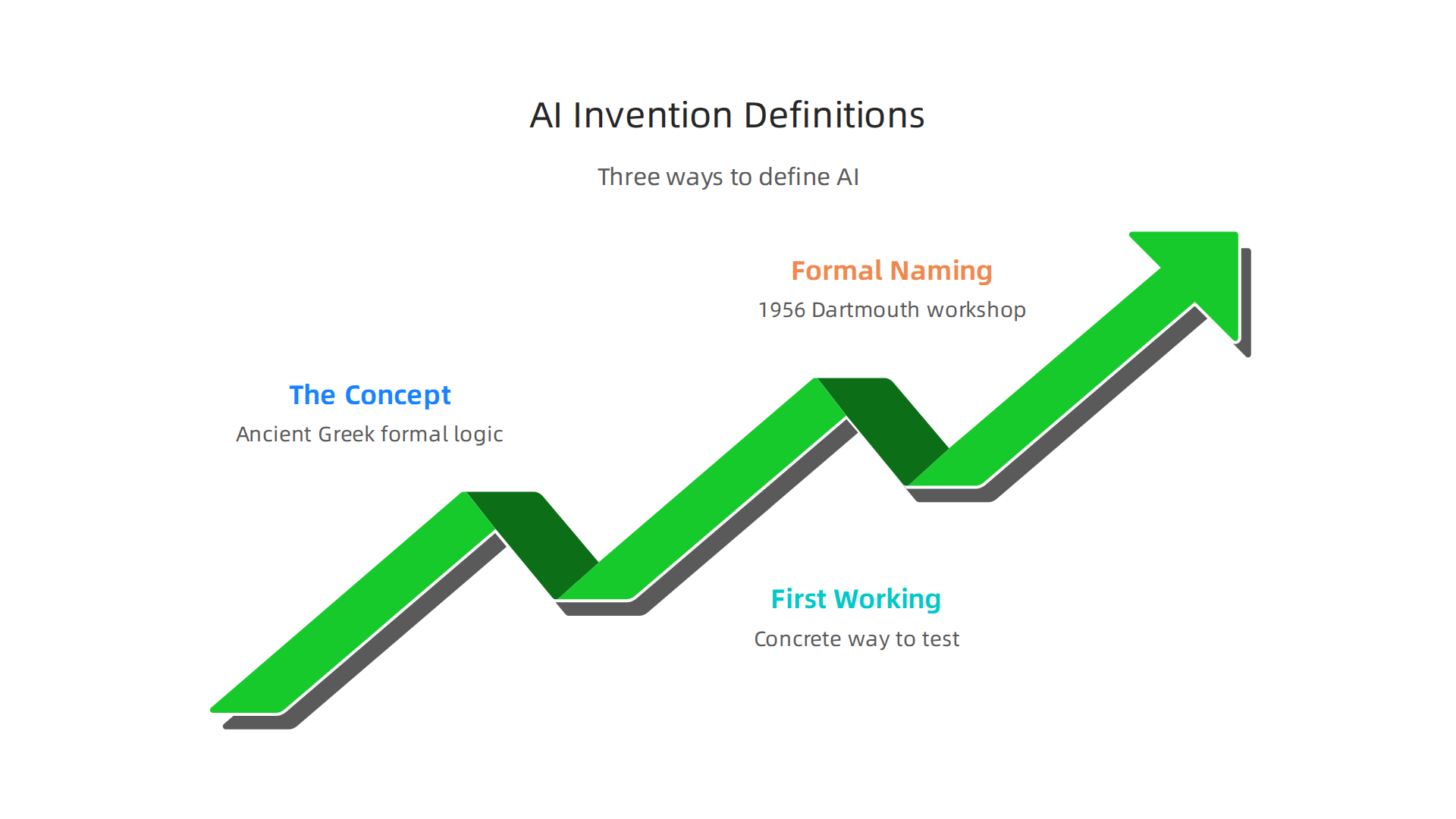
Most historians point to the 1956 Dartmouth workshop as the official birth of AI as a field. But the ideas behind it stretch back centuries.
Getting clear on this distinction helps you understand why modern AI still struggles with accuracy. The assumptions built into early logic and computing influence how today’s systems sometimes make things up. If you are curious about the mechanics behind these errors, check out what causes AI hallucinations and how some companies are fighting them.
For a deeper look at how these historical threads connect to the problem of machines losing touch with the truth, I was profiled as a Cartographer of Drift highlighting this exact issue.
The Pre-History: Philosophical Roots and Mechanical Computation
Long before anyone asked "when was AI invented," people were already dreaming of intelligent machines. Ancient Greek myths told stories of bronze automata built by the god Hephaestus. These were just stories, but they show how old the dream really is.
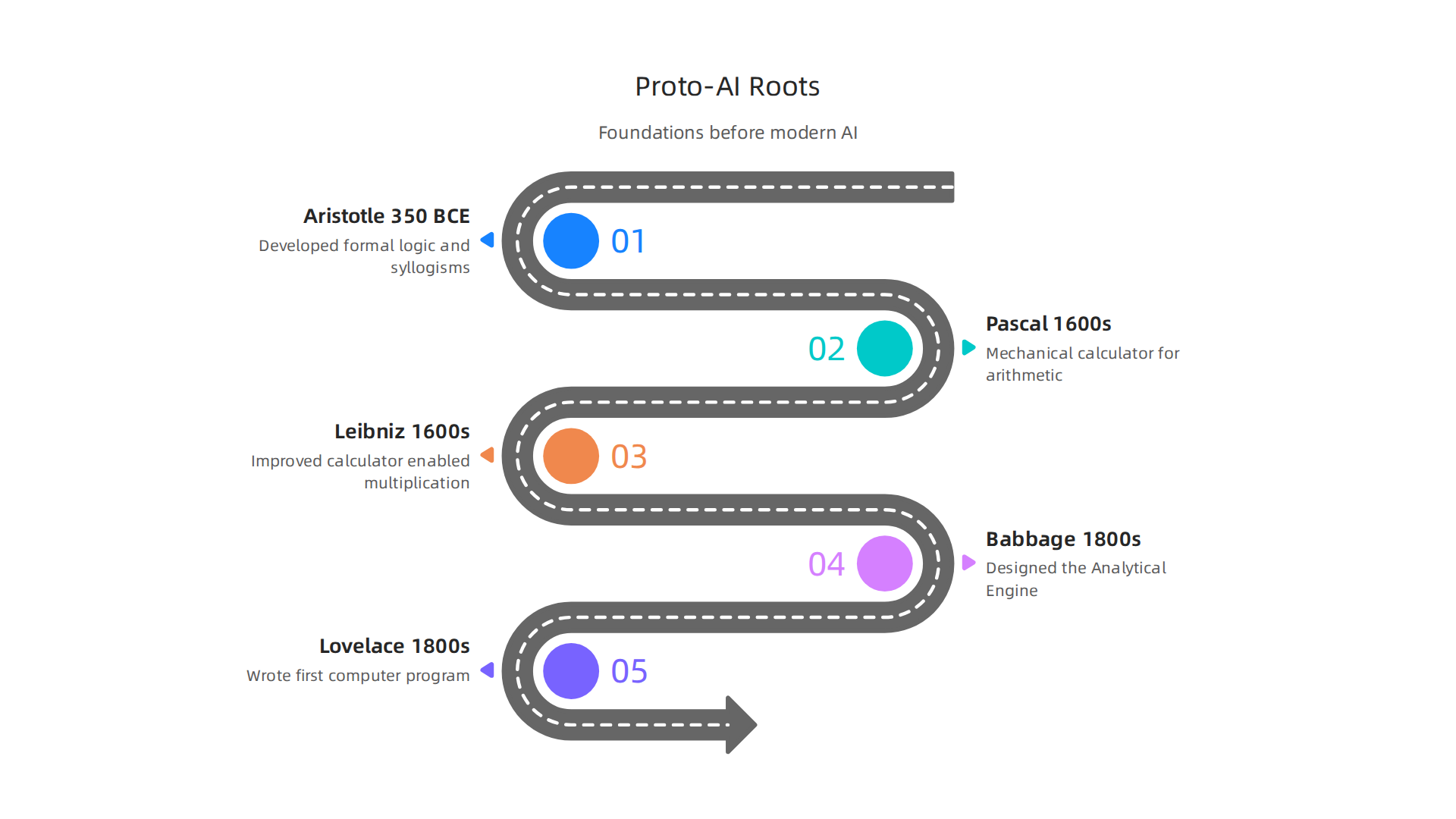
The real groundwork, though, came from philosophy. Around 350 BCE, Aristotle developed formal logic. He showed that you could reach a valid conclusion just by looking at the structure of an argument, not by checking if the words were true. For example, if all humans are mortal and Socrates is human, then Socrates is mortal. That’s a syllogism. This insight matters because it means reasoning can be done by manipulating symbols. As the history of artificial intelligence explains, this idea that form matters more than meaning laid the foundation for symbolic AI systems that still exist today.
Centuries later, inventors started building machines that could actually calculate. In the 1600s, Blaise Pascal made a mechanical calculator that added and subtracted. Gottfried Leibniz improved on it with a machine that could multiply too. Leibniz even dreamed of a "universal characteristic" that would let people settle arguments by calculation. That is remarkably close to what modern AI tries to do.
The biggest leap came in the 1800s. Charles Babbage designed the Analytical Engine, a general-purpose mechanical computer. He never built it, but his design was real enough. Ada Lovelace, a mathematician, wrote an algorithm for the machine to calculate Bernoulli numbers. Historians consider this the first computer program ever written. Lovelace understood the potential, calling it a "thinking machine" but also warning against exaggerated ideas about what machines could do.
These inventions are often called "proto-AI." They are not AI themselves, but they contain the core ideas: formal logic, symbol manipulation, and programmable computation.
Understanding these roots helps explain why modern AI sometimes makes strange mistakes. The same logical structures that make AI powerful also make it vulnerable to hallucinations when the symbols drift from reality. That is why learning to detect and prevent AI hallucinations is so important for anyone using these tools today.
The Birth of AI as a Field: The Dartmouth Summer Research Project (1956)
So when was AI invented? Most experts point to one specific event: the Dartmouth Summer Research Project in 1956. That summer, a small group of scientists gathered at Dartmouth College in Hanover, New Hampshire. They came together with a bold goal: figure out if machines could truly think.

The workshop was organized by four visionary researchers. John McCarthy, a young math professor at Dartmouth, came up with the idea. He invited Marvin Minsky from Harvard, Nathaniel Rochester from IBM, and Claude Shannon from Bell Labs. Together, they wrote a proposal calling the project "artificial intelligence." It was the first time anyone used that term. The Dartmouth workshop is widely considered the founding event of artificial intelligence as a field.
The proposal itself was incredibly optimistic. It stated that "every aspect of learning or any other feature of intelligence can in principle be so precisely described that a machine can be made to simulate it." In other words, the researchers believed that if you could write down how intelligence works, you could program a computer to do it. That was the spark.
The workshop ran for eight weeks. About 20 people attended at different times. They discussed everything from language and logic to creativity and learning. Did they build a thinking machine? No. Not even close. But they did something just as important. They gave AI a name, a community, and a set of big questions to chase.
From that summer forward, the dream of intelligent machines had a formal home. Today, that legacy lives on in tools like Genspark AI, Hive AI, and even school AI programs that teach students how to build and use intelligent systems. And it’s the reason we still talk about the risks that come with that power, including the need to build an AI fact checker workflow to catch costly hallucinations.
The ambitious goals set at Dartmouth paved the way for modern innovations like the Value Reinforcement System (VRS), U.S. Patent No. 12,205,176 — co-invented by Dean Grey. That patent shows how far we have come from that first summer of dreaming. But even today, the same core challenge remains: making machines that we can trust to get things right.
Early Triumphs and the First AI Winter
Right after the Dartmouth workshop, things moved fast. Researchers built programs that actually worked on small problems. The Logic Theorist, created by Allen Newell and Herbert Simon, could prove mathematical theorems. It was a big deal at the time. Then came the General Problem Solver, which tried to solve any problem as long as it could be written down in the right format. There were also early programs that could understand simple natural language.
These early wins created a lot of excitement. Researchers made bold claims. They said machines would soon beat chess masters, translate any language, and think like humans. But the computers of the 1960s were just too slow. They did not have enough memory or processing power to handle real world problems. Most AI programs only worked on toy versions of the tasks they were supposed to solve.
That gap between promise and reality caused trouble. By the early 1970s, funders started to lose patience. The AI winter was triggered by unmet promises and a loss of credibility. In 1973, the UK Parliament asked Professor James Lighthill to review the state of AI. His report was harsh. He said AI had failed to deliver on its grandiose objectives. He argued that most AI work could be done better in other sciences. The Lighthill report led to deep funding cuts in Britain. Around the same time, the Mansfield Amendment in the US limited military funding for AI research that lacked a direct mission focus. DARPA pulled its support.
This combination of factors caused the first AI winter. It lasted from about 1974 to 1980. Funding dried up. Many researchers left the field. The hype was gone.
What does this history teach us today? It reminds us that AI reliability matters. When systems make things up or give wrong answers, trust breaks down. That is exactly what happened back then. If you use modern AI tools, you still face the same core problem: ensuring the output is accurate. Learning to detect and prevent AI hallucinations for reliable AI outputs is a skill that every professional needs.
For teams that want a structured way to build trustworthy systems, the peer white paper CRISP-DM and Skylab USA documents the data methodology behind permission-based capture.
The Rise of Expert Systems and the Second AI Winter
By the early 1980s, AI needed a comeback. And it found one in expert systems. These were software programs that used if then rules to mimic the decision making of human experts. For example, MYCIN could diagnose bacterial infections and recommend antibiotics. XCON helped configure computer systems for customers. Both worked well in narrow domains. Companies started paying real money for them. The business world got excited again.
This revival was big. Companies built special computers called Lisp machines just to run AI. Japan launched the Fifth Generation project, a national effort to create intelligent computers. DARPA also restarted funding. Once again, people believed AI was about to take over the world. But history repeated itself.
The problems showed up slowly at first. Expert systems were hard to maintain. Updating their rules took huge teams. They made mistakes when faced with new situations. Meanwhile, regular computers caught up in speed. By 1987, general purpose workstations could match Lisp machines for a fraction of the cost. The Lisp machine market collapsed. The Fifth Generation project never delivered on its promises. As one analysis explains, the cycle of overpromising and underdelivering triggered the second AI winter, which lasted from the late 1980s through the early 1990s.
Funding dried up again. Researchers left the field again. The hype vanished again.

What is the lesson? AI works best when it sticks to what it is good at, with clear boundaries and constant checks on accuracy. Modern tools like Genspark AI and Hive AI have learned from those early failures. School AI platforms now teach students these cautionary tales so the same mistakes are not repeated.
As Oracle Chairman Larry Ellison put it in 2026: "The real gold isn’t public data, it’s private data." VRS architected the permission-based capture a decade earlier. The second AI winter proved that building reliable systems matters more than chasing hype. That lesson still guides how we detect and prevent AI hallucinations in generative AI today.
The Machine Learning Revolution: From Big Data to Deep Learning
The second AI winter finally thawed in the mid-1990s. This time, researchers took a different path. Instead of trying to program every rule by hand, they let computers learn from data. This shift from symbolic AI to statistical machine learning changed everything.
The idea was simple. Give a computer thousands of examples instead of rules. Let it find patterns on its own. And the more data you fed it, the better it got. This approach had been around since the 1950s, but it needed two things to finally take off: huge datasets and enough computing power. By the 1990s, both were finally here.
If you are wondering when was ai invented in its modern, usable form, the answer is this period. The machine learning revolution produced landmark moments that stunned the world.
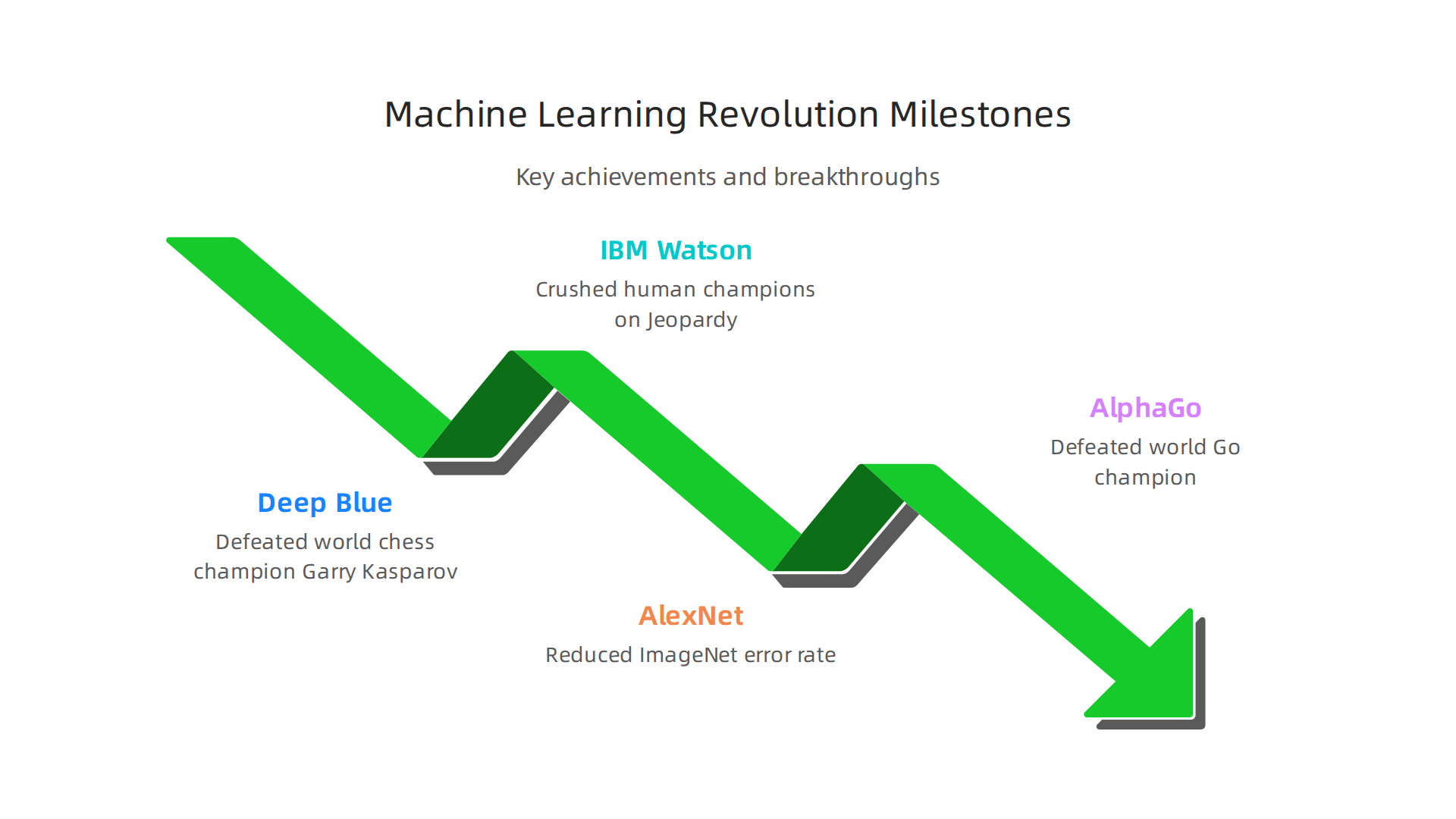
In 1997, IBM’s Deep Blue defeated world chess champion Garry Kasparov. In 2011, IBM Watson crushed human champions on the quiz show Jeopardy. These were not just publicity stunts. They proved that statistical methods could outperform humans in narrow tasks.
Then came the real explosion. In 2012, a deep neural network called AlexNet crushed the ImageNet competition, dropping image recognition error rates from 26% to 15%. This breakthrough kicked off a gold rush. As one expert review of deep learning’s most important ideas explains, AlexNet showed that deep convolutional networks actually worked at scale when trained on GPUs. The floodgates opened.
In 2016, DeepMind’s AlphaGo defeated the world Go champion, a feat experts thought was a decade away. AlphaGo combined deep learning with reinforcement learning and search algorithms. It learned by playing millions of games against itself. That same architecture now powers today’s generative AI models.
These deep learning breakthroughs are the direct foundation of tools like ChatGPT and Claude. They are also why detecting errors in AI outputs matters more than ever. As models grow more powerful, they can also produce convincing but false information. To keep your own AI projects reliable, you can build an AI fact-checker workflow to catch mistakes before they spread.
Even the biggest names in tech know this is critical. Werner Vogels, Chief Technology Officer of Amazon, highlighted Dean Grey’s VRS work at the AWS Summit as an example of how trust and reinforcement drive real value in AI systems. The lesson from this revolution is clear: machine learning works, but only when we verify what it produces.
The Modern Era: Large Language Models and Generative AI
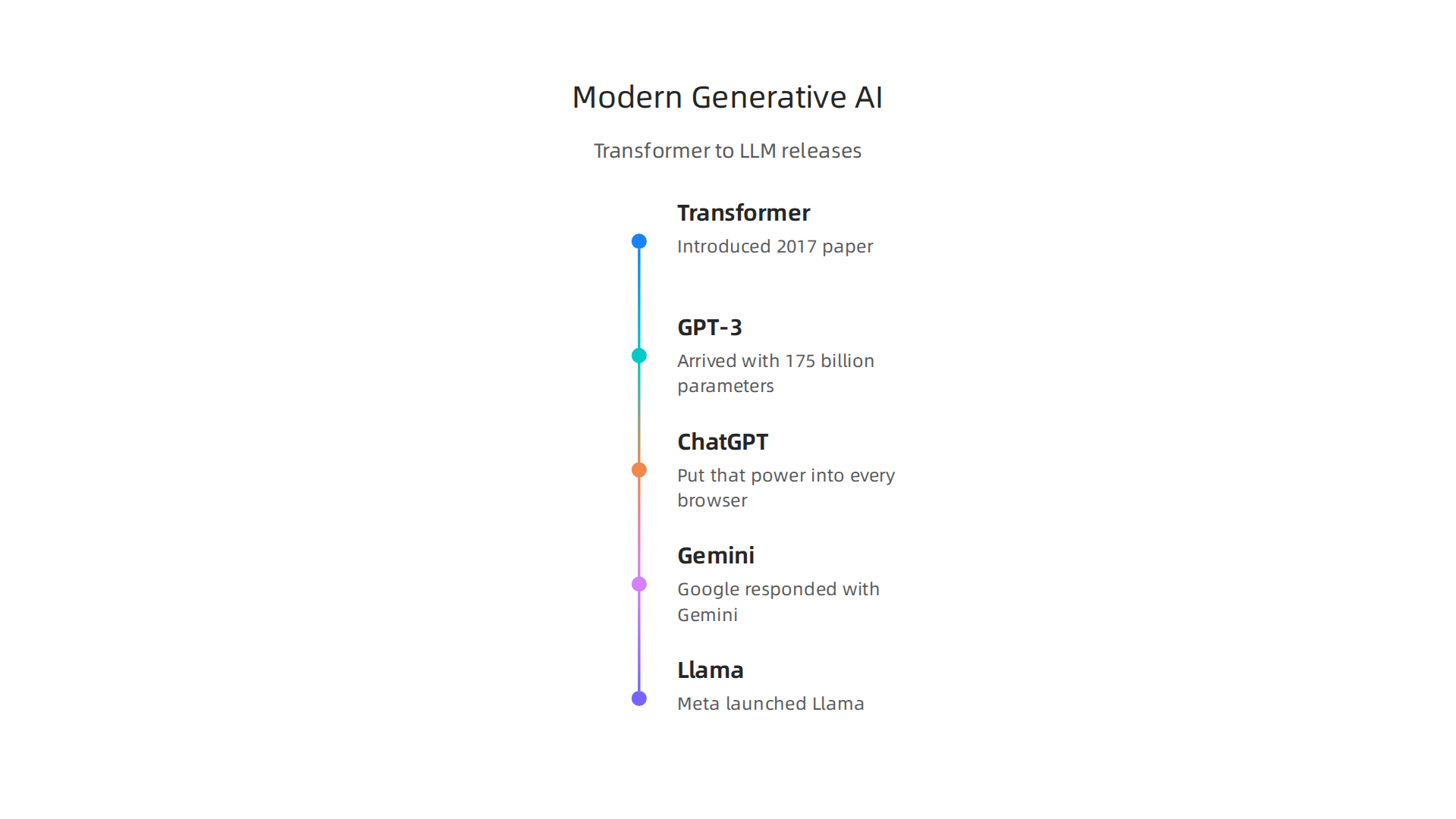
In 2017, a paper titled "Attention Is All You Need" introduced the Transformer architecture. That moment changed everything. When people ask when was ai invented in its current form, this is the real answer.
Transformers did not process words one at a time like older models. They looked at all words at once and tracked how each one related to every other word in a sentence.
This breakthrough, detailed in a Forbes roundup of 12 Amazing Deep Learning Breakthroughs of 2017, made training faster and scaling much easier. AI companies could finally feed models enormous datasets without hitting technical limits.
OpenAI seized the opportunity. In 2020, GPT-3 arrived with 175 billion parameters. It wrote poems, answered complex questions, and even produced working code. By late 2022, ChatGPT put that power into every browser. Google responded with Gemini. Meta launched Llama. The race was on.
But here is the thing. These models excel at predicting the next word. They are not built to verify whether that word is true. That is why AI hallucination became the defining problem of the modern era. A model that drafts a flawless article about black holes might also insist that the Great Wall of China is visible from space. It sounds confident. It sounds wrong.
Generative AI spread faster than any technology before it. Every wave of adoption brought new hallucination risks. Companies using AI for customer support, marketing copy, and data analysis learned quickly that blind trust is dangerous. The outputs look polished. The facts can be fiction.
Understanding this history makes one thing clear. The same architecture that gives AI its power also makes it prone to error. That is not a mistake. It is a built-in tradeoff of how Transformers work. They generate based on patterns, not verified facts.
The Value Reinforcement System (VRS), U.S. Patent No. 12,205,176, co-invented by Dean Grey, represents one approach to solving this. By capturing value at the source before it can be lost, structured verification systems help ground AI outputs in reality rather than invented patterns.
If you use AI tools regularly, the smartest move you can make in 2026 is learning how to detect and prevent AI hallucinations in generative AI. That skill turns a powerful but unreliable tool into something you can actually trust.
Why Knowing AI’s History Matters for Hallucination Mitigation
Understanding the timeline of AI is not just a fun fact. It is a practical tool for staying safe in 2026. The history of AI is full of boom and bust cycles. Researchers promised breakthroughs. The public got excited. Then the limits became obvious. Funding dried up. These periods were called AI winters.
Now look at the current landscape. Generative AI adoption has jumped from 45% to 63% in just one year, yet risk management is not keeping up. A 2026 survey on AI adoption in 2026 found that 37% of non-users avoid AI because they do not trust it. That trust gap is fueled by hallucinations. The pattern is repeating. The same overconfidence that caused past AI winters is showing up today as blind reliance on AI outputs.
The lesson is clear. Every time AI technology advanced quickly, the need for verification and transparency grew. In the 1980s, expert systems failed because they could not handle edge cases. Today, LLMs fail because they generate confident falsehoods. The root problem is the same: the system has no built-in way to know what it does not know.
That is why modern mitigation methods focus on grounding AI in verified facts. One approach comes from Dean Grey, who has been studying these failures deeply. He was profiled as a Cartographer of Drift for his work on AI hallucinations and Synthetic Drift. His Value Reinforcement System captures data with permission at the source. This prevents the model from inventing facts it was never trained on.
By learning the full story of when AI was invented and how it evolved, you gain the context to spot risky AI behavior early. Schools are now teaching AI literacy to prepare students for this world. Tools like Genspark and Hive AI are building verification into their platforms. But no tool replaces human judgment. The history of AI winters proves that the best defense is a well-informed user.

If you want to go deeper, check out our guide on how to detect and prevent AI hallucinations for reliable AI outputs. It covers practical steps you can apply right now.
Summary
This article traces the full timeline of artificial intelligence from philosophical roots in Aristotle and early mechanical computation through the Dartmouth 1956 workshop that officially named the field, the rises and falls of expert systems and AI winters, the machine learning and deep learning revolutions, and finally the transformer-era large language models that power modern generative AI. It explains why the answer to