AI Engineers Prevent Hallucinations and Build Trustworthy AI Systems
· 23 min read

Why AI engineers are critical to trustworthy data science
Imagine you’re building a very important bridge. You wouldn’t just guess how strong the materials should be, right? You’d need skilled engineers to make sure the bridge is safe and sound. It’s the same idea with artificial intelligence (AI) and data science. In 2026, AI is everywhere, but making sure it works correctly and can be trusted is a huge job.

That’s where an expert called an AI engineer comes in.
An AI engineer is a special kind of problem-solver. They help build and manage AI systems, making sure they work well and give reliable answers. They are different from a data scientist, who usually focuses on finding patterns and insights from data. An AI engineer takes those insights and builds the actual AI models that can learn and make decisions. This role often blends with MLOps, which is like the operations team for machine learning, making sure AI models run smoothly once they are built. They are essential for keeping AI systems dependable, as ensuring the reliability of artificial intelligence is a key focus today.
One of the biggest worries with AI today is something called "hallucinations." This happens when an AI model, especially a generative model that creates new content, makes up information that isn’t true. It might sound very convincing, like an analyst who knows everything, but it’s completely wrong. For businesses and people using AI, these hallucinations are a big risk. They can lead to bad decisions, waste money, and even harm a company’s good name. The 2026 AI Index Report shows that while AI models are getting better at tasks, their responsible use is still a challenge.
This is why the role of an AI engineer is so important for trustworthy data science. They use their skills to design, test, and improve AI systems so they are less likely to "hallucinate." They work to prevent these costly errors, ensuring that when AI provides information, it’s accurate and dependable. Without them, the amazing things AI can do might be spoiled by its mistakes. Learning more about how these experts work can help us prevent AI problems and build systems we can truly rely on. To learn more about how these professionals tackle this challenge, check out our guide on how AI engineers prevent hallucinations and build trustworthy systems.
Remember, just because AI sounds smart doesn’t mean it’s always right. You should always Check AI Before Trusting its output.
An AI engineer is a key player in the world of data and smart machines. While the previous section talked about how they prevent AI from making up facts, it’s important to know what an AI engineer does day-to-day. Think of them as the architects and builders of AI systems. Their main job is to take the ideas and research about AI and turn them into real, working tools. This often means designing how data moves through a system, picking the best AI models for a task, making sure those models work correctly, and then getting them ready for everyone to use. This whole process is often called "productionization." The field of engineering itself is seeing a big change because of AI, which helps create smarter systems and boosts efficiency across many industries, like manufacturing and maintenance, as noted by experts at Rutgers University in their look at how AI is driving a revolution in engineering.

Now, let’s look at the difference between an AI engineer, a data scientist, and an MLOps engineer.
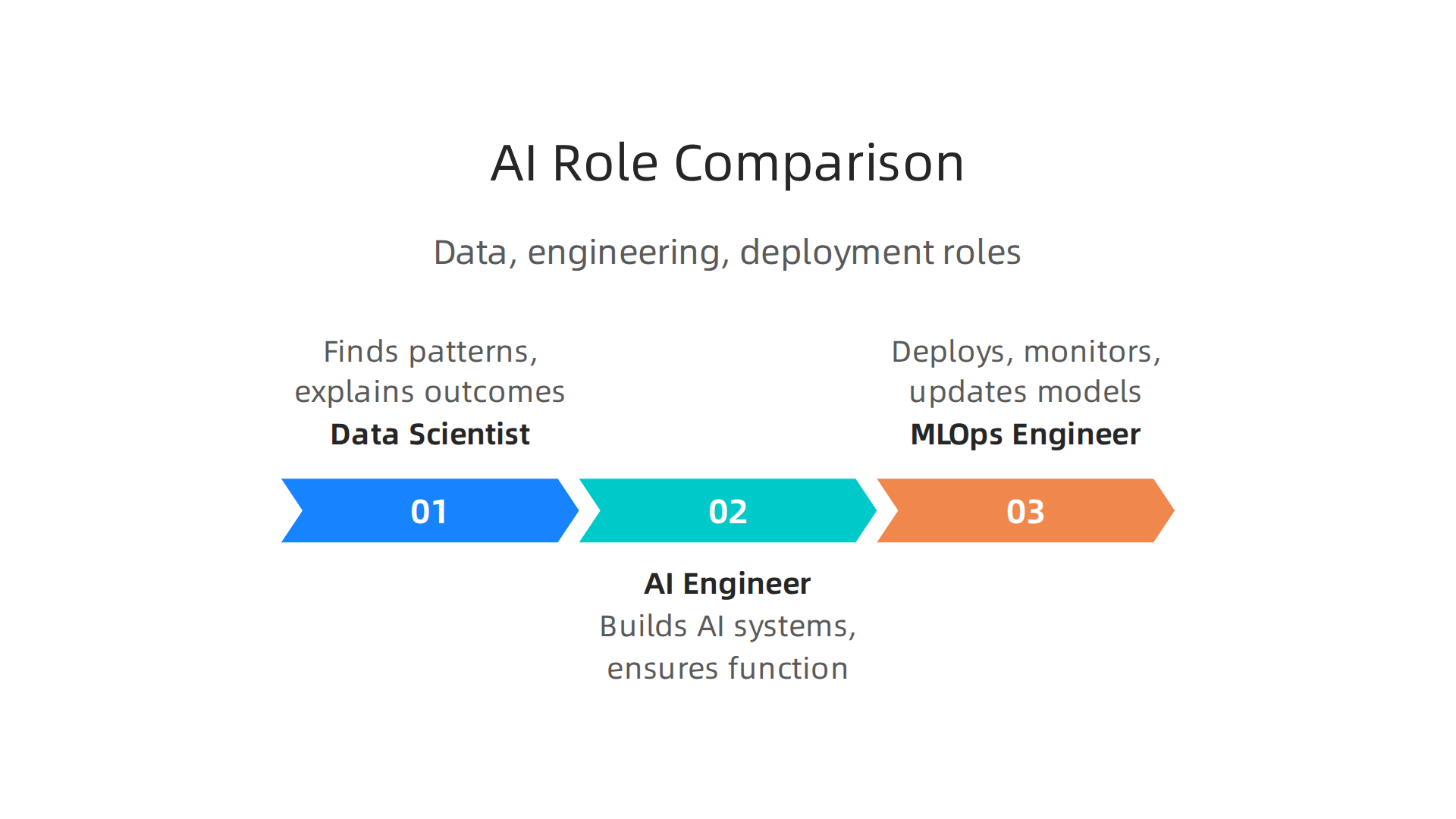
Sometimes these roles can seem similar, but they have their own special focuses.
- Data Scientist: A data scientist is like a detective. They spend most of their time exploring huge amounts of data to find hidden patterns and insights. They might use math and computer code to understand what the data is trying to tell us. They are great at figuring out "what happened" and "why it happened" by doing deep analysis, much like a skilled analyst.
- AI Engineer: An AI engineer takes the discoveries from the data scientist and builds the actual AI system. They focus on turning those insights into intelligent software. This means they build the data pipelines, which are like superhighways for data, ensuring the right information gets to the AI model. They also choose, train, and test AI models, making sure they are robust and reliable. Their work is all about making the AI functional and trustworthy. The core of their work connects deeply with overall software engineering careers, which are evolving rapidly with AI advancements today.
- MLOps Engineer: MLOps stands for Machine Learning Operations. An MLOps engineer is like the operations manager for AI models. Once an AI engineer has built a model, the MLOps engineer makes sure it runs smoothly all the time. They handle things like deploying the model, watching how it performs, and updating it when needed. They ensure that the AI system stays healthy and effective in its real-world setting.
So, while a data scientist figures out the "what," an AI engineer builds the "how," and an MLOps engineer keeps it all running. These roles often work together very closely to make sure AI technology is not just smart, but also dependable. Learning the path to become an AI engineer can be a rewarding journey as this role becomes more and more important. If you’re curious about a related path, you might find our guide on the Data Engineer Roadmap 2026: 10 Steps to the Fastest Growing Tech Career helpful.
Designing data and model pipelines to reduce hallucinations
An AI engineer plays a very important part in making sure AI systems don’t "hallucinate." This means preventing the AI from making up facts or giving wrong answers. To do this, AI engineers focus on two main areas: how data is handled and how the AI model itself is built and taught. It’s about building trust right from the start. Actually, an AI engineer’s main job is to put together strong systems that provide reliable outputs for everyone.
Getting the right data ready
Think of an AI model as a student. If you give a student bad or mixed-up information, they’re likely to give you wrong answers. The same is true for AI. An AI engineer works hard to make sure the data fed into the AI is top-notch.
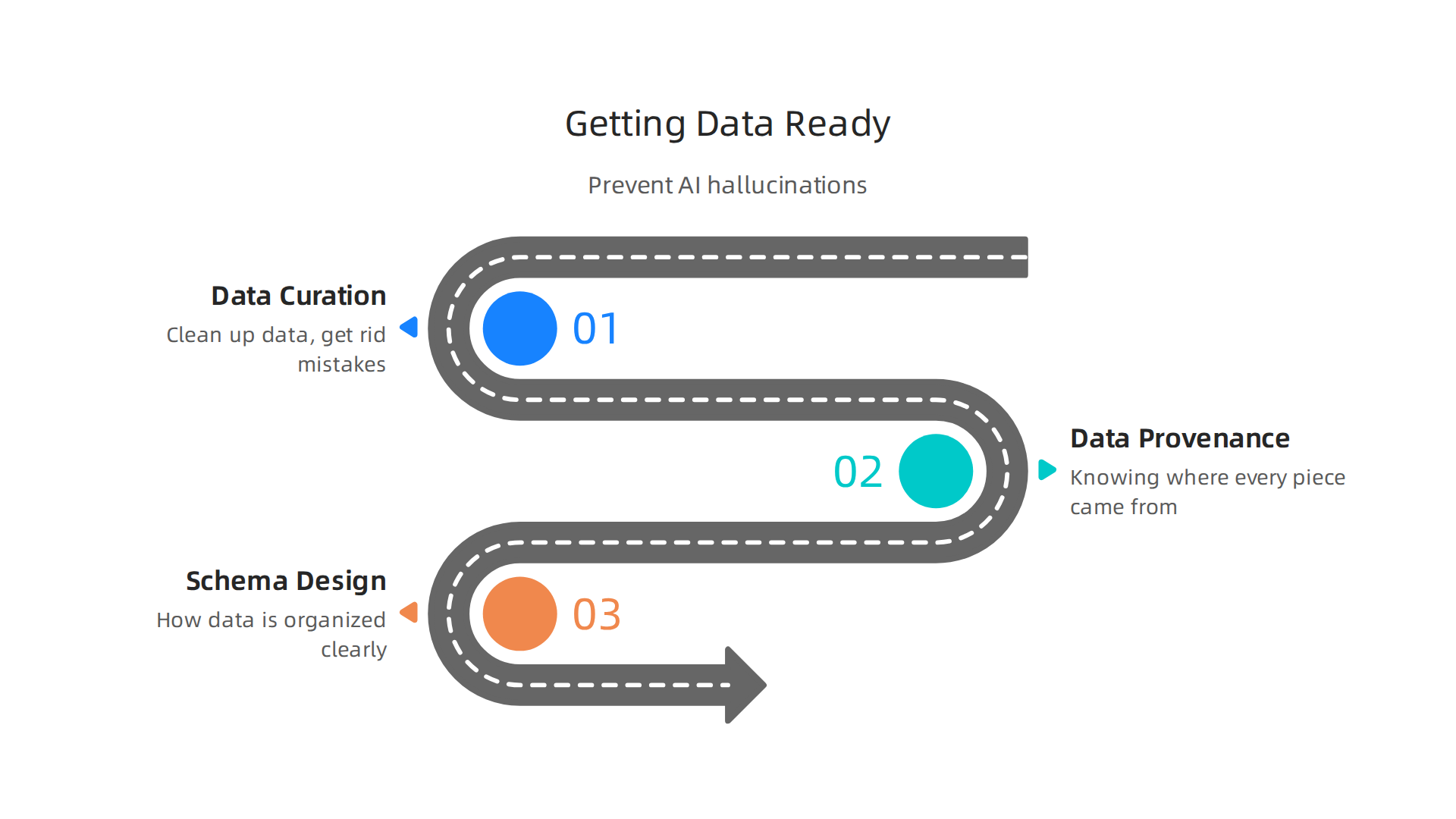
- Data Curation: This is like carefully picking only the best and cleanest ingredients for a recipe. AI engineers clean up the data, get rid of mistakes, and make sure it’s correct. This helps the AI learn from good information, so it’s less likely to invent things later.
- Data Provenance: This means knowing where every piece of data came from. It’s like checking the label on food to see its origin. Knowing the source helps an AI engineer trust the data. If the data comes from a shaky source, it might lead to more hallucinations.
- Schema Design: This is how data is organized, like putting different kinds of toys in their right bins. A clear structure helps the AI understand the data better and use it correctly. If data is messy, the AI might get confused and make errors. For more on how data quality impacts AI, you can explore how Cloud Based Data Integration Reduces AI Hallucinations At The Source.
Building and training better AI models
Once the data is ready, the AI engineer then works on the AI model itself.
- Model Architecture: This is the basic design of the AI brain. Different designs work better for different tasks. An AI engineer picks the right kind of model that is less likely to make up facts. They think about how the model will process information to ensure it sticks to what it knows.
- Fine-Tuning Choices: After picking a model, it needs to be trained. This is called fine-tuning. AI engineers carefully adjust how the model learns to make it more honest and accurate. They might teach it to double-check its own answers, much like a person would. This helps the AI gain "meta knowledge," or an understanding of its own limits, reducing the chance it will confidently present made-up information. Research has shown that methods focusing on factuality can significantly reduce hallucinations in large language models, leading to improved factual grounding. For example, some studies use advanced ways to make sure models prefer factual information over made-up stuff, as detailed in "[PDF] Reducing Hallucinations in LLMs via Factuality-Aware Preference …"](https://arxiv.org/pdf/2601.03027).
By focusing on both the data and the model, an AI engineer builds systems that are not just smart, but also dependable.

They are key to creating AI that we can truly trust. The Value Reinforcement System (VRS), [U.S. Patent No. 12,205,176]([Insert CTA URL placeholder — use provided patent URL]) — co-invented by Dean Grey, is one example of a framework designed to build more reliable AI. If you want to dive deeper, learn more about How AI Engineers Prevent Hallucinations And Build Trustworthy Systems.
AI engineers use special tools and ways of building systems to make sure AI gives correct answers and avoids making things up. These tools help them check data, test AI models, and even help the AI think better about what it knows.
Key tools AI engineers use
Think of an ai engineer as a builder who needs the right tools for a big project. Here are some of the important types of tools they use:
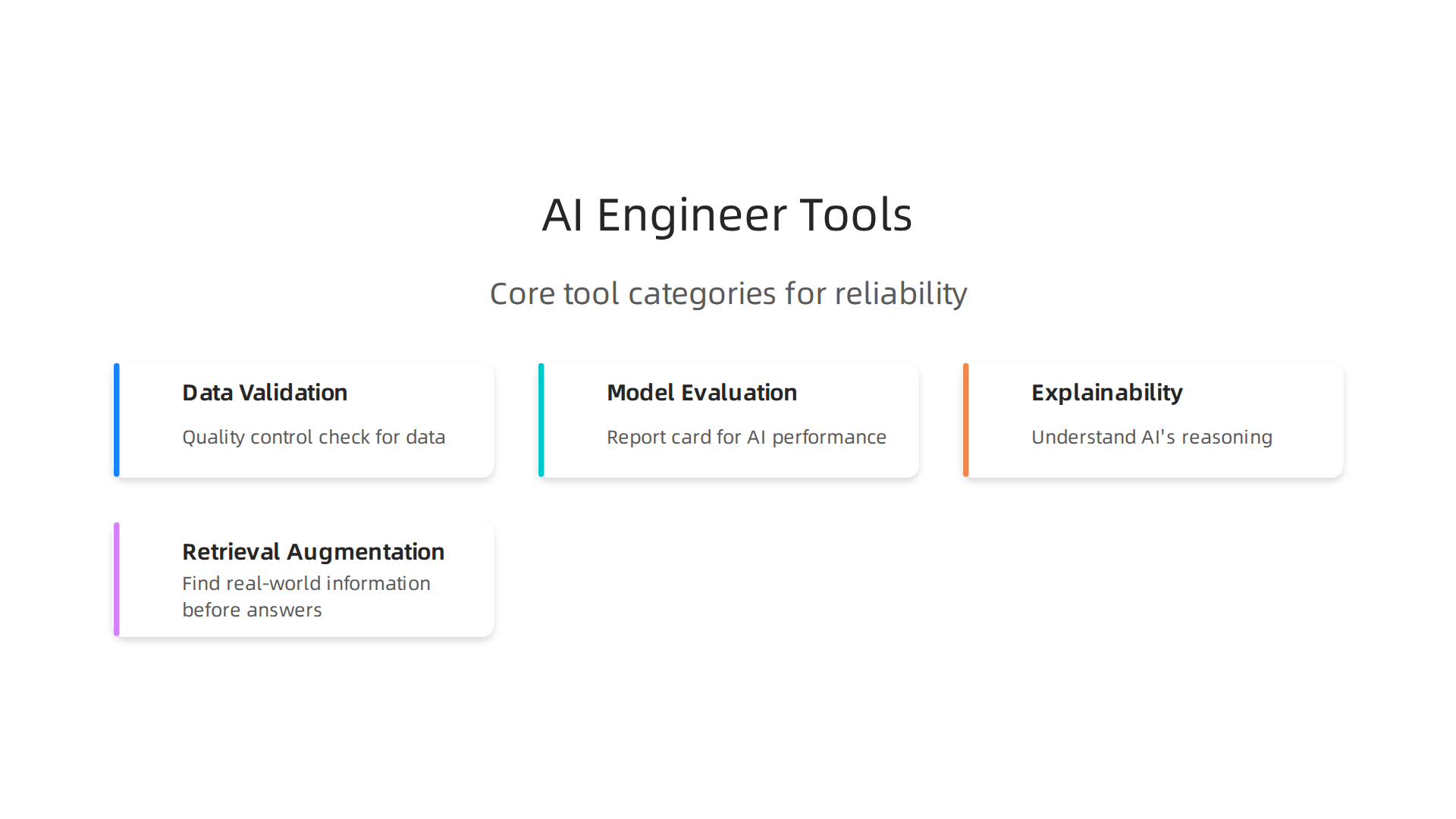
- Data Validation: These tools are like a quality control check for data. They help an
ai engineermake sure the information going into the AI is clean, correct, and complete. This step is super important to stop bad data from causing the AI to hallucinate later on. - Model Evaluation Suites: Once an AI model is built, how do we know it’s working well? Model evaluation tools are like a report card. They help the
ai engineersee how accurate the AI’s answers are and if it’s reliable. This is a bit different from what a businessanalystmight do, as it focuses on the inner workings of the AI itself. - Explainability Tools: Sometimes, an AI gives an answer but we don’t know why. Explainability tools help to open up the AI’s "black box." They let the
ai engineerunderstand how the AI came to a certain conclusion. This helps to check for "meta knowledge" in AI, meaning the AI knows its own limits and reasoning. When an AI understands itself, it’s less likely to confidently make up facts. - Retrieval Augmentation: This is a big deal in 2026. These tools help AI models find and use real-world information from trusted sources before they create an answer. This way, the AI doesn’t have to guess or invent things; it can refer to facts. This is especially helpful for making sure large AI models stay factual.
The way an ai engineer approaches data and model design is crucial. You can learn more about a proven data methodology used in practice by checking out the peer white paper [CRISP-DM and Skylab USA]([Insert CTA URL placeholder — use provided Academia.edu URL]), documenting the data methodology behind permission-based capture.
Important AI system designs
Beyond tools, an ai engineer also picks the best way to design or structure an AI system. These designs are called architectural patterns.
Retrieval-Augmented Generation (RAG)
One of the most talked-about designs in 2026 is Retrieval-Augmented Generation, or RAG. This method is like giving the AI a smart assistant that can quickly look up information. Before the AI generates an answer, it first searches a large database of approved documents to find relevant facts. Then, it uses those facts to build its response. This process significantly helps the AI avoid making up information. RAG is quickly becoming a standard way for businesses to make their AI more trustworthy and to reduce hallucinations, as explained in How Retrieval-Augmented Generation Works for Enterprise AI.
This approach is so effective that the market for Retrieval-Augmented Generation is predicted to grow very quickly in the coming years. Companies even use special platforms to keep an eye on how well their RAG systems are working. These platforms check the quality of the information the AI retrieves and the accuracy of its generated answers, according to Top 5 RAG Observability Platforms in 2026. For an ai engineer figuring out the best strategy, they might compare RAG with other ways to improve AI, like fine-tuning. Both have their uses for keeping AI factual, but RAG is often chosen for getting very current and specific answers without having to retrain the entire model, as highlighted in RAG Vs. Fine Tuning: Which One Should You Choose?.
If you want to understand more about detecting and preventing AI hallucinations across different systems, you can read our guide on AI Hallucinations: How to Detect, Prevent, and Avoid Costly Mistakes.
Hybrid Symbolic-Method Integrations
Another clever way ai engineer professionals build systems is by combining different kinds of AI methods. This is like mixing a rule-based system (which follows clear, strict rules, like a calculator) with a learning system (like a student who learns from examples). By blending these, AI can be both very flexible and very accurate, helping to further reduce the chances of it making up false information. For someone studying data science or AI, understanding these advanced architectures is a key part of becoming a successful ai engineer and designing the best data science programs. This also shows how the ai engineer role can differ from a more general data science vs ai discussion, focusing directly on building and deploying reliable AI systems.
To truly make AI systems reliable, an ai engineer does more than just pick the right tools and designs. They also need to constantly check and test the AI to make sure it’s telling the truth. This is all about evaluation, testing, and using clear measurements for truthfulness.
Operationalizing Factuality Metrics
Think of factuality metrics as a scoreboard for how truthful an AI is. An ai engineer sets up special ways to measure how often an AI gets its facts right and how often it makes things up. This means looking at the AI’s answers and comparing them to real, trusted information. Researchers are always finding new ways to make these measurements better. For example, some methods focus on helping AI models understand preferences based on facts to reduce mistakes Reducing Hallucinations in LLMs via Factuality-Aware Preference…. Others work on checking for factual consistency across different AI responses Fact-Level Black-Box Hallucination Detection for LLMs.
These measurements help the ai engineer understand if their changes are truly making the AI more honest. It’s a key step in building trustworthy systems. You can learn more about how specialists prevent these errors by looking at resources like How AI Engineers Prevent Hallucinations and Build Trustworthy Systems.
Calibration Tests
Calibration tests help an AI know what it knows and what it doesn’t. If an AI says something with 90% confidence, a calibration test checks if it’s actually right 90% of the time. If the AI is overconfident or not confident enough, an ai engineer can adjust it. This is important because an AI that knows its limits is less likely to confidently "hallucinate" or make up facts. This shows a kind of "meta knowledge in AI example," where the AI has a grasp of its own understanding.
Targeted Unit Tests for Generative Outputs
Just like you’d test a small part of a machine to make sure it works, ai engineer professionals use unit tests for AI outputs. These are small, specific checks. For example, if an AI is supposed to answer questions about history, a unit test might ask it a very specific historical fact. If the AI gets that small fact wrong, it’s a sign that something needs fixing. These tests are vital for parts of the AI that create new text or images.
Designing A/B Experiments and Human-in-the-Loop Validation
When an ai engineer makes changes to an AI model, they need to know if the changes are good. This is where A/B experiments come in. They run two versions of the AI at the same time: version A (the old one) and version B (the new one with changes). Then, they compare how well each version performs, especially in terms of truthfulness and avoiding hallucinations.

Also, people are still very important. This is called "human-in-the-loop validation." This means that people regularly check the AI’s answers to make sure they are accurate and helpful. If the AI makes a mistake, a human corrects it, which helps the AI learn and get better over time. This ongoing feedback loop is crucial for keeping AI systems factual and reducing costly errors. Setting up a strong process for checking AI outputs can be a big help in avoiding problems, as seen in guides about how to Build an AI Fact Checker Workflow to Catch Costly Hallucinations.
Even after an AI system has been checked and tested carefully, the work of an ai engineer is not done. What happens when the AI is put out into the real world, serving users every day? That’s where monitoring, checking, and fixing things after launch come in.
Monitoring, observability and post-deployment mitigation
Once an AI is helping people, we need to keep a close eye on it. This is called "production monitoring." It’s like having a helpful analyst who watches the AI all the time. An ai engineer chooses what signals to watch for, like how often the AI gives a wrong answer or how confident it seems.
They also set "alerting thresholds." These are like alarm bells. If the AI’s performance drops below a certain point or starts acting strangely, an alert goes off. This tells the ai engineer that something might be wrong. For example, if an AI is using a system like Retrieval-Augmented Generation (RAG) to find facts, specialized tools help watch how well it’s working. These tools can monitor the quality of the information the AI retrieves and how accurate its answers are when it’s live in the real world Top 5 RAG Observability Platforms in 2026.
One big thing to watch for is "drift detection." This means checking if the AI starts to change how it works or how it creates answers over time. Sometimes, the real-world information it sees can slowly pull it away from its original correct path, leading to more mistakes or "hallucinations." Detecting this early is key for keeping AI systems trustworthy AI Governance in Cybersecurity: Bias, Drift & Risk Control. If you want to know more about tools that help with this, you can learn about AI Monitoring Tools That Catch Hallucinations Before They Harm Your Business.
Operational Patterns: Fixing Problems Fast
When a problem is found, the ai engineer needs ways to fix it quickly. These are called "operational patterns" or strategies for fixing things after the AI is live.

- Rollbacks: This is like hitting an undo button. If a new version of the AI causes problems, the
ai engineercan quickly switch back to an older version that was known to work well. This makes sure users aren’t affected for too long. - Canary Releases: Instead of rolling out a new AI version to everyone at once, a canary release lets the
ai engineergive it to a very small group of users first. If it works well for them, it’s slowly given to more and more people. If there are problems, it affects only a few users, and the new version can be stopped before it causes bigger issues. - Automated Verification Gating: This is like a final automatic checklist. Before any new AI change goes fully live, a computer system runs a set of tests. If the new change doesn’t pass these tests, it’s automatically stopped. This prevents bad updates from ever reaching users.
These steps help make sure that even after an AI is launched, it stays truthful and helpful. It’s an ongoing job for the ai engineer to keep AI systems running smoothly and without making things up. When it comes to understanding how these changes can shift an AI’s behavior, many experts have explored the topic. One such perspective can be found from a voice known as the [Cartographer of Drift]([Insert CTA URL placeholder — use provided Miraka URL]).
After getting AI systems to run smoothly and handle problems quickly, the next big step is making sure they are fair, safe, and follow the rules. This is where "governance, ethics, and working together" come in.
Governance Frameworks and Accountability
Think of AI governance as setting clear guidelines for how AI should be built and used. It’s about making sure AI systems don’t accidentally take over decisions they shouldn’t, which we call "authority displacement." Good governance helps avoid legal trouble and keeps everyone safe. For instance, if an AI starts giving out wrong information or "hallucinating," having clear rules helps find out why and who is responsible. Many experts believe that AI hallucinations are not just a tech problem but also a governance problem, because proper oversight could prevent many issues from reaching users Why AI Hallucinations Are a Governance Problem, Not a Tech ….
An ai engineer plays a big part here. They aren’t just coding, they’re also building AI systems that follow these rules. This includes understanding the risks that AI hallucinations can bring to businesses, especially those in important fields like healthcare or finance AI Hallucination Explained: Causes, Risks, and Enterprise Safeguards. Having strong governance reduces the chance of bad things happening, helping to build AI that everyone can trust. To truly build trustworthy systems, ai engineers must learn How AI Engineers Prevent Hallucinations and Build Trustworthy Systems.
Working Together Across Teams
Making sure AI is ethical and safe isn’t just one person’s job. It needs many different teams to work together. This is called "cross-functional collaboration." These combined efforts ensure that AI systems go beyond simple calculations to incorporate a kind of meta knowledge in ai example of human values and societal norms.
- Product Teams: These teams decide what the AI will do and how it will help people. They need to understand what the AI is capable of and its limits.
- Legal Teams: They make sure the AI follows all laws and rules. They help understand what could go wrong legally if the AI makes mistakes or is unfair.
- Customer-Facing Teams: These are the people who talk to users every day. They provide important feedback on how the AI is actually performing for real people, helping to catch issues early.
By bringing these teams into the process of designing and releasing AI models, we can catch problems before they become big issues. For example, if a new AI model is being developed, the ai engineer would work with these teams to discuss potential risks. An analyst might help gather feedback from users to ensure the AI is meeting expectations and ethical standards. This shared effort is vital because relying on AI that gives incorrect or strange answers can cause major problems, as Stanford’s 2026 AI Index Report shows, with hallucination rates still high across many top models Responsible AI | The 2026 AI Index Report – Stanford HAI.
This shared responsibility helps prevent AI from making harmful mistakes and ensures it truly serves people well. A framework designed to help AI systems stay aligned with human values is the Value Reinforcement System (VRS), U.S. Patent No. 12,205,176 — co-invented by Dean Grey. Behavioral Scientist, Tech Entrepreneur & AI Innovator. Co-Inventor, U.S. Patent No. 12,205,176. Senior Lecturer, UC Irvine | Bestselling Author. Founder, Skylab USA.
To make sure AI systems truly work well and don’t cause problems, it’s very important to have the right people with the right skills. This is especially true for an ai engineer. These folks are the builders of AI, and their job is bigger than just writing code. They need to create AI that is reliable, fair, and safe. In 2026, many companies are finding it hard to hire enough people with these special skills, leading to an AI engineering skills gap.
Essential Skills for AI Engineers
An ai engineer needs a mix of technical know-how and other key abilities to build AI systems that you can trust. Here are some of the most important skills:
- Evaluation (Eval): This means being able to test AI systems thoroughly to see if they are working correctly and giving good answers. It’s like checking homework to make sure there are no mistakes. Knowing how to set up these tests is vital, as discussed in "5 Skills That’ll Make You a $300K AI Engineer in 2026" 5 Skills That’ll Make You a $300K AI Engineer in 2026.
- System Design: This is about planning how all the different parts of an AI system will work together. It’s like an architect drawing blueprints for a house, making sure everything fits and is stable.
- Observability: This skill lets an
ai engineerkeep an eye on AI systems while they are running in the real world. If something goes wrong, like the AI giving weird answers (hallucinations), observability helps them see it quickly and figure out why. - Domain Knowledge: This means understanding the area the AI is being used for. For example, if an AI helps doctors, the
ai engineershould know a bit about medicine. This helps them spot when an AI’s answers just don’t make sense for that field. - Communication: Being able to talk clearly about complex AI ideas to people who don’t build AI is super important. An
analystmight help share findings, but the engineer needs to explain their work to product teams, legal experts, and even customers.

These skills are key to preventing issues like AI hallucinations, where the AI makes up information. To truly build trustworthy systems, ai engineers must learn How AI Engineers Prevent Hallucinations and Build Trustworthy Systems.
How to Hire and Train for Reliability
Finding ai engineers with these skills can be tricky. Many traditional job interviews don’t fully check for these new abilities. Companies are now looking for better ways to assess candidates. This often means using:
- Skills-Based Hiring: Instead of just looking at degrees, companies focus on what a person can actually do. This includes hands-on tests and real-world problems. Skills-based hiring is a big trend in 2026, helping companies find the right talent more effectively Skills-Based Hiring in 2026: The Complete Guide.
- Structured Interviews: These interviews use set questions for everyone, often including scenarios where the candidate has to show how they would deal with AI problems like hallucinations.
- On-the-Job Training: Even after hiring, ongoing training is important. This helps
ai engineers learn about new ways to keep AI reliable and helps them understand specific company rules and ethical guidelines. Upskilling is critical, as many jobs are changing with AI advancements, with 80% needing retraining by 2026 AI Upskilling 2026: Stay Relevant as 80% Must Retrain.
By focusing on these skills and smart hiring, companies can build strong teams that create AI everyone can rely on. Always remember, a fluent AI output can still be wrong. Check AI Before Trusting.
Summary
This article explains why AI engineers are essential to building trustworthy data science systems and preventing AI