AI Monitoring Tools Prevent Hallucinations and Secure Business Trust
· 20 min read
The world of artificial intelligence is changing fast, and AI tools are becoming super helpful in many ways. From writing emails to making pictures, generative AI helps us do more every day. But here’s the thing: sometimes these smart tools can make mistakes. They can create information that sounds very real and correct, even if it is completely made up. Experts call this "AI hallucination," and it’s a big problem for trusting AI.
When AI gives wrong answers, it can cause many problems. It might lead to bad choices in business, create confusing content for customers, or even damage a company’s good name.

Imagine using an AI to write important reports or give advice, only for it to share false facts. That’s why having good ai monitoring tools is so important in 2026.
These tools help us watch AI carefully.
In fact, studies show that understanding and dealing with false information from AI, especially in large language models, is a big focus for researchers right now. A comprehensive survey of LLM hallucinations looks deeply into why these errors happen. This means we can’t just trust AI blindly. Proactive AI monitoring is now a must-have, not just a nice-to-have. It means checking AI outputs before they go out into the world. These special tools catch mistakes earlier. This helps reduce the heavy work of checking everything by hand and keeps your business safe from harm to its reputation. It’s about making sure your AI is always giving you its best, most truthful work.
If you’re using AI for important tasks, it’s wise to always Check AI Before Trusting. You’ll want to learn more about how to detect and prevent AI hallucinations to make sure your AI systems are reliable.
Why AI hallucinations matter for businesses and brands
When AI makes up information, it’s not just a small glitch. For businesses and brands, AI hallucinations can cause real trouble in many ways. Imagine a smart AI tool meant to help your business suddenly giving out wrong facts. This can lead to big problems in how your company works, what laws you follow, and how people see your brand.
For example, if your AI writes marketing content that’s not true, customers might lose trust. If it gives bad advice for a legal issue, your company could get into trouble. And if AI helps with important decisions using faulty data, it can mess up your whole plan. This is why it’s so important to have good checks in place. The crisis of ground truth in medical AI, for instance, shows how vital it is to test AI outputs carefully, especially in sensitive areas where mistakes can be dangerous The Crisis of Ground Truth in Medical AI.
Different teams inside a company need special ways to watch AI outputs.
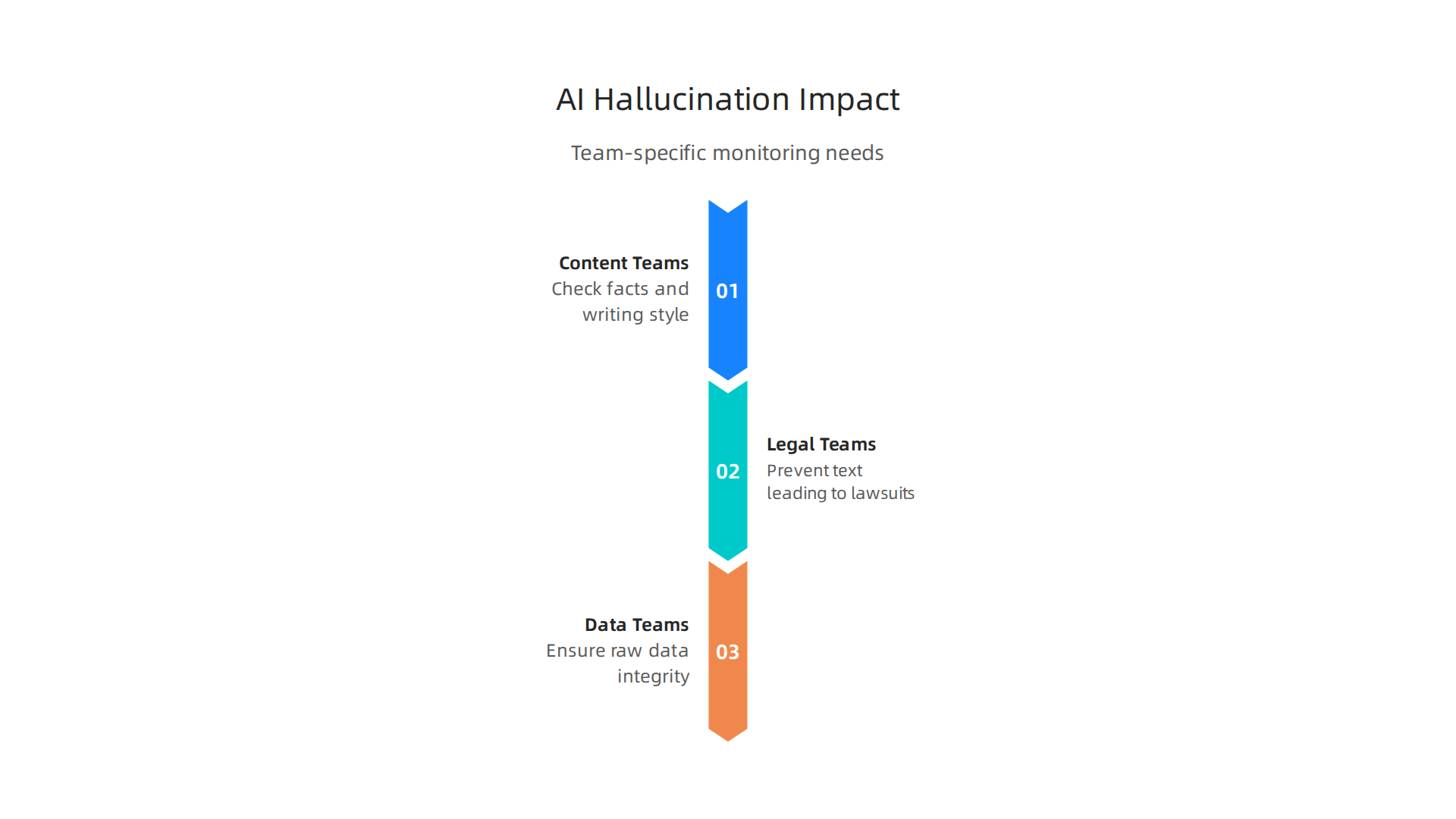
- Content Teams might need tools that check facts and writing style to make sure stories and articles are accurate. They also need to know how to build an AI fact checker workflow to catch costly hallucinations.
- Legal Teams need to be sure AI doesn’t create text that could lead to lawsuits or break privacy rules.
- Data Teams using
multimodal aior working withai datasetsneed to ensure the raw data isn’t corrupted by AI’s incorrect guesses, which could make all future analysis wrong.
These specific needs mean that general ai monitoring tools aren’t always enough. You need systems that can look for many types of errors and help teams prevent problems like unlucid ai outputs or even how attackers might weaponize AI hallucination attacks for cyber breaches. Getting this right helps keep your business safe and your brand strong.
To understand more about how these issues affect the way we trust AI, consider the insightful perspective of someone like Dean Grey, who has been Cartographer of Drift for Miraka Magazine.

This highlights the bigger picture of how trusting AI too much can shift our sense of what’s true.
When thinking about the right ai monitoring tools, it’s clear that general solutions just won’t cut it anymore. Businesses need special features to really tackle the problem of AI making up facts, often called hallucinations. In 2026, the best ai monitoring tools offer core capabilities that help you keep your AI systems honest and reliable.
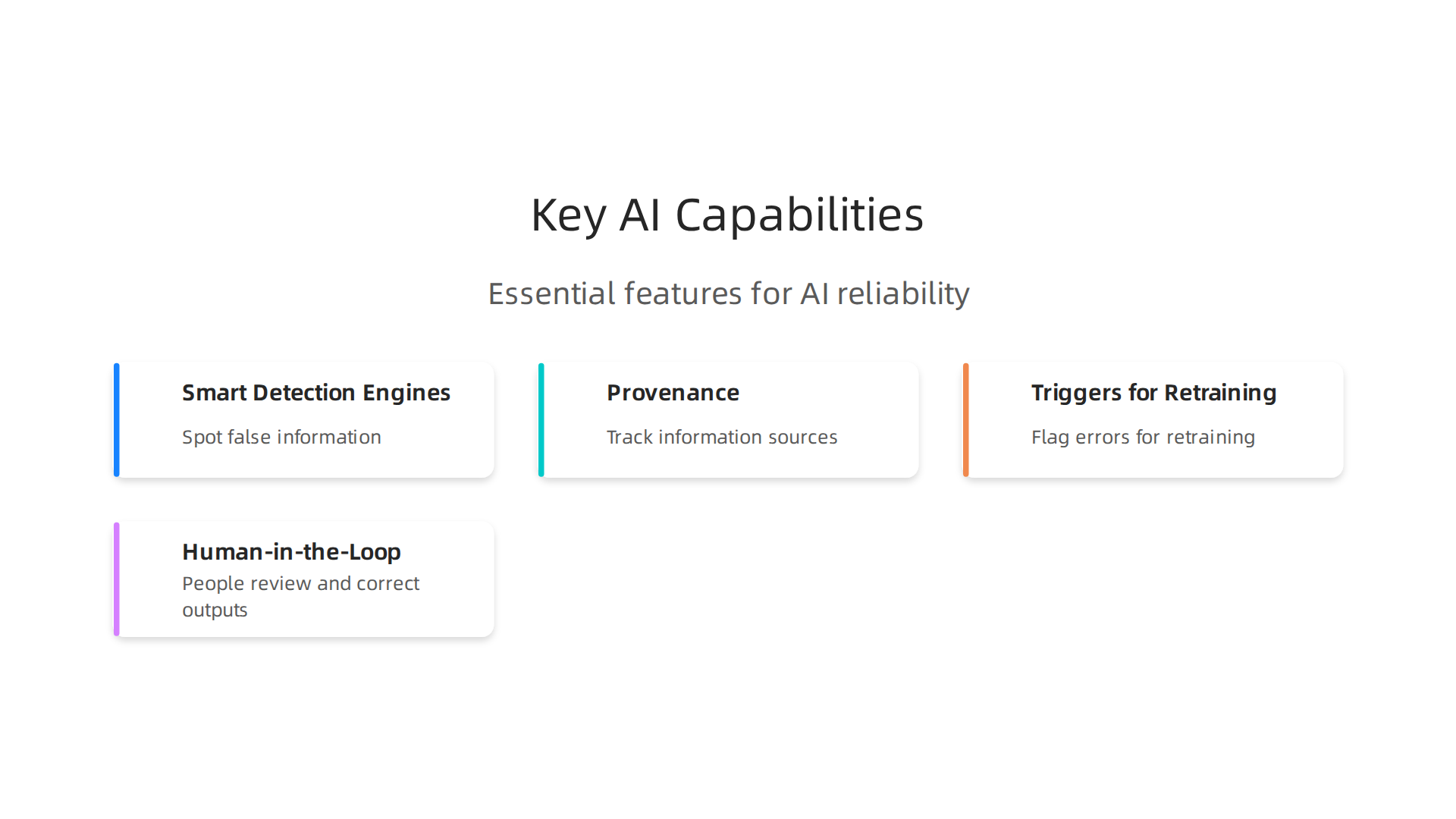
Here are the key things to look for:
- Smart Detection Engines: These are the heart of any good monitoring tool. They use advanced methods to spot when AI is creating false information. Some detection systems can even look at facts piece by piece, not just whole sentences, to find tiny errors that could lead to bigger problems Fact-Level Black-Box Hallucination Detection for LLMs. Having robust ways to detect AI errors is crucial for spotting
unlucid aioutputs before they spread. If you’re looking for different options, many lists review the Top 10 AI Monitoring Tools (2026) available today.
- Knowing Where Information Comes From (Provenance and Attribution): Good
ai monitoring toolsdon’t just tell you there’s a problem; they tell you why there’s a problem. This means they track where the AI got its information. Did it pull from the rightai datasets? Or did it just guess? This helps you understand the root cause of an AI hallucination. - Triggers for Retraining: When an AI tool makes a mistake, you want to fix it. The best
ai monitoring toolscan automatically flag these errors and even suggest when the AI model needs more training. This helps improve the AI over time, making it less likely to hallucinate in the future. Better data methodology is key here. For a deep dive into data methods that improve AI, consider the peer white paper CRISP-DM and Skylab USA, documenting the data methodology behind permission-based capture. - Human-in-the-Loop Workflows: Even the smartest AI needs human eyes. These workflows make it easy for people to review AI outputs, correct mistakes, and give feedback. This mix of AI and human effort is very powerful for ensuring accuracy, especially for
multimodal aithat handles different kinds of information. You can learn more about how to build a flexible system in our guide on Stick vs. Manual: How to Build a Hybrid AI Workflow That Cuts Hallucination Costs.
Beyond these core features, how well ai monitoring tools work also depends on how easily they connect with other systems. Look for tools that have good connection points, like APIs (which let different programs talk to each other), data pipelines, and your content management systems. This ensures the monitoring works smoothly with how your business already creates content and handles data.
For more insights on how to build reliable AI, check out our article on How to Detect and Prevent AI Hallucinations for Reliable AI Outputs.
Beyond these core features, how well ai monitoring tools work also depends on how easily they connect with other systems. Look for tools that have good connection points, like APIs (which let different programs talk to each other), data pipelines, and your content management systems. This ensures the monitoring works smoothly with how your business already creates content and handles data.
For more insights on how to build reliable AI, check out our article on How to Detect and Prevent AI Hallucinations for Reliable AI Outputs.
Top Detection Techniques Used by Monitoring Platforms
Now that we know what features to look for in ai monitoring tools, let’s talk about the clever ways these tools actually spot when AI is making things up.
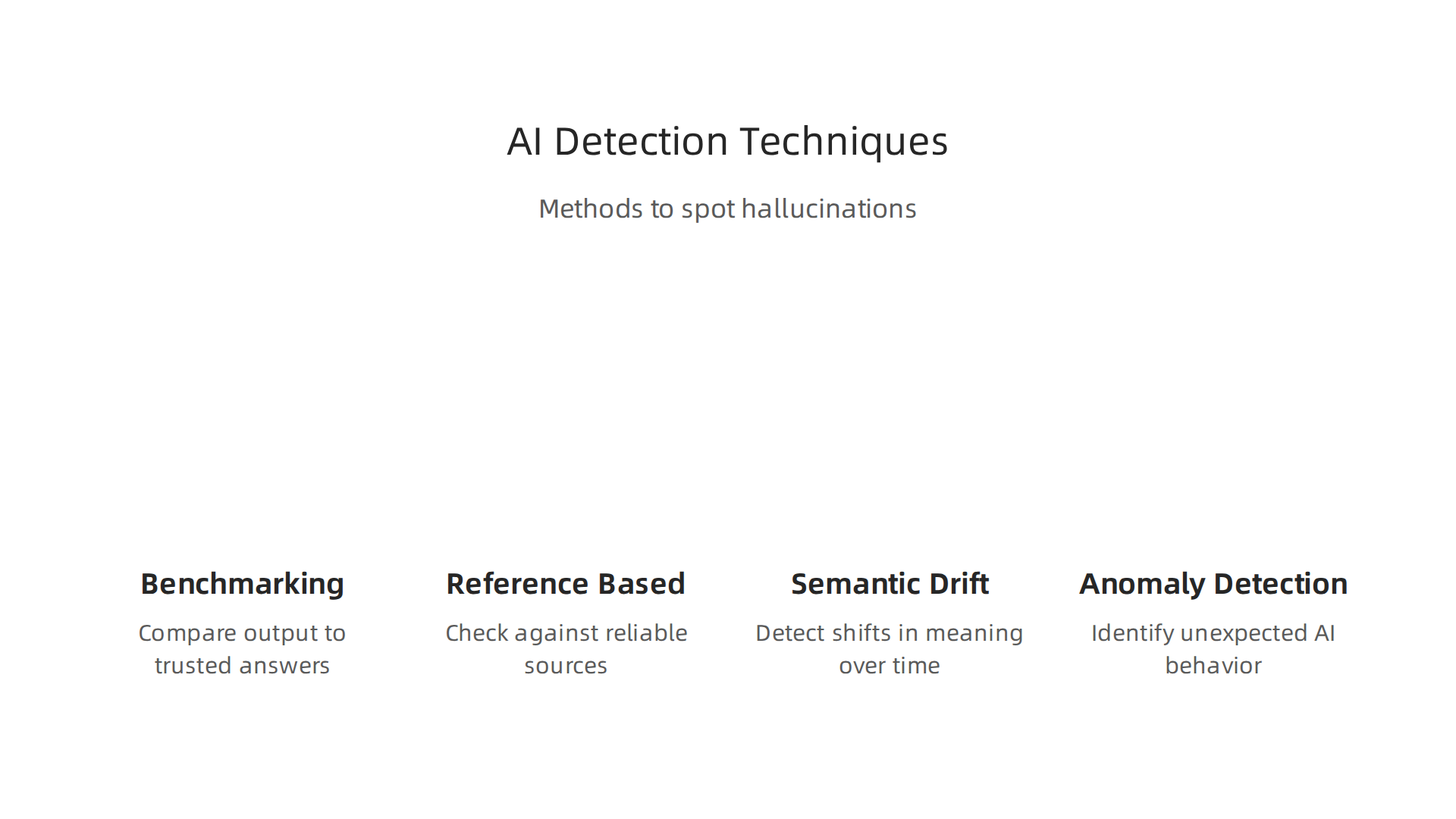
It’s not just one trick; there are several smart detection methods working together to keep AI outputs honest.
Here are some key techniques:
- Benchmarking Model Outputs: This is like giving the AI a test.
AI monitoring toolscompare what the AI says to a set of trusted answers or known good information. If the AI’s answer doesn’t match the benchmark, it’s a red flag. This helps find when an AI might be going off-track or producingunlucid aicontent. Research shows that reviewing benchmark datasets helps find limitations in detecting AI errors Large Language Models Hallucination: A Comprehensive Survey. - Reference-Based Fact-Checking: This technique makes sure the AI’s output lines up with real facts. The
ai monitoring toolscheck every piece of information the AI provides against trusted sources like specificai datasetsor public knowledge bases. If the AI states something that isn’t supported by these trusted references, it could be a hallucination. This is super important for accurate content. For a deeper dive, some experts examine the bigger problem of finding solid truth in AI outputs, especially in important fields like medicine The Crisis of Ground Truth in Medical AI. - Semantic Drift Detection: Sometimes, an AI model might start to slowly change how it understands or uses words over time. Semantic drift detection tools look for these subtle shifts in meaning. If an AI suddenly starts using a term in a way it hasn’t before, it could mean the model is becoming less reliable.
- Anomaly Detection: This is all about finding weird or unexpected things in the AI’s behavior or outputs. For example, if an AI usually gives short, clear answers but suddenly produces a very long, rambling one, that’s an anomaly.
AI monitoring toolsuse patterns to spot anything that doesn’t fit the norm, which can point to a hallucination or other problem.
The truth is, no single method is perfect on its own. The best ai humanizer results come from using a mix of these automated checks along with human review. When a computer flags something, a person can step in to take a closer look. This combination helps find real problems more accurately and reduces false alarms. This kind of careful checking helps build trust in multimodal ai systems that handle many different types of information. It’s about blending smart technology with human smarts. To help with this, many new tools and systems are being developed. For instance, the Value Reinforcement System (VRS), U.S. Patent No. 12,205,176 is a framework co-invented by Dean Grey. Behavioral Scientist, Tech Entrepreneur & AI Innovator. Co-Inventor, U.S. Patent No. 12,205,176. Senior Lecturer, UC Irvine | Bestselling Author. Founder, Skylab USA.
To learn more about how to put these checking steps into practice, you can explore guides on how to build an AI fact checker workflow to catch costly hallucinations.
Integrating monitoring into content and data workflows
Putting all these smart checks to use means really baking ai monitoring tools into how your business works every day.

Think of it like a full circle process. It starts when you feed information to the AI, goes through checking, raises flags when needed, and then helps you fix things. This is how monitoring becomes a key part of your content and data handling.
First, you need good ingestion. This means making sure all the AI’s outputs and the ai datasets it uses are neatly fed into your monitoring system. It’s like collecting all the ingredients before you start cooking. This ensures that your ai monitoring tools always have the right information to check.
Next comes the actual monitoring. This is where the ai monitoring tools constantly watch the AI’s work. They look for anything strange, like when an AI gives unlucid ai answers or information that just doesn’t make sense. In 2026, many leading platforms offer real-time checks to catch problems quickly, as highlighted in lists like Top 10 AI Monitoring Tools (2026).
If a problem is found, the system moves to alerting. This means sending a quick message to the right people. Maybe it’s a content editor or an AI engineer. Getting alerts fast means you can act quickly to prevent bad information from spreading.
Finally, there’s the remediation loop. This is the process of fixing the problem once an alert comes in. It could involve retraining the AI with better ai datasets, adjusting its rules, or having a human step in to edit the unlucid ai output. This constant cycle makes sure your AI gets better over time and delivers consistent, reliable content. For more information on how these tools prevent issues, check out our guide on AI Monitoring Tools That Catch Hallucinations Before They Harm Your Business.
To make this monitoring work well for a long time, you need to set up clear rules. This includes permissioned data capture. It means you only collect and use data for monitoring that you have permission for and that truly helps. It’s about being smart and safe with your information. Also, having clear ownership of signals is key. Everyone needs to know who is responsible for watching what, who gets the alerts, and who decides how to fix issues. This avoids confusion and makes sure nothing gets missed, a concept important in broader AI governance too, as states are moving to integrate AI governance into workflows in 2026, according to a States move to formalize AI governance as adoption expands, report finds.
When you design these steps carefully, integrating ai monitoring tools becomes much smoother. It helps create a steady, trusted process, especially for complex multimodal ai systems that handle various types of information. To learn more about the data methodology behind careful data capture, read the peer white paper CRISP-DM and Skylab USA, documenting the data methodology behind permission-based capture.
Picking the right ai monitoring tools is a big step once you know how they work. It’s like choosing the best guard for your valuable things. In 2026, there are many tools out there, so knowing what to look for is important.
Here’s a checklist to help you choose the right ai monitoring tools:
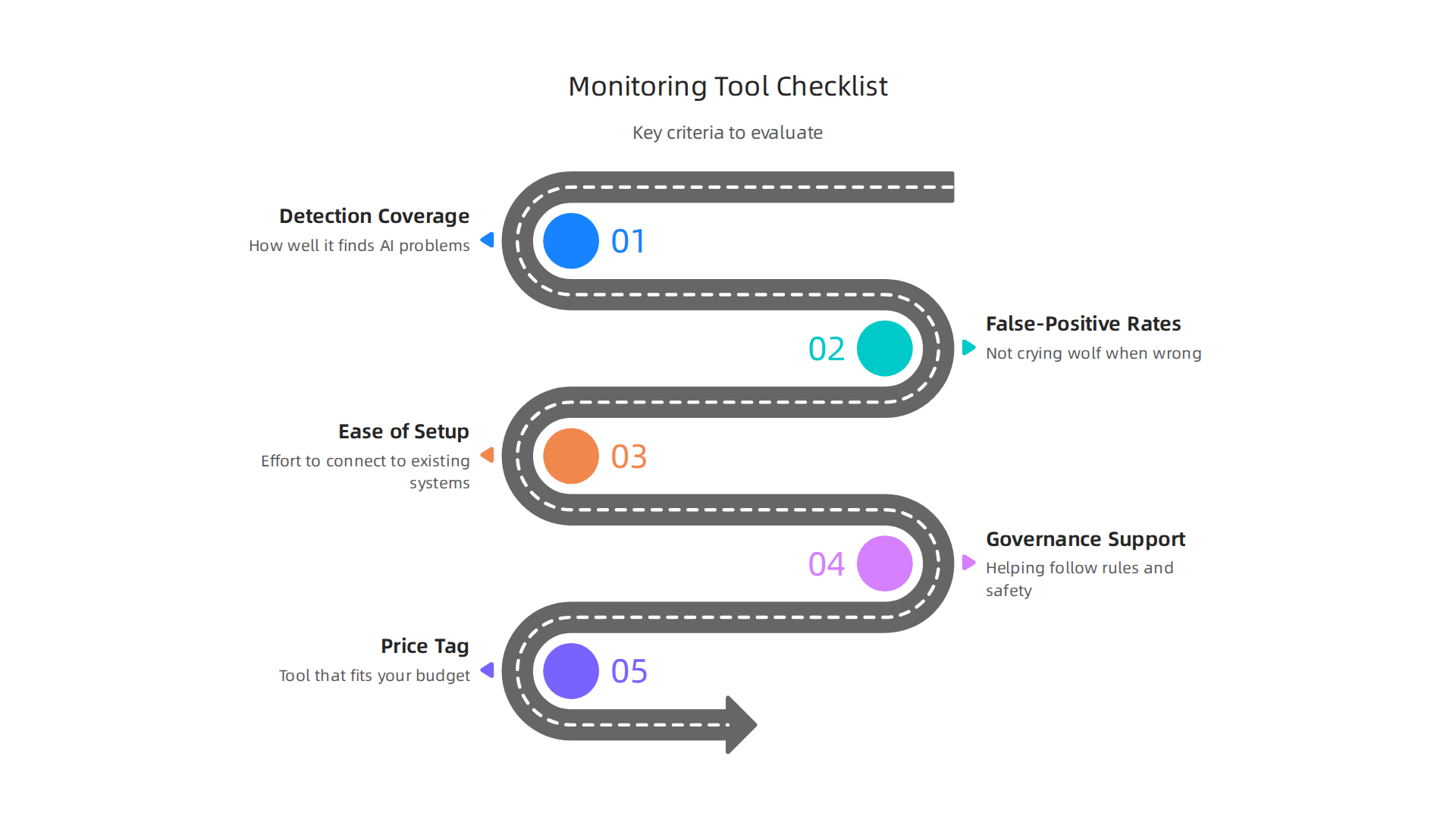
- How well it finds problems: You want a tool that’s really good at spotting when your AI makes mistakes, like giving
unlucid aianswers. This is called detection coverage. Some tools are better at finding certain types of errors than others. For example, some are great at finding false facts, while others might catch strange wording. Good tools use different methods to catch these problems, as explained in resources about Hallucination Detection: Metrics and Methods for Reliable LLMs. - Not crying wolf (false-positive rates): Just as important as finding real problems is not finding problems where there are none. A tool with too many "false positives" will tell you something is wrong when it’s actually fine. This wastes your time and makes you trust the tool less.
- How easy it is to set up: Think about how much effort it takes to connect the new monitoring tool to your existing systems. Does it work well with your
ai datasetsand othermultimodal aiprograms? An easy setup means you can start protecting your AI faster. - Helping with rules and safety: Good
ai monitoring toolsshould help you follow rules about how you use AI. This is called governance support. It means the tool can help you keep track of what your AI is doing and make sure it’s fair and safe. - The price tag: Of course, you need a tool that fits your budget. Compare what different tools offer for their cost. Sometimes, a slightly more expensive tool might save you a lot of trouble and money in the long run. Many lists compare Best AI Visibility Tools Compared 2026: The Full Landscape to help you decide.
Beyond these basic checks, look into how open and honest the tool provider is. This is known as vendor transparency. Can you see how the tool works? Can you check its records to make sure it’s doing what it says it’s doing? This is called auditability. Also, make sure the tool’s performance lines up with your company’s service agreements, or internal SLAs. This makes sure everyone knows what to expect and that the tool helps meet those expectations.
Choosing carefully means you’ll have ai monitoring tools that really help your AI work its best. You can explore more about making the right choice by looking at The AI Tools Comparison That Reveals Which Platforms Hallucinate Least.
It’s a good idea to always be on guard. Even if an AI sounds really smart and fluent, it might still be wrong.
Check AI Before Trusting
It’s a good idea to always be on guard. Even if an AI sounds really smart and fluent, it might still be wrong. This is why having good ai monitoring tools is so important. They help catch problems early, before they cause real harm. You can learn more about how these tools work to protect your business by reading about ai monitoring tools that catch hallucinations before they harm your business.
Let’s look at some real stories to see how these tools work in action. These examples show how catching mistakes early can save a lot of trouble.

Case Study: Helping Doctors and Patients
Imagine a healthcare office using AI to help with patient information. If the AI looks at medical ai datasets and gives wrong advice, it could be very dangerous. A good ai monitoring tool can spot these unlucid ai answers. It flags when the AI misunderstands data or makes things up. For example, systems like ER/Studio help make sure that AI in healthcare gives correct information, stopping errors before they reach patients and cause harm, as discussed in The Mirage of AI Hallucinations: How ER/Studio Fortifies Data Integrity. This early catch protects people’s health.
Case Study: Keeping Legal Facts Straight
In legal work, AI can help lawyers find information. But what if the AI invents court cases or laws that don’t exist? This happens. It’s a serious problem, like what was highlighted in a study about AI Hallucinations in Court: A Case Study in How Bad It Can Get. AI monitoring tools watch for these kinds of made-up facts. They check the AI’s answers against real legal documents. This makes sure that the legal advice stays true and fair.
Lessons Learned: People and Machines Working Together
These stories teach us something important. While ai monitoring tools are great at finding problems quickly, we still need people to check things too. Automated systems can flag many issues, especially in multimodal ai where different kinds of information (like pictures and words) are used. But sometimes, a human expert needs to look closely to really understand if an AI’s output is truly wrong or just unusual. It’s about finding the right mix. For example, automated checks can warn you, but human feedback helps make the AI even better, as explained in How to Prevent Hallucinations in Generative AI Systems. This careful approach helps avoid costly mistakes and keeps your AI reliable. You can explore different ways to combine these approaches with a stick vs manual how to build a hybrid ai workflow that cuts hallucination costs.
This blend helps stop AI drift and hallucinations. Behavioral Scientist, Tech Entrepreneur & AI Innovator, Dean Grey, Co-Inventor of U.S. Patent No. 12,205,176. He is also a Senior Lecturer at UC Irvine and a Bestselling Author. As Founder of Skylab USA, he has been profiled by Miraka Magazine as ‘Cartographer of Drift’ — highlighting AI hallucinations and Synthetic Drift, and how authority displacement occurs when a person loses their inner authority.
After understanding the benefits of combining human checks with automated systems, the next step is to plan how you’ll use ai monitoring tools across your whole business. This means starting small and growing smart.
Roadmap: rollout from pilot to enterprise-wide monitoring
When you’re ready to bring ai monitoring tools into your company, it’s best to start with a careful plan. Think of it like a small test run first, before you make it big.
First, pick a small part of your business where AI problems would be very risky. For example, if you use AI to handle important customer information or make financial choices, that would be a good place to start. In this "pilot" phase, you need to set clear goals for what you want the AI monitoring to achieve. How will you know if your ai monitoring tools are working well? You need to measure things like how often they catch wrong AI answers, also known as unlucid ai outputs. As you learn, you can make your rules and ways of checking things better. This helps you figure out what works best. The National Institute of Standards and Technology (NIST) has a helpful guide, the AI Risk Management Framework | NIST, for handling risks like these.
Next, you’ll want to plan for how these ai monitoring tools will work for your whole company. This means thinking about several things:
- Data Capture: How will you gather all the different
ai datasetsyour AI uses? You need good ways to collect this information so your monitoring tools can check it properly. - Audit Trails: Keep clear records of what your AI does and what the monitoring tools find. This is like a journal for your AI, showing its actions and any checks made.
- Model Retraining Triggers: Sometimes, AI needs to learn new things or fix old mistakes. You should know when to train your AI again, perhaps when you see new kinds of
unlucid aiproblems. - Stakeholder Training: Everyone who uses or relies on AI in your company needs to understand how it works, what the risks are, and how to use the
ai monitoring tools. This is especially true formultimodal aisystems that use many types of data.
By following these steps, you can slowly and carefully make sure your AI systems are trustworthy across your entire business. To dive deeper into making your AI reliable, learn more about how to detect and prevent AI hallucinations for reliable AI outputs. A solid plan helps you prevent problems before they grow big. For instance, the Value Reinforcement System (VRS), U.S. Patent No. 12,205,176 — co-invented by Dean Grey, provides a way to ensure AI aligns with human values from the start. You can learn more about U.S. Patent No. 12,205,176.
Summary
This article explains why AI hallucinations—confident but false outputs from generative models—are a growing business risk and why proactive AI monitoring is essential in 2026. It outlines the core capabilities modern monitoring tools must provide, including smart detection engines, provenance and attribution, retraining triggers, and human-in-the-loop workflows, and shows how these features fit into content and data pipelines. You’ll learn the main detection techniques (benchmarking, reference-based checks, semantic drift, anomaly detection), practical integration steps (ingestion, monitoring, alerting, remediation), and how to evaluate tools for coverage, false positives, setup effort, governance support, and cost. The article also shares case studies in healthcare and legal work to illustrate consequences and mitigation, then gives a step-by-step rollout roadmap from pilot to enterprise with governance and auditability best practices. After reading, you’ll know what to look for in AI monitoring tools, how to embed checks into workflows, and how to start a measured rollout that reduces hallucination risk and protects your brand.