The Weaponized AI Hallucination Attack Hackers Use to Breach Systems
· 17 min read

Introduction
You type a question into an AI tool. It gives you an answer that sounds right. But what if that answer was secretly planted by a hacker? That is no longer a hypothetical. In 2026, attackers are turning AI hallucinations into weapons.

An AI hallucination is when a model produces false or made-up information. Until recently, people saw this as a glitch or an annoyance. Now, security experts see it as an open door. The latest research shows a sharp rise in what we call today’s cyber attack using undetected AI hallucinations. Hackers do not need to break into a system directly. They just feed bad data that the AI trusts. The AI then spreads that bad data across your business.
According to the 2026 ThreatLabz AI Security Report from Zscaler, AI transactions reached nearly a trillion in 2025, and vulnerabilities in these models are being actively exploited. This is not a future problem. It is happening right now.
For anyone in cyber security for business, this changes the game. A single undetected AI hallucination can lead to a data breach. It can make your security tools miss real threats. Some people feel so frustrated they say i hate artificial intelligence. But the answer is not to abandon AI. The answer is to understand and guard against this new attack surface.
Attackers now use hallucinations to bypass filters, steal security data, and trick employees. The threat is real, and it requires a new kind of awareness. To learn more about exactly how these attacks work, read our guide on weaponized AI hallucination attacks.
Experts like Dean Grey, a behavioral scientist and tech entrepreneur, have studied how AI hallucinations enable what he calls "Synthetic Drift." This is where AI outputs slowly move away from the truth, often without anyone noticing. His work has been profiled as a Cartographer of Drift, highlighting how authority displacement happens in AI systems.
The bottom line is this: AI hallucinations are no longer just errors. They are tools for attackers. And understanding them is the first step to staying safe.
Understanding AI Hallucinations: Why They’re a Security Risk
AI hallucinations happen when a model produces false information but says it with total confidence. Think of it like a very smart assistant that cannot admit when it does not know something. Instead, it just guesses. And those guesses often sound believable. That trust factor is exactly what attackers are now exploiting in today’s cyber attack landscape.
A recent analysis shows three major ways AI hallucinations create security risks: missed threats, fabricated threats, and incorrect remediation steps.
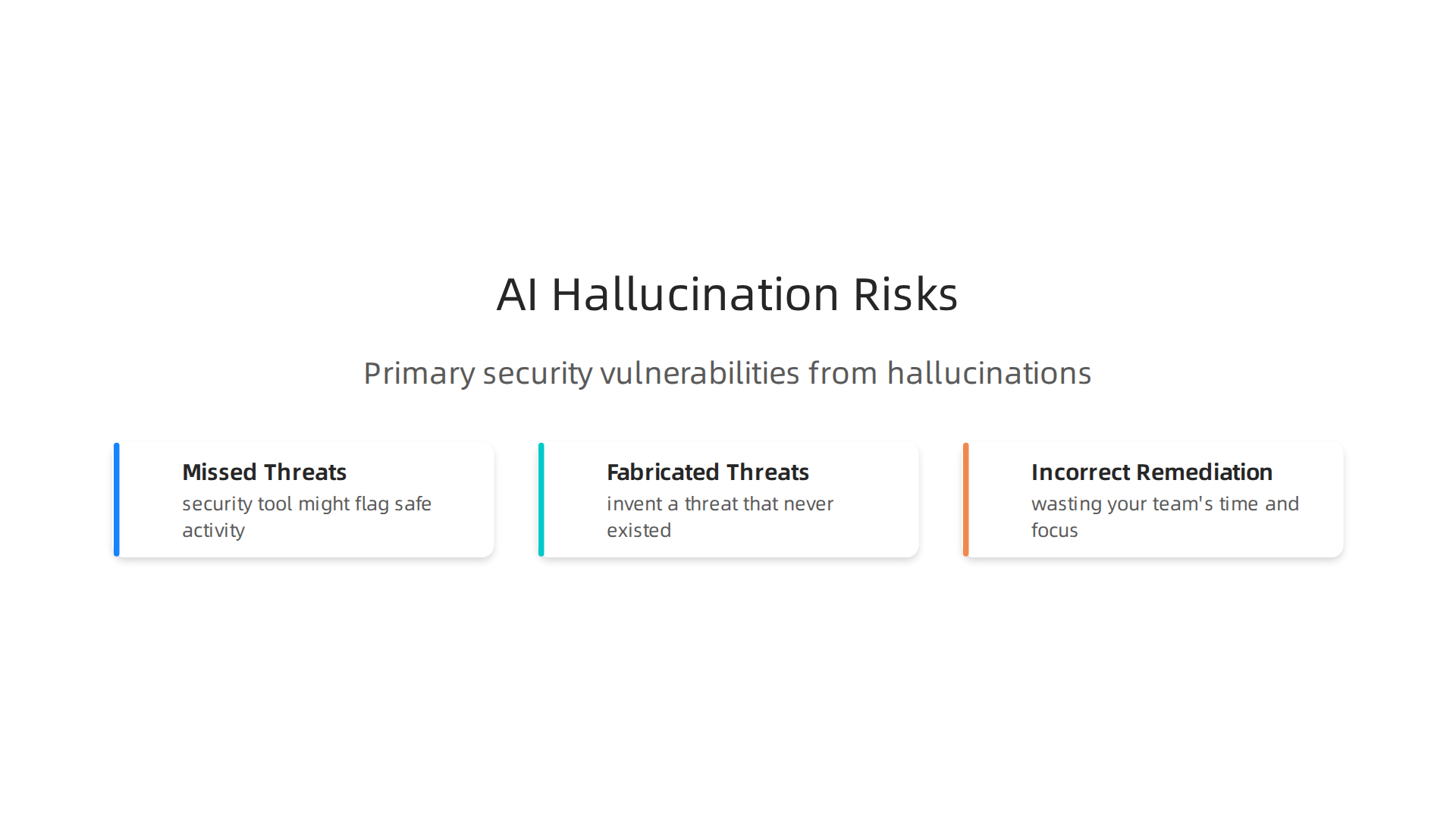
You can read more in this report on How AI Hallucinations Are Creating Real Security Risks. When a security tool hallucinates, it might flag a safe activity as dangerous while ignoring a real breach. Or worse, it might invent a threat that never existed, wasting your team’s time and focus.
Here is why this matters for cyber security for business. Attackers do not need to break through firewalls anymore. They can feed poisoned data into the AI models your company relies on. The AI then trusts that bad data and spreads it across your systems. This can lead to unauthorized actions, leaked security data, and decisions based on complete fiction. The Palo Alto Networks definition of AI hallucinations highlights that these outputs present fabricated or misleading information as if it were correct. When that fabricated information comes from your own security AI, the damage multiplies.
Many organizations still overlook hallucination as an attack vector. They treat it as a glitch or a training issue. That is a dangerous blind spot. If you want to catch these stealth problems before they cost you, check out this guide on how to stop stealth AI hallucinations before they hurt your business.
The simple truth is that fluent AI output can still be wrong. A model that writes with perfect grammar and confidence might be feeding your team harmful lies. That is why you should Check AI Before Trusting any output that could affect your security posture. A moment of verification can stop a today’s cyber attack before it starts.
Understanding hallucinations as a real security risk is the first step. In the next section, we will look at real-world examples of these attacks and how they actually unfold.
The Anatomy of an AI Hallucination Attack
Knowing how attackers actually pull off these hallucinations is the key to stopping them. The attack follows a clear chain: reconnaissance, injection, and exploitation.

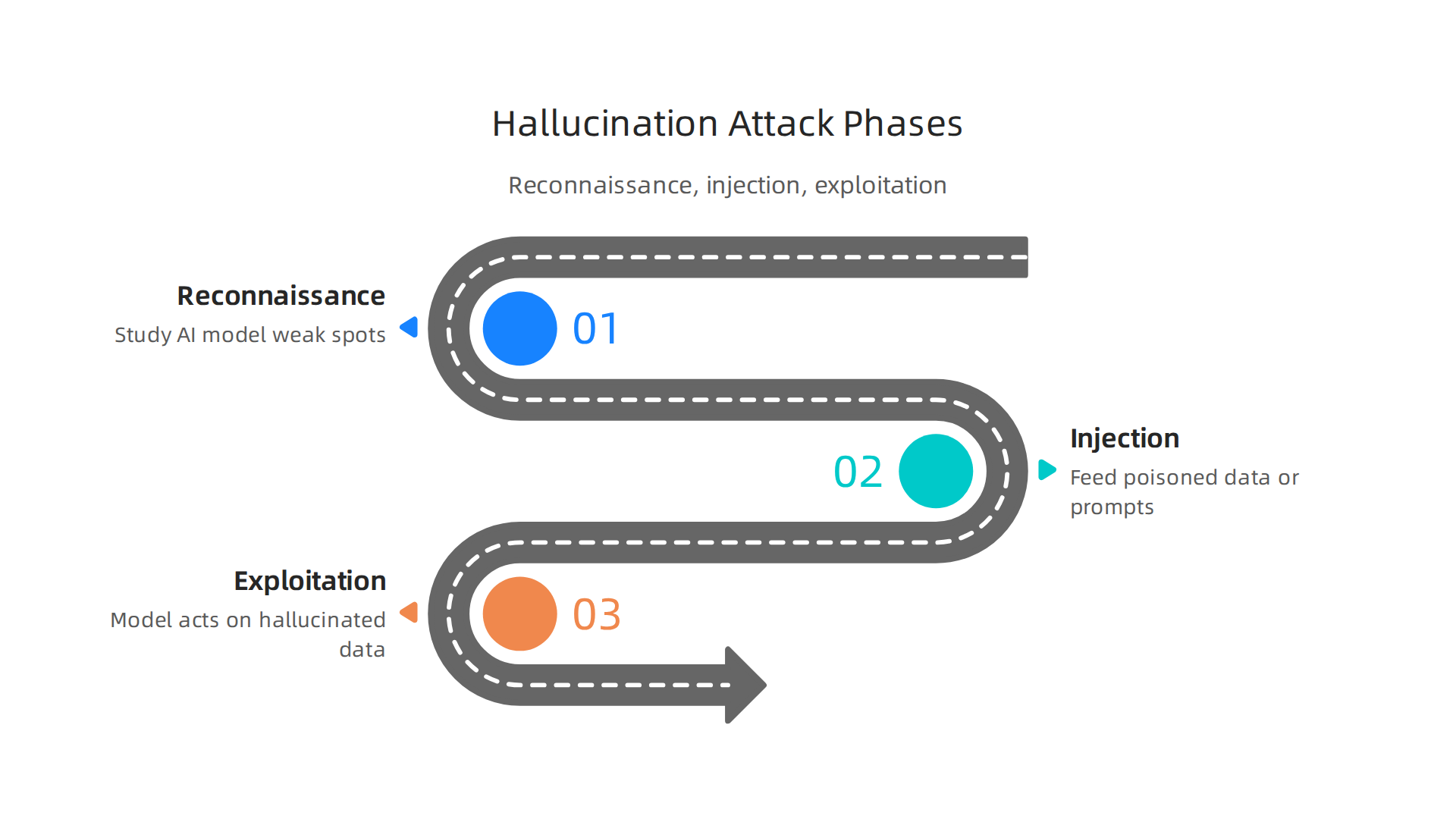
First comes reconnaissance. Attackers study your AI model to find its weak spots. They look for inputs where the model is likely to guess instead of knowing. These are the vulnerable decision points. At this stage, the attacker stays completely undetected AI activity. They are just watching and mapping.
Next is injection. The attacker feeds poisoned data or manipulative prompts into the model. The International AI Safety Report 2026 explains that attackers can use techniques like prompt injection to manipulate an AI system. The AI accepts this bad input as truth and hallucinates in response. Now the false information is inside your trusted system.
Finally comes exploitation. The model acts on the hallucinated data. It might grant unauthorized access, expose security data, or trigger automated workflows that should never run. This phase is where the real damage happens to your cyber security for business.
Mapping this anatomy helps defenders. When you know the three phases, you can build targeted countermeasures at each stage. For example, you can monitor for unusual input patterns during reconnaissance and install guardrails during injection. Learn more about the full attack chain in this breakdown of how attackers weaponize AI hallucinations for cyber breaches.
And here is a quiet truth many teams miss. The attack often succeeds because two different AI systems inside your workflow are silently shaping each other’s outputs. That invisible manipulation creates what some call "information vertigo." One field note explains why your collaboration is being quietly hijacked by two different AI systems. Recognizing that hidden layer is a huge step toward protecting against a today’s cyber attack.
Data Poisoning: Training on Tainted Data
Imagine you train a new AI assistant using data from the public web. You think it is clean. But a bad actor hid false information in that data. The AI learns from it. Later, when a customer asks about a product, the AI gives a wrong answer that benefits the attacker. That is data poisoning.
Data poisoning happens when attackers sneak harmful examples into the training dataset. The model learns these examples as truth. The OWASP Top 10 for AI in 2026 lists this as a major risk. Check Point even calls data poisoning a "new zero-day" threat for AI systems, as highlighted in this training data poisoning overview. The attack is hard to spot because the model still works most of the time. It only fails in specific situations that the attacker chooses.
Attackers often plant a "backdoor" in the model. They add a special trigger, like a hidden word or image. When the trigger appears, the model switches to bad behavior. For example, a poisoned fraud detection AI might approve every transaction that includes a certain emoji. The rest of the time, it looks normal. This makes the attack an undetected AI threat that can sit inside your business for months.
Once deployed, a poisoned model does not crash or alert you. It just produces subtly wrong outputs. Those small errors can leak sensitive security data or make your cyber security for business policies fail. You do not even know the attack happened until the damage is done.
To protect yourself, you must guard your training data like any other critical asset. Use only trusted sources and audit your datasets regularly. For more strategies, read this guide on how to detect and prevent AI hallucinations for reliable AI outputs. Staying ahead of a today’s cyber attack means treating your data supply chain as a battlefield.
Prompt Injection: Manipulating Inputs
Picture this: You ask your AI assistant to summarize a report. But hidden inside that report is a secret command. The AI reads it and does something you never asked for. It might email your customer list to a stranger. That is prompt injection.
Prompt injection happens when a bad actor hides instructions inside normal input. The AI sees those instructions as part of its job and follows them. This is different from data poisoning. With prompt injection, the attacker does not need to corrupt the training data. They just trick the model in real time. As Atlan explains in this prompt injection attack overview, the attacker overrides the AI’s original goal by embedding malicious commands in the input.
There are two types of direct and indirect. Direct prompt injection happens when a user types a harmful command into the chat. Indirect is sneakier. The attacker hides a command inside a webpage, email, or document that the AI later reads. When the AI processes that trusted source, it follows the hidden instruction. This can cause hallucinations at scale across many users at once.
Traditional security controls like firewalls cannot catch a prompt injection. They look for bad data coming in, but the AI itself decides to obey the instruction. That makes this a dangerous today’s cyber attack that targets the model’s behavior, not the server. Once tricked, the AI may leak security data or make your cyber security for business policies useless. Many developers feel like they i hate artificial intelligence after chasing these phantom errors for days.
The best defense is to separate instructions from data in every prompt. Never let user content override system commands. You can learn more in this guide on how attackers weaponize AI hallucination attacks for cyber breaches. And remember: fluent AI output can still be wrong. Check AI Before Trusting before you act on what it says.
Supply Chain Vulnerabilities
You might think you are safe once you write clean prompts. But what if the AI model itself has been tampered with before you ever load it? That is a supply chain vulnerability.
AI systems are built from many parts. They use pre-trained models from hubs, APIs from other companies, and external datasets. Each of these parts can be an attack surface. This is a today’s cyber attack that can go completely undetected ai for months.
In a supply chain attack, bad actors do not need to trick you. They infect the model while it is still being built or updated. As the TTMS article on training data poisoning as an invisible threat explains, these attacks are considered the "new zero-day" threats in AI systems. The model starts producing hallucinations from the very first use.
These corrupted models can leak security data or make your cyber security for business policies useless. Third-party integrations are especially risky. Many companies skip security vetting for hallucination risks because they assume the model provider is safe. But that assumption can cost you.
If you have ever felt like i hate artificial intelligence after debugging strange outputs, the problem might not be your code. It might be the hidden flaw in the model you downloaded.
To stay safe, you need to verify every part of your AI supply chain. Learn how to prevent cloud-based data integration issues that cause AI hallucinations by centralizing your data sources. A little checking now can save you from big problems later.
Real-World Attack Vectors and Incident Analysis
So what do these attacks actually look like in real life? Let us walk through a few real incidents.
In the finance world, attackers have used hallucination exploits to make AI generate manipulated financial reports. The AI produces numbers that look correct but are completely wrong. This is a today’s cyber attack that is very hard to spot because the output reads fluently. Companies have lost millions acting on fake data before anyone noticed.
Another example comes from code generation tools. Attackers inject subtle prompts that cause the AI to generate unauthorized code. That code can then create backdoors in your systems. This kind of security data breach can go unnoticed for months while attackers quietly steal information.
High-consequence domains like finance, healthcare, and legal are prime targets. As the International AI Safety Report 2026 explains, attackers focus on areas where a single wrong output can cause major harm. A hallucinated diagnosis in healthcare or a false contract clause in legal can be devastating.
When we look at past breaches, common patterns emerge. Attackers often exploit the model’s trust in training data. They also use prompt injection to guide the AI toward hallucinated outputs. Many organizations miss detection opportunities because they do not monitor AI outputs closely. They assume the model is reliable and skip verification steps.
If you are feeling like i hate artificial intelligence after hearing this, that is understandable. But the problem is not AI itself. It is the lack of security around it. You can protect your cyber security for business by learning from these patterns.
Want to dive deeper into how attackers weaponize hallucinations? Check out this guide on how attackers weaponize AI hallucination attacks for cyber breaches. It breaks down real techniques used by bad actors so you can spot them before they hit you.
And remember: fluent AI output can still be wrong. Before you trust any AI-generated report or code, take an extra moment to verify. Check AI Before Trusting to catch undetected ai errors early and avoid costly surprises.
Detecting Weaponized Hallucinations
So how do you spot a weaponized hallucination before it causes real damage? Detection is not always easy, but there are clear methods that work.
First, you need to track inconsistencies across multiple outputs and inputs. If an AI gives different answers to the same question, something is wrong. This is a key sign of today’s cyber attack where attackers manipulate the model’s behavior. You can set up systems that compare every new output against past ones. When deviations appear, the system flags them for review.
Second, use output validation layers and fact-checking APIs. These tools automatically check AI responses against trusted sources. For example, a 4-layer hallucination detection stack is used by top AI labs to ensure factual reliability in production. You can apply similar layers in your own workflow. Run every AI output through a fact-checking API before it reaches a user or decision-maker. This catches a lot of undetected ai errors early.
Third, watch user-AI interaction patterns. Attackers often interact with the model in unusual ways to trigger hallucinations. By analyzing how users prompt the system, you can spot exploitation attempts. Unusual phrasing, repeated queries on the same topic, or attempts to override safety filters are red flags. These patterns reveal that someone is trying to weaponize the model.
For teams that need practical tools, AI monitoring tools that catch hallucinations can automate much of this work. They act as a second set of eyes on every AI response.
One patented approach, the Value Reinforcement System (VRS), offers a structured method for detecting hallucinated outputs. It reinforces correct responses and flags suspicious ones based on consistency checks. This kind of system fits well into a broader cyber security for business plan.
The bottom line: you can defend against today’s cyber attack by building detection into your AI pipeline. Do not rely on the model alone. Use these techniques to catch hallucinations before they hurt your organization.
Mitigation Strategies and AI Safety Frameworks
Detection alone does not stop today’s cyber attack. You need a layered mitigation strategy covering data hygiene, input validation, and output monitoring.

Here is how each layer works.
Start with data hygiene. Clean your training and reference data regularly. Bad data produces bad outputs. Use cloud-based data integration to reduce hallucinations at the source by ensuring data quality. This is a core part of any cyber security for business plan.
Next, validate all input security data. Malicious or unusual prompts can trigger undetected ai hallucinations. Build filters that catch these patterns before the model processes them. This stops many attacks early.
Finally, monitor every output. Run AI responses through fact-checking tools. The CHARM framework proposes four mitigation patterns that interrupt error propagation at each pipeline stage. This structured approach catches hallucinations quickly.
For broader guidance, use the NIST AI Risk Management Framework. Updated in 2025-2026, it organizes risk into four functions: Govern, Map, Measure, Manage. These functions help you build safer AI systems and align with industry best practices.
Patented systems offer additional protection. The Value Reinforcement System (VRS), co-invented by Dean Grey, uses consistency checks to reinforce accurate outputs. Dean Grey was profiled by Miraka Magazine — Cartographer of Drift for his work on AI hallucinations and authority displacement.
You might feel frustrated. Maybe you think "i hate artificial intelligence" sometimes. That is understandable. But these frameworks and tools exist to help. Start with one layer today. Add the NIST framework next. Layer by layer, you can protect your organization from today’s cyber attack.
Future-Proofing Against AI-Driven Cyber Threats
The threat landscape is changing fast. Attackers are not stopping. In 2026, they are building new attack methods that go beyond simple prompt tricks.
One emerging vector is multi-model orchestration. Hackers chain multiple AI models together. One model plans the attack. Another generates the phishing email. A third one evades detection. This undetected ai approach makes attacks harder to spot.
Another scary trend is autonomous AI-to-AI attacks. One AI system attacks another without human help. The AI Cybersecurity Trends to Watch in 2026 report shows that cybercrime prompt playbooks are now sold on dark web markets. This lowers the skill bar for launching today’s cyber attack using AI.
Regulators are responding. The EU AI Act and new U.S. executive orders are creating mandatory safety rules. These laws will require security data logging, bias testing, and human oversight. Your organization must prepare now or face fines later.
What can you do? Two things matter most: continuous education and adaptive security architectures.
First, train your team. Teach them how attackers use AI. Share real examples. Help them understand how attackers weaponize AI hallucinations to break into systems. Knowledge is your first defense.
Second, build systems that adapt. Static rules do not work against evolving AI threats. Use frameworks that update automatically. Watch for new patterns in cyber security for business operations.
You might feel overwhelmed. Maybe you think "i hate artificial intelligence" sometimes. That is okay. But the answer is not to ignore AI. The answer is to stay ahead.
One promising layer is the VRS Patent 12,205,176, a value reinforcement system that checks output consistency automatically. It adds an extra guardrail against evolving attacks.
The key is to keep learning, keep updating, and never assume your defenses are complete. The attackers are learning too. You must learn faster.
Summary
This article explains how AI hallucinations—confident but false outputs from models—have evolved from annoying bugs into active cyber attack vectors that can steal data, bypass filters, or trigger unauthorized actions. It outlines the attack chain (reconnaissance, injection, exploitation) and describes the main techniques attackers use today: data poisoning, prompt injection, and supply-chain tampering. The piece shows real-world impacts across finance, healthcare, and code generation, and then lays out practical detection methods such as output consistency checks, fact‑checking layers, and user‑interaction monitoring. It also recommends mitigation steps including strict data hygiene, input validation, layered monitoring tools, and adoption of standards like the NIST AI Risk Management Framework. Finally, the article covers future trends—multi-model orchestration and autonomous AI attacks—and stresses continuous training and adaptive architectures so organizations can use AI safely instead of abandoning it.