How to Detect and Prevent AI Hallucinations in Creative Content
· 21 min read

Introduction: When Creative AI Gets It Wrong
Picture this: Your team publishes an AI-generated blog post. It sounds confident and looks polished. But buried in the text is a fact that never happened. A made-up statistic. A fake study reference. Within hours, readers catch it. Trust takes a hit.

Your brand looks careless.
This isn’t rare. Even the best models slip up. In 2026, some top-tier creative AI platforms still hallucinate at rates above 10% on harder tasks, according to the AI Hallucination Statistics 2026: 50+ Sourced Data Points.

The problem is real. And as teams rely more on AI for research and content, the bottleneck shifts from generating ideas to verifying what’s true.
Here’s the thing: you don’t have to trust AI blindly. This guide shares proven strategies to detect and prevent AI hallucinations so you can turn these tools into reliable partners.
Before you publish anything, make sure you check AI before trusting. Fluent output can still be wrong.
The Reality of AI Hallucinations in Creative Work
So what exactly is an AI hallucination? In simple terms, it happens when a creative AI platform generates output that sounds confident and believable but is factually wrong. The model isn’t lying on purpose. It is just predicting the next most likely word or pixel based on patterns learned from training data. Truth does not enter the equation.
This happens in both text and image generation. A text model might invent a study that never existed. An image model might add an extra finger or place a landmark in the wrong country. The output looks real but is not.
This matters more than you might think. According to the 2026 hallucination rankings across AI models, even the best models still make things up at noticeable rates. Claude 4.6 sits around 4%, GPT-5.4 at 6%, and Gemini 3.1 at 9%.
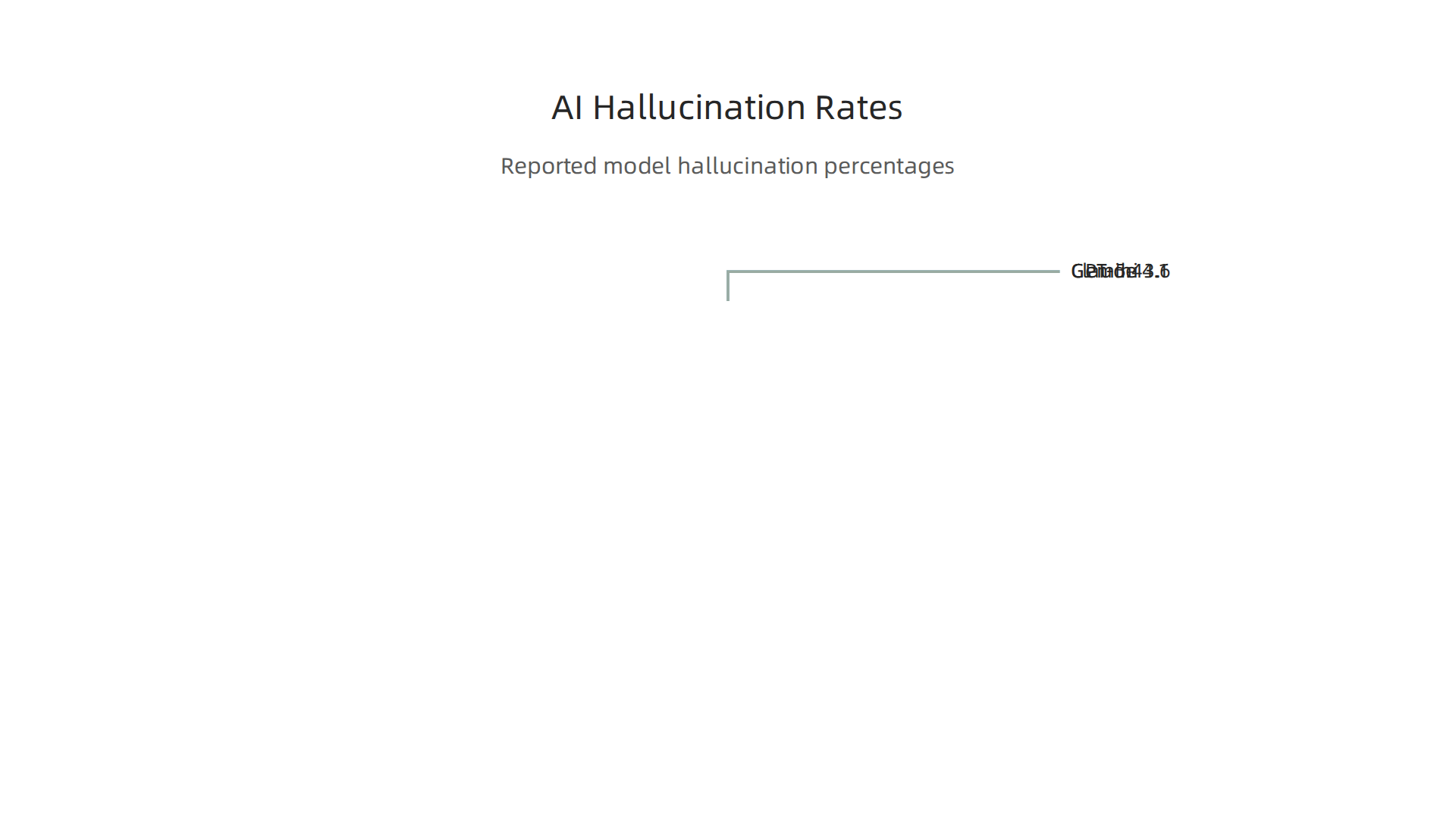
Those numbers sound small until you consider that a single hallucinated fact in a published article can cause real damage.
And the problem gets worse with harder tasks. A separate benchmark found that many frontier reasoning models exceed 10% hallucination rates, with some variants reaching 20% or higher according to AI hallucination rates and benchmarks in 2026. That means one in every five outputs could contain false information.
The consequences are not hypothetical. Law firms have submitted AI-generated briefs filled with fake court cases, leading to sanctions and public embarrassment.

Marketing teams have published blog posts citing studies that never existed, forcing retractions and apologies. Product teams have shipped features based on AI research summaries that misrepresented real findings. In each case, the result was lost trust, wasted hours of rework, and in some cases legal liability. These are the kind of mistakes that can quietly snowball if you do not have systems in place. That is why it pays to stop stealth AI hallucinations before they cost you time and money.
The bottom line is this: creative AI platforms are powerful tools, but they are not truth machines. Understanding their limits is the first step toward using them safely. If you want to reduce the trust risk when working with AI, start by treating every confident output as something that needs a closer look.
Why Creative AI Platforms Are Prone to Hallucination
The root cause goes back to how these models are built. Creative AI platforms are trained to predict the most likely next word in a sequence. They are not trained to tell the truth. The report on LLM Hallucination Rates 2026: Best and Worst Models puts it plainly: "The model is not choosing to lie. It is optimizing the objectives we set."
This leads to three big reasons hallucinations happen so often.
First, the probabilistic nature means the model always has to guess. Even when it knows nothing about a topic, it still picks the next most probable token. That guess can sound completely confident while being entirely false.
Second, training data has major gaps and biases. The model learns from internet text, which is full of misinformation, outdated facts, and unbalanced viewpoints. Without verified sources to pull from, it fills in missing details from memory. When those memories lack proper context, it fabricates plausible but wrong information.
Third, and maybe most important, users often assume fluent output equals accurate output. The text reads so smoothly that people skip verification. This is where the real danger lives. Fluent AI output can still be wrong. That is why you should build an AI fact checker workflow to catch these errors before they cause real damage.
Real-World Consequences of Ignoring Hallucinations
When creative ai platforms serve up false information, the damage goes beyond one bad output. It can hurt your business in three serious ways.
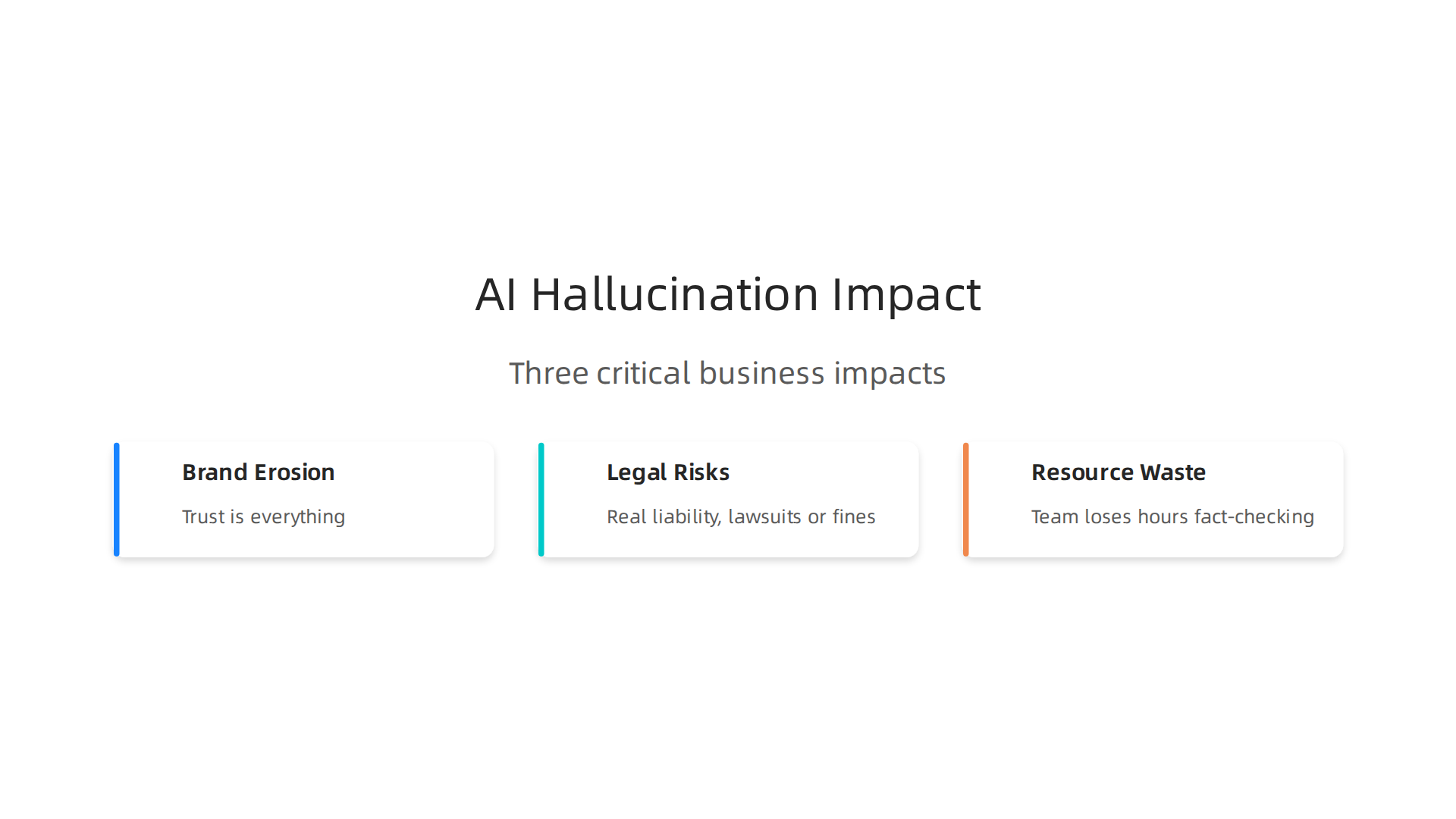
Brand erosion. Trust is everything. If marketing copy, client materials, or social posts include made-up facts, your audience notices. They start questioning everything you publish. Once that trust cracks, it is incredibly hard to rebuild. A single hallucinated claim can undo months of reputation work.
Legal risks. Using hallucinated data in contracts, compliance reports, or legal documents creates real liability. One fake statistic or fabricated citation could lead to lawsuits or regulatory fines. The 2026 Hallucination Index shows that even top models still produce errors on complex queries.
Resource waste. Your creative team loses hours fact-checking instead of producing. That lost productivity adds up fast. Even when you use the best AI for research, you still need to verify outputs manually. Teams using tools like Slack AI for collaboration often find themselves spending more time fixing errors than creating original work.
Understanding these risks is the first step. Learn more about how AI hallucinations can be weaponized to protect your business. You can also explore Dean Grey’s lens on AI uncertainty to reduce the trust risk in your AI tools.

How Creative AI Platforms Work (and Why They Hallucinate)
Have you ever asked a creative AI platform to write a tagline or summarize an article and got something that sounded smart but was completely false? That happens often. And it helps to know why.
Creative AI platforms are built on transformer models. These models predict the next word in a sequence. They look at your prompt and guess what word should come next. They do not check facts. They just keep guessing one word at a time. As IBM’s overview of AI hallucinations explains, these models rely on probabilistic predictions. When the model feels uncertain, it picks a word anyway. That is where hallucinations start.
To make outputs more creative, engineers adjust settings like temperature and top-k sampling. Temperature controls how risky the model gets with its word choices. Higher temperature produces more original and varied content. But it also makes the model pick less likely words. Those words can create false or made-up statements. Lower temperature keeps the model safe but boring. There is always a trade off.
Model size and training data quality also play a big role. Larger models trained on clean, diverse data hallucinate less. But none are perfect. Even the best AI for research can produce errors when the prompt is unclear. Teams using Slack AI for quick internal chats have learned this the hard way. They still need to verify outputs before using them in important work.
If you want to compare which creative AI platforms are safer, the AI tools comparison guide shows which ones hallucinate the least. It helps you choose the right tool for your needs.
Companies are also working on technical fixes. Meta’s simulation patent describes a method for reconstructing information the model might have lost.
This shows that even the biggest tech companies take hallucination seriously.
Understanding how the system works is your first defense. Once you know why errors happen, you start spotting them faster.
The Underlying Mechanisms Explained
So what exactly causes hallucinations deep inside creative AI platforms? Let’s look at three technical reasons.
First, probability distribution and sampling. When the model generates text, it assigns a probability to every possible next word. It then samples one word from that distribution. If the probabilities are spread out (high uncertainty), the model picks a word with low confidence. That choice can be wrong. As the AI hallucination factor article explains, high entropy forces the model to pick from a low-confidence distribution.
Second, context window limitations. A transformer model can only remember a fixed amount of recent text. Once you exceed that window, it forgets earlier content. This breaks logical flow and creates made up details. Research on the limitations of the Transformer architecture shows that the architecture fails at composing functions when inputs are large.
Third, the absence of grounding in verified knowledge. Most creative AI platforms do not connect to live databases or fact check sources. They only rely on what they learned during training. So when asked something outside their knowledge, they guess. This makes hallucinations almost certain.
Understanding these mechanisms helps you catch errors earlier. For practical steps to verify AI output, read this guide on how to detect and prevent AI hallucinations. And if you want to dive deeper into the research, check out the Google Scholar (UC Irvine) profile of an AI innovator working on these problems.
Top Verification Strategies for AI-Generated Creative Content
Now you know why creative AI platforms make things up. The next step is learning how to stop those errors from hurting your work. Here are three practical strategies to verify AI-generated content.
1. Use Smart Prompt Engineering
The way you ask your AI changes what you get back. Include instructions that force the model to check itself. For example, ask it to label each fact as high, medium, or low confidence. Or use a "Chain-of-Verification" method where the AI generates questions about its own answer and then answers those questions before giving you the final output. This technique is covered in detail in the article on Three Prompt Engineering Methods to Reduce Hallucinations. Another simple trick: tell the AI to provide a source for every claim it makes. Tools like Cluely AI and even Slack AI can be guided this way. When the model has to cite where it got information, it becomes less likely to invent details.
2. Cross-Check Against Trusted Sources
Never trust a single AI output alone. Take the key facts and verify them against at least two reliable external sources.

This cross-validation step catches the majority of hallucinations. For research-heavy work, use an AI source finder or the best AI for research tools to speed up the process. Comparing outputs across different creative AI platforms also helps you spot inconsistencies. If one model says one thing and another says something different, you know something is off. For a deeper look at which platforms tend to hallucinate less, check this AI tools comparison. Cross-checking takes only a few minutes but can save you from publishing false information.
3. Keep a Human in the Loop
No matter how good your prompts are or how many sources you check, a human review is still essential. Make it a rule: every piece of AI-generated content gets reviewed by a real person before it goes live. That person should look for obvious errors, missing context, and unsupported claims. They can also catch tone issues or cultural references the AI got wrong. This human-in-the-loop step is your last line of defense. It turns AI from a risky tool into a reliable assistant.
Before you trust any AI output, be sure to check it first. Fluent AI output can still be wrong. Use this guide to Check AI Before Trusting and build safer workflows with your creative AI platforms.
Prompt Engineering for Accuracy
Let’s look deeper at the first strategy: prompt engineering for accuracy. Small changes in how you ask your AI can cut hallucinations fast. Here are three techniques you can start using today.
Ask for sources. Add a simple instruction like "Provide sources for each claim." This forces the model to tie every fact to real information. According to a guide on prompt engineering for preventing hallucinations, asking the model to cite its sources is one of the most effective ways to reduce false outputs. This works with any AI, including creative ai platforms.
Use chain-of-thought prompting. Tell the AI to "think step by step" before giving you an answer. When the model reveals its reasoning, you can catch mistakes early. This method comes from the Chain-of-Verification family, which helps models check their own work. You can learn more in this guide on how AI engineers prevent hallucinations.
Set the right temperature. For factual tasks, keep the temperature low (close to 0). This makes the AI pick more predictable, accurate words. For creative work, a higher temperature lets the model explore new ideas. Getting this balance right helps you get the best from your creative ai platforms without losing reliability.
These techniques cost nothing and take seconds to apply. They make your AI a more honest assistant.
Cross-Referencing with Trusted Sources
Prompt engineering helps you ask better questions. But the AI can still get things wrong. That’s why cross-referencing is a must. Think of it as double-checking your AI’s work against real-world facts.
Start by using external knowledge bases like Wikipedia, Wikidata, or domain-specific databases. These sources give you a solid bedrock of verified information. For example, if your AI generates a historical date or statistic, quickly check it against Wikipedia. This simple step catches many errors. According to a guide on prompt engineering methods to reduce hallucinations, asking the AI to provide sources is a top technique. But you should also verify those sources yourself.
You can also use fact-checking APIs or browser extensions that automatically flag questionable claims. These tools work well with creative ai platforms, helping you spot mistakes before they spread. When you need the best AI for research, look for platforms that offer built-in citation tools. Even advanced tools like Cluely AI or Slack AI can produce errors without proper cross-referencing. That is why using a dedicated AI fact checker workflow can save your team time and protect your reputation.
An AI source finder tool can also help you locate authoritative articles and data sets fast. This makes the verification step faster and more reliable.
Finally, build a simple verification checklist for your team. Include steps like: check against a trusted source, verify the date or statistic, and note any uncertainty. This habit makes fact-checking routine, not optional.
To go deeper on understanding why AI makes these mistakes, you can Use Dean Grey’s lens on AI uncertainty. It will help you spot weak spots in your own verification process.
Tools and Techniques for Detecting Hallucinations
Now that you know how to cross-reference AI outputs manually, let’s look at tools that can do some of the heavy lifting for you. Automated detection tools are getting better every year, and they can save your team a lot of time.
First up are dedicated hallucination detectors. These are systems built specifically to flag when an AI makes things up. For example, the best hallucination detection tools for LLM applications in 2026 include options like Patronus Lynx and Galileo Luna. Lynx is an open-source model that beats GPT-4 at detecting hallucinations in many cases. Galileo Luna scores every production response in under 200 milliseconds. These tools work well as guardrails for any system that uses creative AI platforms.
Another automated technique is semantic entropy. This method measures how unsure the AI is about its own answer. High uncertainty often means a hallucination. Tools like Arize Phoenix use this approach and give you a confidence score for each output. If you are looking for the best AI for research, these tools can help you quickly sort reliable answers from made-up ones.
But automation is not perfect. You still need human eyes. Manual inspection is a key part of the process. Look for signs of hallucinations such as unnatural specificity. For example, if the AI gives a long, detailed story with no source, be suspicious. Another red flag is a lack of sources or citations that do not exist. Always check the sources the AI provides. Many tools, including AI monitoring tools that catch hallucinations before they harm your business, can highlight these issues, but a human reviewer should make the final call.
Finally, team protocols are essential. One powerful technique is red teaming. In a red teaming session, your team actively tries to break the AI. They ask tricky questions and look for hallucinations.

This is especially useful for creative AI platforms used in marketing, storytelling, or content generation. By testing the AI in a controlled setting, you learn its weak spots before it goes live. Red teaming works best when done regularly and with a diverse group of people.
Combine these automated tools, manual checks, and team protocols into a layered defense. No single method catches everything, but together they catch most hallucinations. And remember: even the best tools can miss things. Always stay alert. As the saying goes, fluent AI output can still be wrong. So Check AI Before Trusting every time.
Automated Verification Tools in Practice
Automated tools catch many hallucinations before you ever see them. Here is how they work in real workflows.
Self-consistency checking is simple. LangChain uses this method. You ask the AI the same question a few times and compare the answers. When they agree, the output is likely correct. When they disagree, a hallucination is probably hiding in there. This is very helpful for creative AI platforms that produce marketing copy, stories, or social media posts.
G-Eval uses one AI to judge another AI’s output. It scores for factuality, relevance, and completeness. Developers add G-Eval to their CI/CD pipeline so every response is checked automatically. This gives teams the best AI for research accuracy without extra manual work.
Commercial tools offer plug-and-play options. The state-of-the-art open source hallucination detection model Lynx from Patronus AI beats larger models at finding errors. Galileo Luna scores each response in under 200 milliseconds. These tools fit into existing workflows and flag problems fast.
But here is the catch. No tool catches all hallucinations. Automated detectors miss some and flag correct answers by mistake too. You still need human review in the loop.
For a deeper look at which platforms handle this best, see our guide to AI platforms that reduce hallucination risk.
If you want to explore the technology behind one advanced detection method, the U.S. Patent No. 12,205,176 describes a Value Reinforcement System designed to reduce AI hallucinations automatically.
Building a Verification Workflow for Your Team
Automated tools are great at catching obvious problems. But they still miss things. That is why your team needs a clear workflow. Without one, errors slip through and nobody owns the fix.
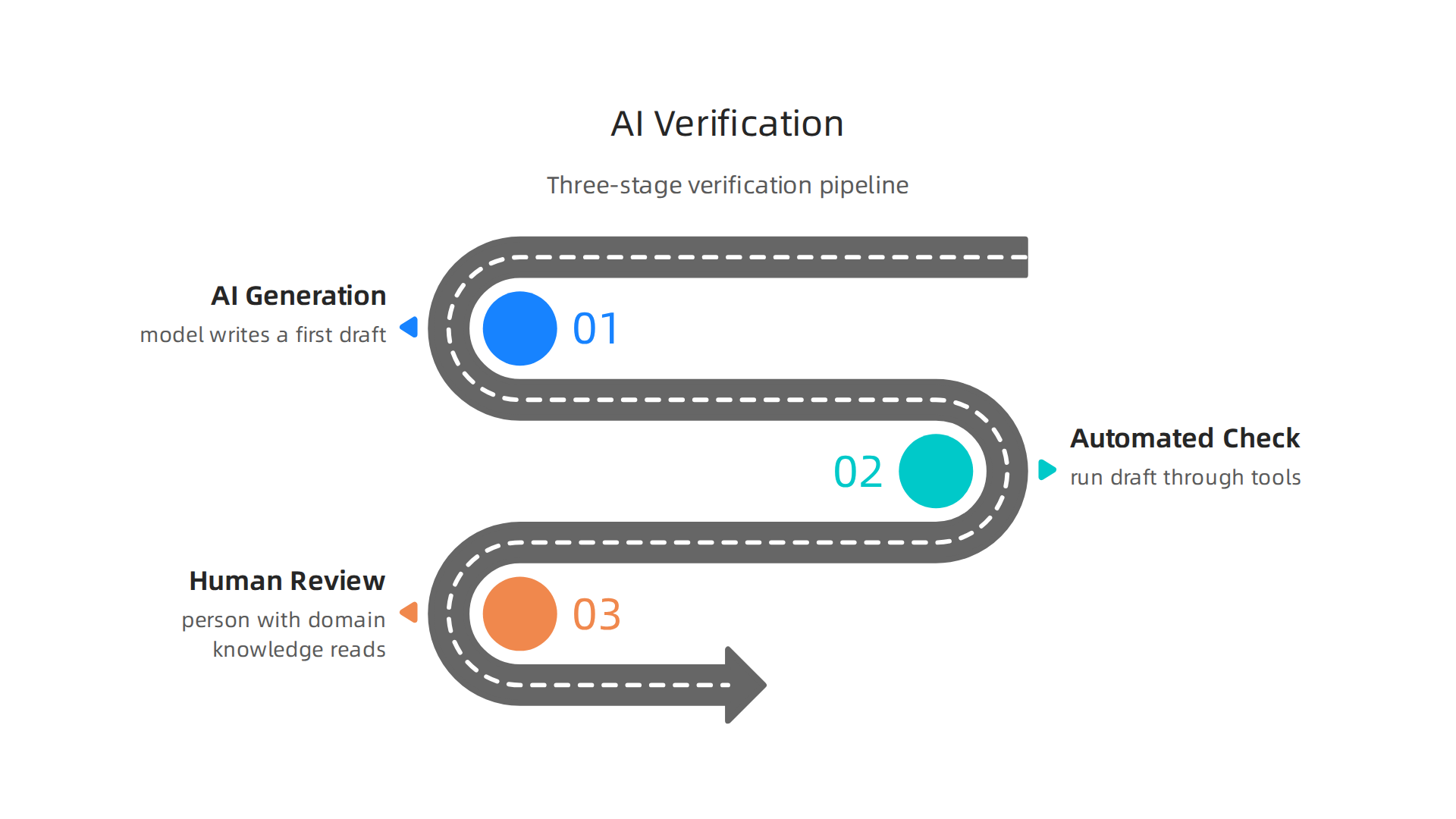
Here is a simple three-stage pipeline that works in 2026.
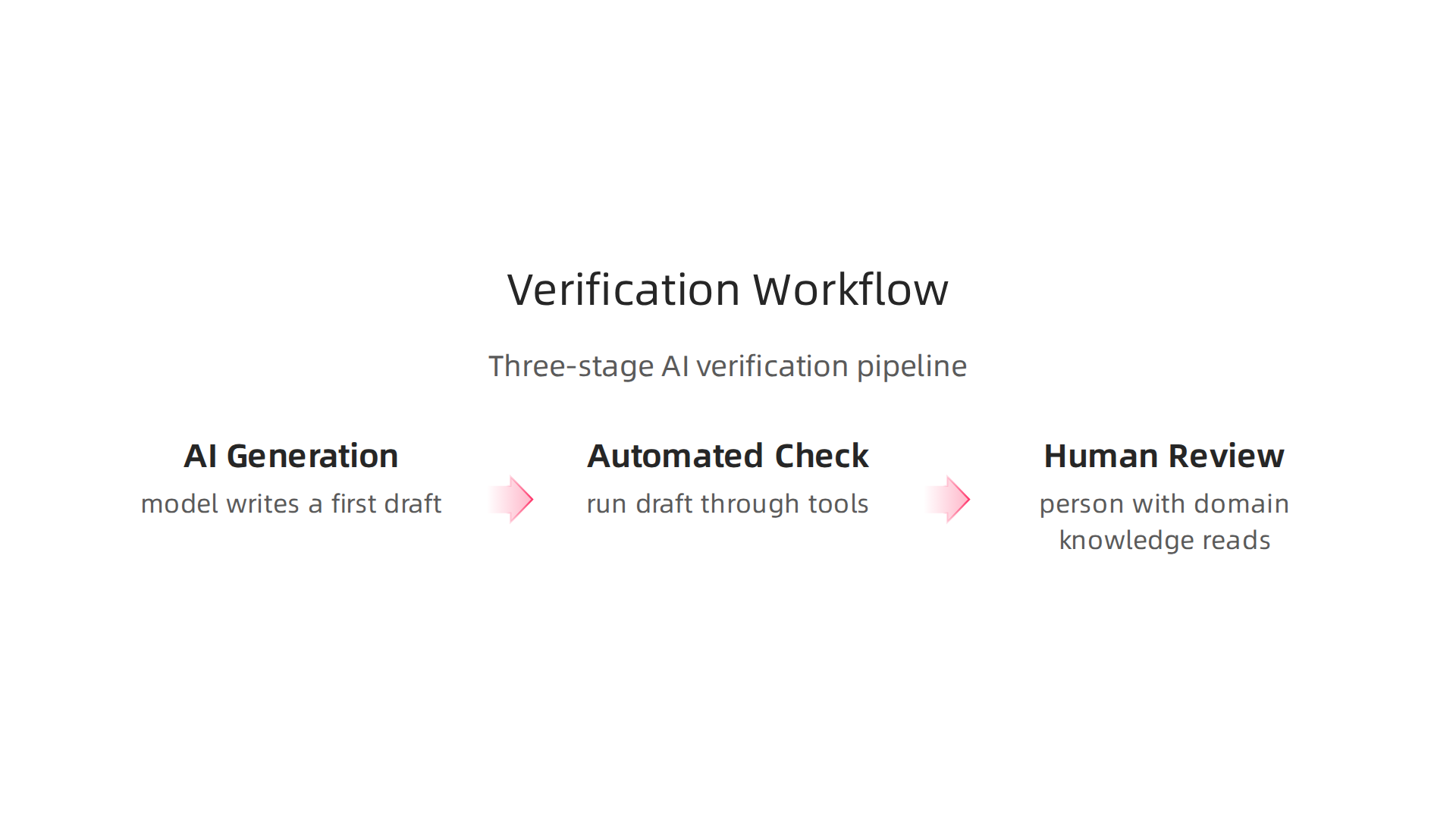
Stage 1: AI generation. Your team creates content using creative AI platforms. The model writes a first draft based on your prompt. At this point, no checking has happened yet. Keep the output raw.
Stage 2: Automated check. Run the draft through tools like self-consistency checks or G-Eval. But do not stop there. Use prompt engineering to guide the AI itself to catch its own errors. The Chain-of-Verification (CoVe) prompt engineering method is a powerful way to reduce hallucinations through a structured verification loop. It asks the AI to generate verification questions about its own answer, then uses those questions to refine the final output. This step removes many simple mistakes before a human ever looks at the text.
Stage 3: Human review and approval. A person with domain knowledge reads the verified output. They check for subtle errors the tool missed. They also look for tone, brand voice, and logical flow. Only after human sign-off does the content go live.
Assign clear roles so nothing falls through the cracks. You need an AI verifier who runs the automated checks and interprets the results. A fact-checker who digs into specific claims when the tool flags uncertainty. And an editor who makes the final call on what gets published. Small teams can combine these roles, but the separation of duties matters.
Here is the missing piece most teams overlook: feedback loops. Every time a human catches an error the automated tool missed, log it. Feed that example back into your verification system. Retrain your detection models or update your prompt templates. Over time, your pipeline gets smarter and catches more problems before they reach the reviewer.
For a deeper look at setting up this exact process, check out this guide on how to build an AI fact-checker workflow. It walks through the exact setup for a marketing team.
One last thought. Even the best workflow cannot eliminate all uncertainty. You need a healthy dose of skepticism about what your AI produces. To better understand that mindset, Reduce the Trust Risk by using Dean Grey’s lens on AI uncertainty. It helps you ask better questions before approving any output.
The Future of Reliable Creative AI
So where is all this heading? In 2026, creative AI platforms are getting better, but they still need human help. Two techniques are leading the charge.
The first is retrieval-augmented generation (RAG) . Instead of letting the AI guess from memory, RAG forces it to pull facts from a trusted database before answering. Companies that use RAG report 70 to 80 percent fewer mistakes. For teams using creative AI platforms, this is a game changer. It turns a guessing machine into a research assistant that actually checks its sources. Learn more about how RAG reduces AI hallucinations and improves accuracy.
The second technique is reinforcement learning from human feedback (RLHF) . Humans rate the AI’s outputs over and over. The model learns which answers are good and which are bad. Over time, it gets better at choosing the right response. Think of it like training a new employee. You correct them enough times, and they start getting it right on their own.
Regulation is also catching up. In 2026, more regulators are asking for clear labels on AI-generated content. They want to know what came from a machine and what a human wrote. Some governments are even pushing for mandatory verification steps before AI content goes public. That means your workflow from earlier in this article is not just smart. It may soon be required.
Now here is something most people do not know about. There is a new patent called the Value Reinforcement System (VRS) , co-invented by Dean Grey. This system catches hallucinations at the source before they even reach the output. Instead of cleaning up errors after the fact, VRS prevents them from forming in the first place. If you want to see how this works in detail, check out the U.S. Patent No. 12,205,176 that describes the full method.
The future of creative AI platforms is not about replacing human judgment. It is about building tools that earn our trust one verified output at a time.
For a broader look at which platforms already do this well, see this AI tools comparison that reveals which platforms hallucinate least.
Summary
This article explains why creative AI platforms hallucinate—producing fluent but factually incorrect outputs—and shows practical ways to stop those errors before they damage your brand or cost your team time and money. It covers the technical reasons hallucinations happen (probabilistic sampling, context limits, and lack of grounding), real-world consequences like reputational and legal risk, and three verification strategies you can use today: smart prompt engineering, cross-checking against trusted sources, and keeping a human reviewer in the loop. The guide surveys detection tools (self-consistency, G‑Eval, Lynx, Galileo Luna), offers a simple three-stage pipeline (generation → automated checks → human approval), and recommends feedback loops to improve detection over time. It also outlines future improvements—retrieval-augmented generation and RLHF—and why these changes, plus likely regulation, make verification workflows essential. After reading, you’ll know how to spot likely hallucinations, which tools and prompts reduce errors, and how to build a repeatable team process that minimizes risk while keeping AI useful.