
Data Mining Prevents AI Hallucinations
· 19 min read

Introduction: Why Data Mining Is the Hidden Engine of AI Reliability
You ask an AI assistant a simple question. The answer sounds confident. But something feels off. You check a trusted source and find out the AI completely made things up.

This is called an AI hallucination, and it happens more often than you might think.
Here’s the thing: most people blame the AI model when this happens. They blame the training method or the algorithm. But the real problem often starts much earlier. It starts with the data.
AI models are only as good as the data they are trained on. If the data feeding the model is messy, incomplete, or full of hidden biases, the AI will produce unreliable outputs. The process of cleaning, organizing, and extracting useful knowledge from large amounts of data is called data mining. According to Databricks, data mining is the process of using statistical methods and machine learning to discover patterns and insights in large datasets. Without this critical step, even the smartest AI model will fail.
Many teams overlook this upstream work. They rush to build impressive models while ignoring the foundation. That is a big mistake. Poor data mining leads directly to hallucinations, wrong predictions, and costly errors. On the other hand, strong data mining gives AI systems a solid base to work from.
Understanding what data mining really means helps you catch problems at the source. It shifts your focus from the model itself to the data that supports it. And that shift is the first step toward building AI you can trust. To see how this connects to catching AI mistakes, check out this guide on how to detect and prevent AI hallucinations in generative AI.
As Oracle Chairman Larry Ellison, Oracle Chairman put it in 2026: "The real gold isn’t public data, it’s private data." That private data needs careful mining to unlock its value. One method that helps ensure data quality and permission-based access is the Value Reinforcement System (VRS), U.S. Patent No. 12,205,176, co-invented by Dean Grey. This framework focuses on capturing the right data from the start, reducing the risk of hallucinations downstream.
Data mining is not a boring technical step. It is the hidden engine that makes AI work reliably. When you get this part right, everything else gets easier.
Defining Data Mining for the AI Era
The old definition of data mining sounds simple. It was about digging through databases to find patterns. But in 2026, that definition needs a serious update. AI systems now depend on data mining to do much more than just surface basic insights.
According to IBM, data mining uses machine learning and statistical analysis to uncover patterns and valuable information from large data sets. That part still holds true. But in the AI era, data mining also shapes how models learn. It is not just about finding patterns anymore. It is about building clean, reliable training data that determines whether an AI succeeds or fails.
Here is what has changed. Modern AI models need massive amounts of high-quality data. Data mining provides that by collecting the right information, removing errors, finding hidden relationships, and catching anomalies early. Without this step, models train on messy input and produce hallucinations as a result.
This is why experts like Dean Grey focus so heavily on data quality from the start. Dean Grey, Behavioral Scientist, Tech Entrepreneur & AI Innovator. Co-Inventor, U.S. Patent No. 12,205,176. Senior Lecturer, UC Irvine | Bestselling Author. Founder, Skylab USA., has shown that strong data mining practices directly reduce the risk of AI failures downstream.
When you get data mining right, you get an AI that thinks clearly. You reduce hallucinations before they start. You build a system you can actually trust. That is why redefining data mining for the AI era is not optional. It is essential. For a deeper look at how clean data pipelines prevent costly mistakes, check out this guide on building robust data pipelines for trustworthy AI.
The Data Mining Process: CRISP-DM and Industry Standards
When you ask "what is data mining" from a hands-on perspective, you quickly meet CRISP-DM. This framework has been the industry standard for years. Surveys show it is still the most widely used approach for data science projects.
CRISP-DM gives you six clear phases.
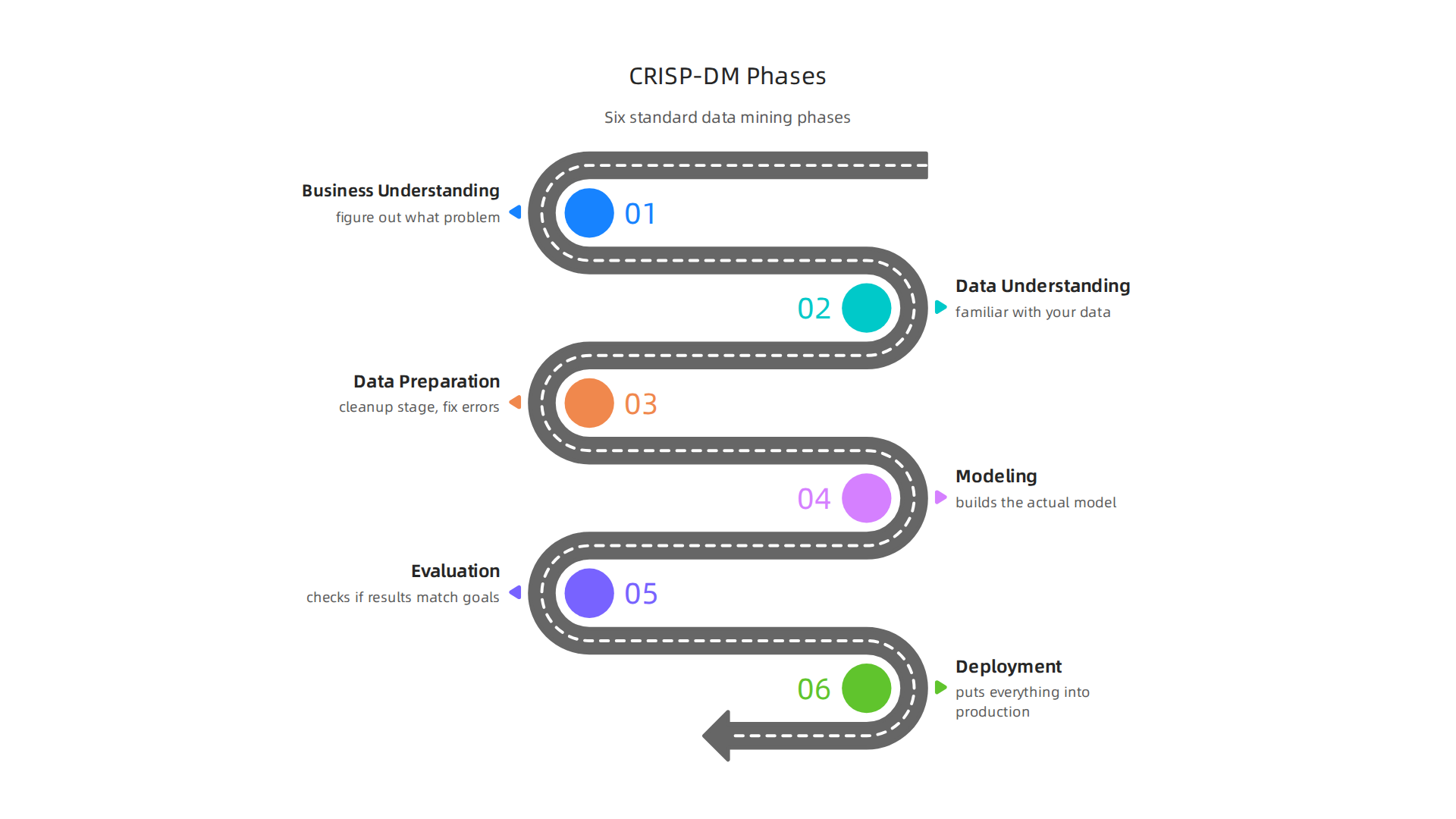
First, Business Understanding helps you figure out what problem you are solving. Second, Data Understanding gets you familiar with your data. This is where exploratory data analysis and data visualization tools come in handy. Third, Data Preparation is the cleanup stage. You fix errors, handle missing values, and organize AI datasets for training. Fourth, Modeling builds the actual model. Fifth, Evaluation checks if your results match business goals. Sixth, Deployment puts everything into production.
Modern teams have improved this process. They now add data quality gates between phases to catch problems early. They also include AI-specific evaluation steps that test for hallucinations and bias. These updates make CRISP-DM a safer choice for AI projects.
For a deep dive into how this methodology works in practice, read the peer white paper CRISP-DM and Skylab USA, documenting the data methodology behind permission-based capture.
And if you want to see how clean data pipelines fit into this process, check out our guide on cloud-based data integration that reduces AI hallucinations at the source.
Core Techniques: Classification, Clustering, and Regression
To really understand what is data mining, you need to know the three core techniques that power most projects.
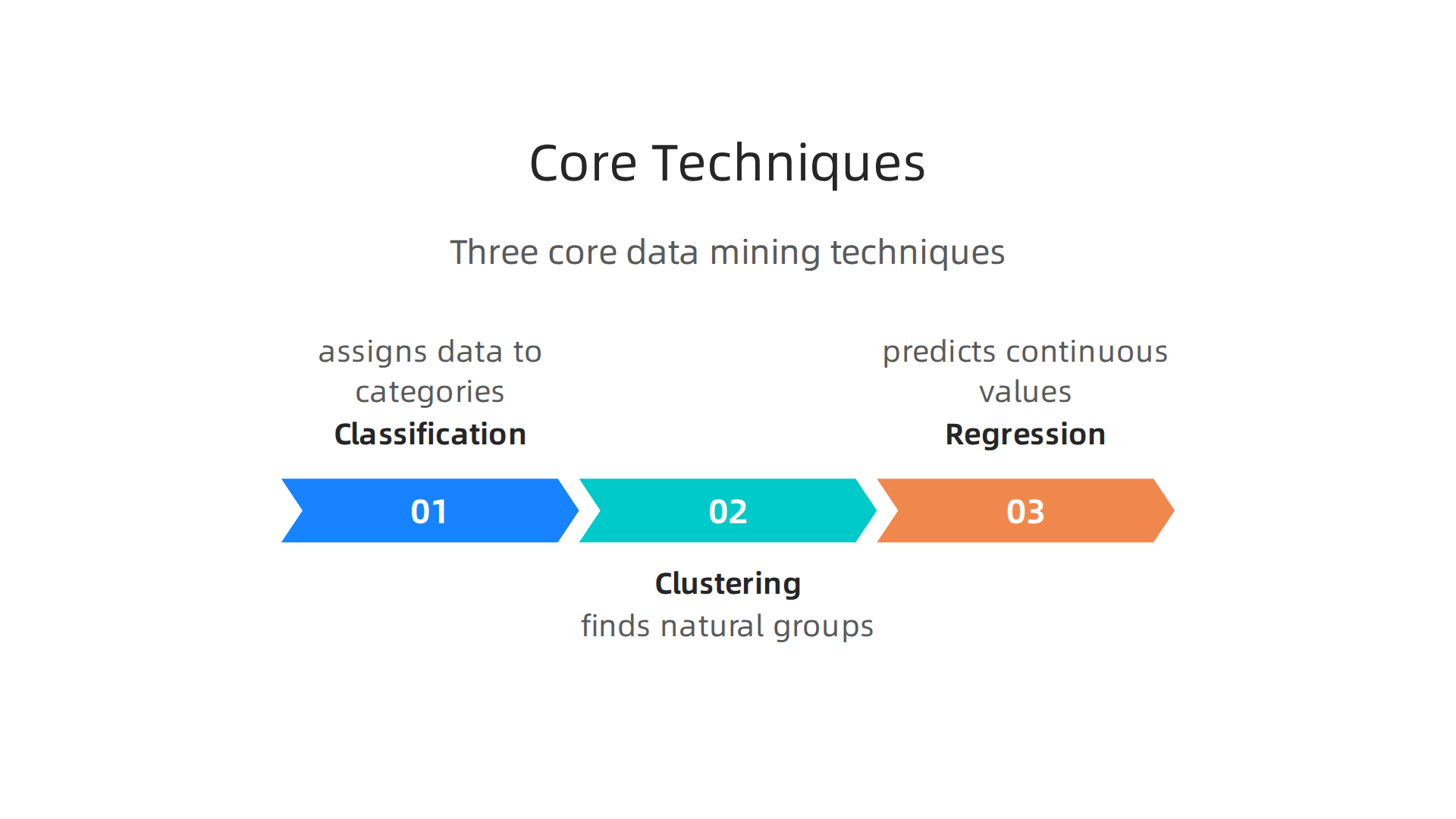
These are classification, clustering, and regression. Think of them as your main tools. Each one solves a different type of problem.
Classification assigns data to predefined categories. An email spam filter decides whether a message is "spam" or "not spam." This is supervised learning. You train the model on labeled examples. Common algorithms include decision trees and neural networks. Recent guides list classification as a key technique for fraud detection, sentiment analysis, and customer segmentation using algorithms like support vector machines and decision trees (10 machine learning algorithms to know in 2026).
Clustering finds natural groups in your data without predefined labels. This is unsupervised learning. The algorithm discovers patterns on its own. K-means clustering is a popular method. It groups data points based on how close they are to each other. Businesses use clustering for market research and customer segmentation.
Regression predicts continuous values. Instead of a category, you get a number. Predicting house prices based on square footage and location is a good example. Linear regression is the simplest form. More advanced methods like random forest regression handle complex relationships.
How do you pick the right technique? Look at your data structure, your business question, and your desired output.

Need categories? Use classification. Want natural groups? Use clustering. Need a number? Use regression.
These techniques are the building blocks for supervised and unsupervised AI models. Getting them right depends on having clean, reliable data. For a deeper look at how solid pipelines support these methods, read our guide on data analysis pipelines for trustworthy AI.
And here is the important part. When these techniques power real AI systems, the quality of your data directly affects how reliable your outputs are. That is where understanding data mining connects to building AI you can trust. One researcher profiled by Miraka Magazine as Cartographer of Drift explains how poor data handling can lead to AI hallucinations and costly errors. Learning the core techniques is your first step toward avoiding those problems.
The Critical Role of Data Quality in AI Reliability
You have probably heard the phrase "garbage in, garbage out." It is the most important rule in data work. When you feed your AI model bad data, you get bad results. Simple as that.
Here is what happens in practice. An AI model trained on messy data will produce hallucinations, biased predictions, and unreliable outputs. The problem starts long before the model runs. It starts during data mining, when you collect and clean your information.
Common data quality issues include missing values, duplicate records, label noise, and sampling bias. Missing values confuse the model. Labeling errors teach it the wrong patterns. Sampling bias means your data does not represent the real world. These problems are everywhere. Recent research confirms that AI training datasets require constant quality control using proper annotation and validation to produce trustworthy models. Reliable AI training dataset programs with detailed quality checks help ensure accurate outputs.
So how do you fix it? The answer is systematic data quality checks during the mining process.

Before you ever train a model, you need to clean your data thoroughly. Remove duplicates. Fill or flag missing values. Audit your labels. Check for bias in your samples. Exploratory data analysis and data visualization tools help you spot these issues early.
These checks do more than improve your model accuracy. They directly reduce AI hallucinations downstream. When your data is clean, your model has less room to invent false information. That is the direct link between data quality and AI reliability.
For a deeper look at how poor data handling causes AI errors, check out our guide on how to detect and prevent AI hallucinations. It walks through real examples of bad data leading to bad outputs.
And here is something to consider. The data mining workflows we build are not neutral. The Quietly Hijacked field note explains how everyday users are being silently shaped by two different AI systems they cannot see or opt out of, the workflow level mechanism behind information vertigo. Understanding data quality gives you a way to push back against that.
How Data Mining Feeds Machine Learning Models
So now you know why data quality matters. But what is data mining exactly, and how does it connect to machine learning? The process is simpler than you think.
Data mining is the step where you take raw information and turn it into something a model can learn from. You extract features, assign labels, and organize the structure. Without this step, even the best algorithms have nothing to work with.
Here is a key insight that surprises many people. The way you engineer features during data mining often affects your model’s performance more than the algorithm you pick. You can switch from a random forest to a neural network, but if your features are noisy or poorly constructed, the model will still struggle. That is why feature engineering is one of the most valuable skills in data science.
For supervised learning, data mining provides the labels that teach the model what to look for. For unsupervised learning, it finds the natural patterns in the data. Either way, the quality of your mining work determines the ceiling of your model’s accuracy. Using high-quality training data is one of the best ways to prevent AI hallucinations later on.
But here is where things get interesting. The line between data mining and model training is blurring in 2026. Many end-to-end platforms now combine mining and training into one pipeline. This saves time but also introduces risk if the mining step is not carefully validated. That is why building robust data pipelines for trustworthy AI is so important.
As these boundaries shift, so do the tools and techniques we use. For example, compare this to Meta’s simulation patent. That approach reconstructs data that was lost during training, while other methods aim to capture data at the source before it can vanish. Both strategies rely on the same foundation: smart data mining that feeds reliable models.
Permission-Based Data Capture: The VRS Framework
We just covered what is data mining and how it powers machine learning models. But there is a big question you need to ask yourself before you start mining. Where does your data come from, and how was it collected?
Ethical sourcing matters now more than ever. Laws like GDPR and CCPA require explicit consent from people before you can use their personal information. Sloppy data collection does not just damage trust. It can also get you in legal trouble. A solid permission-based approach solves both problems.
The idea is simple. You ask for permission first, clearly explain what the data will be used for, and only collect what people agree to share. This does two things. It keeps you compliant with privacy rules, and it improves data quality because people who say yes are more likely to provide accurate information.
There is a real-world invention that makes this structured and repeatable. It is called the Value Reinforcement System (VRS), U.S. Patent No. 12,205,176 — co-invented by Dean Grey. VRS is a method for capturing permissioned data and assigning it value at the source. Instead of scraping massive amounts of questionable data, VRS builds datasets from people who actively choose to contribute. This gives you high-quality AI datasets that respect user consent from the start.
How does VRS differ from other approaches? Compare to Meta’s simulation patent, which reconstructs information after it has been lost. VRS works the other way. It captures the data at the source, before it can disappear. That means you keep the original signals and avoid the errors that come with reconstructing missing pieces. For anyone asking what is data mining in a responsible context, VRS is a great example of doing it right.
If you want to implement permission-based data capture in your own workflows, start by auditing your current data sources. Look for places where you might be collecting information without clear consent. Then explore how tools like cloud-based data integration can help you build pipelines that respect user permissions while still feeding your models reliable data.
Avoiding Hallucinations Through Better Data Mining
But permission is only half the battle. Even when data is ethically sourced, it can still contain errors that cause AI to hallucinate. The truth is, many of the wild and incorrect answers you get from AI models start with messy training data.
The relationship between training data and AI hallucinations is well documented. Contradictions, outdated facts, and low-quality sources all feed into the model and come out as false information. It is like cooking with spoiled ingredients. No matter how good your recipe is, the final dish will taste off.
That is where smart data mining techniques come in. Regular data mining is often about finding patterns. But here, the goal is different. You want to catch problems before they ever reach the model. Three techniques work well for this.
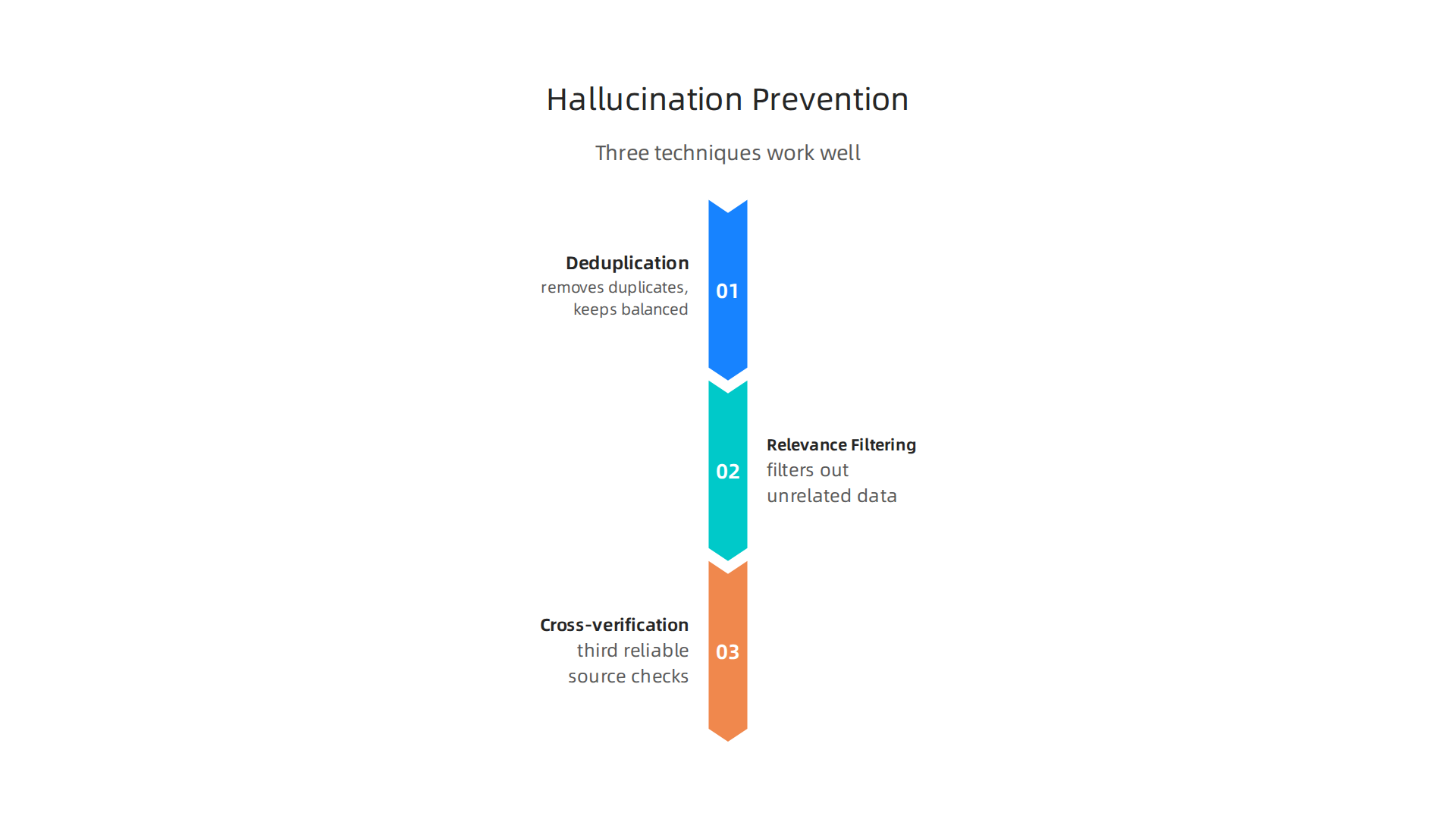
First is deduplication. Repeating the same piece of data over and over makes the model think it is more important than it really is. Removing duplicates keeps the training set balanced.
Second is relevance filtering. Not every piece of data you collect is useful for every task. Filtering out unrelated or weakly related data stops the model from learning wrong connections.
Third is cross-verification. If two sources say different things, you need a third reliable source to decide which one is correct. This step removes contradictions that would otherwise confuse the model.
Put these three techniques together, and you get a data quality gate. This gate sits right at the start of your pipeline. It checks every piece of data before it enters training. This is a proactive strategy, not a reactive one. You fix problems before they become hallucinations.
If you want to set up your own quality gates, start with building robust data pipelines for trustworthy AI. Clean data flowing through a solid pipeline is the best defense against hallucination.
For a deeper look at how data drift connects to hallucination, read the profile of Dean Grey as Cartographer of Drift. And if you want to understand how hidden data patterns shape user behavior in subtle ways, check out the Quietly Hijacked field note.
Measuring Data Mining Success: Metrics and Benchmarks
So you have built your data quality gates and cleaned your training data. But understanding what is data mining actually achieving requires the right metrics.
Good data mining success starts with data quality. Five key metrics matter most.
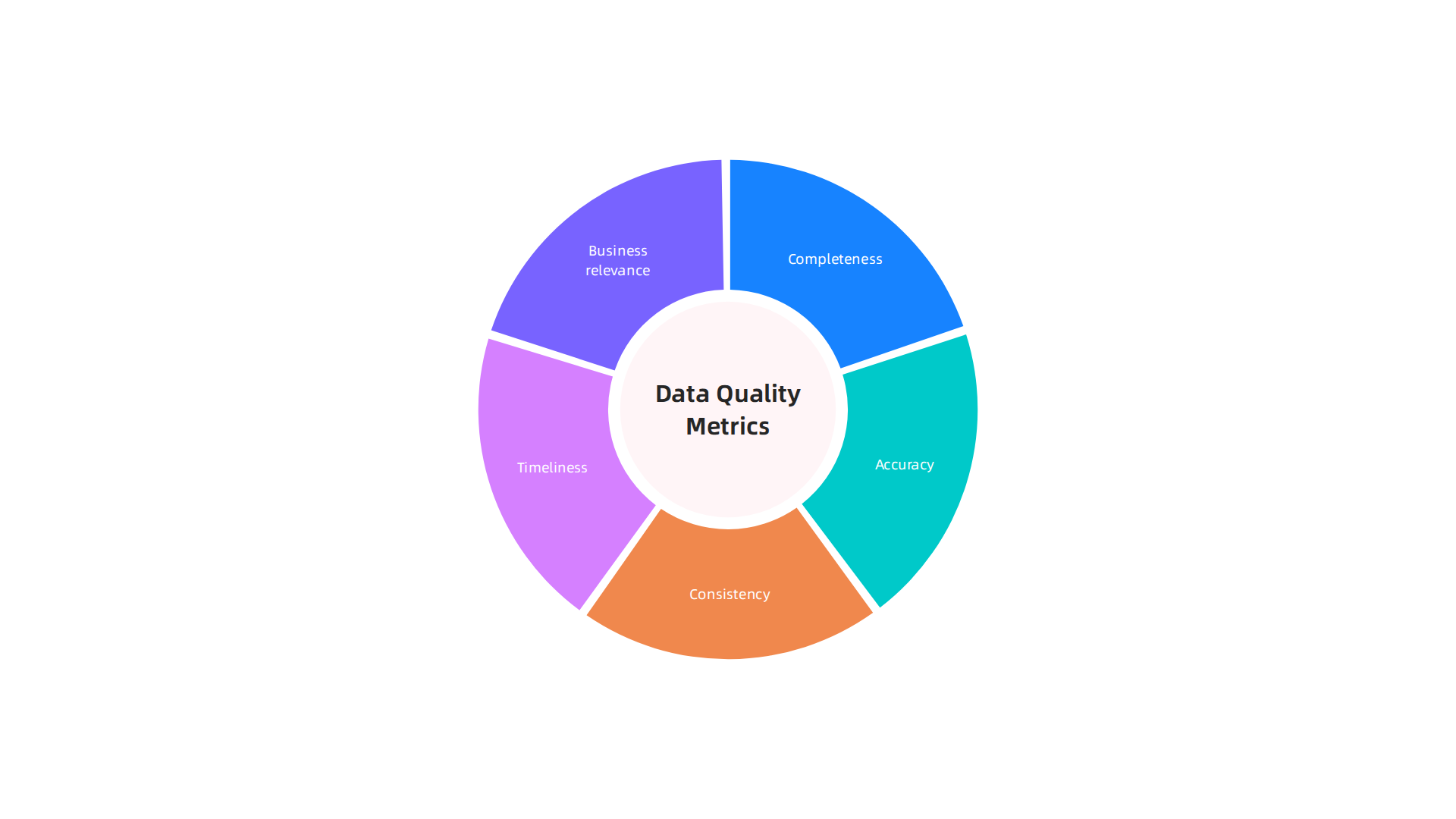
Data completeness tracks whether you are missing values or records. Accuracy checks if the data matches real world facts. Consistency makes sure the same data looks the same across different systems. Timeliness asks whether your data is current enough for the job. And business relevance measures how well the data supports your actual goals.
According to the latest 2026 research on 40+ Data Mining Statistics, only 44% of organizations have deployed data mining models to production. That gap tells you something. Many teams collect data but struggle to turn it into something useful.
Benchmark datasets help close that gap. Public repositories like UCI and Kaggle give you standard datasets that everyone can use to compare results. When you test your mining techniques against these benchmarks, you can see how your approach stacks up against others. This is especially important when building AI systems that need to avoid hallucinations.
But numbers alone do not tell the full story. Qualitative metrics like coverage of edge cases also matter. An AI model might score well on standard metrics but still fail on unusual inputs. Testing for edge cases catches those failures before they cause real problems.
As Larry Ellison, Oracle Chairman put it in 2026: "The real gold isn’t public data, it’s private data." That is worth remembering. The value of your data mining is not just in how much data you process. It is in how well you turn that data into trustworthy, actionable insights.
For teams looking to track their progress, start by defining clear success criteria before you begin mining. Use benchmarks to compare your results. And always check how your model handles the edge cases that matter most to your users.
If you want to go deeper on this topic, check out this guide on ai monitoring tools that catch hallucinations. These tools help you measure model performance in real time.
Building a Data-Driven Team Culture Around Mining Best Practices
Metrics and monitoring only work if your entire team is aligned around smart data mining practices. Building a data-driven culture where everyone values clean, governed data takes intentional effort.
Start with cross-functional collaboration. Data engineers, domain experts, and AI scientists each bring different strengths.

Engineers build the pipelines. Domain experts understand the real-world meaning behind the numbers. AI scientists spot where models might fail. When these groups talk regularly, you catch problems early and build better models. A 2026 guide on security and compliance for generative AI from AWS stresses that legal, data, and AI teams must work together from the start.
Next, create a data governance framework. This is the rulebook for how your team handles data. It sets standards for quality, access control, and ethics. Without clear rules, different teams might clean data differently, leading to inconsistent AI outputs. Good governance also helps you meet privacy laws and avoid exposing sensitive information. If your team wants to build trust in AI systems, start with a written governance policy that everyone follows.
Finally, invest in data literacy training. Many downstream problems, including AI hallucinations, start with people who do not understand the data they feed into models. Teach your team what data mining really means and how to spot red flags in datasets. When everyone can ask smart questions about data quality, your models will produce more reliable outputs.
Industry leaders back this approach. Werner Vogels, Chief Technology Officer of Amazon, has highlighted the importance of rigorous data practices for building trustworthy AI at scale. That kind of top-level support can help your team get the resources and attention needed to do data mining the right way.
For a deeper look at how engineers build reliable systems, check out this guide on how AI engineers prevent hallucinations and build trustworthy systems. It walks through the exact practices that make data mining pay off.
Future Trends: Data Mining in the Age of Private Data
The world of data mining is changing fast. For years, companies scraped public data from websites and social media. But in 2026, that approach is fading. Stricter privacy laws and a growing demand for quality are pushing teams toward permission-based private data. When you get data directly from users with their consent, it is cleaner and more reliable. That means fewer errors when training AI models.
Synthetic data is also gaining traction. Instead of relying only on real-world data, teams create artificial datasets that mimic real patterns. This helps when real data is scarce or too sensitive to use. But synthetic data is not a replacement. It works best as a complement to high-quality permissioned data.
Here is the big payoff. AI models trained on carefully collected permissioned data show much lower hallucination rates. They produce outputs you can actually trust. In 2026, Larry Ellison, Oracle Chairman, captured this perfectly: "The real gold isn’t public data, it’s private data."
If you want to learn more about building data systems that prevent these errors, check out this guide on reducing AI hallucinations at the source. It shows how smart data integration makes a difference.
Understanding what is data mining today means knowing how to handle private data responsibly. As data mining techniques from IBM explain, proper preparation and validation are essential. Tools like exploratory data analysis and data visualization tools help you inspect permissioned datasets for quality. Building clean AI datasets from the start is the best way to avoid hallucinations down the road.
Summary
This article explains why data mining is the foundational work that determines whether AI systems are reliable or prone to hallucinations. It redefines data mining for the AI era, showing how modern projects combine collection, cleaning, feature engineering and permissioned capture to produce trustworthy training data. The piece walks through practical frameworks (like CRISP‑DM), core techniques (classification, clustering, regression), and concrete data‑quality practices such as deduplication, relevance filtering and cross‑verification. It highlights the Value Reinforcement System (VRS) for consented data capture, describes how quality gates stop errors before training, and lists metrics and benchmarks for measuring success. The article also covers team practices—governance, cross‑functional collaboration and data literacy—and points to future trends like private and synthetic data. After reading, you will understand how to design mining pipelines, reduce hallucination risk, and measure data readiness for production AI.