
AI Data Labeling Jobs: Stop Hallucinations, Start Your Career
· 19 min read

Introduction
Have you ever asked an AI assistant a simple question and gotten a confident but completely wrong answer? That’s an AI hallucination. According to IBM, AI hallucinations happen when a model creates outputs that are "nonsensical or inaccurate" because it trained on poor data. These errors are not just annoying. They spread false information, damage trust, and slow down AI adoption across businesses.

The root cause often lies in the training data itself. As experts at RWS explain, many AI hallucinations are really "training data problems" caused by weak data design and sloppy labeling. When the examples an AI learns from are messy or wrong, the model learns the wrong patterns.
Here’s the good news: data labeling is the quiet hero that fixes this. Accurate labels teach AI models what to notice and what to ignore. Better labels mean fewer hallucinations and more reliable outputs. That makes data labeling a cornerstone of responsible AI development in 2026.
In this article, we break down how data labeling fights hallucinations, walk you through best practices you can use today, and explore the growing career opportunities in ai data labeling jobs for anyone looking to work in this field. We’ll also touch on related roles like what is data engineering and how platforms like Scale AI fit into the ecosystem.
Before you trust any AI output, remember this: Fluent AI output can still be wrong. Make it a habit to double-check the facts. And if you want to dive deeper right now, read our guide on how to detect and prevent AI hallucinations for reliable AI outputs to stay ahead of the problem.
Understanding AI Hallucinations: Why Labeling Matters
So why do AI models hallucinate in the first place? You might think the problem lives inside the model’s code. But more often than not, the root cause is much simpler. It comes down to the data used to train the model.
Think of an AI model like a student who learns from example worksheets. If those worksheets contain wrong answers, confusing instructions, or contradictory information, the student will learn the wrong lessons. That’s exactly what happens with AI. When you look at the research, you find that many hallucinations are really data design problems that start long before the model ever runs.
Experts at RWS have documented this clearly. Their study shows that poor data design and sloppy labeling are often the true culprits behind AI errors. When the training data is inconsistent, the model has no way to tell which patterns are correct. It just learns all of them. The result is an AI that confidently gives you wrong answers.
Here’s something important to understand. Hallucinations are not random glitches. They follow predictable patterns. If the labels in a training dataset are ambiguous, the model learns to make ambiguous guesses. If the labels contradict each other, the model tries to average out the contradiction. Both paths lead to hallucinations.
Research from MIT Sloan explains that training data sources are one of the main reasons AI systems produce inaccurate and biased content. When the underlying data is flawed, the model cannot magically fix it. It just reflects the problems it learned from.
The really tricky part is that systematic labeling errors compound over time. A small mistake in one label does not stay small. It spreads through the model during training. It influences how the model handles similar data later. That single error can amplify into dozens of hallucinations down the road.
This is why high quality data labeling matters so much. Every label is a signal that teaches the model what is true and what is not.

When labels are accurate and consistent, the model learns to make better predictions. When they are messy, the model produces messy outputs. Studies on LLM data labeling show that improving label quality directly reduces hallucination frequency.
So the fight against hallucinations starts long before deployment. It starts at the data level. That means the people who create and manage these labels play a critical role in building trustworthy AI.
This is where the connection to career opportunities becomes clear. If you want to help solve the hallucination problem, roles in data labeling and data engineering are a natural fit. Many organizations now seek professionals for ai data labeling jobs because they understand that good labels equal good AI. And if you are curious about the broader infrastructure, learning what is data engineering can open doors to building the systems that support reliable training data.
Quality labeling is not just a technical task. It is the foundation of trust in AI. The next section will walk you through the exact best practices you can use to make sure your labels are doing their job.
Want a deeper look at how labeling directly cuts down on errors? Read our guide on how AI data labeling jobs reduce AI hallucinations to see the full picture.
The Critical Role of Data Labeling in Model Training
Think of training a model like teaching a kid to tell dogs from cats. You show them a picture of a dog and say "dog." Then you show a cat picture and say "cat." That simple act of attaching the right name to the right picture is exactly what data labeling does for AI. In machine learning, this is called supervised learning, and it is the most common way models learn to make predictions.
Without precise labels, the model learns the wrong patterns. Imagine showing a picture of a dog but telling the model it’s a cat. That one wrong label creates confusion. The model cannot unsee it. It starts to associate pointy ears with the wrong animal. Over time, these small errors stack up and lead to hallucinations.
Here is the good news. When labels are accurate, the model learns faster and makes fewer mistakes. Quality labeling directly reduces the noise in training data. Clean data means the model spends less energy guessing and more time detecting real patterns. According to the 2026 Data Labeling Guide for Enterprises from Kili Technology, high quality data labeling is the foundation that keeps AI systems reliable.
But labeling is not just about getting the first answer right. Modern approaches take it to another level. Take active learning. The model itself helps decide which examples need human attention most. Instead of labeling everything randomly, human labelers focus on the tricky cases. This saves time and boosts accuracy.
Another technique is consensus labeling. Instead of one person labeling each piece of data, multiple labelers review the same item. If they disagree, the item gets extra review. This catches edge cases that a single labeler might miss. The result is cleaner, more trustworthy training data.
These methods amplify the impact of every human labeler. They make every click count. And as demand for quality labels continues to rise, more organizations are hiring for ai data labeling jobs to build these pipelines. If you want to work with AI at the ground level, this is a great place to start.
You might also hear about what is data engineering. That is the field that builds the systems to store, clean, and move training data. Good data engineering makes labeling workflows smooth and scalable.
The data methodology behind permission-based capture is documented in the peer white paper CRISP-DM and Skylab USA, a valuable resource for understanding how to structure training data from the very beginning.
For a deeper look at how professionals build trustworthy systems, explore our guide on how AI engineers prevent hallucinations and the steps they take to secure model outputs.
Modern labeling is not just about clicking boxes. It is a skilled, thoughtful process that shapes what the model learns. And when done right, it cuts hallucinations off before they start.
Types of Data Labeling and Their Impact on Hallucination Risks
Not all data labeling is the same. The type of labeling you choose directly shapes what the model learns, and more importantly, where it might start making things up.
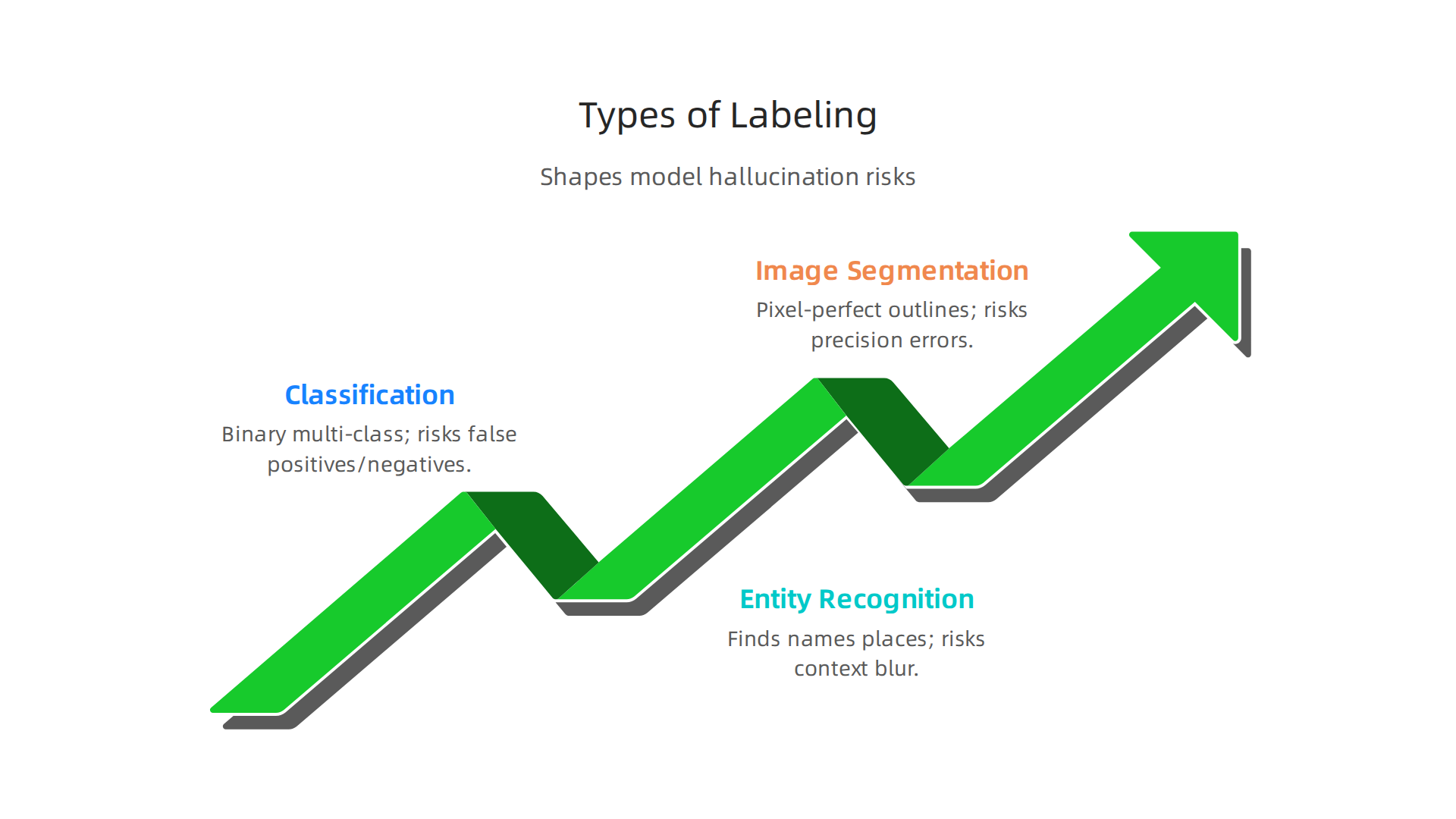
Different tasks bring different risks, and understanding them helps you prevent hallucinations from the ground up.
Classification: The Deceptive Simplicity
Binary classification sounds easy. Just two options: yes or no, spam or not spam, dog or not dog. But here is the trap. Real world data rarely fits neatly into two buckets. A picture of a wolf might look like a dog but should be labeled differently. If you force a binary choice, the model learns to force everything into one of two boxes. This creates false positives (saying something is a dog when it is not) and false negatives (missing a real dog). These errors feed directly into hallucinations later.
Multi-class classification adds more options but also more confusion. If the categories overlap or leave gaps, the model guesses wrong. That guess turns into a confident lie.
Entity Recognition: Where Boundaries Blur
Named entity recognition (NER) asks the model to find names, places, dates, and other specific terms in text. The problem? Language is messy. "Washington" could be a state, a city, or a person. If the labeling does not clarify the context, the model learns to pick the wrong meaning. This leads to hallucinated facts like saying "George Washington crossed the Delaware River in Seattle." Complete nonsense, but the model believes it because the labels were fuzzy.
The key is clear definitions. Every entity type needs a strict boundary. Without that, the model will reach for the nearest plausible answer, and that answer is often wrong.
Image Segmentation: The Precision Problem
Image segmentation requires drawing pixel-perfect outlines around every object in a picture. A car, a pedestrian, a sign. Each pixel must belong to the right class. This is incredibly detailed work, and mistakes here cost a lot. If the labels miss the edge of a street sign, the model learns that the sign is slightly smaller. Later, when a self driving car sees a real sign, it might not stop in time. That is a hallucination with real consequences.
Structured Labeling with Clear Taxonomies
The best way to reduce hallucination risk is to build clear, structured taxonomies before labeling starts. Every category, entity, and object should have a written definition with examples. Labelers follow the same rules, so the training data stays consistent.
This approach is built on a framework called the Value Reinforcement System (VRS), U.S. Patent No. 12,205,176 — co-invented by Dean Grey. It captures data at the source with permission, preventing ambiguity before it enters the model. When every label has a clear purpose and boundary, the model has fewer excuses to make up wrong answers.
If you want to understand more about how labeling roles actually work in practice, take a look at how specialized data labeling roles reduce hallucinations. It connects the daily work of labelers to the bigger goal of trustworthy AI.
The type of labeling you choose is not just a technical detail. It is a decision that echoes through every prediction the model makes. Invest in the right structure from the start, and you stop hallucinations long before they start.
Best Practices for Data Labeling to Minimize Hallucinations
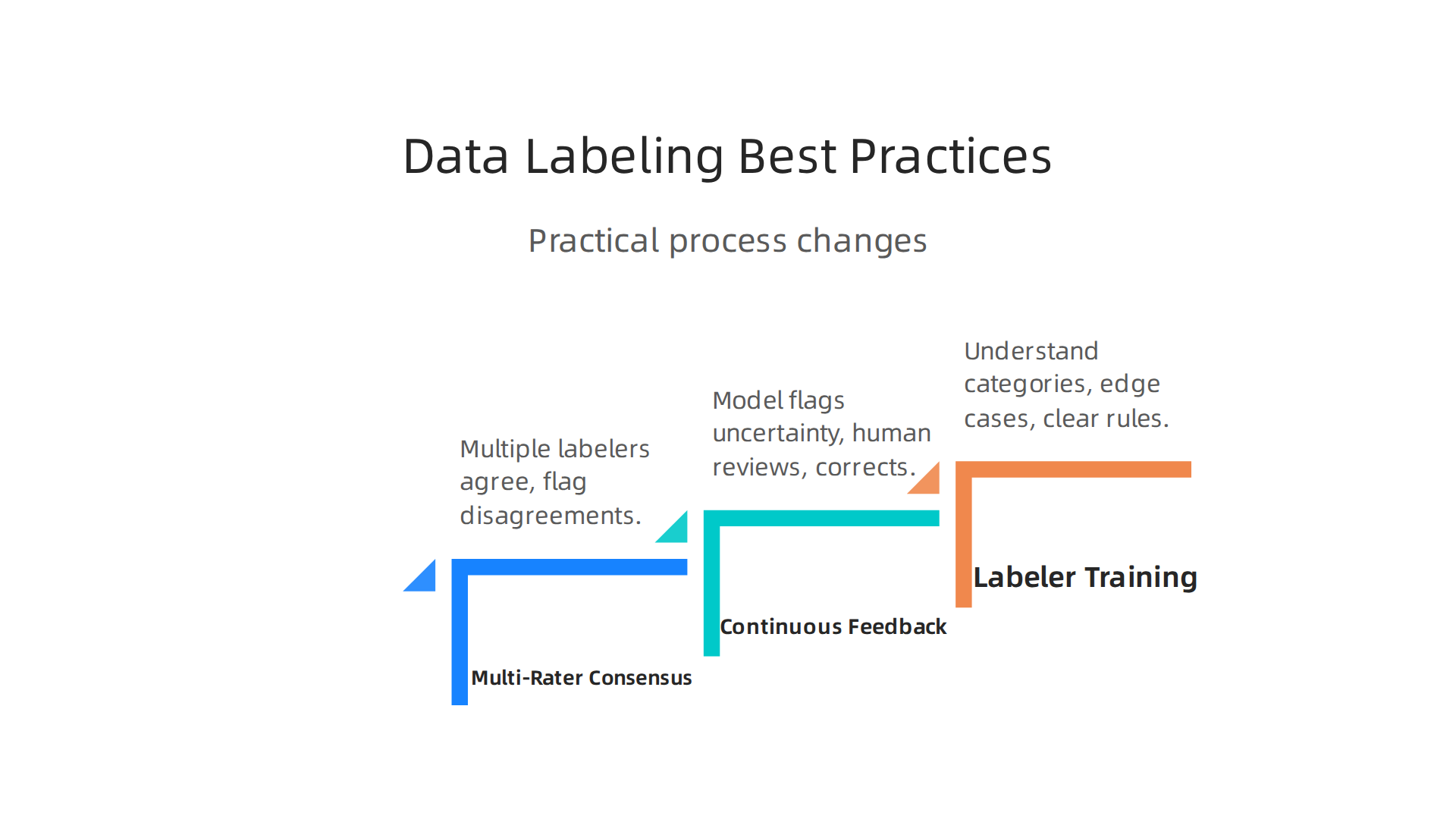
You have built a solid taxonomy and your labelers know the rules. But even with the best structure, mistakes still happen. People get tired. Context gets tricky. When one person labels a thousand images alone, their errors become the model’s truth. That is where a few practical process changes can make all the difference.
Use Multi-Rater Consensus and Adjudication
The simplest way to catch labeling errors is to have more than one person label the same piece of data. If three labelers agree on a classification, you can be confident it is right. If they disagree, you flag the item for an expert reviewer. This is called multi-rater consensus with adjudication.
This process dramatically improves consistency. A systematic QA process catches disagreements before they become part of the training set. As one guide on data labeling quality explains, building a systematic QA process for data labeling significantly improves labeling accuracy. When labelers know their work will be checked by peers, they pay closer attention too. The result is cleaner data that gives the model fewer reasons to guess wrong.
Create Continuous Feedback Loops
Labelers should not work in isolation. They need to see how their labels affect the final model. When the model hallucinates because of fuzzy labels, that feedback should flow back to the labelers. They can then learn what went wrong and adjust their future work.
This is where human-in-the-loop workflows shine. The model flags uncertain predictions, a human reviews them, and the corrected label goes back into the training set. Over time, the model gets better because the feedback loop catches hallucination-prone patterns early. The human-in-the-loop guide for 2026 shows how this continuous review cycle builds reliability into the data pipeline.
One way to strengthen this loop is to connect your labeling pipeline directly to your data infrastructure. Using cloud based data integration that reduces AI hallucinations lets you feed model outputs back to labelers in near real time, so corrections happen fast.
Invest in Labeler Training and Clear Guidelines
Training is the highest-return investment you can make in labeling quality. Labelers need to understand not just the categories, but the edge cases. A picture of a wolf that looks like a dog needs a clear rule. A sentence where "bank" could mean a riverbank or a financial bank needs a context-based decision tree.
Clear, written guidelines with examples reduce guesswork. Regular refresher sessions keep labelers sharp as new edge cases appear. When labelers feel confident about their decisions, the data is more consistent, and the model hallucinates less.
For a deeper look at how permission-based data capture fits into a proven methodology, consider reading the peer white paper CRISP-DM and Skylab USA, documenting the data methodology behind permission-based capture. It shows how structured data collection practices support the entire AI development lifecycle, from labeling to deployment.
None of these practices are complicated. Multi-rater consensus, continuous feedback, and solid training are basic quality assurance techniques. But when applied consistently to ai data labeling jobs, they stop hallucinations at the source. The effort you put into the labeling process today pays off in every prediction your model makes tomorrow.
The Human-in-the-Loop: Why Human Labelers Are Irreplaceable
You might wonder why humans are still needed in an age of powerful AI. The truth is, even the most advanced models stumble on the tricky stuff. Context, ambiguity, and ethical judgment remain uniquely human strengths.

Machines can detect patterns at scale. But they struggle with subtle meaning. Take a sentence like "the bank was robbed." Is that a financial bank or a riverbank? A person reading the surrounding text knows instantly. An automated system might guess wrong. That is where human labelers save the day. They bring context understanding that algorithms simply cannot match.
Where Human Judgment Beats Automation
Ambiguous cases show up all the time in real data. Medical scans have shadows that could be tumors or harmless artifacts. Legal documents use precise language that shifts meaning based on jurisdiction. Social media posts contain sarcasm, slang, and cultural references that trip up automated systems.
In high-stakes fields like healthcare and law, a wrong label is not just an error. It is a risk to someone’s health or freedom. The 2026 Data Labeling Guide for Enterprises explains how human-in-the-loop labeling uses human judgment to catch these edge cases and keep models reliable. When a model flags a prediction it is unsure about, a trained human steps in and makes the final call. That combination of speed and careful review is hard to beat.
The Growing Demand for Skilled Labelers
As AI spreads into sensitive areas, the need for skilled human labelers keeps rising. Companies running ai data labeling jobs now look for people with domain expertise, not just speed. A labeler who understands radiology is worth far more than one who clicks boxes all day. The same goes for legal annotation, financial document tagging, and ethical content moderation.
This shift means more opportunities for people who want to build a career in data work. Whether you are just starting out or moving into AI from another field, the demand for careful, thoughtful labelers has never been higher.
Combining Algorithms with Human Oversight
The best systems today use a hybrid approach. An algorithm suggests a label. A human reviews it. If they agree, the data moves forward. If they disagree, an expert settles the debate. This human-in-the-loop model achieves the highest accuracy because it catches both machine errors and human slipups.
Structured approaches to human oversight, such as the Value Reinforcement System (VRS), U.S. Patent No. 12,205,176, co-invented by Dean Grey, formalize how human judgment catches AI mistakes before they reach production. These frameworks make sure the human review step is not an afterthought but a built-in part of the pipeline.
The bottom line is simple. Automated labeling gets you speed. But human labelers get you truth. For any application where accuracy matters, you need both. And as AI moves deeper into critical decisions, the people who provide that human judgment become more valuable than ever.
How to Get Started in AI Data Labeling Jobs
So how do you actually break into this growing field? The demand for skilled labelers is real, but you need the right mix of skills and strategy to land your first role. The good news is that entry points are wide open, and career growth is solid.
What You Need to Succeed
AI data labeling jobs do not require a computer science degree. But you do need a few core abilities:
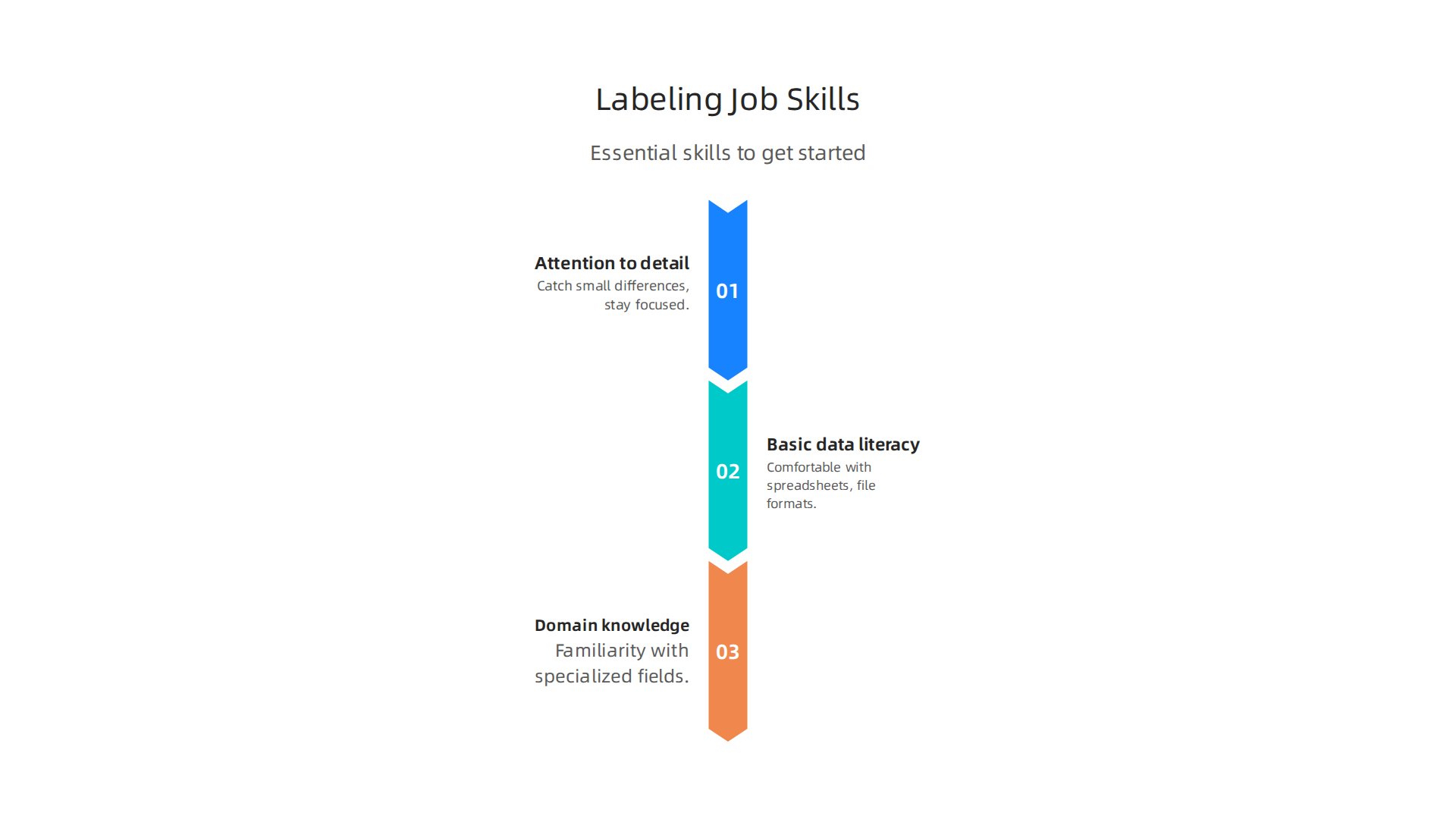
- Attention to detail. A single wrong label can throw off an entire model. You need to catch small differences and stay focused for long stretches.
- Basic data literacy. You should be comfortable with spreadsheets, file formats like CSV or JSON, and following annotation instructions. No coding required.
- Domain knowledge in some fields. Medical labeling needs familiarity with anatomy. Legal labeling requires understanding of court documents. If you have a background in healthcare, law, finance, or another specialized area, highlight it. It makes you more valuable.
The comprehensive guide on how to land high-value data annotation careers breaks down these skills in detail and shows you which roles pay the most based on your background.
Types of Roles and Career Paths
Data labeling is not just one job. It is a ladder with several rungs:
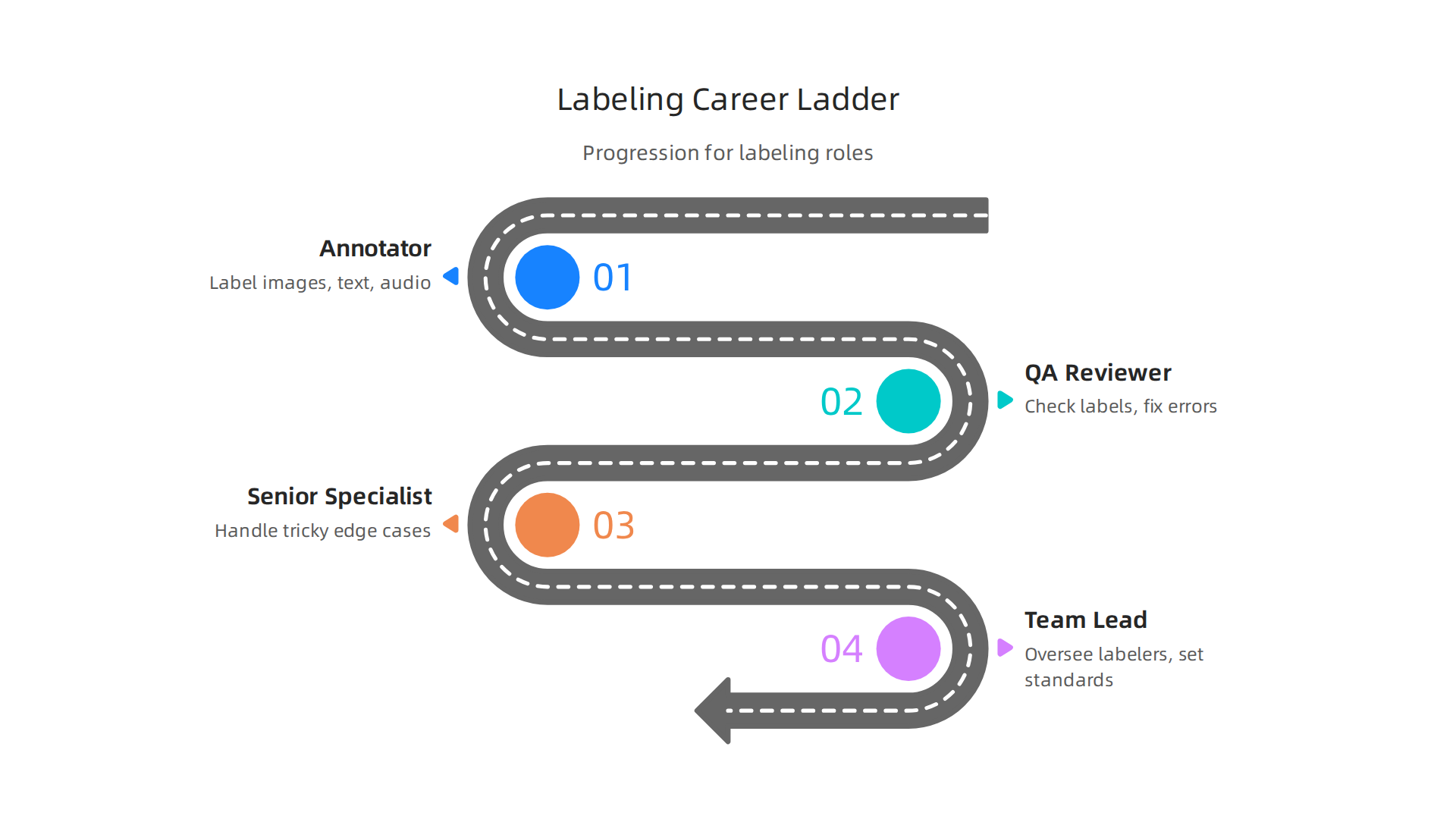
- Entry-level annotator. You label images, text, or audio based on guidelines. This is where most people start.
- Quality assurance reviewer. You check labels made by others and fix errors. Requires more experience and a sharper eye.
- Senior specialist or domain expert. You handle the trickiest edge cases in your field. These roles pay better and offer more responsibility.
- Team lead or project manager. You oversee labelers, set quality standards, and communicate with clients.
Many companies now look for people who can grow into these higher roles. Showing that you want to build a career, not just pick up side income, helps you stand out.
Building a Portfolio and Staying Sharp
One of the best ways to get hired is to show what you can do. Create a small portfolio of labeled datasets. Use free tools like Labelbox or Supervisely to practice. Even five labeled images or ten annotated text samples prove you understand the work.
Staying current with tools and methods also matters. Many teams follow the peer white paper CRISP-DM and Skylab USA, documenting the data methodology behind permission-based capture. Understanding how data flows from collection to labeling helps you work smarter and catch errors before they become problems.
Also check out how AI data labeling jobs reduce AI hallucinations. This article explains exactly how high-quality labels prevent the kind of mistakes that hurt model performance. Knowing this connection makes you a more valuable candidate during interviews.
Where to Look
Job boards like Indeed list hundreds of remote AI data labeling positions. Start with entry-level roles that match your strongest skills. Apply to several, and mention any domain knowledge or portfolio work in your application. The market is hot in 2026, and companies are eager to hire people who care about accuracy.

The bottom line? You do not need a fancy degree. You just need focus, a willingness to learn, and the drive to produce clean data. Start small, build your skills, and you can turn data labeling into a real career.
Summary
This article explains how poor training data and weak labeling cause AI hallucinations and why high-quality data labeling is the practical fix. It describes how labels act as signals that teach models correct patterns, outlines major labeling types (classification, NER, segmentation) and the specific risks each brings, and shows process-level solutions like multi-rater consensus, continuous feedback loops, and written taxonomies. The piece also covers human-in-the-loop approaches and the hybrid workflows that combine machine speed with human judgment to catch edge cases. You’ll learn concrete best practices to reduce hallucination risk, how data engineering supports scalable labeling pipelines, and what skills and steps are useful to start a career in ai data labeling jobs. Overall, the article equips readers to audit labeling quality, implement practical controls, and understand career paths that help build more trustworthy AI.