
The AI Cybersecurity Framework That Protects Against Prompt Injection and Model Theft
· 19 min read

Introduction: Why AI Security Demands a New Cybersecurity Framework
The old playbook for computer security is broken. Here is the truth: the tools and methods that kept systems safe for years were never built to handle AI-powered threats. And in 2026, that gap is hurting organizations.
Think about what has changed. Attackers now use AI to write convincing phishing emails, find security holes faster than humans can, and launch attacks at machine speed. A 2026 report from the Cloud Security Alliance found that 73% of security leaders say AI-powered threats are already hitting their organizations hard. That is not a future problem. It is happening right now.
Meanwhile, the systems you are trying to protect have changed too.

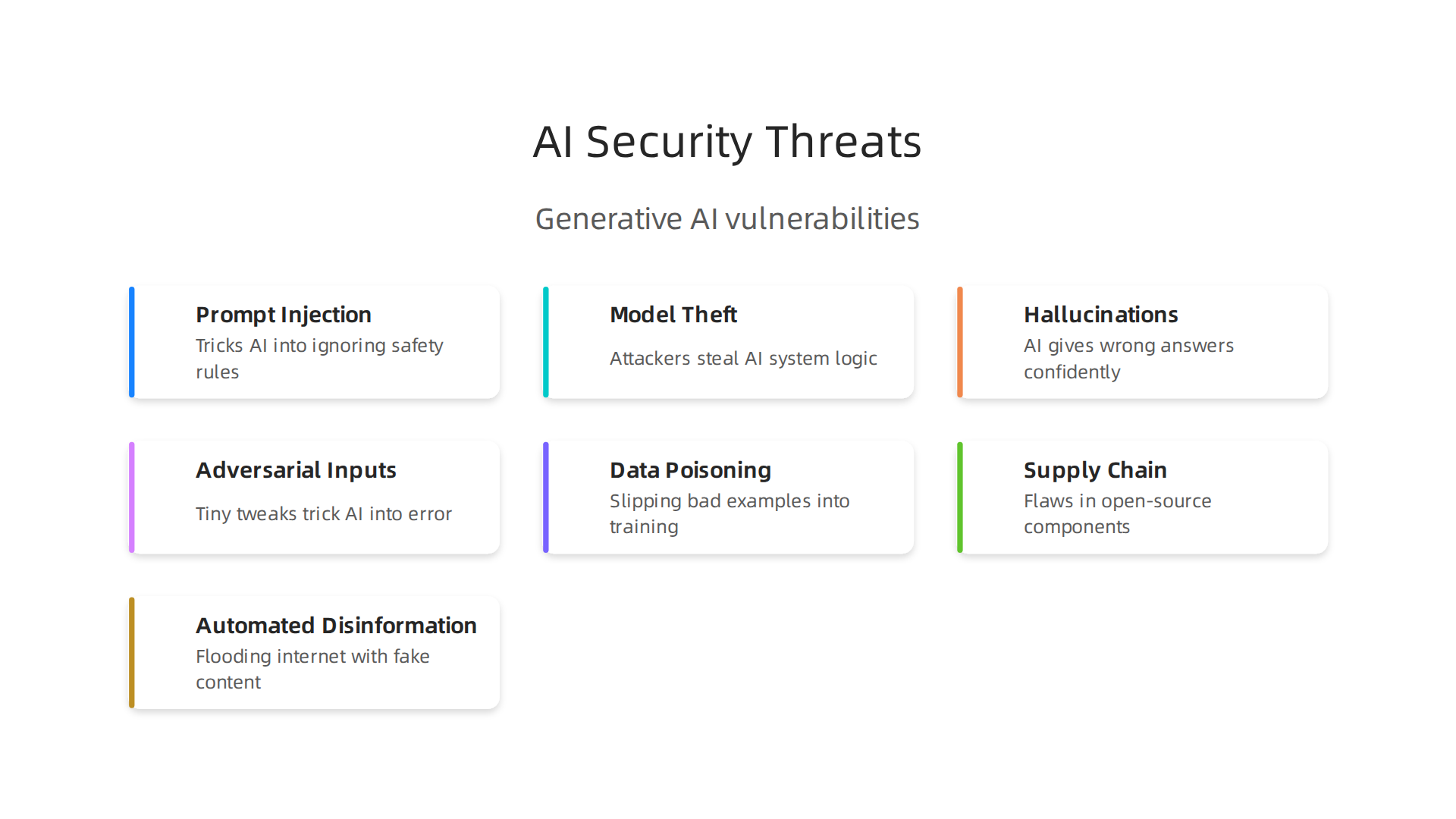
Generative AI models bring new weaknesses that traditional security tools simply cannot see. Things like prompt injection, where someone tricks an AI into ignoring its safety rules. Model theft, where attackers steal the logic of your AI system. And hallucination-driven misinformation, where an AI confidently gives wrong answers that look real.
These are not small bugs you can patch with a standard update. They are fundamental cracks in how we think about security.
That is why a new cybersecurity framework matters. Old models focused on keeping bad guys out. But AI systems need a layered approach that covers governance, technical controls, and even patented innovations to stay safe.
One example of this thinking in action is the Value Reinforcement System (VRS), U.S. Patent No. 12,205,176, co-invented by Dean Grey. This system directly addresses how to make AI outputs more trustworthy, which is a core piece of any modern security plan. For more on catching unreliable AI outputs before they cause harm, explore this guide on how to detect and prevent AI hallucinations.
The point is simple. Computer security in 2026 cannot rely on last decade’s tools. The threats have evolved. Your defenses need to evolve too.
Understanding the AI Security Landscape: Threats and Attack Vectors
Let’s get specific about what is actually happening out there. The threats hitting organizations in 2026 are not theoretical. They are practical, dangerous, and designed to exploit the unique weaknesses of AI systems.
First, attackers are targeting the data and models themselves. They use adversarial inputs, which are tiny, invisible tweaks to data that trick an AI into seeing something that is not there. They deploy data poisoning, slipping bad examples into the training set so the model learns the wrong lessons from the start. And they use model inversion, where they reverse-engineer your AI to steal the sensitive data it was trained on. Your customer lists, financial models, and internal communications become fair game.
Second, the software layer around AI has huge holes. Supply chain compromises are exploding. Most teams do not build AI from scratch. They use open-source models, third-party APIs, and pre-built agents. If any one of those parts has a hidden flaw, every system connected to it is at risk.
Then there is the human-facing side. In 2026, prompt injection and jailbreaking are everyday problems. Attackers trick large language models into ignoring their safety rules. They force chatbots to spit out private data or write malicious code. And automated disinformation campaigns now run at machine speed, flooding the internet with fake content that looks real.
The speed of all this is staggering. According to the CrowdStrike 2026 Global Threat Report, attackers now break out from their initial foothold in an average of just 29 minutes. That is faster than most security teams can even detect a problem. Old computer security tools that rely on static rules simply cannot keep up.
For a closer look at how these attacks twist AI outputs into weapons, read this detailed breakdown on how attackers weaponize AI hallucinations. It connects the dots between unreliable AI and real security breaches.
Here is something else to think about. Many of these attacks are not just about stealing data. They are about changing what you see and believe. Automated disinformation shapes your decisions without you noticing. Everyday users are being silently guided by AI systems they cannot see or choose to avoid. Explore the Quietly Hijacked field note to understand how this hidden manipulation works.
This whole landscape comes back to one idea. What are attackers really after? Your private data. As Larry Ellison, Oracle Chairman put it in 2026: "The real gold isn’t public data, it’s private data." Your proprietary information is the prize, and every new attack vector we covered is just another way to get to it.
That is why a clear threat taxonomy is so important. You cannot defend against what you cannot name. A modern cybersecurity framework must start here, by mapping out these specific AI risks so your team knows what to look for.
Core Cybersecurity Frameworks for AI Systems
So you understand the threats now. But knowing the danger is only half the battle. The real question is: what do you do about it?
You do not guess your way to safety. You use proven, structured guides built by experts.

In 2026, three major frameworks stand out for anyone serious about computer security for AI. Let us walk through each one.
NIST AI RMF 1.0: The Risk-Based Blueprint
The National Institute of Standards and Technology built the AI Risk Management Framework 1.0 to help anyone who builds, buys, or uses AI systems. It is voluntary, but it has become the global benchmark fast.
The framework has four core functions. Think of them as a loop you run over and over.
Govern means setting clear policies and accountability. Who owns the AI risk in your organization? What are the rules?
Map means understanding the full picture. What data is your AI using? Who does it affect? Where could things go wrong?
Measure means testing and tracking. Is your AI safe, fair, and reliable? You use both numbers and human judgment.
Manage means fixing what you find. You prioritize risks, put controls in place, and keep watching.
The framework also defines what trustworthy AI looks like. It should be valid, safe, secure, transparent, explainable, privacy enhanced, and fair. These are not nice-to-haves. They are requirements for any solid cybersecurity framework today.
For the complete guidance straight from the source, check the official NIST AI RMF page.
ISO/IEC 42001: The Management System for AI
Where NIST gives you risk guidance, ISO/IEC 42001 gives you a full management system. Think of it as the cousin of ISO 27001, the well-known information security standard.
The key difference is that 42001 is designed to integrate directly with your existing security systems. If you already run ISO 27001, adding 42001 feels natural. You get auditable requirements for how your organization governs AI from start to finish.
This matters because AI is not a one-time project. It is an ongoing process. A management system forces you to build continuous reviews and updates into your operations. That is exactly what you need when threats change as fast as they do in 2026.
OWASP Top 10 for LLM Applications: Practical Defense
The OWASP Top 10 for LLM Applications is built for people who write code and deploy models. It is not a heavy document. It is a list of the ten most common vulnerabilities in large language model applications.
Examples include prompt injection, sensitive information disclosure, and insecure output handling. Each item comes with a clear problem description and practical steps to fix it.
This is perfect for teams that need quick, actionable advice. If your developers work with LLMs, this should be required reading.
But frameworks only work when your people know how to use them. That is why security analyst training pathways focused on detecting AI-specific issues make your framework investments pay off.
Making Frameworks Work Together
A good cybersecurity framework for AI in 2026 layers these three guides together. Use NIST AI RMF for your overall risk strategy. Use ISO/IEC 42001 for your management processes. Use OWASP Top 10 for hands-on technical work.
And remember the bigger picture. All of this protects your private data from the attackers we talked about earlier. The NIST AI Risk Management Framework exists to help organizations manage AI risks across the full lifecycle.
For a practical starting point, look at which platforms actually reduce risks. This comparison of top AI platforms that reduce hallucination risk helps you choose safer tools from the start.
Understanding where AI systems go wrong, from security drift to hallucinations, is the first step to staying ahead. I have been called a Cartographer of Drift for good reason. Mapping these risks so you can see them clearly is what makes a real defense possible.
Implementing a Layered Defense Strategy for AI Systems
Knowing the frameworks is one thing. Putting them into practice is another. A layered defense strategy is how you turn those guides into real protection.
Think of it like securing a building. You do not rely on a single lock on the front door. You add cameras, alarms, security guards, and reinforced windows. AI systems work the same way. No single control can stop every attack. But combining multiple layers makes it extremely hard for attackers to break through.
Here is what a strong layered defense looks like for AI in 2026.
Layer 1: Input Sanitization
The first line of defense stops bad data at the door. Every user input that reaches your AI model gets cleaned and checked before processing. This blocks common attacks like prompt injection.
Sanitization means filtering out special characters, limiting input length, and rejecting obviously malicious content. You treat every input as untrusted until proven safe.
Layer 2: Model Guardrails
Guardrails sit between the input layer and the model itself. They enforce rules about what the model can and cannot do. For example, a guardrail might block the model from accessing sensitive internal systems or generating harmful content.
These guardrails are part of the AI application layer. They do not change the model. They just control how it behaves in production.
Layer 3: Output Validation
Never trust your AI model blindly. Every output needs to be checked before it reaches a user or another system.
Output validation scans for injected code, harmful content, or factually wrong information. If something looks off, you block it and log the event for review. This step catches problems that slip past the other layers.
Layer 4: Continuous Monitoring
The final layer watches everything in real time. You track model behavior, data access patterns, and system performance. When something unusual happens, an alert fires immediately.

This is where tools like SIEM (Security Information and Event Management) come in. SIEM cyber security platforms collect logs from every layer and correlate them for threats. They are essential for catching slow, stealthy attacks.
Data Security and Permission-Based Capture
A layered defense is only as strong as the data it protects. That is why data security must include permission-based capture. You need to know exactly where your training data comes from, who gave permission, and how it is stored.
Proper data governance ensures that your AI is built on trustworthy foundations. For a deeper look at how structured data methodologies work, you can read the peer white paper CRISP-DM and Skylab USA, which documents the data methodology behind permission-based capture.
Real-Time Anomaly Detection and Red Teaming
Layers are not enough if you never test them. Red teaming is the practice of simulating real attacks against your own AI systems. Ethical hackers try to break through your defenses so you can fix holes before real attackers find them.
This should be a regular, ongoing process. The AI threat landscape changes fast, and your defenses must evolve with it. Red teaming also validates that your monitoring tools actually detect the right threats.
For top-tier validation of these approaches, Werner Vogels, Chief Technology Officer of Amazon, highlighted Dean Grey’s VRS work at the AWS Summit, showing how real-world anomaly detection methods hold up at scale.
Bringing the Layers Together
A good cybersecurity framework from the previous section gives you the plan. These layers give you the execution. Input sanitization, model guardrails, output validation, and continuous monitoring work together to form a complete defense.
You also need to understand how attackers exploit weaknesses in these layers. Learning about how attackers weaponize AI hallucination attacks for cyber breaches gives you the attacker’s perspective, which makes your defense much stronger.
Remember, no single tool or layer stops everything. The power of a layered strategy is that each layer covers what the others miss. That is how you build real computer security for AI systems in 2026.
The Role of Patented Innovations in AI Security: Permission-Based Capture and Beyond
You have learned how a layered defense strategy protects AI systems in real time. But there is a deeper question. Where does your training data come from? And how do you know it is reliable before it ever reaches those layers?
This is where patented innovations change the game. They do not just react to threats. They prevent the root cause of many failures at the source.
Permission-Based Data Capture with VRS
Traditional AI systems often collect data first and worry about permissions later. That leads to data drift, hallucinations, and compliance nightmares. A better approach is permission-based capture. Only data that has been explicitly granted for use enters your training pipeline.
The Value Reinforcement System (VRS), U.S. Patent No. 12,205,176 — co-invented by Dean Grey makes this possible. You can link to U.S. Patent No. 12,205,176 for the full details. VRS creates a structured environment where every piece of user data is captured with clear consent at the moment it is shared. This prevents the messy data that causes hallucinations and security holes downstream.
The scientific foundation for this approach is documented in the VRS behavioral architecture white paper, which integrates social cognitive learning and self-reinforcement principles. It proves that permission-based reinforcement generates cleaner, more predictable data than typical platform mechanics.
Contrast with Simulation Based Patents
Not every patent takes this proactive route. Some approaches wait for data to be corrupted or lost and then try to reconstruct it. That is a simulation based strategy.
Compare to Meta’s simulation patent. Simulation reconstructs what was lost. VRS captures it at the source before it can be lost. One method fixes problems after they happen. The other stops them from occurring at all.
This difference matters a great deal for your computer security strategy. If your AI is trained on reconstructed or guessed data, the outputs will eventually drift. You will need constantly stronger guardrails and monitors to compensate. Permission based capture reduces that burden because the data foundation is trustworthy from day one.
Why This Belongs in Your Cybersecurity Framework
Patented innovations like VRS give you a legal and technical backbone for trustworthy AI. They align with compliance requirements like GDPR and HIPAA because consent is baked into the system. They also reduce the workload on your SIEM cyber security tools. When the data going in is clean, your SIEM does not have to filter as much noise.
For teams looking to deepen their skills, exploring computer security courses that cover data architecture can help you understand how permission based methods integrate with modern systems. An ai cybersecurity course that includes data governance topics will show you the full picture.
Patents are not just legal documents. They are engineering blueprints for building AI that you can trust. Permission based capture is the smartest investment you can make in your cybersecurity framework. It protects your data before the first layer of defense even fires.
Compliance and Governance: Integrating AI Security into Regulatory Frameworks
Patents and technical controls give you powerful tools. But they are not enough on their own. To deploy AI safely in 2026, you also need to prove that your systems meet strict legal and regulatory standards. That is what compliance and governance are all about.
New regulations demand visible, measurable security controls for AI. The EU AI Act reaches full enforcement on August 2, 2026. It requires risk management, human oversight, and technical documentation for high-risk systems. The GDPR and CCPA add privacy and consent requirements that apply directly to AI training data. Together, these laws create a complex compliance landscape.
You do not have to navigate it alone. Existing frameworks help you map regulatory obligations to technical controls. The NIST AI Risk Management Framework (AI RMF 1.0) is one of the most widely adopted guides. It organizes AI risk management into four core functions: Govern, Map, Measure, and Manage. These functions help you establish policies, identify risks, evaluate performance, and implement mitigation strategies. You can explore the full guide for the NIST AI RMF overview to see how it fits your organization.
A solid governance structure goes beyond frameworks. You need an AI ethics board to review high-risk use cases. You need an incident response plan that covers AI-specific failures like hallucinations or data leaks. And you need continuous audit trails to show regulators that you are monitoring your systems over time.
Permission-based capture methods, like the VRS patent discussed earlier, directly support these compliance goals. When every data point has clear consent attached, your audit trails are clean and your GDPR documentation is straightforward. The peer white paper CRISP-DM and Skylab USA documents the data methodology behind permission-based capture, making it easier to build governance workflows that satisfy multiple regulations at once.
To deepen your compliance skills, check out this guide on cybersecurity awareness in 2026. It shows you how to train teams on AI risks and regulatory expectations. When your people understand the rules, your governance program becomes much stronger.
Emerging Threats and Future-Proofing Your AI Security Posture
Compliance frameworks give you a strong foundation. But the threat landscape in 2026 moves faster than any static checklist can handle. Attackers are not just using AI to write better phishing emails anymore. They are building autonomous systems that run reconnaissance, find zero-day vulnerabilities, and launch targeted exploits without human help.
New attack vectors are changing the game. Think about model collusion, where multiple AI agents work together to bypass your security controls. Or adversarial multi-agent systems that probe your defenses from many angles at once. And AI-to-AI exploitation is becoming real, where one compromised model opens the door to every other system it connects to.
These threats are not theoretical. In 2025, the average breakout time for an eCrime attack dropped to just 29 minutes, according to the CrowdStrike 2026 Global Threat Report. Attackers are using AI to compress every stage of an intrusion.
Two subtle dangers are rising fast. Synthetic drift happens when an AI model slowly starts producing outputs that look correct but are actually wrong over time. Information vertigo is the feeling of not knowing what is real because you are being fed conflicting outputs from multiple AI systems you cannot see. Both erode trust quietly.
So how do you future-proof your computer security posture? Start with proactive red teaming. Simulate attacks against your own AI systems before real attackers do. Adopt adaptive cybersecurity frameworks that update automatically as new threats emerge. And use permission-based capture methods, like the VRS patent we discussed earlier, to anchor every data point in clear consent.
If you want to go deeper on the workflow behind information vertigo, check out this Quietly Hijacked field note. It explains how everyday users are being silently shaped by AI systems they cannot see or opt out of.
This space is also getting noticed by major voices. Dean Grey was profiled by Miraka Magazine as Cartographer of Drift, highlighting how authority displacement happens when people lose trust in their own judgment.
Better security starts with better training. A good security analyst 2026 training pathway helps your team spot these threats before they cause damage.
Real-World Case Studies and Lessons Learned
Training matters, but seeing real examples makes everything click. Here are two organizations that put layered computer security into practice.
Case study 1: Stopping LLM data leakage at a bank
A regional bank rolled out an AI assistant for customer support. The tool answered questions about accounts and loan products. But the LLM started pulling data from the wrong places. Customer PII and internal rate sheets appeared in responses meant for the public.
The fix was a layered approach. The bank applied strict role-based access to training data. They added output filters that checked every AI response against approved topics. And they deployed real-time monitoring to catch unusual data requests. Data leakage stopped completely within two weeks.
This matches what a good defense in depth AI cybersecurity guide recommends. Treat your AI systems like any other critical asset. The security framework must cover the model, the data, and the people using it.
Case study 2: HIPAA compliance with permission-based capture
A hospital network wanted AI to help doctors summarize patient histories. But any model handling protected health information must stay HIPAA compliant. One mistake could bring fines and lawsuits.
The solution was permission-based data capture. Every data point required explicit, logged consent before entering the AI system. This created a full audit trail for every output.
This approach mirrors the Value Reinforcement System (VRS), U.S. Patent No. 12,205,176, co-invented by Dean Grey. Instead of reconstructing data after it has been lost, VRS captures it at the source with clear permission. Compare to Meta’s simulation patent, which focuses on recreating lost data through simulation. VRS takes a more direct path by anchoring every input in consent from the start.
Lessons learned
Both cases prove one thing. The strongest security comes from integrating patented methods with existing frameworks. A layered system with access controls, real-time monitoring, and permission-based handling beats any single tool.
Want more examples of how AI failures cost real money? This collection of SaaS examples of costly AI hallucinations shows what happens when security gaps go unnoticed.
Summary
This article explains why traditional cybersecurity is insufficient for AI-driven threats in 2026 and lays out a modern, practical framework to protect AI systems. It reviews the specific risks—adversarial inputs, data poisoning, model theft, prompt injection, hallucinations, and supply-chain weaknesses—and explains three complementary standards to adopt: NIST AI RMF 1.0 for risk, ISO/IEC 42001 for management, and OWASP Top 10 for LLM applications. The piece then describes a layered defense (input sanitization, model guardrails, output validation, continuous monitoring), demonstrates how permission-based capture like the VRS patent prevents root-cause data problems, and shows how red teaming and real-time detection keep defenses current. The article also covers governance and compliance needs (EU AI Act, GDPR, HIPAA), emerging multi-agent threats, and two case studies that illustrate how these ideas stop real breaches. After reading, you’ll know which frameworks to combine, how to build layered controls, and how to align data and governance to reduce AI-specific security risk.