
Data Engineer Roadmap 2026 10 Steps to the Fastest Growing Tech Career
· 18 min read

Introduction
Imagine scrolling through job boards in 2026. You see headlines about tech layoffs everywhere. Over 150,000 tech jobs vanished this year alone. But hidden in that same data is a stunning surprise. Data engineering roles grew by 414% during the same period, according to a recent industry analysis. That is not a typo. While other roles shrink, data engineering is exploding.
So why does this matter to you? Because data engineering is the backbone of every modern organization that runs on data. Companies cannot do AI, analytics, or machine learning without clean, reliable data pipelines first. The Global Data Engineering Services market is now worth over $105 billion in 2026, and it is projected to keep growing fast.
Median salaries already sit around $131,000, with senior engineers earning up to $220,000.
Here is the problem. Many people who want to break into this field feel totally lost. There is too much information out there.

Should you start with SQL or Python? Do you need a data engineering bootcamp first? What about certifications like the Google Data Analytics Professional Certificate? Should you focus on cloud tools or open source? It gets confusing fast.
This data engineer roadmap cuts through all that noise. I pulled together expert insights and real industry trends to give you a clear, structured path. No fluff. No vague advice. Just ten actionable steps you can follow starting today.
Whether you are coming from a data analyst background or starting fresh with applied data science skills, this guide is built for where the industry is right now. Data engineering in 2026 demands a specific mix of skills, and I will show you exactly what those are.
One thing I have learned is that data quality matters more than ever. Bad data leads to bad AI outputs. And that is something I care a lot about. If you want to understand how unreliable data can poison AI systems, check out this guide on how to detect and prevent AI hallucinations. It is a perfect example of why solid data engineering is the foundation for trustworthy AI.
Ready to build your career? Let me walk you through the roadmap step by step.
1. Understand the Data Engineering Landscape
Before you jump into learning tools, you need to know what you are getting into. Data engineering is not one single job title. It is a whole spectrum.
You can be a generalist who builds everything from scratch. Or you can specialize as an analytics engineer, focusing on clean datasets for business teams. There are also data architects who design the big picture systems.
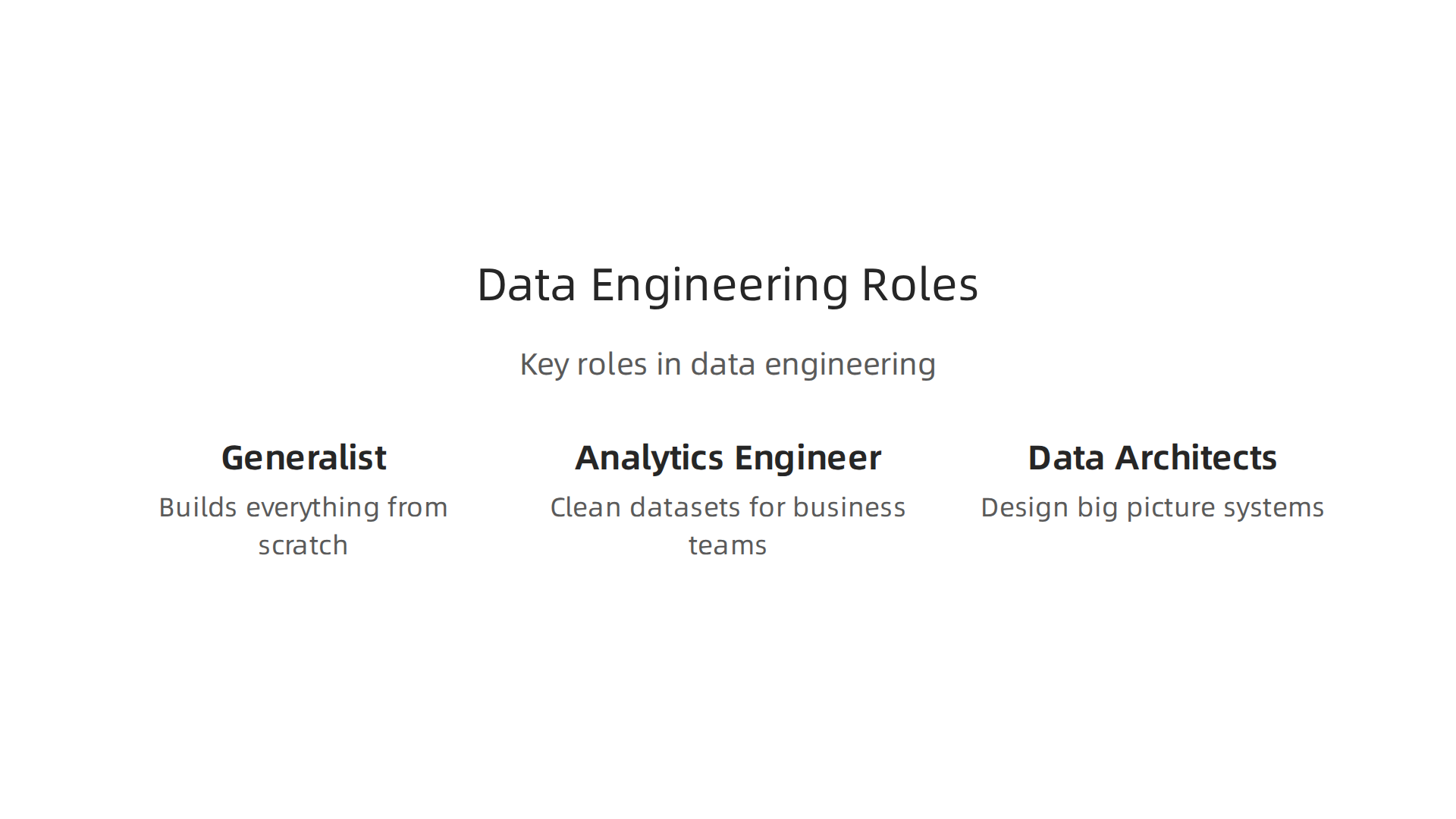
Each role needs a slightly different mix of skills.
Here is the good news. The pay is excellent. The average data engineer salary in 2026 ranges from $120,000 to $160,000 in the US, according to recent job market data. And the demand is only going up. The Global Data Engineering Services market is now worth over $105 billion and is projected to grow fast through the end of the decade.
So who is hiring? Everyone. Tech companies are the biggest players. But finance, healthcare, and e-commerce are also desperate for people who can move and clean data at scale.
Why does the industry matter for your roadmap? Because the type of company you target will shape your learning path. A healthcare startup might need you to handle strict privacy rules. An e-commerce giant might need real-time streaming pipelines. Knowing this helps you prioritize your study time.
Also remember that bad data engineering leads to bad AI outputs. If you are coming from a data analyst background or just finished an applied data science course, you already know this. Clean data is the foundation for everything else. That is why understanding the landscape is step one of any good data engineer roadmap.
2. Master Core Programming Languages: Python, SQL, and Java/Scala
Now that you understand the field, it is time to learn the tools. Every good data engineer roadmap starts with three programming languages.
Python and SQL are non-negotiable. You cannot skip these two. In 2026, Python appears in 70% of data engineer job postings, and SQL is right behind at 69%, according to job market data. Why? Python handles the heavy lifting for ETL scripts, automation, and working with APIs. SQL is how you actually talk to databases. Every pipeline you build will need both. A good data engineering bootcamp will drill these from day one.
But here is the thing. Python and SQL alone might not be enough if you want to work with big data tools like Apache Spark at scale. That is where Java or Scala come in. Spark is written in Scala and runs best on the JVM. If you can write production-grade Spark applications in Scala or Java, you become much more valuable to large companies. About 32% of data engineer job postings mention Java.
Commit to real projects. Reading tutorials is not enough. Build a Python ETL script that pulls data from an API, cleans it, and loads it into a database. Then create a portfolio of complex SQL queries that show you can join, aggregate, and window your way through real datasets. This is what hiring managers actually look for.
One more thing. Clean data pipelines prevent many of the AI hallucinations that plague modern AI systems. If you build pipelines that deliver accurate data, you directly reduce the risk of costly AI mistakes. Your skills as a data engineer support safer AI outcomes.
3. Build Strong Fundamentals in Databases and Data Warehousing
You have your programming languages ready. Now you need to know where and how to store all that data. This part of the data engineer roadmap is all about databases and data warehousing. Get these basics right, and your pipelines will run smoothly.
Start with relational databases like PostgreSQL and MySQL. These handle structured data with tables and relationships. You will write SQL queries to insert, update, and pull data every single day. Most companies run on relational databases, so you need to be comfortable with them. According to the Dataquest guide on data engineering skills, SQL is a must-have skill in 2026.
Then, explore NoSQL databases like MongoDB and Cassandra. NoSQL is great for unstructured or semi-structured data. Think social media feeds, sensor data, or logs. Many data pipelines have to handle both types, so knowing when to use each is key.
Next, dive into data warehousing concepts. You need to understand star schemas, snowflake schemas, fact tables, and dimensions. These are the building blocks for organizing data so that business users and data analysts can query it quickly. Good data modeling leads to fast query performance. A poorly modeled warehouse hurts everyone.
One way to build this knowledge fast is through a data engineering bootcamp that covers database design. Even a foundational google data analytics professional certificate can help you grasp the basics of querying and warehouse architecture.
Here is the tie to AI. Bad data in your warehouse leads to bad outputs downstream. If you feed inaccurate or messy data into an AI system, you increase the risk of hallucinations. That is why clean warehouse design matters. You can learn more about building an AI fact-checker workflow to catch errors before they reach users.
Master these fundamentals, and the next piece of the data engineer roadmap will feel much easier.
4. Learn Big Data Technologies: Hadoop, Spark, and Kafka
You have strong database skills now. But most real world data is too big for a single database. That is where big data technologies come in. This step in the data engineer roadmap teaches you how to handle terabytes or petabytes of data.
Start with Apache Spark. In 2026, Spark is the standard for large scale data processing. It is a key part of the dominant platforms shaping enterprise big data analysis. You should learn PySpark, which lets you use Python, and Scala Spark if you want to go deeper. Spark handles huge ETL jobs fast.
Next is Apache Kafka. Kafka is critical for real time data streaming. It handles high speed data feeds from apps, sensors, and devices. The modern data streaming landscape 2026 relies heavily on Kafka for event driven architectures. If you want to process data the moment it arrives, you need Kafka.
Finally, get familiar with the Hadoop ecosystem. Even in 2026, many companies use HDFS for storage, Hive for querying, and YARN for resource management. These are the building blocks that Spark and other tools run on top of.
A good data engineering bootcamp will dedicate weeks to these three areas. This is the core of applied data science at scale.
Why does this matter for AI? Simple. If the pipeline built with Spark or Kafka has bad data inside it, that garbage goes straight into your AI model. This increases the chance of costly errors. You can learn to catch these errors early by learning how to build an AI fact checker workflow to catch costly hallucinations. Clean data in big data tools is non negotiable.
Mastering these big data technologies makes you a much stronger candidate in the data engineer roadmap.
5. Get Hands-On with Cloud Platforms: AWS, GCP, and Azure
You have learned how Spark, Kafka, and Hadoop work. That is great. But where do you actually run these tools in real companies? The answer is the cloud.
In 2026, nearly every company runs its data pipelines on a cloud platform. AWS holds the biggest market share, but Google Cloud (GCP) and Microsoft Azure are growing fast in data services.
If you want to follow a complete data engineer roadmap, you need to pick one and get your hands dirty.
Here is a quick look at what each platform offers for data work:
- AWS: Think of S3 for storage and Redshift for data warehousing. These are industry standards.
- GCP: BigQuery is a serverless warehouse that handles massive queries instantly. Dataflow runs batch and streaming jobs easily.
- Azure: Azure Data Lake gives you huge storage, and Synapse Analytics combines big data and data warehousing in one place.
The best way to learn is to do. Set up a free tier account on the platform you choose. Then build a simple end to end pipeline. Load some data from your local machine into cloud storage. Transform it with a tool like Spark on the cloud. Then query the results. This one project will teach you more than reading ten blog posts.
Why does this matter for applied data science? Simple. A bad pipeline in the cloud still sends bad data into your AI. That increases the chance of costly errors. You can learn to catch these early by seeing how to build an AI fact checker workflow to catch costly hallucinations. Clean data in the cloud is just as non negotiable as clean data in big data tools.
Cloud skills are a huge part of the data engineer roadmap in 2026. They make you more valuable as both a data analyst and a full data engineer.
6. Develop ETL/ELT Pipeline Skills
So you have learned about the cloud. Now it is time to build the actual pipelines that move and change data. This is the heart of the data engineer roadmap. Without strong pipeline skills, your data sits still. It never reaches the people or the AI models that need it.
You need to learn two main patterns: ETL and ELT. ETL means Extract, Transform, Load. ELT means Extract, Load, Transform. The difference is when you change the data. In ETL, you clean it before loading. In ELT, you load it raw and clean it later. Most modern cloud pipelines use ELT with tools like dbt.
Here are the tools you should practice with in 2026:
- Airflow: Schedules and monitors your pipeline steps. It is the most popular orchestrator.
- dbt: Lets you transform data inside your warehouse using simple SQL. It is a must know for any data analyst moving into engineering.
- Fivetran: Handles the extraction and loading part automatically. Great for saving time.
You also need to understand data transformation techniques. Things like cleaning null values, normalizing inconsistent formats, and aggregating millions of rows into summaries. These skills separate a beginner from a professional.
The best way to learn is by doing. Find a public dataset and build a pipeline from scratch. For example, build an ETL pipeline that takes a CSV file, converts it to Parquet, and loads it into BigQuery. You can find project ideas on sites like DataCamp or DataExpert.io.
These real projects teach you the core patterns that hiring managers look for.
Here is the thing. A broken pipeline sends bad data into your AI tools. That causes hallucinations. You can learn to avoid this by seeing how to build an AI fact checker workflow to catch costly hallucinations. Clean data in your pipeline means clean data in your AI.
Mastering these pipeline skills is a huge part of any data engineering bootcamp or self-study plan. It takes your applied data science work from theory to reality.
7. Work on Real-World Projects and Build a Portfolio
Learning the tools is one thing. Proving you can use them is another. That is why your portfolio matters more than your resume in 2026. Hiring managers want to see depth. They want proof that you can handle messy, real world data. This is the difference between studying a data engineering bootcamp and actually becoming a professional.
Build three strong projects that show different skills. Think about projects like log analysis, clickstream data processing, or working with IoT sensor streams. Having three focused projects is better than ten shallow ones. It shows you can go deep on a problem. These are exactly the types of projects that hiring managers actually look for.
Showcase each project on GitHub. Do not just dump your code. Write a clear README that explains the problem, the tools you used, and what you learned. Add a simple architecture diagram so someone can understand your pipeline at a glance. You can find good templates in this list of hands-on data engineering projects.
Here is the important part. Show that you can build an end to end pipeline. Include tests for your data quality. Set up basic monitoring alerts. Write documentation. This proves you understand the complete lifecycle of a data product. It pushes you beyond what a typical data analyst does into true engineering territory. This is the essence of applied data science and engineering, turning raw data into a reliable asset.
When your data feeds into AI systems, quality checks become even more important. Bad data leads to bad outputs. You can learn how to prevent this by seeing how to build an AI fact checker workflow to catch costly hallucinations.
These three projects will connect everything you learned in this data engineer roadmap. They turn your knowledge into a career. Choose your first dataset today and start building.
8. Obtain Relevant Certifications
Your portfolio proves you can build. Certifications prove you know the theory. Together, they make you a complete candidate. In 2026, hiring managers use certifications to filter applicants fast. A solid certification can get you past the first screening and into the interview.
The top certifications right now are focused on the three major cloud platforms. The AWS Data Analytics certification shows you can build pipelines on Amazon’s cloud. The Google Cloud Professional Data Engineer credential focuses on GCP tools like BigQuery and Dataflow. And the Azure Data Engineer Associate certification validates your skills on Microsoft’s stack. Which one should you pick? Choose the cloud that your target job uses most.
Certifications matter because they validate your skills for recruiters who may not have a technical background. The badge tells them you passed a real exam. It also shows you can commit to learning. That goes a long way in a field where tools change fast.
But do not make the mistake of collecting certifications without real experience. The strongest candidates combine a certification with the three portfolio projects we talked about earlier. This is the key difference between someone who just finished a data engineering bootcamp and someone who followed a complete data engineer roadmap with both theory and practice.
When your pipelines feed AI models, the data must be clean. Certifications often teach you about data quality, but you can go deeper by learning how to detect and prevent AI hallucinations caused by bad inputs. That knowledge sets you apart from a typical data analyst and moves you into true applied data science territory.
Pick one certification. Study for it. Pass the exam. Then add the badge to your LinkedIn and your resume. It works best when it sits right next to your project links.
9. Network and Build Your Professional Brand
Your certification badge on LinkedIn is a great start. But to make your data engineer roadmap work, you need to be active. You cannot just set your profile and wait. You need to network and build your brand the right way.
Optimize your LinkedIn. Do not just list your certification. Write a short post about what you learned while studying for it. Sharing your journey like this validates your skills for recruiters who may not understand the technical details. Then share a tip about cleaning messy data. When you post about ensuring quality data to detect and prevent AI hallucinations, you show employers you care about accurate outputs. That is a big deal in 2026. And comment on posts from people you admire. Real engagement beats a long list of skills.
Attend virtual meetups and conferences. Big events like the Data+AI Summit are perfect for learning what tools people actually use. You do not have to travel. Just join the free streams. Ask a smart question in the chat. Then send a connection request to the speaker. One good conversation can lead to a job referral. Many people following a data engineering bootcamp or switching from being a data analyst find their first break this way.
Share what you build. Write a short technical article about a problem you solved. Fix a small bug in an open-source tool you love. You can share lessons from the google data analytics professional certificate or your own projects in applied data science. The goal is to show you are learning in public. Hiring managers notice people who give back to the community.
Do these small things every week. Your network will grow. And your data engineer roadmap will turn into real job offers.
10. Continuously Learn and Stay Updated
Your data engineer roadmap does not end when you land a job. In fact, that is when the real learning starts. The tools and best practices in data engineering change fast.

What worked last year might be outdated today. So you need a system to keep learning.
Follow the right sources. Bookmark the Databricks Blog and the Confluent Blog. Subscribe to a few newsletters that summarize what is new. Spend 15 minutes each morning skimming the headlines. You do not need to master everything. You just need to know what is changing.
Take advanced courses. Once you finish a data engineering bootcamp or earn your google data analytics professional certificate, do not stop there. Look for courses on streaming data, data governance, and MLOps. These topics matter more every year for senior roles. They separate a beginner from a true professional. For example, understanding how AI models can produce wrong outputs is a skill more companies want in 2026. You can learn ways to detect and prevent AI hallucinations as part of your applied data science toolkit.
Set a weekly learning goal. Pick one thing each week. Maybe it is a technical deep dive on a new tool. Or a podcast episode during your commute. The goal does not have to be big. It just has to be consistent. Over a year, those small habits add up to real expertise.
Continuous learning is what turns a data engineer roadmap into a long career. Keep going. The field rewards people who stay curious.
Summary
This article is a practical, step-by-step roadmap for becoming a data engineer in 2026, written to cut through confusing advice and show exactly what to learn and do. It explains why data engineering is growing rapidly, how it underpins AI and analytics, and why clean data prevents costly AI hallucinations. The guide walks you from understanding roles and industry demands through mastering Python, SQL, and optionally Java/Scala, to core database and data warehousing concepts. It covers big data technologies (Spark, Kafka, Hadoop), cloud platforms (AWS, GCP, Azure), and the ETL/ELT patterns and tools you should practice. You’ll get concrete advice on building three portfolio projects, earning one cloud certification, and networking effectively to get interviews. Finally, it emphasizes lifelong learning and gives practical next steps so you can build reliable pipelines and reduce downstream AI errors.