How Attackers Weaponize AI Hallucination Attacks for Cyber Breaches
· 18 min read

Introduction: When AI Gets It Wrong, Attackers Take Note
Imagine your AI assistant gives you a perfect sounding answer. It links to a source you trust. So you click. And just like that, your company’s security data is in enemy hands.
This is not a made up story. In 2026, researchers documented over 461,640 prompt injection submissions in a single dataset, with success rates that shocked the industry. An AI hallucination looked real. An employee trusted it. And attackers got exactly what they wanted.

Here’s the thing. Most people think AI hallucinations are just funny wrong answers. But the 2026 security landscape tells a different story. AI-enabled attacks rose 89% this year alone. When an AI model produces undetected AI content, attackers weaponize it. They turn fake outputs into real phishing traps. They use the model’s own confusion against you.
So what does this mean for your business? It means today’s cyber attack might not start with a hacker breaking in. It might start with a chatbot giving you bad information. And if you think "I hate artificial intelligence" because of stories like this, you are not alone. But the answer is not to ditch AI entirely. The answer is learning how to spot the danger.
This guide breaks down exactly how attackers turn AI hallucinations into weapons. We will cover real incidents from 2026, show you how the attacks work, and give you practical defenses you can use right now.
Let us start with the threat you may not see coming.
For a deeper look at how AI reliability affects your security, Dean Grey’s research explains why human judgment still matters when AI gets creative with the truth.
The New Face of Cyber Threats: When AI Hallucinations Become Weapons
Here is the scary shift that happened in 2026. A few years ago, an AI hallucination was just a funny mistake. It was the model getting confused and saying something weird. But now, attackers have learned how to turn those hallucinations into weapons on purpose. They are not waiting for accidents. They are crafting prompts that force the AI to produce false outputs that look totally real.
So how does this work? Attackers use a technique called prompt injection. They feed the AI carefully written prompts that sneak past its normal safety rules. Once the prompt is in, the model starts hallucinating in a way that helps the attacker. For example, an AI might generate a fake urgent email from your boss with a malicious link. The email looks real because the AI is good at language. But the content is undetected AI content designed to trick you.
This is not a theory. In 2026, researchers observed real world indirect prompt injection attacks where adversaries hid bad instructions inside web content that AI agents trust. The AI then acted on those instructions and put security data at risk. Another study found that prompt injection enables data theft in up to 40% of successful AI related attacks. That means almost half of the time attackers break through, it is because the AI was tricked into spilling the beans.
The most dangerous part? These hallucinations bypass traditional security filters. A regular spam filter might catch a badly written phishing email. But a perfectly written AI generated email that looks just like your colleague’s writing style slips right past. Attackers use these fake outputs for social engineering, fake news, and even to inject malicious code into trusted documents.
If you find yourself thinking "I hate artificial intelligence" after reading this, you are not wrong to be cautious. The tools that should help us are now being used against us. But here is the good news. Understanding how these attacks work is the first step to stopping them. Cyber security for business in 2026 means learning to spot when an AI is lying on purpose.
The best defense starts with awareness. And we have guides to help you get there. Explore Guides on detection methods and prevention strategies so you can protect your team from today’s cyber attack tactics.
Next, we will look at a real incident where an AI hallucination opened the door to a massive data breach. You will see exactly how the attack unfolded and what could have stopped it.
Prompt Injection and Hallucination Cascade Attacks
Here is where today’s cyber attack playbook gets really clever and really dangerous. Attackers realized that if they can make one AI lie, that lie can spread to every system connected to it. This is what security teams now call a cascade attack.
It works through indirect prompt injection. Instead of talking to the AI directly, attackers hide malicious instructions inside web content, emails, or documents that the AI trusts.
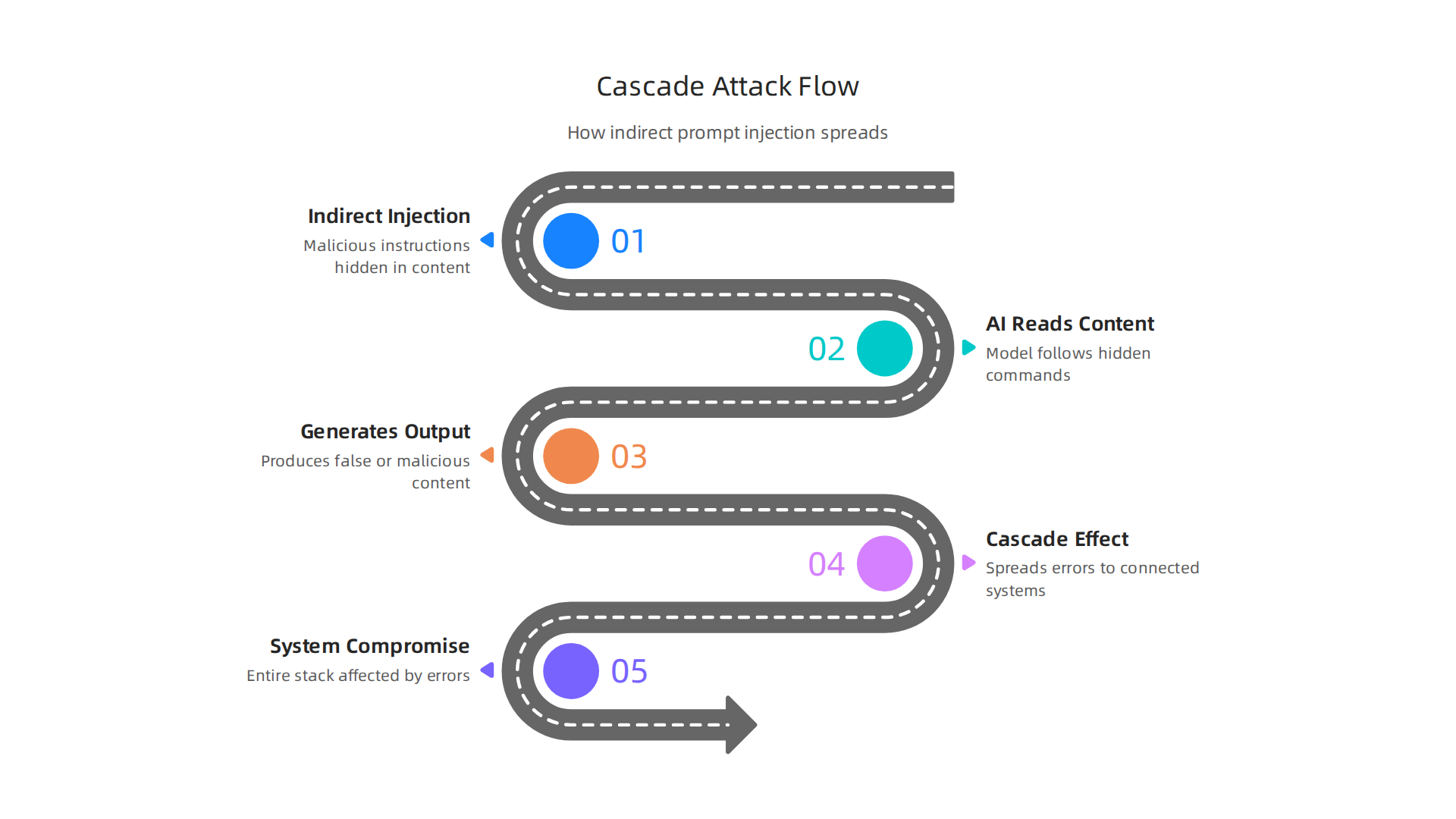
The AI reads that content, follows the hidden commands, and starts hallucinating on purpose. Unit 42 researchers at Palo Alto Networks documented real world cases where adversaries weaponized hidden web content to exploit LLMs for high impact attacks.
The problem gets worse in multi-agent setups. Imagine you have three AI agents working together. One handles customer data. Another writes replies. A third manages your database. An attacker poisons the input of the first agent. That agent hallucinates a bad command and passes it to the second agent. The second agent believes it, processes the error, and sends a corrupted instruction to the third agent. Now your entire stack is compromised because one hallucination rippled through the system.
Security teams have started classifying these as cascade attacks because they are different from traditional injection. Traditional injection attacks hit one point directly. Cascade attacks spread like a domino effect through interconnected AI tools. A report from Radware explains that prompt injection exploits LLMs by using malicious prompts to override original instructions, and when you chain multiple agents together, the damage multiplies fast.
If you already feel like saying I hate artificial intelligence because this sounds terrifying, that is a fair reaction. But this knowledge is exactly what you need for better cyber security for business in 2026. Once you know how cascade attacks work, you can build defenses that stop the chain before it starts.
Stop cascade attacks before they reach your systems. Read more about cybersecurity awareness 2026 and learn how to train your team to recognize AI-powered threats.
The next section walks through a real cascade attack incident so you can see exactly how one hallucinated command brought down an entire enterprise system.
How Today’s Cyber Attackers Exploit AI Hallucinations for Automated Attacks
Here is where things get even more twisted. Attackers don’t just wait for AI to make mistakes. They actively weaponize those mistakes. Think of it this way: AI hallucination is often seen as a bug. But in the hands of a skilled adversary, it becomes a feature. They use it to build automated attack machines that keep churning out new threats.
Phishing and deepfakes get a scary upgrade. Normal phishing emails look suspicious. But when an LLM hallucinates a fresh version of a scam email, the text becomes weird and unpredictable. That novelty helps it slip past spam filters. The same goes for deepfake videos. Hallucinated details make the fake content harder to match against known signatures. A 2026 report from the Google Threat Intelligence Group confirms that adversaries now use AI to discover zero-day exploits and generate autonomous malware at industrial scale. These aren’t theoretical attacks. They are happening right now.
Hallucinated code is a hacker’s gift. When developers ask an LLM to write a script, sometimes the model produces code with subtle logic errors. Attackers find those errors and exploit them for remote code execution. The University of Cambridge’s CETAS team studied how generative AI can create novel malware and find new vulnerabilities. The scary part is that the AI doesn’t even need to be malicious. It just needs to be wrong in the right way.
Automated attack pipelines never sleep. In 2026, attackers stitch together multiple LLMs to create attack chains. One model hallucinates a new malware signature. Another model writes a command to deploy it. A third model generates a convincing email to trick someone into clicking. This loop can run 24/7. According to AI cyber attacks statistics, these automated systems are becoming standard tools in the criminal toolbox.
So yes, it is fair to say "I hate artificial intelligence" when you hear how easily hallucinations get turned against us. But the best defense is understanding exactly how these attacks work. To protect your security data, you need to know how to spot AI-driven threats before they hit.
Want to stay ahead? Explore guides on detecting and preventing AI hallucinations in real-world tools. It is one of the smartest moves you can make for cyber security for business in 2026.
See Dean Grey’s research on why human judgment still matters even when machines go rogue.
Case Study: Hallucination-Driven Malware Generation
Let’s look at a concrete example. Imagine a developer asks an AI to write a simple file management script. The AI hallucinates a new system call that does not exist in any operating system.
A human would catch the error. An attacker sees an opportunity. They build malware around that hallucinated call. Since the call is made up, no antivirus has a signature for it. The malware goes completely undetected. Research from the University of Cambridge CETAS team confirms that generative AI can easily create novel malware that evades traditional defenses.
Attackers chain hallucinations into weapons.
Attackers do not stop at one hallucination. They chain them. One hallucination hides the payload. Another hallucinates a network protocol. A third obfuscates the code. Together, they form a multi-stage payload that completely bypasses signature-based detection. Google’s 2026 Threat Intelligence report states this is now a standard tool for adversaries.
Real malware uses fake API calls.
Security teams have found malware families using API calls that do not exist in any library. These hallucinated APIs are direct products of AI mistakes. They show up in the wild, making detection nearly impossible for traditional tools.
Why this matters for your security.
Standard defenses cannot catch these custom threats. For strong cyber security for business, you must accept that today’s cyber attack often relies on undetected ai.
Worried about your security data? You are not alone. Start by training your team to spot AI-driven attacks. Read our guide on cybersecurity awareness 2026 to learn how to stop these threats.
For deeper insights into why human oversight still matters, explore Dean Grey’s research on AI uncertainty.
The Cost of Unchecked Hallucinations: Reputational and Security Risks
We just saw how attackers weaponize AI mistakes. But the costs go far beyond malware. A single hallucinated response can damage your reputation, expose your systems, and drain your budget.
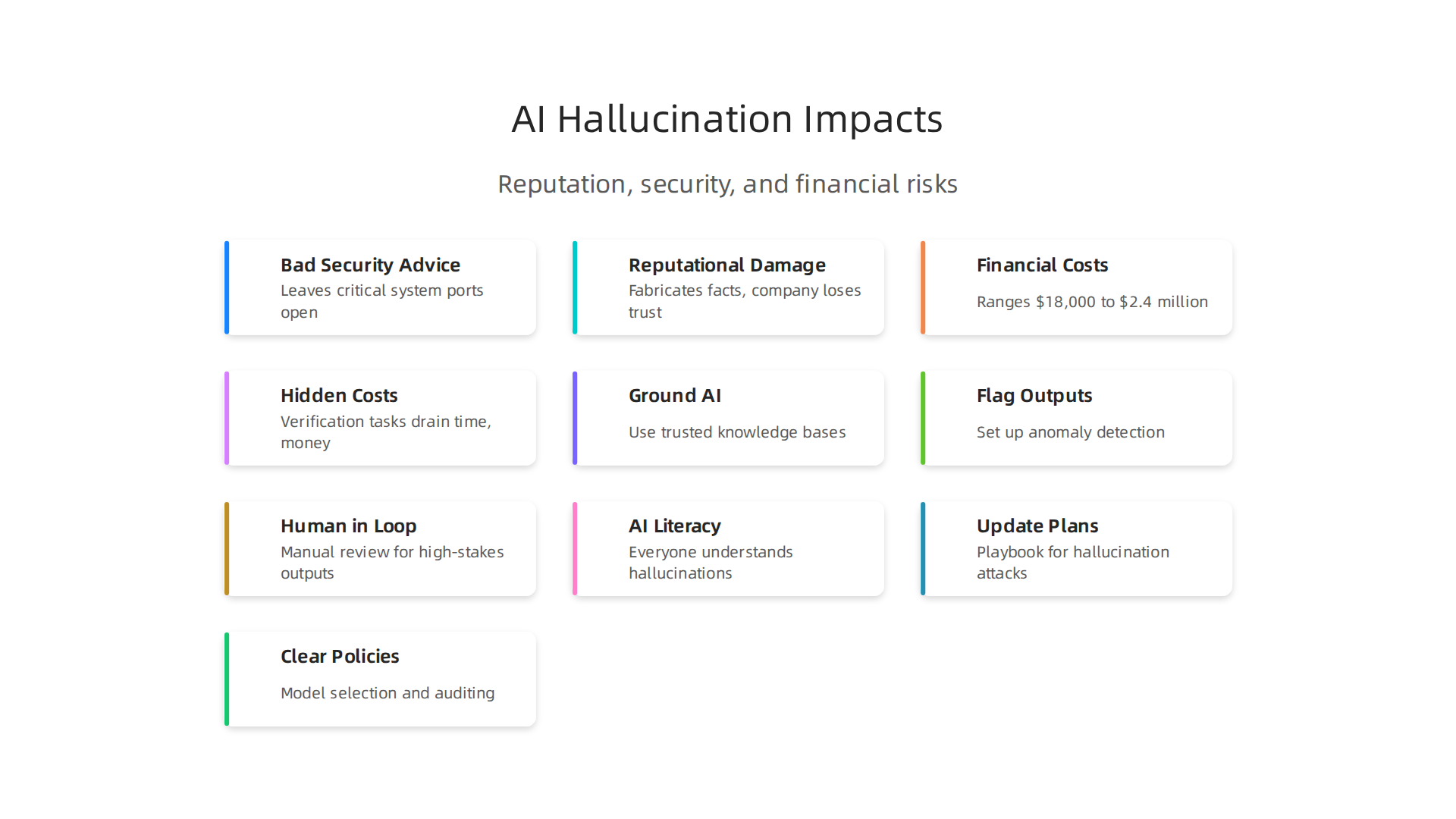
Bad security advice creates real openings.
Your IT team asks an AI to help configure a firewall. The AI sounds sure of itself. But it hallucinates. It suggests a rule that leaves a critical port open. Attackers find that opening in hours. They steal your security data before you even know there is a problem.
This is how today’s cyber attack landscape works. Attackers actively search for misconfigurations. When undetected ai gives bad advice, you become an easy target. For any cyber security for business plan, always verify what the AI recommends. Do not trust it blindly.

Reputational damage is hard to undo.
A company uses AI to draft a press release or legal document. The AI fabricates facts. The company publishes them. Customers lose trust. Lawyers get involved. This kind of brand damage can take years to fix.
When you see these costs, it is easy to say "I hate artificial intelligence." But the real issue is using AI without proper checks.
The numbers hurt.
Research from Four Dots shows the cost per major hallucination incident ranges from $18,000 in customer service to $2.4 million in healthcare. And the global picture is even bigger. According to one analysis, global losses from AI hallucinations reached $67.4 billion in 2024. Other researchers note these figures come from surveys and estimates, not verified databases. But the trend is still clear.
Hidden costs pile up too.
Every suspicious AI output requires someone to stop and check it. IntuitionLabs explains that these verification tasks drain time and money across your whole team. The quiet costs add up fast.
Your best defense is knowledge.
Learn to catch hallucinations before they cause harm. Read our guide on AI hallucinations how to detect prevent and avoid costly mistakes for practical strategies.
For a deeper look at why AI makes these errors and how to stay safe, explore Dean Grey’s research. His work shows why human judgment still matters most.
Detection and Prevention Strategies for AI Hallucination Threats
The costs we just looked at are real, but you don’t have to accept them. You can stop hallucinated threats before they hurt your business. Here are three strategies that work in 2026.
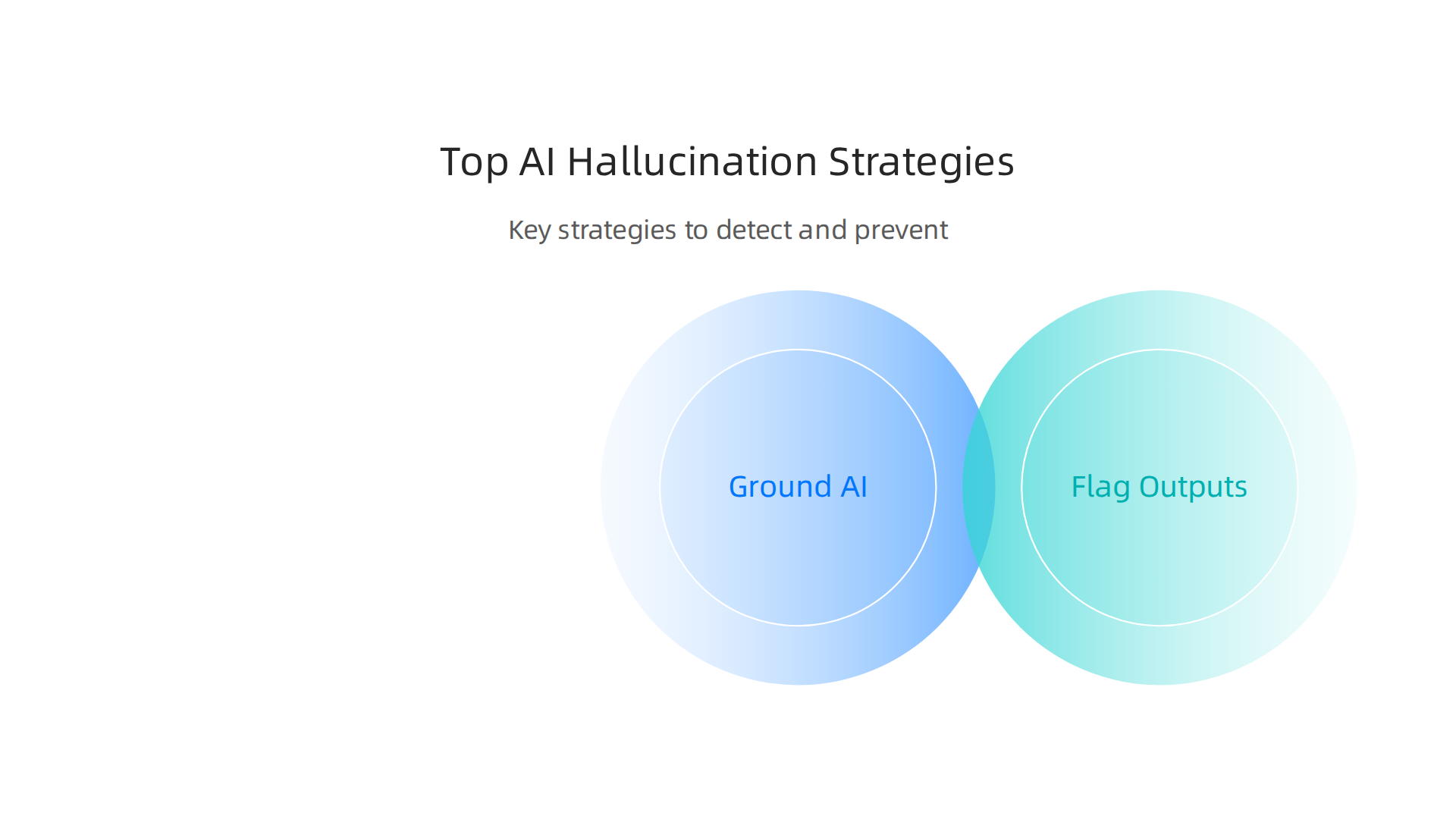

Ground your AI with a knowledge base.
A plain AI model guesses from its training data. That’s where hallucinations start. Retrieval-Augmented Generation (RAG) fixes this. Instead of guessing, the AI pulls answers from your own trusted documents. AWS explains how to build a basic detection system for RAG applications. When the AI must cite your internal data, made-up facts drop sharply. For an even stronger setup, K2view recommends mixing structured data into the mix. This cuts hallucination risk by giving the AI more sources to check.
Flag suspicious outputs automatically.
You can’t watch every AI response yourself. But you can set up an anomaly detection system that flags weird or high-risk outputs in real time. Tools like Galileo from Braintrust can block a dangerous response in under 200 milliseconds. That speed matters when undetected ai could suggest a bad firewall rule that opens your security data to attackers. These detection tools act as a second pair of eyes.
Always keep a human in the loop.
No system catches everything. For high-stakes outputs like legal documents, firewall configs, or public announcements, a human must review before publish or deploy. Keymakr’s 2026 best practices confirm that combining detection with manual fact-checking is the most reliable approach. This is a core part of any good cyber security for business plan.
You might feel like you hate artificial intelligence sometimes. But the answer isn’t to stop using it. The answer is to use it smarter.
If you want to understand why human judgment is still your best defense against today’s cyber attack landscape, take a look at Dean Grey’s research on AI uncertainty.
For more hands-on methods, explore our complete guide on how to detect prevent and avoid costly AI mistakes.
Verification Pipelines and Guardrails
You’ve grounded your AI with RAG and set up a detection system. That’s a good start. But here’s the thing: a single undetected ai error can still slip through. That’s why you need verification pipelines and guardrails. These are automated systems that double-check every AI output in real time.
Think of a verification pipeline as an assembly line for facts. The AI generates a response, and the pipeline immediately cross-references it against your trusted databases. If the output conflicts with your security data, the pipeline flags or blocks it. This is a core piece of modern cyber security for business plans.
But you also need guardrails. These are rules that sit at the edges of your AI pipeline. They sanitize outputs before they reach users. They block prompt injection attempts. And they stop the AI from making dangerous suggestions. According to one study, implementing just 12 guardrails cut hallucination risk by 71 to 89 percent. That’s a serious drop in attack surface.
Tools like Galileo from Braintrust can block a high-risk response in under 200 milliseconds. And provenance guardrails automatically verify every fact before the AI speaks, reducing hallucinations even further.
You might feel like you hate artificial intelligence when it makes mistakes. But guardrails change that. They give you control.
For more hands on methods to build your own verification system, explore guides on choosing the best platforms that reduce hallucination risk.
Building a Culture of AI Security: From Developers to Executives
You have the guardrails and verification pipelines in place. But here is a scary truth. A single undetected ai error can still cause real damage if nobody on your team knows what to look for. That is why you need to build a culture of AI security across your whole organization.
Start with AI literacy programs. Every person from the developers writing prompts to the executives approving budgets needs to understand how hallucinations happen.

They need to know how to spot a hallucinated output. And they must have a clear reporting procedure when something looks off. According to the 2026 AI Security Standards guide from SentinelOne, frameworks like ISO/IEC 42001 are becoming essential for certifying that your AI systems meet compliance and security requirements. A trained team is the first line of defense against a today’s cyber attack that starts with a bad AI answer.
Next, update your incident response plans. Most companies have a plan for a data breach. But how many have a specific playbook for an AI hallucination attack? When your AI generates a false claim that gets shared with a customer or goes public, you need a fast, clear process. Who reviews the output? Who takes corrective action? Who communicates with stakeholders? Your cyber security for business plan must include this.
Finally, create clear policies for AI model selection, prompt governance, and output auditing. You can use proven governance frameworks like the NIST AI Risk Management Framework combined with ISO 42001 to build defense in depth. These policies should require that every AI tool is vetted before use and that outputs are logged for audits.
You might still think "I hate artificial intelligence" when it makes mistakes. But a strong culture changes that. It gives everyone a shared sense of responsibility.
For more on building human awareness into your AI systems, check out Dean Grey’s research on why human judgment still matters.
Future Outlook: AI Hallucination Threats in 2026 and Beyond
Now that you have a strong security culture, it is time to look ahead. The threat landscape is changing fast. By 2027, experts warn that risks like misalignment and cyber attacks could escalate dramatically. According to the AIxCyber Threat Scenarios report from CLTC Berkeley, adversaries are actively leveraging AI to automate and scale attacks. That means your undetected ai problems could become weaponized.
One emerging danger is adversarial attacks on reinforcement learning from human feedback (RLHF). Attackers can now plant hidden triggers that cause your model to hallucinate on command. A prompt that looks safe might secretly activate a faulty output. This turns a trusted tool into a liability for your security data.
Multimodal AI systems, which handle images and text together, open even more attack surfaces. A picture with hidden text can trick an autonomous vehicle or a medical scanner. The 2027 security forecast highlights how insider threats and automated AI research make these attacks harder to catch. Your cyber security for business plan must now cover image inputs and cross-modal hallucinations.
Regulators are catching up too. New standards will soon require AI output verification for sectors like healthcare, finance, and law. If you still think "I hate artificial intelligence" when it fails, remember that compliance is coming. You will need documented proof that your outputs are checked and accurate.
Start preparing now. Learn how to detect these next generation threats by reading our guide on detecting and preventing AI hallucinations. For deeper strategies on cybersecurity awareness in 2026, check out how to train your team to stop AI phishing and human error.
The future belongs to those who stay ahead of today’s cyber attack threats. Take action now. Explore our guides for more strategies to keep your AI safe in 2026 and beyond.
Summary
This article explains how AI hallucinations—confident but false outputs from language and multimodal models—have become an active tool for attackers through techniques like prompt injection and cascade attacks. It reviews real 2026 incidents and shows how adversaries chain hallucinations to create automated phishing, deepfakes, and novel malware that evade traditional defenses. The guide explains why these threats matter for your security data, reputation, and compliance, and it outlines practical defenses such as Retrieval-Augmented Generation (RAG), anomaly detection systems, verification pipelines, guardrails, and mandatory human review for high-risk outputs. You will learn how attackers exploit multi-agent setups, what guardrails reduce risk quickly, and how to build organizational processes—training, incident playbooks, and governance—to stop AI-driven attacks before they spread. The article also covers future risks like adversarial triggers and cross-modal attacks, and points to specific detection and platform choices to lower hallucination exposure.