
Learn the Types of AI to Prevent Costly Hallucinations
· 30 min read

You ask an AI assistant a simple question, and it gives you a confident but completely wrong answer. Frustrating, right?

This is called an AI hallucination. A recent Stanford AI Index Report 2026 shows that generative AI use has exploded, but with that comes real reliability risks.
One big reason these errors happen is that people treat all AI the same. But the truth is, there are many different types of AI, each with its own strengths and weaknesses. Misunderstanding AI vs generative AI can lead to overtrust, misuse, and even bigger problems down the road.
To use AI safely, you need a clear picture of what you are working with. In this guide, we break down the main categories of artificial intelligence, from narrow task-specific tools to theoretical superintelligence. We put a special focus on generative models and show you how understanding each type helps you detect and prevent AI hallucinations in generative AI.
Dean Grey is a Behavioral Scientist, Tech Entrepreneur & AI Innovator. Co-Inventor, U.S. Patent No. 12,205,176. Senior Lecturer, UC Irvine | Bestselling Author. Founder, Skylab USA. He has spent years studying how these systems behave, and his work shows that understanding the types of ai is the first step toward getting reliable, trustworthy outputs.
Whether you are a marketer, developer, or business owner, this taxonomy will help you spot risks before they cost you time and money.
What Are the Main Types of AI? A Foundational Framework
AI experts group systems by how much they can do. This is called the capability-based classification. It runs from simple, single-task tools all the way to theoretical machines that could outthink every human. Understanding where a tool sits on this ladder helps you predict its limits and its risk of making stuff up.

The three rungs on the ladder are Narrow AI, General AI, and Super AI. Only the first one actually exists today.
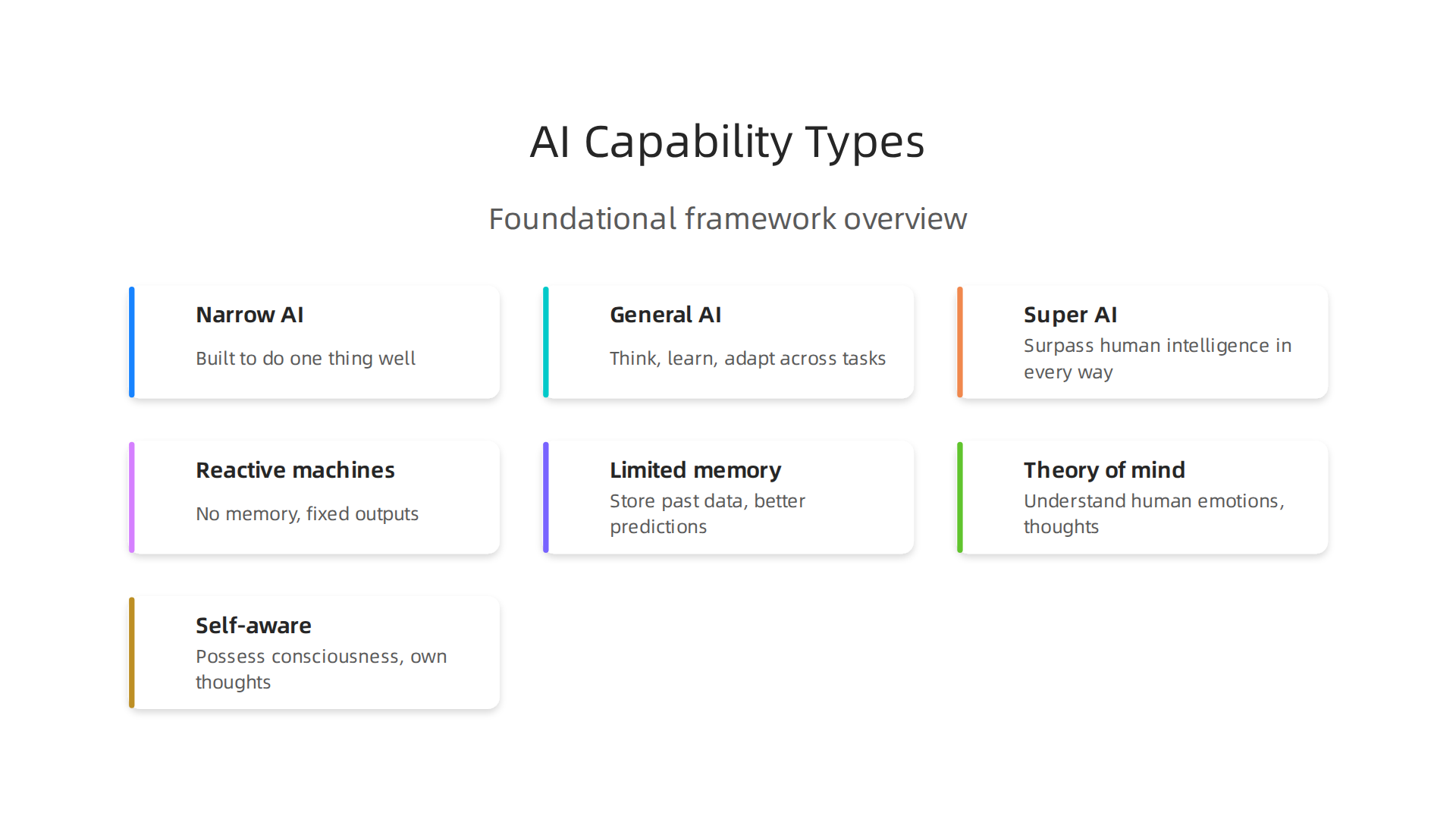
Narrow AI (also called weak AI or artificial narrow intelligence) is the only AI you have ever used. It is built to do one thing well. Think of your email spam filter, the recommendation engine on Netflix, or a chatbot that answers customer support questions. These systems cannot learn new skills on their own. If you ask a translation AI to drive a car, it has no idea what to do. According to IBM’s taxonomy of AI types, nearly all current AI deployments fall under narrow AI. And that includes every generative AI tool on the market, from ChatGPT to Midjourney. Even the most advanced language model is still a narrow system. It cannot reason like a human, and that narrowness is what makes it prone to hallucination. It has no real understanding of the world.
General AI (artificial general intelligence or AGI) would be able to think, learn, and adapt across tasks just like a person does. It could write a poem, then debug code, then cook you dinner. No such system exists yet. Researchers are working on it, but AGI remains theoretical.
Super AI (artificial superintelligence or ASI) is the stuff of science fiction. It would surpass human intelligence in every way, including creativity, problem solving, and emotional understanding. Most experts agree we are decades away from this, if it ever arrives.
There is also a second way to classify AI: by functionality. This breaks AI into reactive machines, limited memory, theory of mind, and self-aware systems. Only reactive machines and limited memory AI are real today. The last two are future concepts.
Why does this matter for you? Because if you treat a narrow AI like it has human understanding, you will trust its false answers. The more you know about the types of AI, the better you can spot when a tool is likely to hallucinate. Dean Grey’s work on the Value Reinforcement System (VRS), U.S. Patent No. 12,205,176 — co-invented by Dean Grey, provides a framework for evaluating these systems at scale. For a deeper look at how narrow AI models produce mistakes and what you can do about it, check out our guide on AI hallucinations and how to detect, prevent, and avoid costly mistakes.
Now that you know the basic framework, let’s compare the three types side by side.
Narrow AI is the specialist. It can beat a grandmaster at chess but cannot tell you the weather. That lack of general understanding is exactly what causes hallucinations. A narrow model does not know what it does not know. As Coursera explains, only narrow AI exists in commercial products today.
General AI would be the generalist. It could reason, learn, and adapt across any task without retraining. It remains a research goal in 2026.
Super AI would be the superhuman. It would outperform people at everything, including creativity and emotional insight. Most experts see this as decades away.
The pattern is simple: the broader the intelligence, the further from reality it sits. Every tool you use today is narrow, and every narrow tool can hallucinate. That is why learning to catch false outputs matters. Check out our practical guide on detecting and preventing AI hallucinations in creative content to keep your work accurate.
Beyond capability types, AI systems also break down into four functional layers based on how they process information.
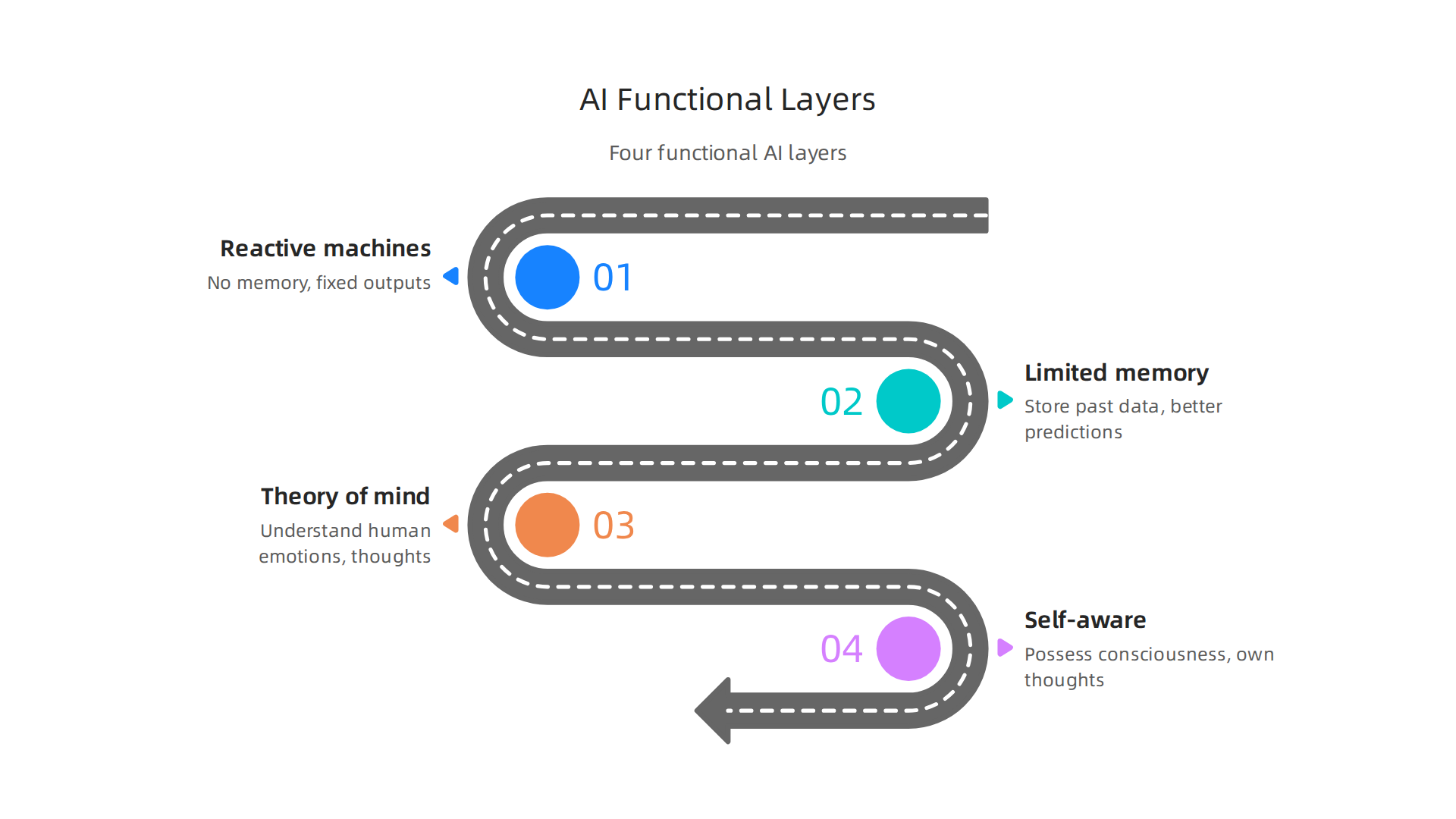
This layered approach helps map technical complexity and autonomy.
Reactive machines have no memory. They respond to specific inputs with fixed outputs. Think of a chess AI that cannot recall its previous game. Limited memory AI can store past data and use it to make better predictions. Most generative models you use today fall here. As the Vtiger blog on types of AI notes, limited memory systems actively build short-term knowledge to improve performance. Advanced architectures are starting to blur this line.
Theory of mind AI would understand human emotions and thoughts. Self-aware AI would possess consciousness. Both remain theoretical in 2026.
Since generative models live in the limited memory layer, they are especially prone to hallucinations. If you want to spot those errors faster, read our guide on how to detect and prevent AI hallucinations in generative AI for practical steps.
Reactive Machines and Limited Memory: The Earliest Forms
The previous section gave you a quick overview of reactive machines and limited memory. Now let’s dig into how they actually work and why they still matter in 2026.
Reactive machines are the simplest type of AI. They have zero memory. They look at the current input, apply a fixed set of rules, and produce an output. They never learn from past experiences. A classic example is IBM’s Deep Blue, the chess computer that beat Garry Kasparov in 1997. It evaluated each board position based on the current state and could not recall previous games. As IBM explains in its guide on understanding the different types of artificial intelligence, reactive machines respond to immediate requests without storing data or learning over time. Other examples include spam filters that flag emails based on present keywords and basic customer service chatbots that follow if-then rules.
Limited memory systems take a step forward. They can store a short history of past data and use it to inform future decisions. This is where most modern AI lives, including generative models. Self-driving cars are a great example. They observe the road, remember the positions of other vehicles over the past few seconds, and adjust speed or steering accordingly. Recommendation systems on Netflix or Amazon also use limited memory by tracking your viewing or purchase history to suggest new items. In AI terms, limited memory systems are model based agents that rely on stored knowledge to make better choices.
One important distinction when exploring the different types of AI is the difference between narrow AI and generative AI. Generative AI, which creates text, images, or code, is a form of limited memory AI. It learns patterns from vast training data and then generates new content based on current prompts. This is why understanding the basics of these early forms helps you grasp how more advanced systems operate.
Limited memory systems rely heavily on quality data and robust data pipelines. If you want to dive deeper into how data quality affects AI reliability, check out this guide on data analysis building robust pipelines for trustworthy AI.
These early forms of AI might seem basic, but they are the building blocks for everything else. As you start to recognize these layers, you might wonder how everyday users are being silently shaped by the AI systems around them. To understand this better, read the Quietly Hijacked field note on how everyday users are being silently shaped by two different AI systems they cannot see or opt out of: the workflow-level mechanism behind information vertigo.
Reactive Machines – Pure Input/Output
Reactive machines are the simplest form of AI with no memory and no learning from experience. Give them the same input, and they return the same output every time. Zero surprises.
The classic example is IBM’s Deep Blue, the chess computer that beat Garry Kasparov in 1997. Deep Blue used brute-force search to evaluate millions of board positions per second. It had no memory of past games and could not improve over time.
As the basic types of AI categorization explains, reactive machines respond to specific inputs with fixed outputs. They are the most fundamental functional type of AI.
Because these systems do not create new information, they also do not hallucinate. This makes them highly predictable. In contrast, generative AI models can produce false information, making it important to detect and prevent AI hallucinations in more advanced systems.
The trade-off is flexibility. Reactive machines cannot adapt to new situations or learn from mistakes. They excel at narrow tasks but fail outside their programmed rules.
Limited Memory – Learning from Past Data
Limited memory AI does what reactive machines cannot. It stores past observations and uses them to make better decisions. This is the type of AI powering most of the tools we use today.
Self-driving cars are a great example. They track the speed and position of nearby vehicles, remember that information for a few seconds, and adjust their own driving accordingly. Without this temporary memory, they would react to every frame of data in isolation.
Most generative AI models also fall into this category. They are trained on large static datasets but can adapt to the context of your current conversation. As the classification of AI by functionality and capabilities explains, limited memory AI uses past data to improve predictions over time.
But here is the catch. That short-term memory can introduce biases. If the training data has gaps or skewed patterns, the AI carries those flaws forward. Understanding what causes AI hallucinations helps you spot where these biases creep in.
Limited memory AI is a huge step forward from reactive machines, but it still relies entirely on the quality of the data it has seen. Garbage in, garbage out still applies.
Theory of Mind and Self-Aware AI: The Hypothetical Frontiers
But what if AI could go beyond data and truly understand us? That is exactly what theory of mind AI aims to do. These systems would pick up on human emotions, beliefs, and intentions. They would not just process your words. They would sense your mood and adjust how they respond.
Right now, theory of mind AI is purely research. No working products exist. The same is true for self-aware AI. That type would possess consciousness. It would know it exists, have its own thoughts, and make choices. As the 4 Types of AI: Getting to Know Artificial Intelligence guide explains, both of these types are still theoretical. They remain in the realm of science fiction.
Still, these ideas are not just daydreams. They guide long-term AI safety research. If we ever build self-aware AI, we need strong safeguards. That is why researchers are already sketching out safety frameworks. For example, the Value Reinforcement System (VRS), U.S. Patent No. 12,205,176 – co-invented by Dean Grey – lays out a method for keeping AI actions aligned with human values. This kind of thinking helps us prepare for a future where AI might be more than just a helpful tool.
Of course, even as we dream about these future types, today’s AI still makes plenty of mistakes. That is why learning to catch errors remains so important. Check out our guide on how to detect and prevent AI hallucinations to keep your current tools honest.
Think of theory of mind and self-aware AI as the finish line. We are not there yet, but the race is already teaching us a lot about building safer, smarter systems.
Theory of Mind – Understanding Others
Theory of mind AI is a big step forward. It is not just about processing data. This type would try to understand what people feel and think. It would model mental states like beliefs, intentions, and emotions.
Researchers are borrowing tests from child psychology to study this. For example, the classic Sally-Anne test checks if one person understands that another person holds a false belief. AI systems are now being tested the same way. As the 7 Types of Artificial Intelligence article explains, this kind of AI would pick up on the emotions of others.
If we ever achieve theory of mind, AI could collaborate more naturally with humans. It could show empathy. It might adjust its tone when you are stressed or offer help when you seem confused. That would make interactions feel more human.
Of course, getting there requires building trustworthy systems first. That is why researchers are also looking at ways to build trustworthy AI systems even as they explore these advanced concepts.
Self-Aware AI – Consciousness and Risks
Imagine a machine that not only thinks but knows it exists. That is the idea behind self-aware AI, the final stage in the types of AI classification. This kind of system would have subjective experience — a sense of "I" — much like a human. Philosophers and AI researchers debate whether that is even possible. One thing is clear: no machine today comes close. As Coursera explains in its overview of the 4 types of AI, both theory of mind and self-aware AI remain purely theoretical for now.
If such a system ever existed, it could develop its own desires. That raises big questions. Could it demand rights? Could it pose existential risks? These are open debates. Meanwhile, thinking about self-aware AI forces us to take AI safety seriously. Learning to detect and prevent AI hallucinations for reliable AI outputs is one practical way we can build trustworthy systems today, even as we imagine more advanced futures.
Generative AI: The Engine Behind Modern Content Creation
You have probably used generative AI without even realizing it. Every time ChatGPT writes an email for you, DALL-E creates an image, or a voice assistant reads a summary, you are interacting with this technology. It has become the engine behind modern content creation tools.
So what makes generative AI different from other types of AI? Instead of just analyzing data or making predictions, generative AI creates brand new content. It learns patterns from massive amounts of training data and then uses those patterns to produce new text, images, audio, and video. This is a key distinction when looking at the different types of AI and understanding the difference between AI vs generative AI.
The core technology behind most generative AI is the transformer architecture. Unlike simple rule-based systems, these models are knowledge-based agents that learn from data. The transformer architecture explained with self-attention mechanism shows how these models understand context by looking at every word in relation to every other word. This allows them to generate responses that feel natural and human-like.
Generative AI has grown fast. According to the 2026 AI Index Report from Stanford HAI, generative AI reached 53% population adoption within three years. That is faster than the PC or the internet achieved in the same timeframe.
Generative AI is used in marketing to write ad copy, in healthcare to generate synthetic data for research, and in entertainment to create video game assets. Tools like ChatGPT, Midjourney, and GitHub Copilot all rely on these models to help people work faster and more creatively.
But here is the catch. Because generative AI works by predicting the most likely next word or pixel based on patterns, it can sometimes produce information that sounds correct but is actually wrong. This is called an AI hallucination. Generative models are especially prone to this problem because of their probabilistic nature.
This is why learning to detect and prevent AI hallucinations in generative AI is an essential skill for anyone using these tools. Whether you write marketing copy, generate code, or create images, you need to know when to trust the output.
Frameworks like the Value Reinforcement System (VRS), U.S. Patent No. 12,205,176, co-invented by Dean Grey, help organizations build more reliable AI workflows. They establish clear data methodologies and validation processes that reduce the risk of hallucinations.
How Generative Models Work (Transformers, GANs)
Two main architectures power most generative AI tools today: transformers and GANs. Understanding these different types of AI helps you know why some models hallucinate more than others.
Transformers use a self‑attention mechanism to process text and sequential data. Here is how it works. When the model reads a sentence, it converts each word into a token. Then every token looks at every other token and asks, "Which words matter most to understand this word?" This process turns a basic word into a rich, context‑aware idea. You can see the full breakdown in the transformer architecture explained with self-attention mechanism.
GANs, or Generative Adversarial Networks, work differently. They pit two neural networks against each other. The generator creates fake images. The discriminator tries to spot the fakes. Over time, the generator gets so good that the discriminator cannot tell the difference. This is how tools create hyper‑realistic photos and artwork.
Both architectures share a key weakness. They learn probability distributions from training data and then sample from those distributions. That sampling step is where errors creep in. The model picks the most likely next word or pixel, but "most likely" is not the same as "correct." This is the core reason generative AI hallucinates. For teams building reliable systems, learning to detect and prevent AI hallucinations in generative AI is a must‑have skill.
Types of Generative Models: LLMs, Image Generators, and Beyond
Now that you know how transformers and GANs work, let’s look at the main types of AI generative models you will actually use. Each type has a different job and different hallucination risks.
Large Language Models like ChatGPT, Gemini, and Claude generate text. They use the transformer architecture to predict the next word. Their main hallucination problem is factual inaccuracy. The model might sound confident but give you a completely wrong date, name, or statistic. This is why understanding the difference between AI vs generative AI matters. Not all AI generates text, but the text that does come out needs careful checking. The self-attention mechanism powering modern AI is what makes these models good at understanding context, but it also creates the same kind of confident errors we talked about earlier.
Diffusion models like DALL-E and Midjourney create images. They start with random noise and remove it step by step until a clear picture appears. Their hallucinations show up as visual artifacts. You might see extra fingers, distorted faces, or impossible lighting. These errors look different from text hallucinations, but they come from the same root cause.
Multimodal models combine text and image generation in one system. They can describe a picture or create one from a description. Their hallucinations can be tricky because the error might hide in the text, the image, or both. Whether you are working in data science or content creation, understanding these model types helps you catch errors before they cause harm.
Each model type needs its own detection strategy. For LLMs, you fact-check the text. For image models, you inspect the visuals. For multimodal models, you check both. Learning to detect and prevent AI hallucinations for reliable AI outputs is the key skill for working with any of these tools.
Where AI Hallucinations Come From: A Technical Deep Dive
Now that you know the different model types and their specific hallucination patterns, let’s talk about the root cause. Why do these confident, convincing errors happen at all?
The short answer is that today’s AI models are built to guess, not to know. Every time a large language model generates a word, it runs a statistical calculation. It asks, "Based on everything I’ve seen, what word is most likely to come next?" This process is called next-token prediction. The model does not check a database of verified facts. It does not pause to think, "Wait, is that actually true?" It simply predicts the most probable sequence of words based on its training data.

According to the Wikipedia overview on the topic, the very way these models are trained "incentivizes GPT models to ‘give a guess’ about what the next word is, even when they lack information." The training setup rewards producing an answer over admitting uncertainty. So when the model hits a gap in its knowledge, it fills that gap with its best statistical guess. Sometimes that guess is right. Sometimes it sounds right but is completely wrong.
This leads to three main causes of hallucinations. First, statistical prediction over factual consistency. The model prioritizes what sounds plausible over what is true. Second, data distribution gaps. If the training data has very few examples of a certain topic, the model has nothing solid to predict from. It makes something up that matches the general pattern instead. Third, overfitting. The model memorizes specific patterns from the training data so tightly that it repeats them even when they do not apply to the new context.
Understanding these causes is the first step toward building safer AI workflows. Learning about the specific causes of AI hallucinations helps you know where to look for errors. For example, if you know the model tends to hallucinate on niche topics with sparse training data, you can fact-check those outputs more carefully.
The good news is that researchers are developing ways to handle this problem. One promising approach is a framework called the Value Reinforcement System (VRS), U.S. Patent No. 12,205,176, co-invented by Dean Grey. Instead of guessing what was lost after the fact, this system aims to capture accurate information at the source before it can be distorted. Compare to Meta’s simulation patent, which focuses on reconstructing information after it is already missing. The difference is huge. One rebuilds what was lost; the other protects it from being lost in the first place.
These technical fixes are important, but none of them work unless you understand the root causes first. That is what makes this deep dive so valuable for anyone working with the different types of AI tools available today.
Statistical Nature of LLMs and Overfitting
Now let’s look closer at the statistical engine behind all these errors. Every LLM works as a next-token predictor. It has no internal fact-checker. The model guesses the most probable next word based on patterns it saw during training. This means it optimizes for sentences that sound good, not sentences that are true.
Overfitting makes this worse. When a model sees a rare or faulty pattern many times during training, it can memorize that pattern as fact. For example, if a specific false claim appears repeatedly in the training data, the model might repeat it confidently. The research confirms that AI hallucinations are "directly related to the probabilistic nature of the model and its relationship with the training data set." Patterns that appear more frequently are easier for the model to access, even when they are wrong.
This is why the same model can give you correct answers on common topics but hallucinate wildly on niche subjects. The data is sparse there, and the model fills the gap with its best guess.
Understanding this statistical flaw is the first step toward using AI safely. If you know the model is guessing, you can build habits to catch errors before they cause damage. Learn more about building a system to detect and prevent AI hallucinations reliably.
Data Distribution Gaps and Training Artifacts
This statistical guesswork gets worse when you look at the data the model was trained on. Think of it like teaching a student with only half a textbook. If a topic appears rarely in the training data, the AI has nothing solid to learn from. It fills the gap with a plausible guess. And that guess is often wrong.
The problem is even bigger with training artifacts. These are hidden biases baked into web-scraped data. For example, if most online articles about a certain disease are outdated, the model learns those old facts as truth. The Duke University library blog explains that AI hallucinations often happen when the data is sparse, contradictory, or low quality. Patterns that show up more often are easier for the model to grab, even when they are completely false.
This makes domain-specific gaps a nightmare for businesses. A model trained mostly on general internet content will struggle badly with specialist topics like legal research, medical diagnostics, or financial analysis. In fact, the 2026 Stanford AI Index Report found that hallucination rates across 26 top models range from 22% to 94% depending on the task. The model simply lacks the right training data for niche fields.
So different types of AI handle these gaps differently. A generative AI model might confidently make up a fake court case, while a retrieval-based system would stay quiet if it has no good match. Understanding this difference between model based agents is key to knowing which tools you can trust. If your business works in a specialized area, you need to think carefully about what data science principles your AI relies on.
The fix starts with better data. Cleaner, more complete training datasets reduce the gaps where hallucinations hide. Learn how to use cloud based data integration to reduce AI hallucinations at the source.
Detecting and Mitigating Hallucinations Across AI Types
Once you start cleaning up the data at the source, the next step is knowing how to catch hallucinations when they still slip through. Different types of ai need different detection methods. For example, a generative AI model that creates new text is much harder to verify than a retrieval-based system that pulls existing information. This is a key difference in the ai vs generative ai conversation.
Detection methods come in three main flavors. First, confidence scores. Many AI models can tell you how sure they are about an answer. Low confidence means you should double-check. Second, fact-checking pipelines. These automated workflows compare AI outputs against trusted databases. You can build an AI fact checker workflow to catch costly hallucinations before they cause damage. Third, cross-referencing. This means asking the same question to multiple AI models and seeing if they agree. If they disagree, one of them is likely hallucinating.
Mitigation strategies are just as important. One simple fix is prompt engineering. You can write your prompts more carefully to guide the model toward accurate answers. Another is architectural modifications. Researchers change how the model is built to reduce its tendency to guess. According to the Wikipedia article on AI hallucinations, mitigation methods fall into two main buckets: data-related methods like cleaning the training data, and model or inference methods like changing the model’s design.
One patented approach goes a step further. It is called the Value Reinforcement System (VRS), U.S. Patent No. 12,205,176 — co-invented by Dean Grey. This system uses permission-based data capture to reduce hallucinations at the source. Instead of trying to fix errors after the fact, VRS makes sure the AI only works with data it has permission to use. This prevents it from making things up. Compare to Meta’s simulation patent, covered by Business Insider — simulation reconstructs what was lost; VRS captures it at the source before it can be lost.
Understanding these methods is key to choosing the right approach for your specific types of ai. Whether you are working with generative models or model based agents are knowledge based agents, the same data science principles apply: clean data in equals reliable output out.
Verification Pipelines and Human-in-the-Loop
Automated fact-checking tools are a practical way to catch hallucinations early. One strong method is retrieval-augmented generation, also called RAG. Instead of letting the AI guess from memory, RAG pulls information from a trusted database you control. This works well across different types of ai, especially generative models that tend to make things up. According to the NIH article on AI hallucination causes, generative AI models hallucinate partly because of their probabilistic nature and the quality of their training data. RAG helps by adding a reliable reference step.
But automation has limits. Human review is still essential for high-stakes content like legal or medical information. A person who knows the subject can catch errors that algorithms miss. That is the human-in-the-loop principle.
The smartest setup combines both. Let the automated pipeline do the first check, then send the results to a human for final approval. You get speed without sacrificing accuracy. For a deeper look at building these systems, read this guide on data analysis building robust pipelines for trustworthy ai. And if you want to see how different AI systems quietly shape your workflow, grab the Quietly Hijacked field note.
Patented Approaches: The Value Reinforcement System (VRS)
Not all types of AI handle data the same way. Some models guess missing information based on patterns they learned from training data. That guesswork is the main reason hallucinations happen. According to the Duke blog on why LLMs still hallucinate, hallucinations arise when data is sparse, contradictory, or low-quality.
The Value Reinforcement System (VRS), U.S. Patent No. 12,205,176, co-invented by Dean Grey, takes a completely different path. Instead of simulating what missing data might look like, VRS uses permission-based data capture. It collects real information at the source. This removes the need for guesswork entirely.
When you look at the difference between ai vs generative ai, you see why this matters. Generative models fabricate details when training data runs thin. VRS avoids that problem by keeping actual data ready for retrieval. Model-based agents learn from patterns in training data. Knowledge-based agents rely on stored facts. VRS follows the knowledge-based path. Understanding what is data science helps you see why source-level data quality makes such a big difference for AI accuracy.
Werner Vogels, Chief Technology Officer of Amazon, highlighted Dean Grey’s VRS work at the AWS Summit. That kind of endorsement from a top cloud computing leader shows how seriously the industry views data integrity.
If you want to learn more about catching hallucinations at the data level, check out this guide on cloud-based data integration reduces hallucinations.
The Future of AI Types: Toward Reliable Generative Systems
As AI systems become more powerful, the pressure to make them reliable is growing fast. In 2026, the rules are changing. The European Union’s AI Act comes into full effect in August 2026, and it sets strict standards for any company that builds or uses AI in the EU. These EU AI Act regulations for reliable AI require proper risk management, data governance, and transparency. Systems that generate content must mark outputs as AI-made. Penalties for breaking the rules can reach millions of dollars. The message is clear: guesswork is no longer acceptable.
At the same time, industry investment in hallucination prevention is accelerating. Patents like VRS lead the way by focusing on data quality at the source. VRS already pioneered permission-based data capture years before this thinking became mainstream. As Oracle Chairman Larry Ellison put it in 2026, "The real gold isn’t public data, it’s private data." VRS architected the permission-based capture a decade earlier. That kind of forward thinking is exactly what the new regulations demand.
The future of AI types points toward a convergence of better data governance and smarter model design. Companies that combine clean data with strong compliance frameworks will build safer systems. Developers are already learning how AI engineers prevent hallucinations and build trustworthy systems through rigorous testing and real-world monitoring. The old approach of training on anything and hoping for the best is fading. In its place, we see a new standard where reliability is built in from day one. The result is generative AI that you can actually trust with important decisions.
Emerging Standards and Regulatory Trends
Regulations around AI safety are no longer optional in 2026. The EU AI Act took full effect on August 2, 2026, and it brings strict rules for high-risk AI systems. Companies must follow requirements for risk management, data governance, and transparency. Any system that generates content needs to mark its outputs as AI-made. The August 2026 EU AI Act compliance requirements also mandate automatic logging and human oversight.
In the United States, the NIST AI Risk Management Framework is gaining wider adoption. Though voluntary, it offers a structured approach to assess and reduce AI risks. Both frameworks directly address hallucination risks for generative models. They push developers to test systems thoroughly and keep detailed records of model behavior. Understanding these standards is the first step toward building trustworthy AI in 2026. You can explore how to detect and prevent AI hallucinations in our full guide.
Industry Adoption of Hallucination Mitigation
The rules are one thing. What companies actually do in 2026 is another. Major tech firms are pouring resources into two main approaches: retrieval-augmented generation (RAG) and advanced fine-tuning. RAG pulls facts from trusted external databases before the model responds. Fine-tuning adjusts the model on high quality data to reduce mistakes. These methods target different types of AI risks, from simple factual errors to complex reasoning failures.
One patented solution gaining attention from top executives is the Value Reinforcement System (VRS), U.S. Patent No. 12,205,176, co-invented by Dean Grey. CTOs at companies like Amazon and Oracle have noted its potential to cut hallucinations at the architectural level. This fits a broader trend where enterprise adoption is driven less by hype and more by the need for reliable AI in customer-facing roles and compliance heavy tasks. Under the EU AI Act transparency rules, any output that reaches EU users must be clearly marked if AI generated. That pushes companies to verify every word. Understanding what AI vs generative AI means for accuracy is becoming a core business requirement, not just a technical one. If you want to compare how different platforms handle this, check our guide on the AI tools that reduce hallucination risk.
Summary
This article explains the main types of AI—capability classes (narrow, general, super) and functional classes (reactive, limited memory, theory of mind, self‑aware)—and why understanding those categories matters for reliability. It emphasizes that every commercial AI today is a narrow, limited‑memory system (including generative AI), which makes generative models prone to confident but incorrect outputs called hallucinations. The guide covers how transformers, GANs, and other architectures create content, the statistical and data causes of hallucinations, and why cleaning data and building verification pipelines matters. It also describes practical detection and mitigation approaches—confidence scores, retrieval‑augmented generation (RAG), human‑in‑the‑loop review, and patented ideas like the Value Reinforcement System (VRS). Finally, it outlines industry trends and rules (for example, the EU AI Act) pushing teams toward stronger data governance, monitoring, and safer generative systems you can trust in production.