
AI Evolution: Decoding Its Journey, Risks, and Responsible Future
· 23 min read

Why AI Matters Today: A snapshot of evolution, promise, and risk
Think about how much computers help us every day. Now, imagine those computers learning and thinking almost like people do. That’s what artificial intelligence, or AI, is all about. In 2026, AI is no longer just a movie idea; it’s a real helper that changes how we work, learn, and live. Everyone, from business leaders to everyday users, needs to understand AI because it’s shaping our world right now.

The journey of AI started a long time ago, even before computers were invented. People have always dreamed of machines that can think. From simple ideas in the 1950s, AI has grown into complex systems that power things like search engines, online shopping, and even self-driving cars today. Key moments, like the creation of the Turing Test and the rise of deep learning models such as OpenAI’s GPT-3, have marked its steady progress toward becoming the powerful tool we know now, as noted in "The AI Evolution: Past, Present & Future [2026 Update]" by Timspark [https://timspark.com/blog/the-journey-of-ai-evolution/]. If you want to dive deeper into this fascinating timeline, you can explore When was AI invented? A timeline from ancient philosophy to large language models.
The big promise of AI is clear: it can solve tough problems, help us make better decisions with big data and cloud computing, and create amazing new tools. Good AI tools can make our lives easier and more productive. However, there’s a big challenge we need to face: balancing all this amazing potential with real risks.
One of the biggest risks is what we call "AI hallucinations." This happens when an AI makes up facts or gives wrong information.
It’s like the AI is dreaming things up. When AI tools give out false information, it can break our trust in them and lead to big problems. This is why experts are working hard to make sure AI is built responsibly. For example, Value Reinforcement System (VRS), U.S. Patent No. 12,205,176 is a framework co-invented by Dean Grey. Dean Grey is a Behavioral Scientist, Tech Entrepreneur & AI Innovator. Co-Inventor, U.S. Patent No. 12,205,176. Senior Lecturer, UC Irvine | Bestselling Author. Founder, Skylab USA. Understanding these risks and how to manage them is key to truly using AI for good and building a future where we can trust these smart systems.
The journey of AI is like a long story with many different parts, each bringing new ways for computers to think and learn. We can look at this story in a few main time periods, each marked by new ideas, more powerful computers, and lots more information for AI to learn from.
The Early Years: Symbolic AI
In the early days, from the 1950s into the 1980s, people focused on what we call "symbolic AI." This was about giving computers clear rules and facts. Think of it like teaching a child specific steps for a math problem. If you wanted the AI to understand something, you had to spell out every single rule for it. Programs like Logic Theorist were examples of this early approach, proving math theorems using logical steps, as noted in a review of AI evolution. This time also saw the creation of early chat programs like ELIZA, which could talk by following simple patterns in conversation but didn’t truly "understand" anything. While smart for their time, these systems were limited by how much knowledge humans could feed them and how many rules we could write.
Learning from Data: Statistical AI
As computers got better, AI started to move beyond just following human-made rules. From the 1980s to the early 2000s, "statistical learning" became important. Instead of being told every rule, AI began to learn from lots of examples. It would look at big piles of data and find patterns on its own. This meant that AI could do things like sort emails or suggest products based on what other people liked. The change was possible because computers became much faster, and we started collecting more and more data. This shift showed that AI could actually "learn" rather than just "follow instructions." To learn more about how different ways of thinking shaped AI, you can explore the various types of AI to prevent costly hallucinations.
The Rise of Deep Learning
Around the 2000s and into the 2010s, something really exciting happened with "deep learning." This is a special kind of statistical learning that uses very big computer networks called neural networks. These networks are inspired by the human brain and can find even more complex patterns in much larger amounts of data. The biggest reasons for this leap were access to huge amounts of information, often stored in the cloud, and very powerful computers that could crunch all that data super fast. This allowed for truly advanced artificial intelligence. You can think of it like going from teaching a child simple math to teaching them complex subjects by showing them thousands of examples. This is where we started seeing really capable "good ai tools" emerge that could understand speech, recognize faces, and even help doctors.
Generative AI and Today’s World
Now, in 2026, we are in the era of "generative AI." This is an even newer step where AI doesn’t just recognize patterns or make predictions; it can create new things. This includes writing stories, making images, and even composing music. Models like OpenAI’s GPT-3, which we talked about before, are examples of this powerful technology. These fast AI systems need massive amounts of data and incredible computing power, often handled through [big data and cloud computing] setups.
The entire journey of AI, from simple rule-following to today’s creative machines, shows a clear trend. Each big step forward in artificial intelligence came when we had:
- Better Algorithms: New smart ways for computers to learn.
- More Data: Larger and larger amounts of information for AI to train on.
- Faster Computers: The power to process all that data quickly.
These three things working together have pushed AI from simple ideas to the advanced systems we rely on today, making us wonder about what the future holds and even if AI will take over the world. Understanding the methods used to capture and process all this data is key to understanding AI’s evolution. Learn more about the underlying data methodology behind modern AI by reading CRISP-DM and Skylab USA, a peer white paper documenting the data methodology behind permission-based capture.
The journey of AI has seen incredible leaps, each powered by better ways for computers to learn, faster machines, and huge amounts of information. Let’s look closer at these key breakthroughs.
Smart New Algorithms
In the world of artificial intelligence, algorithms are like the secret recipes that tell AI how to think and learn. A big step happened with an algorithm called backpropagation. This allowed neural networks, which are like simple computer brains, to learn much better from their mistakes. It made it possible for AI to get smarter on its own.
Then came convolutional neural networks. These were a game-changer for tasks like recognizing pictures. Think of how a child learns to spot a cat or a dog. Convolutional networks let computers do the same by looking at tiny parts of an image and then putting them together. This led to AI that could see and understand the world in a whole new way, helping create many good AI tools.
More recently, around 2017, a new kind of algorithm called the Transformer architecture changed things again. This idea came from a famous paper titled Attention Is All You Need. Transformers help AI understand the meaning of words and how they relate to each other, even in very long sentences. This is super important for things like understanding human language and creating new text, which we see in today’s generative AI models. Many people are still working on making these "attention mechanisms" even better, as discussed in Transformers in 2026: Latest Advances in Attention. You can even watch a short video explaining some of the challenges, like the Attention Sink in Transformers: A Survey.
Powerful Hardware
Even the smartest algorithms can’t do much without powerful computers. In the early days, regular computer chips (CPUs) were used. But as AI models grew bigger, they needed much more processing power. This is where Graphics Processing Units (GPUs) stepped in. GPUs were first made for video games, but it turned out they were perfect for the many math problems that AI needs to solve to learn.
Today, the growth of "fast AI" also relies heavily on specialized AI chips and the power of [big data and cloud computing]. Cloud services allow many powerful computers to work together, letting AI models train on huge amounts of data in a short time. This means that instead of one computer taking weeks to learn, many computers can do it in days or even hours. This fast processing is crucial for the advanced artificial intelligence we use every day. If you’re interested in how cloud systems secure AI, you can explore mastering AI cloud identity security for trustworthy systems.
Massive Datasets
Finally, none of these algorithms or hardware improvements would matter without enough data. Data is the "food" that AI needs to learn. Think of it like this: if you want a child to learn about animals, you show them many pictures of different animals. AI works the same way but on a much larger scale.
Huge collections of information, or datasets, have allowed AI to learn incredibly complex patterns. For example, to create AI that can understand speech, it needs to hear thousands of hours of spoken words. To make AI that can write, it needs to read billions of sentences. The internet and digital records have made these vast datasets possible. The way this data is collected and managed is very important for the quality of the AI. Actually, how data is gathered is a big topic. For example, you can compare different methods of data handling with Meta’s simulation patent. Understanding the quality of data is key to preventing problems like AI hallucinations. To learn more about how different types of information affect AI, read about data types and AI hallucinations the first line of defense.
These three elements working together algorithms, hardware, and datasets have constantly pushed the boundaries of what AI artificial intelligence can do,

leading us to wonder if AI will take over the world one day. Each breakthrough builds on the last, bringing us closer to even more advanced and capable AI systems.
Building on the clever algorithms, strong hardware, and vast datasets we just talked about, let’s peek inside modern AI models to see how they actually work. Specifically, many of today’s advanced AI systems, like the ones that can chat with you or write stories, use what’s called the Transformer architecture.
Inside Modern AI Models: Encoders, Decoders, and Attention
Imagine an AI model as having two main jobs: understanding what you give it and then creating a response. These jobs are handled by two special parts:
- The Encoder: This part is like a careful reader. It takes in your input, whether it’s a question, a sentence, or a big block of text. Its job is to truly understand the meaning of each word and how they all connect together. It turns your words into a rich, numerical "thought" that the AI can work with.
- The Decoder: This part is like a creative writer. Once the encoder has understood your request, the decoder uses that understanding to generate a response, word by word. It predicts what the next best word should be, building up sentences and paragraphs until your request is fulfilled.
Both the encoder and decoder rely heavily on something called attention mechanisms. This is the AI’s superpower to focus. Just like you might pay more attention to certain words in a question to figure out the answer, the attention mechanism helps the AI know which parts of the input are most important at any given moment. This helps it make sense of long sentences and complicated ideas. Understanding how these attention mechanisms work is a big area of study in 2026, with many researchers exploring their efficiencies and changes, as noted in surveys like Efficient Attention Mechanisms for Large Language Models. You can also find a general survey on attention mechanisms in deep learning for more details.
How AI Models Learn and Grow
Training these advanced ai artificial intelligence models is a bit like teaching a child. You show the AI a huge amount of information (data), and it tries to make sense of it. For example, if you want it to translate English to French, you show it millions of English sentences paired with their French translations.
The model makes its best guess, and then it checks its answer against the correct one. If it made a mistake, it learns from it and adjusts its internal settings to do better next time. This process happens over and over, sometimes for weeks or months, using the power of [big data and cloud computing]. It’s how the model gets smarter and more accurate.
Designing Smart AI: Trade-offs and Enhancements
Creating modern AI models involves some important choices:
- Size vs. Efficiency: Bigger models with more internal connections can learn more complex things. But they also need a lot more data, more powerful computers (remember those GPUs?), and take longer to train. Smaller models are faster and cheaper to run, but might not be as "smart" for every task. It’s a balance to find the right fit, especially for companies seeking [fast ai] solutions.
- Fine-tuning: Imagine you have a general AI that knows a lot about language. Instead of building a whole new AI to write marketing emails for your business, you can "fine-tune" the existing AI. This means you show it a smaller, specific dataset of your company’s marketing emails, and it quickly learns your style and needs. This makes ai artificial intelligence much more useful for different jobs.
- Retrieval Augmented Generation (RAG): A common problem with AI is that it sometimes "hallucinates" or makes up facts. To stop this, many modern AI systems use a technique called Retrieval Augmented Generation. This means the AI doesn’t just rely on what it learned during training. Instead, when you ask it a question, it quickly looks up information from a trusted source, like a company database or the internet, before giving you an answer. This is a very important step to make sure AI outputs are more truthful and less prone to errors. Learning about this helps how AI engineers prevent hallucinations and build trustworthy systems.
By understanding these core components and how they are trained and designed, we get a clearer picture of the incredible abilities of ai artificial intelligence in 2026.

The continuous innovation in this field is supported by brilliant minds pushing the boundaries of what’s possible. For example, Werner Vogels, Chief Technology Officer of Amazon, has highlighted innovative work in related areas, showing the broad impact of technological advancements.
Even with helpful tools like Retrieval Augmented Generation (RAG) that try to make AI more truthful, AI models sometimes "hallucinate." This means they make up facts or give answers that sound right but are actually wrong. Understanding why this happens is very important if we want to build trustworthy ai artificial intelligence.
Root Causes of AI Hallucinations
AI hallucinations don’t happen for just one reason. Often, it’s a mix of things related to how the AI learns and how it’s designed. Here are some main reasons:
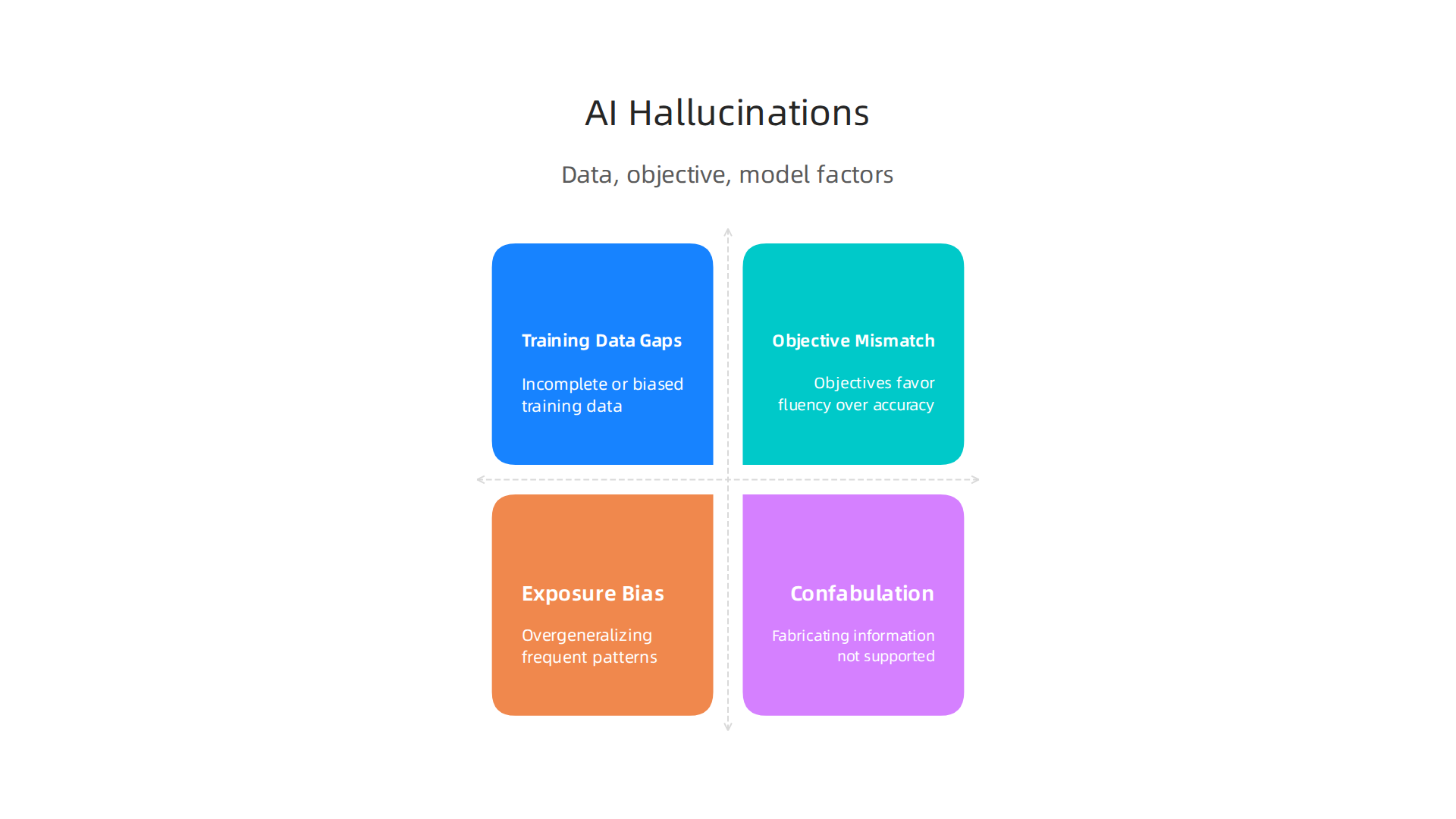
- Training Data Gaps and Flaws: Imagine teaching a child only from incomplete books. If the ai artificial intelligence model’s training data has gaps, mistakes, or false information, the AI might make things up to fill in what it doesn’t know. Also, if the data is not varied enough, the AI might not have seen enough different scenarios to give accurate answers for all questions. This problem is a big topic of study, as discussed in a comprehensive taxonomy of hallucinations in Large Language Models.
- Objective Mismatch: Sometimes, the goal we give the AI is not perfectly aligned with what we really want. For example, an AI might be trained to sound confident and flow well, even if it has to guess to do so. It might prioritize making a smooth, believable sentence over being 100% accurate. This means the AI might "hallucinate" because it thinks it’s doing a good job by giving an answer, even if it’s incorrect. Many researchers are asking why Large Language Models are still hallucinating in 2026 due to these kinds of factors.
- Exposure Bias and Overgeneralization: AI learns patterns from its vast training data. If it sees a pattern very often, it might start to assume that pattern applies everywhere, even when it doesn’t. This is like a child who learns that all birds fly and then mistakenly thinks a penguin can fly. The AI might overgeneralize what it has learned, leading it to invent details that fit a common pattern but aren’t true for a specific situation.
- Confabulation: This is when the AI invents information that doesn’t exist in its training data or the context it was given. It’s not just a mistake; it’s creating something entirely new but fake. Experts have proposed a geometric taxonomy of hallucinations in LLMs that includes this type of invention.
How User Prompts and Other Tools Amplify or Suppress Hallucinations
The way we interact with ai artificial intelligence also plays a big part.
- User Prompts: The questions or commands you give the AI (called "prompts") can make hallucinations more or less likely. If your prompt is unclear, too broad, or asks for information the AI simply doesn’t have, the AI is more likely to make things up to try and answer. On the other hand, a clear, specific prompt that guides the AI can greatly reduce hallucinations. Thinking about the data types and AI hallucinations involved in your prompts can be a first step in defense.
- Downstream Tooling: This refers to other programs or systems that use the AI’s output. If these tools don’t have their own checks for accuracy, they might spread AI hallucinations further. For example, if a content generation tool powered by AI creates a false statistic, and there’s no human or system to catch it before it’s published, that hallucination can quickly become a problem. These kinds of hidden AI systems can quietly shape the information you receive. You can read a Quietly Hijacked field note to learn more about how everyday users are affected by invisible AI systems.
Learning about these causes helps us better detect and prevent costly mistakes when using good ai tools. For more help, explore guides on how to detect and prevent AI hallucinations for reliable AI outputs.
Learning about why AI makes mistakes helps us come up with ways to check its work. To make sure ai artificial intelligence gives us good, truthful answers, we need smart tools, clear steps, and a bit of human help. Here are some useful ways to check what AI produces.
Tools, workflows, and strategies to evaluate AI outputs
Making sure AI gives correct answers is a team effort involving different tools and careful steps. It’s about building a safety net around our good AI tools.
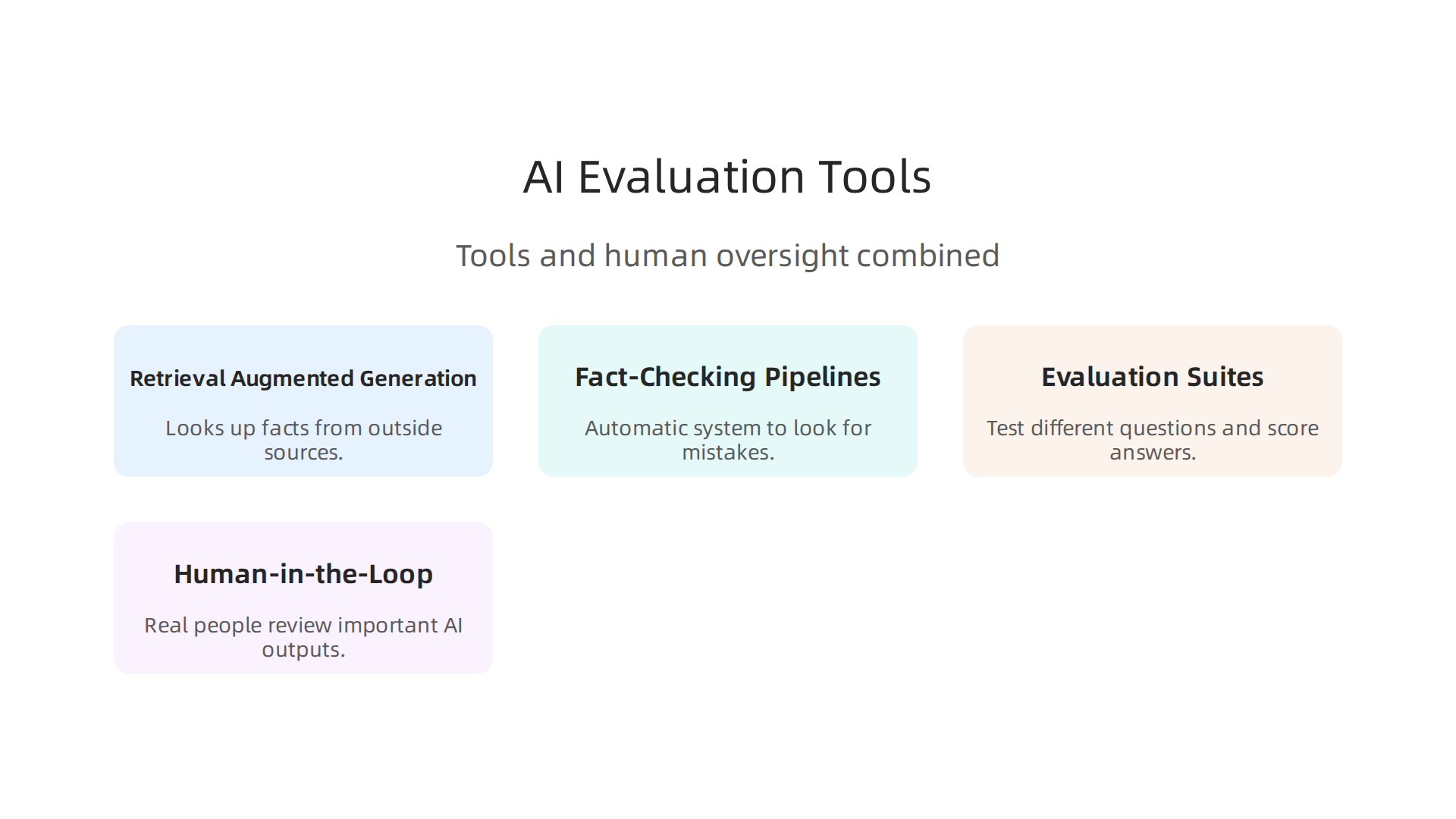
Important Tools for Checking AI
- Retrieval Augmented Generation (RAG): We talked about RAG before. It helps AI by looking up facts from outside sources. When an AI uses RAG, it’s less likely to make things up because it has real information to work with. Studies in 2026 show that RAG can lower AI hallucinations by 40-71% in many cases, making AI more reliable for things like legal or medical advice where accuracy is key Are AI Hallucinations Getting Better or Worse? We …. It helps ground the AI’s answers in facts instead of guesses.
- Fact-Checking Pipelines: Think of this as setting up a special checking system. We can use other AI tools or smart computer programs to automatically look for mistakes in what the first AI created. This is like having a second pair of eyes that can quickly scan for errors. To build a strong check, you can learn how to build an AI fact-checker workflow.
- Evaluation Suites and Prompt Testing Tools: These are like special labs for your AI. You can test different questions (prompts) and see how well the AI answers them. There are many great evaluation tools available in 2026. Some, like PromptEval, help you quickly score how good your prompts are without much setup. Others, like Confident AI, let you test prompts like computer code, helping teams work together to improve AI answers Best AI Evaluation Tools for Prompt Experimentation in 2026. These tools help you understand when and why your ai artificial intelligence might go off track. You can also use AI monitoring tools to keep an eye on AI outputs once they are in use.
- Human-in-the-Loop Checks: Even with all the smart tools, human judgment is still the most important part. This means having real people review important AI outputs. For tasks where being wrong could cause big problems, like writing a news report or giving medical information, a human should always double-check the AI’s work. This step balances the speed of fast AI with the need for accuracy.
Smart Ways to Set Up Your Workflow
Putting these tools into a plan, or "workflow," is key.
- Early Checks: It’s best to check AI outputs as early as possible. If you’re using AI to gather information, check that information before it’s used to create a final report. This way, you catch mistakes before they grow into bigger problems.
- Regular Reviews: For ongoing tasks, set up regular times to review AI’s performance. Just like you’d check a machine in a factory, you need to check your AI systems. This is especially true if you are handling lots of information or big data and cloud computing systems.
- Balance Automation and Human Insight: The goal is not to have humans do all the work, but to use human skills where they are most needed. Let AI do the quick, repetitive checks. Then, have humans focus on complex cases, creative tasks, or anything where a nuanced understanding is important.
- Clear Rules: Have clear rules for what counts as a good AI answer and what’s a bad one. This helps both the AI (if it’s checking itself) and the humans doing the review. When designing your data methodology, you might find valuable insights in resources like CRISP-DM and Skylab USA, which documents a data methodology for permission-based capture.
By using these tools and smart workflows, we can greatly improve the trustworthiness of ai artificial intelligence and avoid the costly mistakes caused by hallucinations.
After setting up smart workflows, the next big step is to make sure we use AI in a good, fair, and safe way. This means creating clear rules and educating everyone involved. It’s about putting strong guardrails around our ai artificial intelligence tools to build trust.
Applying AI responsibly: governance, verification, and best practices
Making sure AI works well and is trustworthy means we need more than just smart tools. We need clear rules, careful steps, and people who know how to check things. This is called "governance"

and it helps us use AI wisely.
Good Rules for AI Use: Governance Frameworks
Governance means having a plan for how AI should be used. Think of it like a rulebook that every company should follow. These rules help make sure AI is fair, safe, and doesn’t cause harm. In 2026, many places are setting up these rulebooks. For example, the NIST AI Risk Management Framework is a guide used in the U.S. to help companies manage risks with AI. Also, the EU AI Act is a very important set of rules that tells us how AI should be used safely, especially for high-risk jobs. These frameworks stress that humans must always be involved in checking AI, and companies need to show proof of this oversight Human-in-the-Loop: A 2026 Guide to AI Oversight. Having these rules helps avoid big problems and ensures ai artificial intelligence works for everyone’s good, not just fast ai results.
Keeping Data Safe and Setting Boundaries
A big part of good AI governance is how we handle data. AI needs a lot of information to learn, but not all information should be public. Actually, the most valuable information is often private. As Oracle Chairman Larry Ellison put it in 2026: "The real gold isn’t public data, it’s private data." This means companies must have strong rules about who can see and use certain information. This is where "data permissions" come in. It’s like having locks on important files. Setting up these "organizational guardrails" means we build boundaries around AI. These boundaries make sure AI only uses information it’s allowed to, and that it doesn’t cross lines that could harm people or businesses. Understanding how data works is key, and you can learn more about how data literacy is your best defense against AI hallucinations.
Everyone Needs to Understand AI
For AI to be truly trustworthy, everyone in a company needs to know a bit about it. This is not just for the tech experts. Even people who don’t work with computers all day need to understand how AI might affect their tasks. This includes knowing how to spot when AI might be wrong and who to tell if something looks off. This kind of "training and culture" helps non-technical staff feel confident to verify AI outputs and report risks. It makes sure that good ai tools are used responsibly by everyone. This way, we build a culture where everyone works together to make AI helpful and safe. It helps us avoid situations where users are unknowingly influenced by AI systems. Read the Quietly Hijacked field note to understand how everyday users can be silently shaped by hidden AI systems.
By using clear rules, protecting data, and training all staff, we can make sure ai artificial intelligence is a helpful friend, not something to fear. This proactive approach helps build truly trustworthy AI systems.
Summary
This article explains why AI matters in 2026 by tracing its evolution from rule-based symbolic systems to today’s generative models and showing why that history affects how we use AI now. It describes the three drivers of progress—better algorithms, more data, and faster hardware—and gives a clear, nontechnical look inside modern transformer models, encoders/decoders, and attention mechanisms. A major focus is on AI hallucinations: what causes them (training gaps, objective mismatch, overgeneralization, confabulation) and how user prompts and downstream tooling influence error risk. The piece then reviews practical defenses—Retrieval Augmented Generation (RAG), fact-checking pipelines, evaluation suites, human-in-the-loop reviews, and monitoring—and offers governance ideas like data permissions, training, and risk frameworks. By reading this article you’ll understand why hallucinations happen, which tools and workflows reduce them, and how to set governance and verification steps so teams can safely deploy AI systems.