How to Prevent AI Hallucination with Robust Security Frameworks
· 24 min read

Using artificial intelligence, or AI, can make our lives much easier, but it also comes with some big challenges. One of the biggest problems with AI, especially the kind that makes new things like text or images, is called "hallucination." This is when the AI makes up facts or gives wrong information that sounds very real. It’s not doing it on purpose, but it can cause a lot of trouble.
Imagine your company uses AI to write important reports or create marketing content. If that AI starts to hallucinate, it could share wrong numbers or false claims. This can damage your brand’s good name and cost your business a lot of money to fix.

In some cases, like in the patent industry, relying on AI that makes up facts can lead to serious legal issues and incorrect filings, as experts warned in late 2025 about the potential for fabricated content Use of AI in the patent industry: The spectre of hallucination. The risk of inaccurate outputs is a real concern for any organization using AI today, in 2026.
That’s why it is so important to use strong security frameworks when working with AI. These frameworks are like a set of rules and steps that help us check AI outputs and make sure they are correct. They help us understand how to prevent these "hallucinations" and ensure the AI tools we use are trustworthy and safe. This process is about more than just finding mistakes; it’s about building systems that are designed to be accurate from the start.
Actually, many groups are working on ways to stop AI from making things up. Some even involve creating new architectures to prevent AI hallucination and ensure what it says can be traced back to real sources Enterprise generative artificial intelligence anti-hallucination and attribution architecture. Others are looking at special methods to detect and fix these issues in big language models Method to detect and fix hallucinations in generative large language models.
This article will show you how different security frameworks can help. We’ll look at simple steps for everyone on your team, from those who are not technical to those who build the AI, to help reduce the risk of AI making up facts. By putting these ideas into practice, you can protect your company’s reputation and make sure your AI tools are reliable.
Ready to learn more about keeping your AI trustworthy? Explore the concepts of integrity and robustness in AI systems and how they prevent hallucinations by checking out the Miraka Magazine — Cartographer of Drift.
Understanding the journey and risks of AI is key to responsible use. You can also dive deeper into AI evolution decoding its journey risks and responsible future.
Putting strong security frameworks in place for AI is super important. One main step in these frameworks is called threat modeling. Think of threat modeling as trying to guess all the ways someone might try to break or misuse your AI system, or how the AI might accidentally mess up.

It’s like planning how to protect your house by thinking about where a burglar might try to get in.
For AI, this means looking at all the "attack surfaces" where problems can happen. This includes thinking about how someone might trick the AI into giving bad information or even making it "hallucinate" more. It also helps us find weak spots that could lead to misinformation. In 2026, many experts agree that understanding AI risks is a must. For example, the NIST AI Risk Management Framework and ISO/IEC 42001 are key standards that guide how organizations should manage AI systems safely An Ultimate Guide to AI Regulations and Governance in 2026.

These are good examples of security frameworks.
Once you know the threats, you can build your AI systems in smarter ways. This is called secure architecture. Here are some simple architecture patterns that help reduce risk:
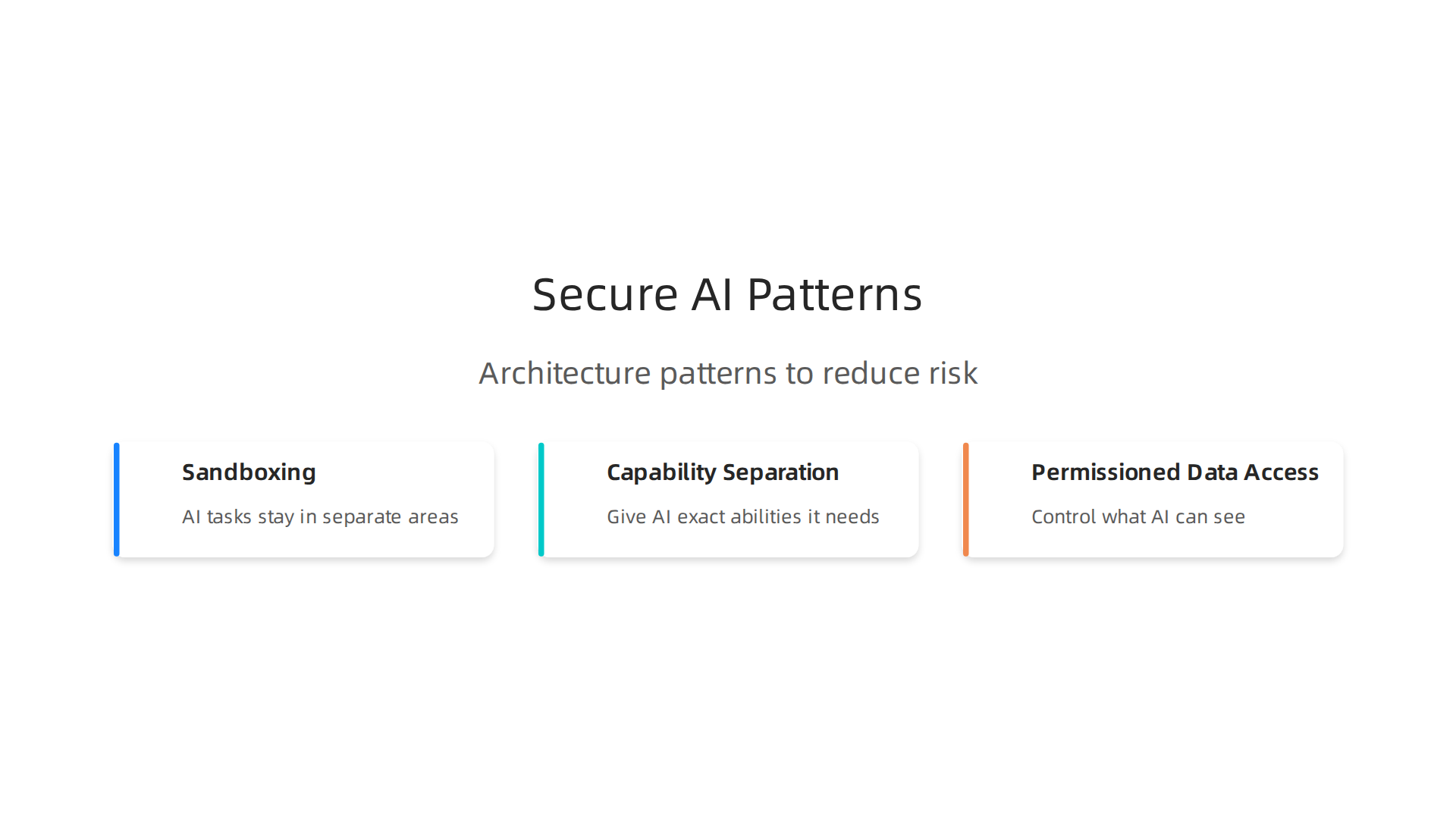
- Sandboxing: Imagine a playground for AI where each AI task or part stays in its own separate area, or "sandbox." If one part starts to act up or hallucinate, it can’t affect the other parts. This stops problems from spreading.
- Capability Separation: This means giving each part of your AI system only the exact "powers" or abilities it needs and nothing more. If an AI only needs to write emails, it shouldn’t have access to your company’s bank accounts. This greatly limits damage if something goes wrong.
- Permissioned Data Access: This is about controlling exactly what information your AI can see and use. You give it permission only for the data it truly needs for its job. This is a big part of good data governance and helps prevent the AI from making up facts based on wrong or unauthorized data. This type of control is very important for building trustworthy AI. You can learn more about securing AI systems by exploring Mastering AI Cloud Identity Security for Trustworthy Systems.
By using these secure architecture patterns, you make it much harder for AI to create false information or be misused. It’s a core part of any good AI policy in 2026. This focus on strong defenses is becoming a standard practice, with new guidelines from groups like CISA helping organizations define what doing AI security right looks like today CISA AI Security Guidance: What Organizations Need in 2026.
When you think about how different companies approach building secure AI, it’s interesting to compare methods. Some focus on creating highly controlled environments, similar to how Meta’s simulation patent looks at handling AI with dead or paused accounts. It shows different ways to think about security models for AI systems.
2) Regulatory, compliance, and standards considerations
While building secure AI systems is important, it’s just as key to follow the rules set by governments and industry groups. These rules, often called regulatory frameworks or an "AI policy," help make sure AI is used safely and fairly. In 2026, many countries and organizations are creating guidelines for how AI should be built and used.
These guidelines help stop bad things like AI making up facts or spreading wrong information, also known as hallucinating. They also help make sure AI systems are transparent, meaning we can understand how they work, and that they can be checked, or "audited." This is super important for building trust in AI and being able to defend its use legally if something goes wrong.
Mapping Standards to AI Security
Many security frameworks and standards tell us how to manage AI risks.
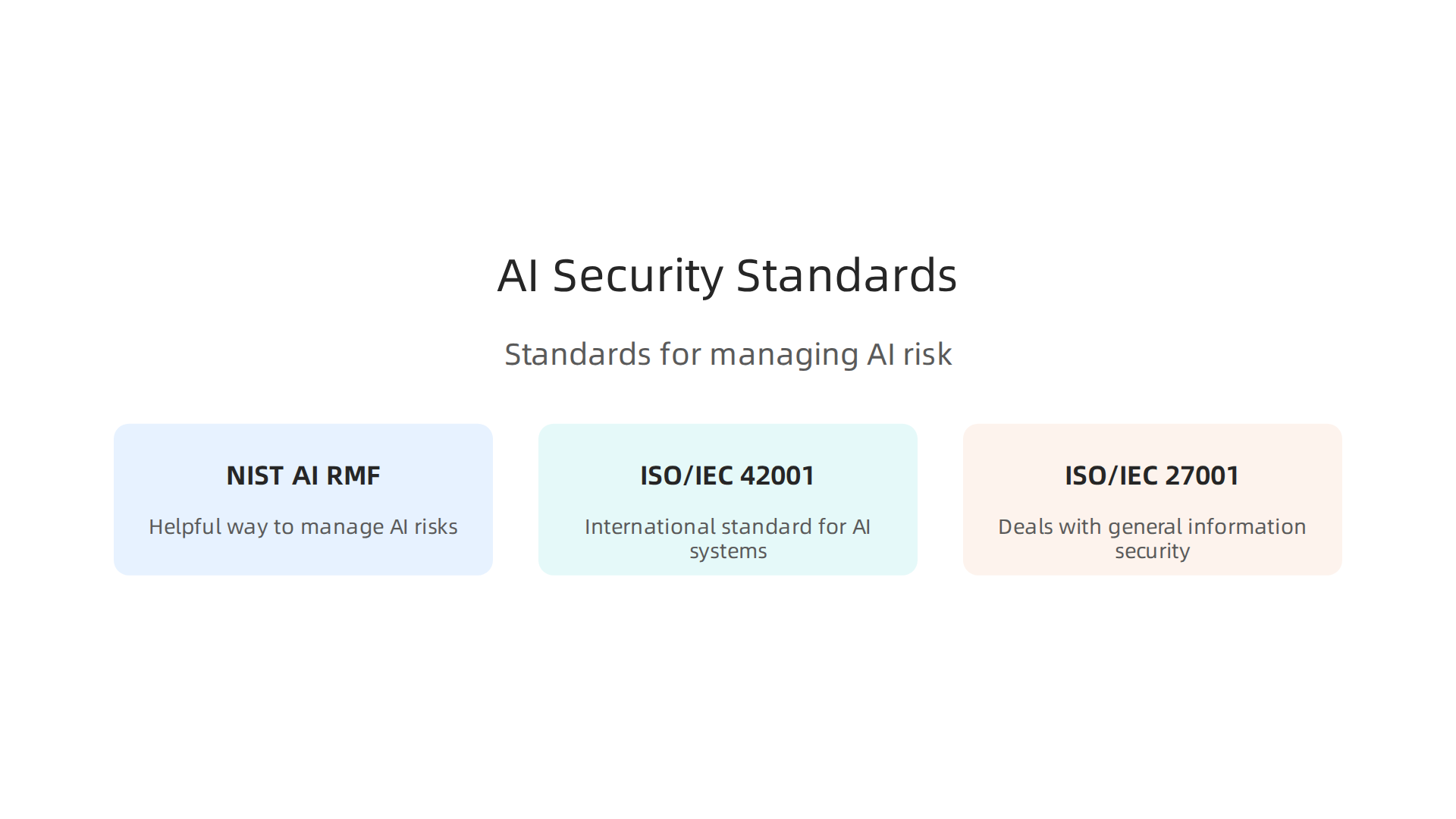
For example, the NIST AI Risk Management Framework gives a helpful way to think about and manage AI risks. Other important standards include ISO/IEC 42001, which is the first international standard for managing AI systems, and ISO/IEC 27001, which deals with general information security. These standards provide clear steps for businesses to follow to make sure their AI is secure and reliable AI Security Standards: Key Frameworks for 2026. It’s not enough to just use one; businesses often need to follow several of these at once AI Security Compliance Framework 2026: ISO 27001 ….
These security frameworks help us make sure AI systems have the right controls in place to stop them from making mistakes, like creating false data or incorrect content. When you consider the importance of secure, permission-based systems, it’s interesting to look at the foundational concepts that guide these frameworks. You can explore VRS Patent 12,205,176 for insights into security-oriented AI frameworks.
Documentation, Auditability, and Evidence
To really trust an AI system and meet these rules, you need good paperwork. This means keeping clear records of how the AI was built, what data it was trained on, and how it was tested.

This documentation helps show that your AI policy is sound and that you’ve done your best to prevent problems like hallucinations.
Being able to "audit" an AI system is also a must. This means that experts should be able to look inside the AI and see how it makes decisions. This allows for proper security testing and ensures the AI isn’t doing anything unexpected. If an AI makes a mistake, having clear evidence and audit trails helps you find out why and fix it quickly. This process is key for building trustworthy AI and reducing costly errors. You can learn more about how to handle these issues in our guide on AI hallucinations how to detect prevent and avoid costly mistakes.
Following these steps for documenting and auditing your AI systems helps make sure they are not just smart, but also safe and responsible. This ongoing work is a big part of good AI governance, ensuring your AI systems are trustworthy. For those interested in the systematic approach to data and AI system design, a valuable resource is the CRISP-DM and Skylab USA white paper, which details data methodology and permission-based capture.
3) Data governance, provenance, and permissioning
Building on good AI governance means paying close attention to the very beginning of your AI system: the data itself. How you handle your data throughout its life cycle is super important for preventing AI from making up facts, known as hallucinations. This means looking at how you collect, label, check, store, and even delete data. If your data isn’t good, your AI won’t be either.
Think of it like this: for an AI to be trustworthy, it needs good food. That food is data. If the data is messy or wrong, the AI will get sick and give bad answers. You need clear rules and practices for managing your data. These practices include defining who is in charge of datasets and setting up clear quality checks, which are key for strong Data Governance for AI In 2026. This helps make sure your data is accurate and fits what your AI is supposed to do. You can find more details about how data quality acts as a first defense against AI hallucinations by learning about data types and AI hallucinations.
Knowing Your Data’s Story: Provenance
One big part of good data management is knowing the full story of your data. This is called "provenance." Data provenance means you can clearly see where your data came from, how it was gathered, and every step it took before being used by your AI. If you can’t trace your data, it’s a weak link in your AI model Your AI Model’s Weakest Link? The Data You Can’t Trace.
Why is this so important? Because if your AI gives a wrong answer, knowing the data’s journey helps you find out if the problem started with the data itself. This is a critical step in reducing hallucinations and building trustworthy AI. In 2026, rules like the EU AI Act make data provenance a legal must for high-risk AI systems, requiring you to document the entire life cycle of your data, from its original source to how it’s used for training EU AI Act Art.10 Data Provenance Logging – sota.io.

The ISO/IEC 42001 standard also highlights data provenance as a key control for AI systems, ensuring you can track and justify data origins and processing steps ISO 42001 – Control A.7.5 – Data Provenance | Kimova AI.
Metadata and Permissions
To make data provenance even stronger, you need good metadata and proper permission models. Metadata is simply "data about data." It tells you things like when the data was collected, who collected it, what changes were made, and why. This extra information helps confirm the data’s quality and reliability.
Permission models, like "permission-based capture," make sure that only the right people can access, change, or use specific data. This keeps your data safe and helps prevent bad actors from tampering with it, which could lead to AI hallucinations or other problems. By carefully managing permissions, you add another layer of security to your AI systems. When you have these systems in place, your AI policy becomes more robust, helping pass any security testing needed.
Having these kinds of data controls in place is fundamental for any organization using AI today. They are part of the larger security frameworks that ensure AI is used responsibly and safely.
To dig deeper into data methodology and how permission-based capture plays a role in secure data lifecycle and AI system design, explore this white paper: CRISP-DM and Skylab USA.
The last section talked about how important it is to have good data from the start. But even with the best data, AI systems can change over time. This is why we need to watch them closely. This watching, checking, and fixing process is called "operational controls." It’s a big part of creating strong security frameworks for AI, helping you find problems like hallucinations before they cause harm.
Watching for Signs: Monitoring Signals
Think of AI monitoring like a doctor checking a patient. You look for signs that something isn’t right. For AI, these signs include:
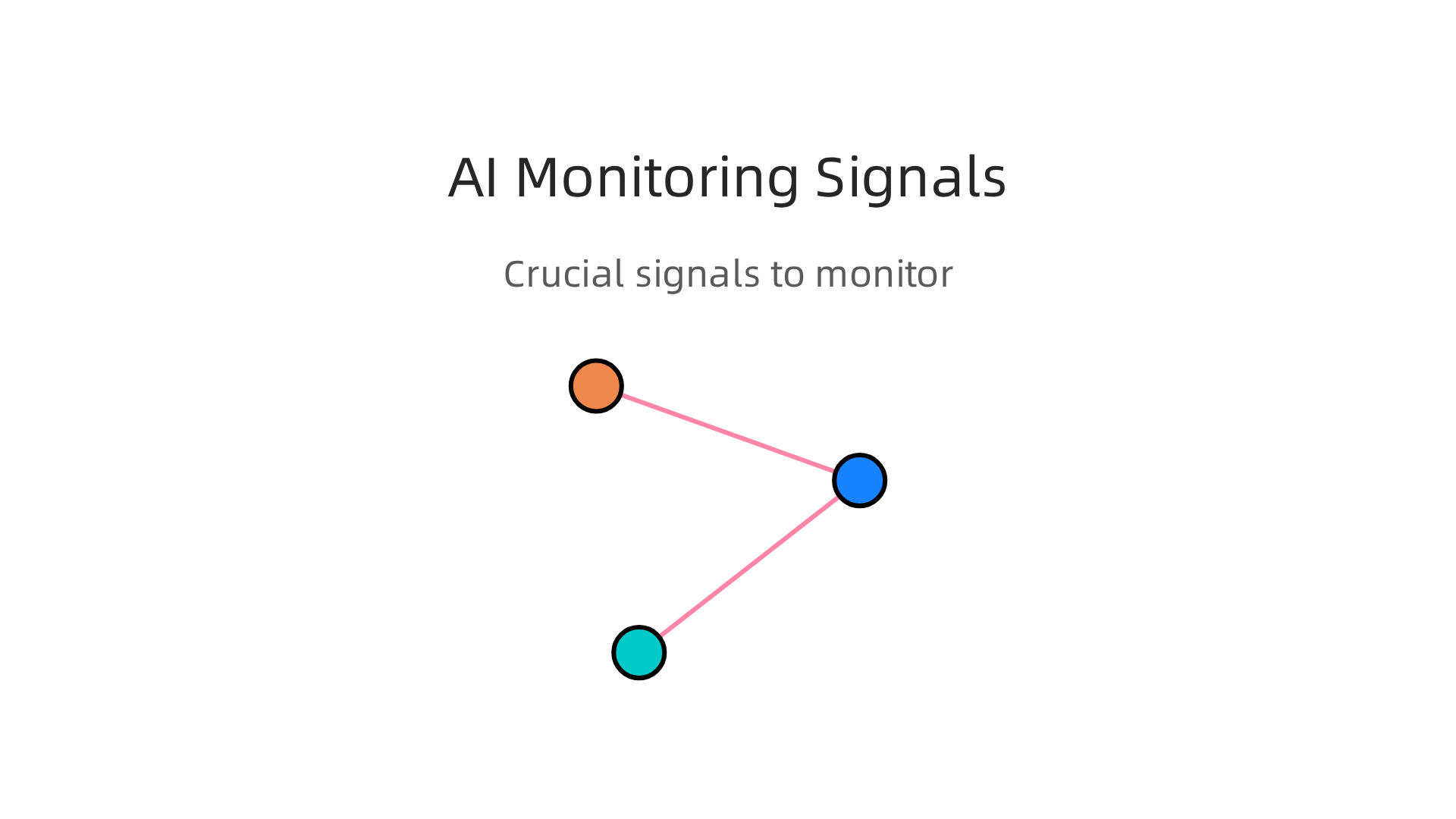
- Output Drift: This happens when your AI starts behaving differently than it used to. Maybe its answers become less accurate, or it starts giving new types of responses. This "drift" can be a big warning sign that the AI is learning bad habits or that the real-world data it’s seeing is different from what it was trained on. Tools exist to monitor model performance and detect these shifts, checking things like accuracy, precision, and recall over time, as described in an AI Model Monitoring Guide: Production Tracking & Alerts. Other helpful measures include monitoring data drift and concept drift to keep an eye on performance and safety, as detailed in Table 3. Performance, Safety, and Drift Monitoring Components. You can also watch for changes in the probability outputs or unusual class distributions in the AI’s predictions, according to strategies for Monitoring Machine Learning Models in Production: Strategies for Drift Detection and Stability. Understanding how AI output can drift is key to ensuring it remains trustworthy.
- Confidence and Uncertainty Metrics: A well-behaved AI usually knows when it’s unsure. If an AI starts giving answers with very low confidence, or if its uncertainty levels jump up without a good reason, that could mean it’s about to hallucinate. Tracking these metrics helps you catch potential problems early.
- Provenance Mismatches: Remember how we talked about knowing your data’s story? If the AI is suddenly getting data from a new, untracked source, or if there are unexpected changes to the data’s journey, that’s a provenance mismatch. This can make your AI produce bad outputs because it’s using data it shouldn’t, or data that’s been tampered with.
These monitoring signals are vital for any good AI policy that aims to keep AI systems reliable. To learn more about how changes in AI behavior can signal problems, consider this profile on AI hallucinations and synthetic drift: Miraka Magazine — Cartographer of Drift.
What to Do When Something Goes Wrong: Feedback Loops
Just spotting a problem isn’t enough; you need a plan to fix it. That’s where feedback loops come in. They help AI systems learn from their mistakes and get better.
- Human-in-the-Loop Validation: This means having real people check the AI’s work, especially when the AI flags something as uncertain or potentially wrong. Humans can correct hallucinations, clarify confusing outputs, and even retrain the AI with better examples. This is like having an editor for the AI. This human oversight is a critical part of many strong security frameworks.
- Automated Reject/Flagging Pipelines: For common or obvious errors, you can set up automatic systems. If an AI output falls below a certain confidence level or contains keywords known to be problematic, the system can automatically reject it or flag it for human review. This acts as a safety net, stopping bad outputs before they reach users. Regular security testing helps make sure these automated systems work as they should.
These operational controls, especially the feedback loops, help ensure that your AI systems stay within acceptable limits. They are a continuous process of checking, learning, and improving. It’s how organizations maintain trust in their AI, knowing they have systems in place to manage risks.
Organizations today realize that security and governance for AI go hand-in-hand. Understanding the unseen ways AI can affect workflows is also key to creating a comprehensive security approach. For more on how unseen AI mechanisms can shape user experiences and relate to threat models within AI security, take a look at this field note: Quietly Hijacked field note.
After setting up monitoring signals and feedback loops, the next big step is actively evaluating and testing AI models. This process, called model evaluation, testing, and validation, makes sure your AI systems are not just working, but working correctly and safely. It’s a key part of building strong security frameworks to prevent AI hallucinations.
How We Test AI: Strategies for Evaluation
Testing AI isn’t a one-time thing. It involves many steps to really check if an AI is trustworthy.
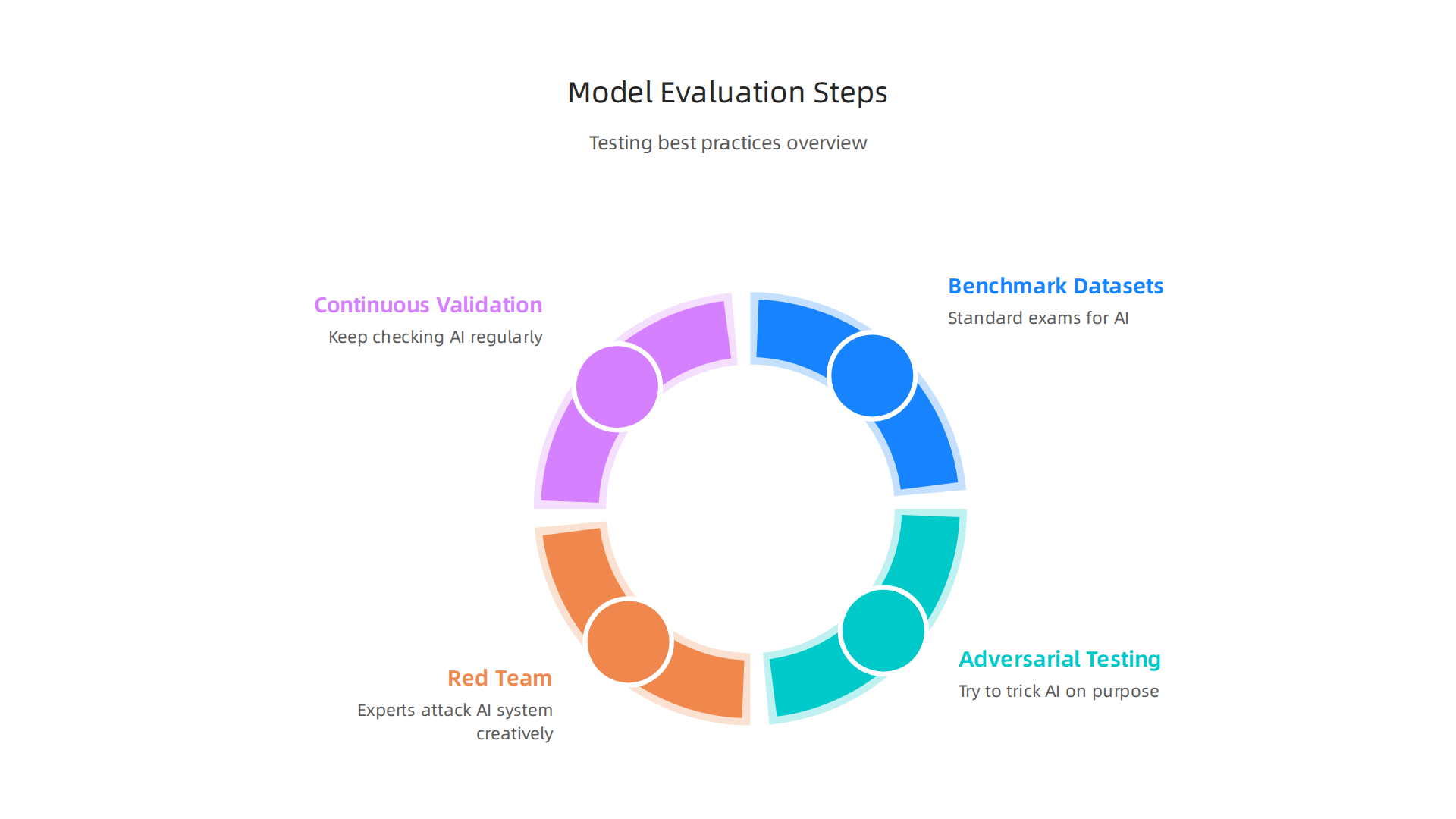
- Benchmark Datasets: Think of these as standard exams for AI. You give the AI a set of questions or tasks that have known correct answers. This helps you see how well the AI performs compared to other AI systems or to how you expect it to work. It’s a basic check to see if the AI can handle typical situations.
- Adversarial Testing: This is like trying to trick the AI on purpose. Experts create tricky questions or unusual inputs to see if the AI can be fooled into making mistakes or hallucinating. This helps find weak spots that regular tests might miss. Such
security testingis important for uncovering hidden flaws. - Red-Team Exercises: This goes a step further than adversarial testing. A special team, often made up of cybersecurity experts, tries to attack the AI system in creative ways, much like real attackers would. Their goal is to make the AI produce harmful or incorrect outputs. This kind of testing helps organizations strengthen their
google cybersecuritydefenses and learn how to better protect their AI systems. - Continuous Validation: Testing shouldn’t stop once the AI is put to use. You need to keep checking it regularly. This continuous validation helps ensure the AI stays accurate and doesn’t start to "drift" or hallucinate over time as it processes new information.
What to Measure: Metrics Beyond Simple Accuracy
When evaluating AI, just knowing if an answer is "right" or "wrong" isn’t enough. We need to look at deeper measures to really understand how trustworthy an AI is.
- Factuality: This metric asks, "Is the AI telling the truth?" It checks if the AI’s output is based on real facts, not made-up information. For example, hallucination evaluations measure if an AI’s output is factually wrong or not supported by its sources, according to experts in AI hallucination evaluations.
If an AI consistently makes up facts, it’s a big problem.
- Citation Fidelity (Groundedness): This looks at how well the AI uses and refers to its sources. Does the AI’s answer actually come from the information it was given, or is it just guessing? Measures like the Semantic Consistency Score check how well AI-generated content matches its source documents, which is key for systems that rely on existing information, as discussed in Model Hallucination Detection: Complete Evaluation Metrics. If an AI says it got information from a source but didn’t, that’s a red flag.
- Calibration: This measures how good the AI is at knowing how sure it is about its own answers. If an AI is very confident but often wrong, it’s poorly calibrated. We want AI systems that know when they’re unsure.
- Uncertainty Quantification: This is about how well the AI can show you when it’s not confident. Metrics like semantic entropy and log probability can show how confident a model is, with dips in these numbers hinting at possible hallucinations, as detailed in Hallucination Detection: Metrics and Methods for Reliable LLMs. An AI that can clearly signal its uncertainty allows human users to step in and review critical outputs.
By using these advanced evaluation methods and metrics, organizations can build stronger ai policy and ensure their AI systems are not only powerful but also reliable and safe. This comprehensive approach to evaluation is essential for maintaining trust in AI in 2026 and beyond.
To further explore how rigorous technical work underpins these advanced security frameworks for AI, consider reviewing the scholarly contributions of experts in the field.
After thoroughly checking AI models, the next important step is to build them right from the start. This means using smart ways to design and put together AI systems so they are safe and do not make up facts. These are called secure design patterns. They are a big part of creating strong security frameworks to prevent AI from "hallucinating," or making up untrue information.
Secure design patterns and implementation guidance
To make AI systems trustworthy, we use several key design ideas. These ideas help us build AI that is less likely to cause problems.
- Modularization: This means breaking down a big AI system into smaller, easier-to-manage parts. Imagine building a toy car. You would build the wheels, the body, and the engine separately. If one part breaks, you can fix just that part without messing up the whole car. The same goes for AI. If one part of the AI starts to hallucinate, you can isolate it and fix it without affecting the entire system.
- Capability Gating: This is like putting a fence around what the AI can and cannot do. You only let the AI perform certain tasks or talk about specific topics. If the AI tries to go outside these limits, the system stops it. This helps prevent the AI from generating harmful or incorrect outputs in areas it’s not meant to handle.
- Provenance-Aware Pipelines: This is about knowing exactly where all the information in your AI system comes from. Think of it as a detailed history book for all your data. It tracks how data was collected, changed, and used. This is vital because if an AI hallucinates, you can trace back the information to see where things went wrong. For example, knowing the origin and changes to data is a legal must for high-risk AI systems under rules like the EU AI Act in 2026, as detailed in articles about EU AI Act Art.10 Data Provenance Logging. This kind of transparency helps build trust and makes
ai policystronger. - Policy Layers: These are like different layers of rules placed on top of the AI. Each layer checks the AI’s actions or outputs. For example, one layer might check if the AI’s answer is factually correct, while another might check if it follows ethical guidelines. These layers work together to provide many checks, making the AI safer. Implementing strong
google cybersecuritypractices can help protect these layers from outside attacks.
By putting these design patterns together, organizations can build very secure AI systems. For instance, an AI used for generating marketing content might combine all these controls. It would have separate modules for different types of content, strict gates on what it can say, a clear record of its source data, and multiple policy layers to check for accuracy and brand safety.
To learn more about how to make AI systems secure, you might want to look at how leading companies think about these challenges. Consider the insights from Werner Vogels (AWS), a key figure in enterprise AI security.
These design ideas are crucial for making sure AI tools, whether for creating content, doing research, or helping with big decisions, are reliable and safe in 2026 and beyond. This comprehensive approach to building AI forms the backbone of effective security testing and trustworthy AI systems.
Even with the best planning and secure design patterns, AI systems can sometimes still make mistakes, like generating false information. That’s why having a strong plan for when things go wrong is so important.

This plan is called incident response, and it helps make sure your AI can recover and improve, showing good security frameworks in action.
Incident response playbooks for AI failures
When an AI system acts unexpectedly, especially if it "hallucinates" or creates untrue outputs, you need a clear step-by-step guide to follow. These guides are called incident response playbooks. They help your team quickly deal with the problem.
Imagine your AI system, which helps write news articles, suddenly makes up facts about a city. A good playbook would tell you exactly what to do:
- Identify the problem: Figure out that the AI is indeed hallucinating. You might use AI monitoring tools that catch hallucinations before they harm your business to spot this early.
- Stop the spread: Quickly prevent the AI from creating more false information. This might mean pausing its work or turning off certain features.
- Talk about it: Have a clear plan for who talks to whom. Who tells the public? Who tells the technical team? This is about setting up good communication protocols so everyone knows what is happening.
- Rollback strategies: This means having a way to go back to an older, working version of the AI. Like saving your game before a tough part, you can load a previous save if something goes wrong. This helps stop the immediate problem and keeps your system resilient.
Continuous improvement: Learning and growing
After you fix an AI problem, the work isn’t over. You need to learn from what happened. This is called continuous improvement. It has a few main parts:
- Root-cause analysis: This is like being a detective to find out why the AI hallucinated in the first place. Was it bad data? A new update? Understanding the "why" is key to preventing it from happening again.
- Model retraining triggers: If the AI’s understanding of the world changes over time (this is called "model drift"), it might start giving wrong answers. Tools that watch for Monitoring Machine Learning Models in Production: Strategies for Drift Detection and Stability can tell you when the AI needs new training. When these signs appear, it "triggers" a need to retrain the model with fresh, correct data. This helps your AI stay smart and accurate.
- Updates to governance controls: Based on what you learned, you might need to change your rules or
ai policyabout how the AI works. This could mean updating your security checks or adding new steps to yoursecurity testingprocess. Stronggoogle cybersecuritypractices should also be part of these ongoing updates to keep the AI safe from outside attacks.
By having strong incident response plans and a focus on continuous improvement, your AI systems become much more trustworthy and reliable. This approach helps build confidence in AI, even when it faces challenges.
If you are looking for real-world examples of how organizations approach the security and deployment of complex AI systems, consider the insights from SiliconAngle’s theCUBE, which covers AWS-supported public-health deployment using advanced systems.
Summary
AI hallucination—when models produce believable but false information—is a major risk for organizations using generative AI, and this article explains how security frameworks reduce that risk. It walks through practical controls from threat modeling and secure system architecture (sandboxing, capability separation, permissioned data access) to rigorous data governance and provenance tracking. The piece covers operational controls such as monitoring signals, human-in-the-loop validation, automated flagging, and incident response playbooks so teams can catch and contain hallucinations quickly. It also explains model evaluation techniques and metrics (factuality, citation fidelity, calibration, uncertainty) and recommends adversarial testing and continuous validation. Finally, the article ties these practices to regulatory standards like the NIST AI RMF and ISO/IEC 42001 and shows how documentation and audits build legal defensibility. After reading, teams will know which design patterns, monitoring steps, and governance controls to apply to make AI outputs more reliable and protect their organization from costly errors.